


Ankarana Special Reserve in northern Madagascar is one of the country’s most rewarding hiking destinations, combining razor-sharp limestone pinnacles, deep canyons, bat-filled caves and dry forest full of lemurs and chameleons. Unlike some tsingy areas that you mostly admire from viewpoints, Ankarana invites you to walk through, over and under the rock itself. This guide focuses on how to hike Ankarana’s main sectors, what wildlife to expect, where to stay and how to reach the reserve from Diego Suarez and Ambanja, so you can turn a dot on the map into a realistic itinerary.
Understanding Ankarana’s Landscapes and Sectors
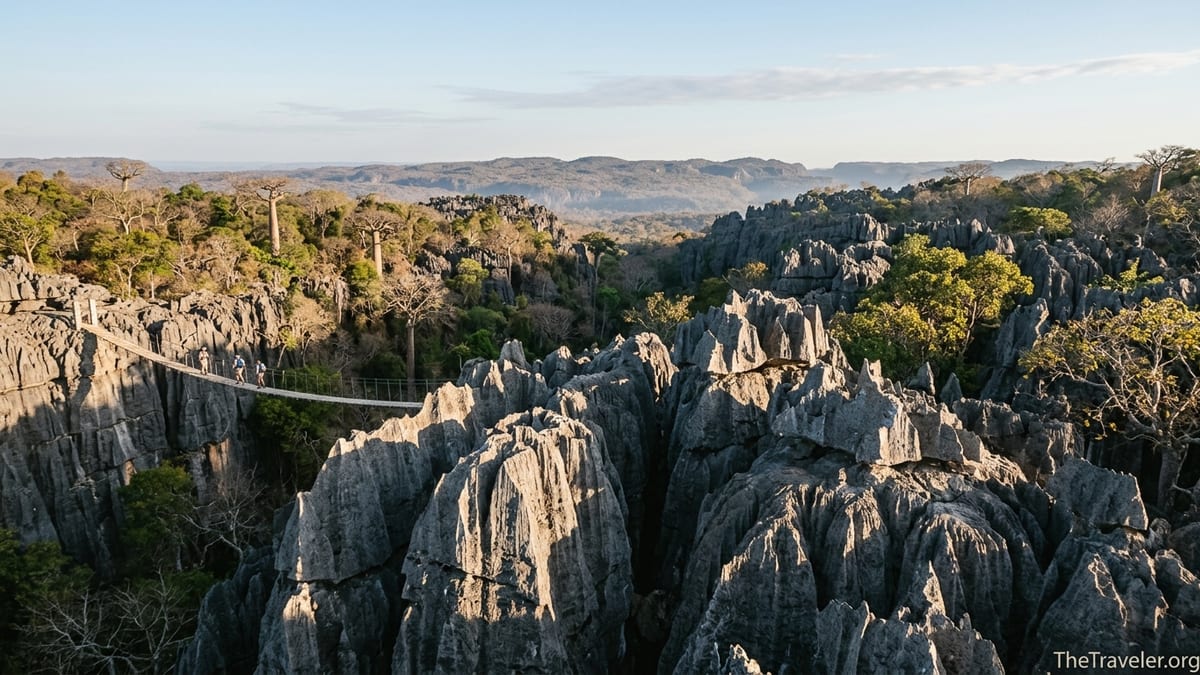
Ankarana Special Reserve protects around 18,000 hectares of karst plateau in Madagascar’s Diana region. The landscape is defined by tsingy, the Malagasy word for the serrated limestone ridges that form when softer rock erodes away. In some places the pinnacles are low and walkable, in others they rise like grey blades above canyons and dry forest. Under the surface, a vast network of caves and underground rivers has carved tunnels, sinkholes and sacred pools, so hiking often alternates between open rock, forest shade and cathedral-like caverns.
For visitors, it helps to think of Ankarana in three practical sectors: the eastern entrance near Mahamasina, the western area accessed from ecolodges such as Iharana Bush Camp, and the more remote northern trails that most short trips skip. The eastern side is where most independent travelers start their visit, as the park office, main guide pool and classic circuits like Tsingy Rary, Tsingy Meva and Perte de Rivière begin here. The western side gives a softer, more scenic experience, with walks that combine tsingy ridges, lakes and village landscapes, usually arranged through your lodge.
Unlike Tsingy de Bemaraha in western Madagascar, Ankarana’s tsingy is more fractured and interspersed with forest, which means fewer fixed metal ladders and more traditional hiking. Trails range from flat forest paths to rocky scrambles and narrow limestone corridors where you will use your hands as often as your feet. This variety is part of the appeal: one circuit might cross a suspension bridge above a canyon, dip into a cool bat cave and finish beside a green pool where crowned lemurs come to drink.
Key Circuits: Tsingy, Caves, Bridges and Viewpoints
The most accessible introduction to Ankarana’s geology is the Tsingy Rary circuit on the eastern side. This half-day walk typically combines dry forest, patches of low tsingy and viewpoints over a grey limestone field. Expect up to 3 hours of walking at a steady pace, with a few rocky sections that require good balance but no technical climbing. Many visitors who arrive from Diego Suarez in the morning do Tsingy Rary in the afternoon as a first taste of the park before tackling longer circuits the next day.
More ambitious hikers often ask for a full-day combination that links Perte de Rivière, Tsingy Meva and sometimes a bat cave such as Grotte des Chauves-souris, depending on trail conditions and water levels. Perte de Rivière refers to the point where a surface river disappears into the underground system through a huge limestone sink. Getting there usually involves several hours of walking through forest, open tsingy and dry riverbeds, with some hot, exposed sections. Tsingy Meva, often translated as the “beautiful tsingy,” rewards that effort with dramatic viewpoints over jagged pinnacles and deep fissures.
Ankarana also features suspension bridges, particularly on loops that combine tsingy with canyons near the Benavony area. These bridges are shorter and less high than the most famous ones in Bemaraha, but they still deliver a jolt of adrenaline as you cross above a void lined with stone blades. A typical day might see you starting in forest alive with bird calls, emerging onto sun-baked rock, traversing a bridge, then descending into a cool, dim canyon where fig roots dangle from the cliffs and the temperature drops noticeably.
The caves are another highlight. Shorter circuits visit easily reached caverns with striking stalactites and stalagmites, while longer trips head to deeper systems with underground streams and sacred chambers. In bat caves you are likely to see large roosts of fruit bats or insectivorous bats clinging to the ceiling, and you will smell them before you see them. Guides usually carry torches, but bringing your own headlamp makes the experience safer and more comfortable, especially if you are photographing formations or watching for cave-dwelling crocodiles, which still occur in some galleries but are rarely seen on standard circuits.
Wildlife: Lemurs, Bats and Dry Forest Specialists
Ankarana lies in Madagascar’s dry deciduous forest zone, which means wildlife viewing is very different from the lush eastern rainforests. Here, trees lose their leaves in the long dry season and many animals are most active at dawn, dusk and night to avoid the heat. On most day hikes you have a strong chance of seeing crowned lemurs, one of the reserve’s emblematic species. Small family groups often move through the mid-level branches along forest trails, and experienced guides can identify their soft calls long before you spot their orange-brown coats and pale faces.
Other lemurs are more discreet but still present. Sanford’s brown lemur and northern sportive lemur can sometimes be seen in the eastern sector, especially on early morning or late afternoon outings. Night walks along the reserve’s periphery or on lodge-owned forest trails may reveal mouse lemurs, tiny nocturnal primates whose eyes glow in torchlight, as well as chameleons sleeping on thin branches and leaf-tailed geckos flattened against tree trunks. These shorter night outings are often arranged directly through accommodations like Ankarana Lodge or Iharana Bush Camp, and they are a satisfying complement to daytime tsingy hikes.
Bat caves are a major wildlife draw. Grotte des Chauves-souris, or “Bat Cave,” is often featured on full-day itineraries when conditions allow. Inside, vast colonies of bats cling to the high ceilings, taking flight in waves if disturbed by loud noise or sudden lights. The feeling of stepping into a warm, humid cave filled with the rustle of wings and the drip of mineral-rich water is unforgettable. Guides will usually brief you on respectful behavior, such as speaking quietly, avoiding flash photography and not touching formations coated with fragile bat guano.
Reptiles and birds round out the fauna list. Visitors commonly encounter northern Madagascar’s iconic panther chameleons and smaller species like stump-tailed chameleons along forest margins. Snakes are present but rarely seen, and most are non-venomous. Birders can look for crested couas, vangas and raptors circling above canyons. Because Ankarana is relatively compact, you often move through several microhabitats on a single walk, increasing your odds of varied sightings without needing to cover extreme distances.
Trail Difficulty, Guide Requirements and Practical Gear
Hiking difficulty in Ankarana ranges from relaxed forest walks of 1 to 2 hours to strenuous, full-day tsingy traverses in intense sun. Even the easier circuits involve uneven ground, heat and short rocky sections, so a moderate level of fitness is important. Travelers who are comfortable walking 8 to 12 kilometers in a day on mixed terrain will find most classic routes well within reach. Those who prefer shorter distances can focus on half-day options near the eastern entrance or choose gentler lakeside and village walks from western lodges.
Local guides are mandatory for entering Ankarana’s official circuits, and you hire them at the park office near Mahamasina or through your lodge. This is not just a formality. Trails weave through a labyrinth of tsingy, canyons and caves where getting disoriented is easy, and flash floods or unstable sections sometimes require same-day changes of plan. A typical arrangement is to pay a park entrance fee per day per person, plus a guiding fee for your group. While exact prices change regularly, travelers in recent seasons report that guide costs feel comparable to other Madagascar national parks, and hiring a guide for a full-day hike usually remains well under what you might pay for a similar experience in Europe or North America.
Footwear and basic gear make a noticeable difference to comfort. Trail running shoes or lightweight hiking boots with good grip are ideal; thin-soled fashion sneakers struggle on the abrasive limestone. A wide-brimmed hat, sunscreen and at least 2 liters of water per person are essential in the dry season, when shade can be limited on the tsingy. Many guides carry small first aid kits, but you should not rely on this. Bringing your own blister plasters, basic pain relief and a headlamp for caves or dusk returns is a smart precaution.
Most circuits can be adapted to your energy level, so communicate frankly with your guide at the start of the day. If you know you dislike exposure or heights, say so before committing to routes with suspension bridges or narrow ledges. Conversely, strong hikers who want a challenge should request longer circuits that combine several landmarks, understanding that heat will be a bigger factor than distance. During or just after heavy rain, some caves or riverbeds may be off-limits, and staff may suggest alternative loops for safety.
Where to Stay: Lodges and Simple Bases Around Ankarana
Most visitors base themselves just outside the reserve rather than camping inside. On the eastern side near the main entrance, Ankarana Lodge and Le Relais de l’Ankarana are popular mid-range options, with bungalows, on-site restaurants and swimming pools that feel particularly welcome after a hot day on the tsingy. Rooms are usually simple but comfortable, with mosquito nets and fans. Travelers booking in advance often combine their park planning with the lodge, which can arrange a car and driver transfer along RN6 and help secure guides for specific circuits.
On the western side of the massif, Iharana Bush Camp offers a more atmospheric ecolodge experience facing the limestone cliffs and a lake. The property’s cabanas use traditional Malagasy design elements such as thatched roofs and earth-toned walls, and it runs its own portfolio of walks and pirogue outings that explore the western tsingy and surrounding countryside. Prices here are typically higher than in basic guesthouses, reflecting the more elaborate setting and included activities, but many travelers consider at least one night worthwhile if their budget allows.
Budget travelers sometimes look for simpler guesthouses in nearby villages or in the town of Ambilobe, then commute to the reserve for day visits. This can save on room rates but adds extra driving time to each hiking day and may limit early starts, which are valuable in the heat. When comparing options, consider not only price but also how quickly you can be at the park gate in the morning and whether the lodge has recent experience organizing the kinds of hikes you want, from family-friendly walks to longer cave circuits.
Booking ahead is advisable during the main dry season from June to October, when northern Madagascar sees its highest visitor numbers. Even though Ankarana is still far from crowded by global standards, the better lodges have limited rooms and can fill up when tour groups combine the reserve with nearby Amber Mountain National Park and Nosy Be. Reserving at least your first night near the park gives you a reliable base from which to fine-tune your hiking plans on arrival.
Getting There: Road Access from Diego Suarez and Ambanja
Ankarana sits along the RN6 highway that links Diego Suarez (Antsiranana) in the far north with Ambanja further southwest. Most travelers arrive from Diego Suarez, either as a direct transfer or with a stop at Tsingy Rouge along the way. In good conditions, the drive from Diego Suarez to the eastern entrance near Mahamasina typically takes around 4 to 5 hours, depending on stops and the current state of the tarmac. Recent trip reports note stretches of broken asphalt and potholes, especially closer to Ankarana, so a 4x4 or robust vehicle with a driver is strongly recommended.
From Ambanja, the drive is similar in length, often 4 to 5 hours along RN6 with a mix of decent road and damaged sections. Many visitors connect via the Ankify ferry port that serves Nosy Be, taking a speedboat to or from the island and then continuing by road. A common northern circuit involves starting in Nosy Be, crossing to Ankify, driving to Ankarana for 2 or 3 nights, then continuing to Diego Suarez and Amber Mountain, or doing the route in reverse. Because public transport schedules can be irregular and slow, most independent travelers arrange a private car and driver through a lodge or local agency rather than relying on shared taxis or minibuses for this leg.
Once at Ankarana, you do not need a vehicle inside the reserve for most hiking circuits, as trails start from designated parking or drop-off points. However, a car remains useful if you plan to explore both eastern and western sectors or if you prefer to sleep at one lodge and hike from another entrance. Fuel availability can vary along RN6, so drivers usually plan refueling stops in larger towns like Diego Suarez and Ambilobe rather than small villages.
Road conditions in northern Madagascar can change quickly with heavy rain, landslides or local works. It is wise to check recent feedback from your lodge or a regional tour operator in the weeks before you travel, particularly if you are visiting early or late in the dry season. Even when the RN6 is rough in places, experienced drivers make the journey routinely, so delays are usually measured in extra hours of bumpy driving rather than outright cancellations.
Dry Season, Heat and How Long to Stay
Ankarana is visitable year-round, but the classic hiking season aligns with the drier months from roughly May to October. During this period, trails are less muddy, riverbeds are easier to cross and the risk of sudden floods in caves or canyons is lower. Daytime temperatures can still be hot, especially in September and October, but the lower humidity compared with the rainy months from December to March makes long walks more comfortable. In the wettest weeks, some circuits may close if underground rivers rise or if paths become too slippery.
For planning, it is useful to think in terms of nights rather than days, as travel time along RN6 eats into hiking hours. Many travelers who want a solid but not rushed experience allocate 2 or 3 nights near Ankarana. With 2 nights, you typically arrive from Diego Suarez or Ambanja, do a half-day walk that afternoon, then dedicate the next day to a full circuit combining tsingy and caves before departing on the third morning. With 3 nights, you can add a second full-day hike, a gentler viewpoint loop, or a night walk in lodge-managed forest.
Those who are very enthusiastic about geology, caves or photography sometimes stay 4 nights to explore both eastern and western sectors in depth. This allows one day focused on dense tsingy at Tsingy Meva, another on bat caves and Perte de Rivière, and a quieter day of walks and pirogue outings from a place like Iharana Bush Camp. If your broader Madagascar itinerary already includes other parks with demanding hiking, such as Bemaraha or Marojejy, you may feel comfortable limiting Ankarana to 2 nights and concentrating on one or two flagship circuits.
Regardless of stay length, plan your hardest hikes for early starts to avoid the worst heat. Leaving the lodge around 7:00 or 7:30 a.m. allows you to cover exposed sections before midday. Afternoons can then be spent by the pool, on shorter walks near your accommodation or on cultural visits to nearby villages. The combination of intense sun, reflective grey rock and limited shade catches some visitors by surprise, so pacing yourself across multiple days is more enjoyable than trying to fit everything into a single marathon outing.
The Takeaway
Ankarana Special Reserve rewards travelers who like their landscapes rugged and their hikes varied. In a compact area you can walk across serrated limestone, duck into cool caves lined with bats, cross suspension bridges above canyons and watch crowned lemurs moving through dry forest canopy. The park’s trail network is flexible enough to accommodate both casual walkers and keen trekkers, provided you are honest about your fitness and preferences when speaking to your guide.
From a practical standpoint, the keys to a successful visit are timing and logistics. Aim for the core dry months when trails are in better condition, plan for at least 2 nights so that travel time does not swallow your hiking, and base yourself at a lodge experienced with the reserve’s circuits. Approach the RN6 journey as part of the adventure rather than a simple transfer, and make sure your footwear, water and sun protection match the realities of hot, abrasive terrain.
For many visitors, Ankarana ends up being a highlight of northern Madagascar, sometimes overshadowing more famous coastal stops. Its mixture of geology and wildlife feels intensely local, and its relative remoteness keeps numbers low enough that you can often watch lemurs or stand on a viewpoint with only your small group and your guide. If you are willing to travel a little off the main tourist path, Ankarana offers one of the most memorable combinations of hiking and nature that Madagascar can offer.
FAQ
Q1. How many nights should I plan for Ankarana Special Reserve? Most travelers find that 2 to 3 nights near Ankarana gives enough time for one half-day and one or two full-day hikes without feeling rushed.
Q2. Do I really need a guide to hike in Ankarana? Yes. Local guides are mandatory for official circuits and essential for navigating tsingy mazes, caves and canyons safely, as well as spotting wildlife you might miss.
Q3. What is the best time of year to visit Ankarana for hiking? The drier months from roughly May to October are best, when trails are firmer, river levels are lower and cave or canyon circuits are more reliably open.
Q4. How difficult are the main tsingy trails? Difficulty varies from easy 1 to 2 hour forest walks to strenuous full-day hikes over rough limestone. Most healthy hikers comfortable with 8 to 12 kilometers on uneven ground cope well.
Q5. Where do visitors usually stay when exploring Ankarana? Many stay at Ankarana Lodge or Le Relais de l’Ankarana near the eastern entrance, or at Iharana Bush Camp on the western side, with budget options in nearby towns.
Q6. How do I reach Ankarana from Diego Suarez or Ambanja? Ankarana lies along RN6. Most visitors hire a car and driver, taking about 4 to 5 hours from Diego Suarez or Ambanja depending on road conditions and stops.
Q7. What wildlife am I likely to see on the trails? Common sightings include crowned lemurs, other forest lemurs on some routes, bat colonies in caves, several chameleon species and dry forest birds like couas and vangas.
Q8. Are there suspension bridges like in other tsingy parks? Yes. Certain Ankarana circuits feature smaller suspension bridges over canyons, offering dramatic views without the extreme height and length of Bemaraha’s largest spans.
Q9. What gear should I bring specifically for Ankarana? Bring sturdy trail shoes or boots with good grip, a hat, high-SPF sunscreen, at least 2 liters of water per person for full days, a headlamp and basic first aid supplies.
Q10. Can I combine Ankarana with other destinations in northern Madagascar? Easily. Many itineraries link Ankarana with Nosy Be via Ankify and with Amber Mountain National Park and Diego Suarez, creating a varied loop of forest, tsingy and coast.