


The brochures promised me a place of endless sunshine, calm seas and easy desert walks. When I finally reached Toliara, on Madagascar’s dry southwest coast, I did find the big blue skies and blazing light that tourism boards love to advertise. What they did not prepare me for was how much the combination of heat, wind, dust and bone-dry air would shape almost every hour of the day. After several visits split between the late dry season and the very start of the rains, here is how Toliara and its surroundings actually felt on the ground, and when I would personally return for city time, beaches, diving and inland nature.
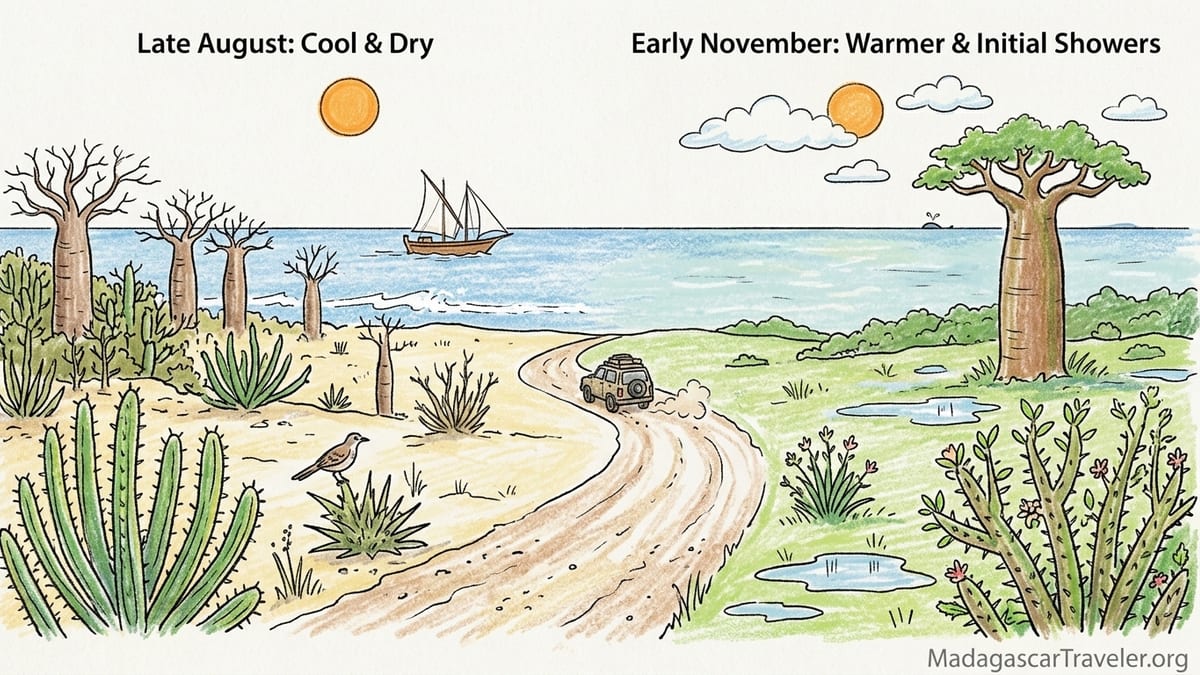
When I Went and What the Weather Was Really Like
My impressions of Toliara come from two specific windows. The first was a trip in late August, at the heart of the cool, dry season. The second was in early November, just as the first showers were starting to tease the southwest while most days remained dry. I did not visit in the peak rainy months of January and February, so any notes about that period are based on research rather than personal experience. On both of my visits I split time between Toliara itself, the beach villages of Ifaty and Mangily to the north, and a long, dusty day trip toward Tsimanampetsotsa National Park to the south.
Climate records describe Toliara as semi-arid, with average daytime highs around 27 degrees Celsius in July and closer to 32 degrees Celsius in December, and annual rainfall well under 600 millimeters, heavily concentrated between January and March. On the ground, in late August, that translated into hot but manageable afternoons and pleasantly cool nights, with almost no cloud and virtually no rain. In early November the heat turned more aggressive in the middle of the day, and the air felt fractionally more humid, but skies were still mostly clear, and rain remained something people talked about rather than something I saw.
Across both seasons, what struck me most was the combination of bright, almost harsh sunlight and a regular south wind known locally as the Tsio Katimo. In August this wind felt like a constant companion from late morning through the afternoon. It kept sweat from lingering on the skin but also whipped dust from unpaved streets into eyes and camera lenses. In November the wind still blew, but a notch weaker on some days, which paradoxically made the heat feel heavier because there was less moving air to take the edge off the sun.
Daytime Heat, Nights and the Reality of Midday Outdoors
In August, my notebook is full of the same remark: “Perfect at breakfast, punishing by lunch.” Early mornings in Toliara city sat around 16 to 18 degrees Celsius. I could walk the seafront in a light shirt and feel completely comfortable. By around 10 a.m. the sun was already sharp, and anything involving direct exposure on bare concrete or open sand quickly became tiring. Between about 11 a.m. and 3 p.m., the combination of temperature in the upper twenties or around 30 degrees Celsius and zero shade meant I limited myself to short hops between cafes, market stalls and my guesthouse courtyard.
Nights in August felt wonderfully forgiving. After sunset temperatures dropped to the high teens. Ceiling fans were usually enough, and I never needed air conditioning. I could sleep under a light sheet with windows open and only the occasional mosquito to worry about. Sitting in the courtyard of a simple hotel in Mangily, I remember needing a thin long-sleeve shirt by 9 p.m., something almost unimaginable on Madagascar’s more humid east coast or in the central highlands around Antananarivo, where nights stay warmer and more humid in the warm season.
By early November, midday heat had noticeably stepped up. Morning walks were still a joy between 6 a.m. and 8:30 a.m., but by 9:30 a.m. I was already looking for shade. Midday thermometer readings in town hovered just above 30 degrees Celsius, but in direct sun on the sand road behind Ifaty beach, it felt considerably hotter. Long, flat rays bounced off pale sand and beige buildings, and sweating did not offer much comfort because the air remained dry. Between roughly 11:30 a.m. and 3:30 p.m., I found serious outdoor activity uncomfortable, and I rearranged plans around long indoor or shaded breaks, cold soft drinks and the occasional ice cream from small shops in Toliara’s center.
Nights in early November still cooled off enough to sleep comfortably, but there was a subtle change. I used a fan more consistently, and in some budget rooms in Toliara, with limited airflow, the heat built up by day lingered into late evening. Compared with the muggy, hard-to-escape humidity I have felt in Toamasina on the east coast, however, Toliara’s heat even in November still felt cleaner and drier, more like walking under a hairdryer than through a steam room.
Wind, Dust, Humidity and Insects
The brochures are honest about one thing: Toliara is windy. Across both August and November, most afternoons came with a steady south or southwest breeze. In August the Tsio Katimo felt strongest, enough that sand on the Mangily beach lifted into small, stinging gusts and plastic chairs on beachside terraces had to be anchored. On the positive side, the wind kept the horizon scrubbed clear, flags on pirogues snapped crisply, and the constant air movement reduced any sense of oppressive heat. On the negative side, the same wind turned unpaved streets into powdery corridors where my shoes and calves collected a fine beige coating by the end of the day.
Dust was most noticeable on the sandy tracks north to Ifaty and on the road section toward Anakao. In August, every passing taxi-brousse or 4x4 produced a dense plume that hung in the air for several seconds. I found a simple cotton scarf useful to cover mouth and nose. In November, after one or two short showers earlier in the month, some of this surface dust compacted slightly, but where it dried out again the fine powder returned quickly. Within town, main streets are paved, but step into the back lanes or the open markets and you feel the desert edge immediately, particularly on windy afternoons.
Humidity in both August and November felt low compared with the rest of Madagascar I had experienced. In practical terms this meant sweat evaporated quickly, washing dried in a matter of hours, and my camera lenses rarely fogged. On the flip side, by the end of an August day out in Tsimanampetsotsa’s spiny forest, my throat felt parched and my lips were starting to crack slightly despite regular water breaks. Lip balm and a large refillable bottle became just as essential as sunscreen. This dry edge is a clear contrast to the east coast, where I often stepped from an air-conditioned room into a wall of humidity, and to Antananarivo’s hills, which have more temperate, occasionally damp evenings.
Insects behaved differently between my two visits. In August, mosquitoes were present but sparse. In Toliara city I would notice one or two in my room each evening, easily dealt with by a coil or plug-in repellent. Around Mangily and the spiny forest, there were a few more at dusk, but long sleeves and repellent kept them under control, and sleeping under a net felt more like a precaution than a necessity. In November, after a couple of light showers, mosquito numbers rose noticeably in low spots and near any standing water. In the backstreets behind Toliara’s port, I met small swarms hovering over puddles left by water trucks. It was still less intense than the dense mosquito clouds I have faced in the eastern rainforests, but enough to justify firm repellent use and checking that guesthouse nets had no holes.
Sea State, Water Clarity and Beach Comfort
On both my August and November stays, the Mozambique Channel was a constant visual presence, but its character changed with the wind. In August, mornings at Ifaty and Mangily often started glassy or with a light chop. Wooden sailing pirogues headed out toward the reef around sunrise, and from the beach you could clearly see the outer reef line where white surf marked the barrier. By late morning the regular south wind kicked up short, steep waves in the inner lagoon. For swimming close to shore this was still pleasant, but longer surface swims or kayaking grew more tiring as the day wore on.
Water clarity in August impressed me. Snorkeling on the inner reef off Mangily, visibility ranged from about 10 to 15 meters on my better days. Local guides explained that the long dry winter leaves the sea relatively free of sediment and that the main river flowing near Toliara carries less muddy runoff at this time. From a practical perspective, coral heads, fish and sandy patches all appeared crisp, and dropping off the side of a simple wooden boat into clear water felt like entering a turquoise auditorium. Even inside the lagoon, where wind created surface chop, the water column below remained reasonably clear.
In early November, visibility remained good but slightly more variable. On calmer days with light wind I still enjoyed clear snorkeling with visibility above 10 meters on reefs closer to the barrier. After a day of stronger wind, or following a small early-season shower inland, the nearshore water took on a faintly milky cast. It was far from poor, but compared with August there was more suspended matter in the first few meters. Long-term dive operators in Mangily told me that the very start of the rainy season can bring small pulses of sediment from rivers north of Toliara, and that cyclones later in the season can really disrupt sea clarity, though I did not experience that myself.
Beach comfort strongly tracked the sun. In August, walking barefoot on the sand at 10 a.m. was no problem. By 1 p.m. the upper layer grew hot enough that I instinctively reached for flip-flops. Shade was easy to find under thatched parasols at small beachside restaurants, and I often spent the midday hours with grilled fish and rice, watching pirogues leaning into the wind rather than baking on the open shore. In November, especially around noon, exposed sand became noticeably hotter. I found myself planning swims for early morning and late afternoon, with a long shaded siesta in between.
Road Conditions and Access to Dry-Country Parks
Road conditions around Toliara vary strongly with the season, and here my personal experience is limited to the dry months. In August, the paved road from Toliara north toward Ifaty and Mangily was already worn and potholed in places, but passable in a regular taxi or shared vehicle. The final stretch along the coast turned to rough sand and corrugations, and vehicles kicked up large dust clouds, but there was no mud. Journey times from Toliara to Mangily hovered around one and a half to two hours depending on stops and traffic.
The track heading south in the direction of Anakao and inland toward Tsimanampetsotsa during August felt firmly within 4x4 territory. Surfaces alternated between packed sand, loose sand and stretches of corrugated dirt. Because the previous significant rains had likely fallen many months earlier, ruts from earlier in the year were baked hard and any remaining puddles were shallow. Travel was slow but predictable. I spent a full day in a sturdy 4x4 organized through a local operator in Toliara, leaving shortly after dawn and returning well after dark, and at no time did we risk becoming bogged down.
In early November, before the main rainy season, road conditions were similar, though a single overnight shower outside Toliara created a short section of sticky surface mud that clung to tires and shoes. Local drivers emphasized that from about late December through March, when rain in the southwest concentrates, some of these same tracks can become difficult or temporarily impassable. Here I rely on research and local testimonies rather than my own wheels: multiple sources describe mud, standing water and unpredictable ruts during peak rains, with some operators adjusting itineraries or postponing Tsimanampetsotsa visits until surfaces dry out again.
By contrast, access within the dry-country parks themselves benefits from the semi-arid climate. In August, walking trails in the spiny forest and around saline flats near Tsimanampetsotsa were bone-dry and dusty. Footing was sure, with only loose stones and sharp roots to watch out for rather than mud. The main challenge came from the lack of shade and the reflective glare from pale soils. Trail markers and signs specifically warned visitors to carry sufficient water and to avoid the hottest hours. In November, the same landscapes showed the very first hints of greening in low shrubs, but the ground remained firm, and there was no standing water along the paths.
Vegetation, Wildlife and How Southwest Differs from East and Highlands
Arriving in Toliara after time in Madagascar’s east or central highlands feels like stepping into another country. Around Antananarivo I had grown used to terraced rice fields, scattered eucalyptus trees and cool, occasionally misty mornings. On the east coast, near Toamasina and the rainforests, it was all glossy leaves, heavy air and rainforest cicadas. Southwest of Toliara, in both August and November, the dominant impression was of spiny forest, drought-adapted shrubs and open sandy spaces that absorbed light rather than reflecting lush green.
In August, vegetation along the road to Ifaty looked tired but incredibly resilient. Tall, octopus-limbed didierea and other spiny plants stood leafless or with small, hard leaves. Baobabs rose like grey pillars, their branches bare or sparsely clothed. Ground cover plants hugged the soil in small, hardy clusters. It felt visually closer to parts of Namibia or the semi-desert around parts of South Africa than to anything I had seen elsewhere in Madagascar. Tsimanampetsotsa’s surroundings in August reinforced this desert-like character, with exposed pale earth around the lake and only pockets of denser vegetation away from the most saline flats.
By early November, I noticed the beginning of a subtle shift. Some shrubs in the spiny forest carried fresh, tender leaves, giving a faint green cast to areas that had looked beige and grey a couple of months earlier. It was not a full transformation, but enough that birds such as vangas and drongos seemed a little more active and vocal at dawn. Guides pointed out that if the early rains continued, small flowers would start appearing within weeks, drawing more insects and birdlife. Compared with the overnight explosions of greenery I have seen in the east after heavy rain, this southwest awakening felt slower and more tentative, constrained by the lower overall rainfall.
Wildlife viewing responded to these conditions. In August, birding around Toliara and the spiny forest was excellent in the early morning when animals concentrated around limited water sources and temperatures were cooler. I spent cool dawn hours looking for long-tailed ground rollers and subdesert mesites, with good success before 9 a.m. By late morning many birds retreated into whatever shade they could find, and activity dropped sharply. In November, with slightly more foliage and marginally higher insect numbers, there was a little more bird noise in mid-morning, but once again the heat pushed both humans and wildlife into slower rhythms after about 10:30 a.m.
Diving, Snorkeling and Whale Season
Diving and snorkeling conditions were a major part of why I came in both August and early November. The barrier reef system off Ifaty and Mangily and the reefs off Anakao further south offer warm water, shallow coral gardens and, in some cases, deeper outer-reef drop-offs. In August, sea temperatures felt brisk at first entry, around the mid twenties in Celsius according to local dive centers, which still meant I was comfortable in a shorty wetsuit or even just a rash vest for shorter snorkels. The cool, dry air on the surface meant I cooled down quickly between dives, so a windproof layer on the boat was helpful once the Tsio Katimo picked up.
Underwater visibility in August ranged from good to excellent on my dives and snorkels. Inner lagoon sites near Mangily offered around 10 to 15 meters of clarity, and outer reef sites reached beyond that on the best days. Coral health varied from patch to patch but fish life was abundant, with parrotfish, butterflyfish and schools of smaller reef fish clearly visible at moderate depths. The lack of significant rain in the preceding months kept sediment low, and river plumes were minimal. Surface chop created by the afternoon wind rarely translated into poor visibility below a few meters.
In early November, water felt slightly warmer on entry, and I swapped to a thinner top for snorkeling only. Visibility, while still decent, fluctuated a bit more, particularly after windy spells. Local dive staff mentioned that as the rainy season moves in from December onwards, storm systems and heavier river discharge can degrade conditions. They also pointed out that strong winds and occasional cyclonic activity, even if centered far up the coast, can send swell down the Mozambique Channel, sometimes forcing cancellations of small-boat trips from Anakao or Mangily for safety. I did not experience any of those cancellations in early November, but I heard from operators who adjust schedules more frequently from late December through March based on sea state forecasts.
For whale watching, my firsthand window was at the tail end of the main season. In late August, from the beach at Mangily, I saw distant blows and occasional tail flukes further offshore, and pirogue skippers talked about regular sightings on trips toward the outer reef. The core humpback whale season in southwest Madagascar generally runs from about June to September, sometimes stretching into early October, with tours offered out of Ifaty, Anakao and other coastal points. My own encounters were not the close, dramatic breaches you might see further north around Nosy Be or on the east coast, but the knowledge that these animals were passing the same horizon gave the sea a sense of scale.
How Dry-Season Conditions Shaped My Daily Rhythm
Across both of my visits, the most practical impact of Toliara’s climate was the strict daily rhythm it imposed. In August, I woke up early, usually around 5:30 or 6 a.m., and tried to pack my longest walks and any inland outings between sunrise and about 10 a.m. This applied whether I was exploring Toliara’s markets, visiting the arboretum just outside town, or heading into the spiny forest. By mid-morning I aimed to be somewhere shaded or on the water, where sea breezes softened the sun. Lunch fell squarely in the hottest window, and I treated it as a protected break rather than something to rush through.
Afternoons in August and November both leaned toward slower, more stationary activities. In Mangily, this meant reading under a thatched shelter, napping in a hammock, or chatting with local guides about the next morning’s birding. In Toliara city, I used the time for indoor tasks like backing up photos, rehydrating and occasionally hiding in air-conditioned cafes. Only after about 3:30 or 4 p.m., when shadows lengthened and the angle of the sun mellowed, did I feel ready to move again, either for another short walk or an end-of-day swim.
This pattern contrasted sharply with my experience in Madagascar’s central highlands, where I often found the middle of the day perfectly fine for walking because temperatures rarely spiked as high and clouds frequently took the edge off the sun. On the humid east coast, the limiting factor had been heavy rainstorms more than pure heat. In Toliara, it was the unfiltered brightness of a semi-desert, combined with a dryness that made dehydration a real risk. I found myself drinking more water than almost anywhere else in the country and adding oral rehydration salts after long days in the field around Tsimanampetsotsa.
The Takeaway
Looking back on my time around Toliara, August stands out as my preferred month for most travel styles. The cool, clear mornings and comfortable nights created excellent conditions for city wandering, visits to the arboretum, and inland walks in the spiny forest or around Tsimanampetsotsa. Diving and snorkeling benefitted from stable seas and clear water, and while the afternoon wind could be vigorous, it remained manageable with a windproof layer on boats. Flaming desert light and big skies made photography rewarding from dawn until about mid-morning, and again in the last two hours before sunset.
Early November offered a different charm. There was a faint sense of the landscape waking up, with more leaves on shrubs and slightly livelier bird activity. Sea temperatures felt a touch warmer, and evenings stayed balmy without tipping into real humidity. The trade-off was a harsher midday period, when unbroken sun and higher temperatures made inland exploration genuinely uncomfortable without strict pacing. I would hesitate to schedule long hikes in exposed areas at this time unless I could start and finish very early.
Based on my firsthand experience and what I learned locally about the months I missed, if I were planning a return, I would choose late July through September for a well-rounded trip. That window promises manageable heat, minimal rain, good road access to dry-country parks, excellent underwater visibility and a strong chance of humpback encounters on the horizon. It is also the period when the desert-like conditions that define southwest Madagascar feel most dramatic yet still human-friendly during the bookends of each day.
If my focus were primarily city exploration and cultural life in Toliara, I would still come in the cooler dry months, spending long breakfast hours in markets and reserving the hottest stretch of the day for indoor visits and rest. For beach time and relaxed snorkeling around Ifaty and Mangily, August and September worked beautifully, with warm enough water and long, breezy afternoons under shade. For diving with more flexible scheduling, I would consider stretching into October while staying mindful of the increasing risk of early-season weather disruptions. Birding and inland nature still feel best in the core dry months, when trails are dry, visibility in the spiny forest is high and both humans and wildlife share the cool dawn window.
FAQ
Q1. What time of year did you personally find most comfortable in Toliara?
Based on my trips, late August felt the most comfortable, with cooler mornings and evenings, clear skies, low humidity and heat that, while strong at midday, could be managed by avoiding the sun between late morning and mid-afternoon.
Q2. Were outdoor activities around Toliara unbearable at midday?
In both August and early November, long outdoor activities in full sun between roughly 11 a.m. and 3 p.m. felt uncomfortable, especially on open sand or desert tracks. Short walks were possible, but I planned serious hikes and birding for early morning and late afternoon.
Q3. How did the wind affect your stay and sea conditions?
The regular south wind helped cool the air but also raised dust in town and chop on the sea. Mornings were calmer and better for boat trips and snorkeling, while afternoons often brought stronger breezes, rougher surface water and sand blowing along exposed beaches.
Q4. What were road conditions like to Ifaty and toward Tsimanampetsotsa in the dry months?
In August and early November, roads were dry and dusty. The paved section toward Ifaty had potholes but remained passable, while the tracks toward Anakao and Tsimanampetsotsa required a 4x4. Travel was slow but predictable, with no deep mud or waterlogged sections during my visits.
Q5. How clear was the water for diving and snorkeling when you visited?
In August I enjoyed very good visibility, often between 10 and 15 meters on the inner reef and better on outer sites. In early November, visibility remained decent but fluctuated more after windy days or light early-season showers, with slightly more suspended particles near shore.
Q6. Did mosquitoes and other insects cause problems?
In August mosquitoes were present but manageable with repellent and nets. In early November, after some initial showers, numbers increased around standing water and in low areas, though still less intense than on Madagascar’s humid east coast.
Q7. How did the dry southwest compare with Madagascar’s east coast and highlands?
The southwest around Toliara felt far drier and more desert-like, with spiny forest, bare soil and intense sun, compared with the lush, humid rainforests of the east and the cooler, greener hills of the central highlands. Humidity was lower, skies clearer and shade much scarcer.
Q8. When would you choose to return for whale watching near Toliara?
I would aim for between late July and early September. During my late August stay I saw distant whale blows offshore, and local operators described this as part of the core humpback season in the southwest.
Q9. Which months would you pick for inland walks and visits to Tsimanampetsotsa?
For inland walks and Tsimanampetsotsa, I would target the cooler dry months from June to September, with a personal preference for August, to benefit from dry trails, bearable daytime temperatures and easier road access.
Q10. If I mainly want beach time and casual snorkeling, when is best?
For relaxed beach time and snorkeling around Ifaty and Mangily, I would pick August or September, when sea conditions are generally stable, water is warm enough for long swims and the combination of clear mornings, breezy afternoons and cool nights makes the overall experience very comfortable.