


I spent a week in and around Toliara in late September 2026, tracking every ariary I handed over. What surprised me most was how cheap daily life in the city felt compared with how quickly costs spiked the moment I added domestic flights, private drivers and boat trips along the coast. This is a breakdown of what I actually spent on transport, beaches and excursions, plus what similar trips are likely to cost you right now.
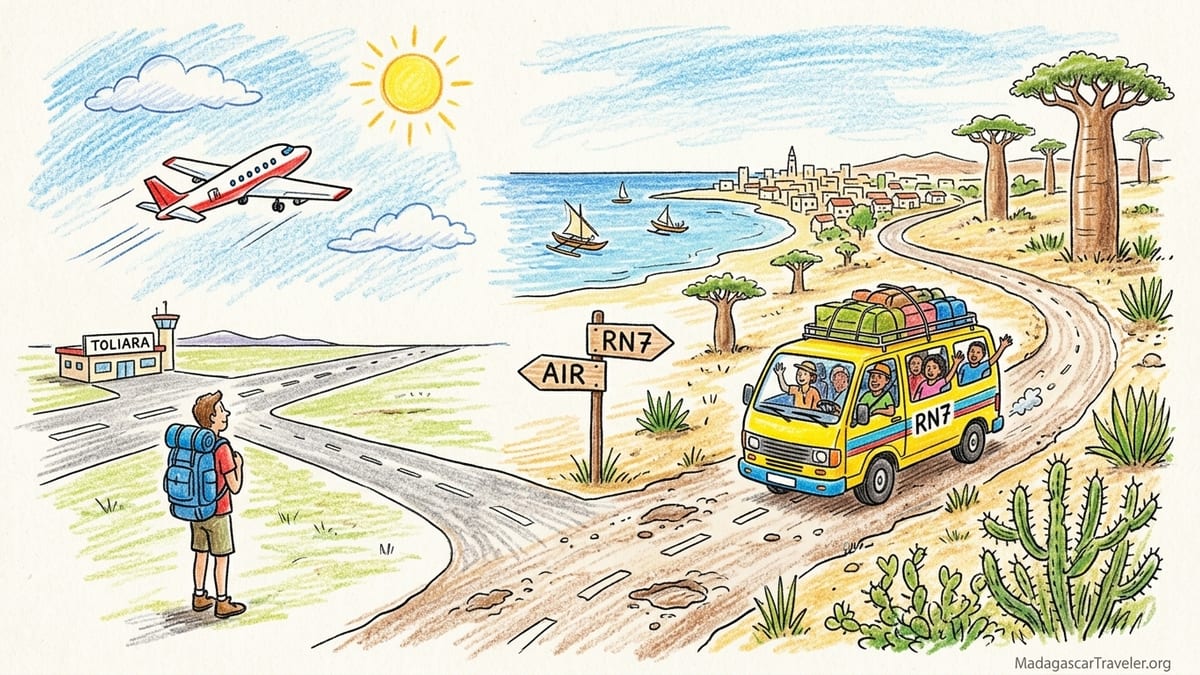
Getting to Toliara: Flight vs RN7 Overland
I arrived in Toliara by air from Antananarivo, flying Madagascar Airlines at the end of September 2026. I booked my one-way ticket about three weeks in advance and paid the equivalent of 185 US dollars for a basic economy fare with one checked bag included. That price sat roughly in the middle of what I was seeing in early October 2026, with one-way fares between the capital and Toliara generally ranging from about 150 to just over 300 dollars depending on the day and booking class.
On my travel dates, the specific departure I chose was similar to flight MD718, an afternoon service that currently connects Antananarivo Ivato and Toliara in about 1 hour 45 minutes. I paid the fare online by card on 12 September 2026. At the time of purchase, cheaper seats around 160 dollars were already gone for my preferred date, while the most flexible options were well over 250 dollars. Domestic airfare was my first big shock: in a country where a plate of grilled fish can cost less than 3 dollars in a local eatery, paying close to 200 dollars for a single internal leg feels steep.
Before booking the flight I compared that with the overland RN7 option. Route Nationale 7 runs about 900 kilometers from Antananarivo to Toliara and is fully paved but potholed in sections. Reports from recent travelers in 2025 and 2026 suggest that local taxi-brousse services for this route typically charge the equivalent of 15 to 30 dollars per seat in a crowded minibus, taking two long days on the road with an overnight stop. A more comfortable private car with driver for a multiday RN7 trip, visiting places like Antsirabe, Ranomafana and Isalo before ending in Toliara, commonly costs several hundred dollars for the vehicle and fuel spread over a week or more, usually arranged through a local agency in Antananarivo.
I chose to fly in because my time was tight and I had already driven the RN7 on a previous visit. If you are purely budget focused and have several spare days, overland public transport will be dramatically cheaper than flying, but it is uncomfortable, slow and rarely feels like a “holiday” in itself. For most short trips to Toliara and the nearby beaches, the cost of getting there and back from Antananarivo will probably be your single biggest expense.
Arriving in Toliara: Airport Transfers and First Impressions
Toliara’s small airport sits a short drive from the city. On arrival I chose a prearranged transfer organized through my guesthouse because I was landing mid-afternoon with luggage and camera gear. I confirmed the ride by WhatsApp in mid-September 2026 and paid 40,000 ariary in cash on arrival, about 9 US dollars at the exchange rate I was getting that week. That covered a clean sedan, an English-speaking driver waiting with my name sign and drop-off at a central hotel near the seafront.
For comparison, regular taxis waiting outside the terminal were quoting me between 25,000 and 30,000 ariary when I asked out of curiosity. Those taxis are older vehicles and usually do not have meters, so you need to agree on the price firmly before getting in. I did one airport run in the other direction at the end of my stay by local taxi, negotiated to 25,000 ariary in mid-September 2026. It was perfectly fine, just a bit more worn and without air-conditioning.
My first impression was how quickly prices dropped once I left the airport zone. The ten-minute drive passed dusty streets with pousse-pousse (hand-pulled rickshaws) and shared taxis that cost a fraction of what I had just paid to cover 900 kilometers by air. The transfer felt reasonably priced compared with other African cities but underlined the theme of my week: logistics in Madagascar can be expensive, but daily life on the ground in a regional city like Toliara is not.
If you are landing in daylight and do not have much luggage, it is easy enough to skip the prearranged transfer and use a regular taxi. For late-night arrivals or families with kids, paying 5 to 10 dollars equivalent for a reserved car is money well spent.
Where I Slept: City Hotels vs Beach Lodges
I split my stay between a modest hotel in central Toliara and a beach lodge near Ifaty, about 25 kilometers north of town. In late September 2026 I paid 145,000 ariary per night (around 32 dollars) for a simple but clean double room with private bathroom and fan in Toliara. The rate included breakfast and decent Wi-Fi. I booked directly with the hotel a few days beforehand and paid in cash at check-out.
Moving up to the beach raised costs sharply. For three nights at a midrange lodge near Ifaty, with bungalows set just behind the dunes, I paid 320,000 ariary per night, roughly 70 dollars at my exchange rate on 20 September 2026. That rate included breakfast but not other meals. Seafront rooms with air-conditioning and hot water were priced higher, some around 90 to 110 dollars per night at that time. These were low to shoulder season prices. I was shown a rate card for Christmas and August holidays where the same bungalow would jump closer to 100 dollars.
The price gap between town and beach surprised me. In Toliara itself you can still find basic guesthouses under 70,000 ariary (about 15 dollars) if you are willing to share a bathroom or stay a bit away from the center, while midrange hotels in the city rarely exceed 200,000 ariary per night. Along the coast toward Ifaty and Mangily, especially in small resorts with direct sea views or dive centers, nightly rates jump into a different bracket. The setting and silence are wonderful, but it is easy to underestimate how quickly beach accommodation will inflate your daily budget compared with staying in town and doing day trips.
For a week-long visit, one sensible compromise is to spend several nights in Toliara and two or three nights on the beach. That approach keeps your overall lodging costs moderate while still giving you time on the sand and access to snorkeling or diving.
Everyday Costs in Toliara: Food, Taxis and Pousse-Pousse
Once I settled into the city, the affordability of day-to-day life became obvious. In late September 2026, I was paying between 18,000 and 25,000 ariary (4 to 5.50 dollars) for a full plate of grilled fish or zebu stew with rice and vegetables in local restaurants frequented by residents. Bottled water was typically 2,000 to 3,000 ariary in shops. A large beer in a basic bar cost me 6,000 to 7,000 ariary (about 1.30 to 1.60 dollars at the time).
At more tourist-oriented restaurants along the seafront or at hotel dining rooms, prices climbed but remained reasonable. A fresh seafood platter with shrimp and calamari at a popular beachside grill set me back 45,000 ariary, roughly 10 dollars, in the third week of September 2026. Imported items were the main outliers. A simple western-style pizza in a hotel restaurant ran to 40,000 ariary, and a glass of imported wine was typically 20,000 ariary, significantly more than local drinks. Resort menus near Ifaty pushed things further, with main courses of grilled lobster and prawns often around 70,000 to 80,000 ariary. Those are still lower than European beach prices, but noticeably inflated compared with meals in town.
Urban transport in Toliara was extremely inexpensive. Short taxi rides within the city, for example from the market to my hotel or from the seafront to a neighborhood eatery, cost between 5,000 and 8,000 ariary when I negotiated in person during September 2026. At night I paid 10,000 ariary for similar distances. Pousse-pousse rides were even cheaper. For a kilometer or two, 2,000 to 3,000 ariary was standard, and a longer ride out to the bus station cost me 6,000 ariary. I always agreed on the fare before boarding and tried to tip a little extra on longer, hotter runs.
Breakfasts that were not included with my room rarely exceeded 10,000 ariary in town. I paid around 8,000 ariary for a coffee and pastry in a small café. In practical terms, I found that 60,000 to 80,000 ariary per day (about 13 to 18 dollars) easily covered food, snacks and local transport in Toliara when I was not splurging on imported items or drinking much alcohol. The contrast between these low daily costs and the high price of flights and excursions is what defines the overall budget profile of a Toliara trip.
Coastal Excursions and Boat Transfers: Where Budgets Jump
The moment I left the city for the coast, my spending increased noticeably. On 21 September 2026 I hired a driver with a sedan to take me from central Toliara to Ifaty, wait while I checked in at the lodge and then continue a short distance to a nearby village for sunset. For this half-day arrangement, including fuel, I paid 180,000 ariary, about 40 dollars. This was arranged through my Toliara hotel the evening before. A simple one-way transfer without extra stops could have been as low as 120,000 ariary, but I wanted the flexibility to photograph along the way.
The biggest surprise came with boat-based excursions. A full-day snorkeling trip from Ifaty lagoon, including boat, local guide, basic gear and a seafood lunch on the beach, cost me 210,000 ariary on 23 September 2026. I booked directly with the dive and excursion desk at my lodge. There were cheaper informal offers down on the sand, some quoting 120,000 to 150,000 ariary for a similar outing, but safety equipment and environmental practices varied and I chose the more established operator.
Diving costs escalate further. In late September 2026, certified divers were paying the equivalent of 65 to 90 dollars for a two-tank boat dive in the Ifaty area when booking through lodges that partner with local dive centers. Rental gear and fuel for the boat drive prices up. Compared with other Indian Ocean destinations this is not extreme, but it stands in stark contrast to the very low cost of simply being in Toliara. If your trip includes several days of boat-based snorkeling or diving, those line items can quickly form a major share of your total budget.
Even short boat transfers add up. I paid 60,000 ariary (around 13 dollars) for a round-trip pirogue ride to a nearby sand spit and mangrove area for an afternoon, booked informally through fishermen at the beach in September 2026. It was a beautiful outing and felt fair value, but again illustrated how anything that involves fuel or a sizable boat crew costs significantly more than walking, taking a pousse-pousse or wandering around Toliara’s markets.
Nature, Culture and Entry Fees Around Toliara
Toliara’s headline nature attraction for many visitors is the Arboretum d’Antsokay, a botanical garden about 12 kilometers southeast of the city along the RN7. I visited on 20 September 2026. Entry for foreign adults that day was 25,000 ariary, a bit higher than older guidebook figures, and included a guided walk through the spiny forest section that lasted a little over an hour. I paid in cash at the small reception hut. The on-site café offered simple lunches for around 25,000 to 30,000 ariary and cold drinks for 5,000 ariary.
To get there and back I hired a local taxi for three hours, including waiting time during my visit, for 60,000 ariary, agreed the evening before. Shared taxis and minibuses pass along the RN7 and could be cheaper, but having a dedicated car let me photograph at sunset on the return journey. Overall, the half-day at the arboretum, including transport, entry, guide and lunch, came in under 20 dollars. That felt like excellent value given the quality of the guiding and the chance to learn about Madagascar’s endemic flora.
Within Toliara itself, cultural visits are inexpensive. The small regional museum charged me 10,000 ariary for entry in late September 2026, with an extra voluntary contribution box near the door. Visiting local markets cost nothing unless I bought crafts or spices. I picked up small handmade souvenirs and a cotton scarf at the municipal market for 30,000 ariary total. A short drive to the sacred banyan tree near the village of Miary, east of Toliara along a dusty track, involved a 40,000 ariary round-trip taxi in September 2026 and a modest tip to the local caretaker who explained the rituals around the tree.
What stood out is how affordable it is to fill days in and around Toliara with meaningful experiences that do not require boats or high-end resorts. Entry fees and tips for guides in natural and cultural sites are typically small amounts relative to international budgets, though it is still important not to bargain aggressively over what is essentially income for local communities.
Private Drivers, Long Drives and What Really Adds Up
For travelers linking Toliara with other parts of Madagascar, private drivers are often the most comfortable and time-efficient choice. On a previous journey along RN7 that ended in Toliara in 2024, I hired a driver with a sturdy sedan for nine days, covering Antananarivo to Antsirabe, Ranomafana, Isalo and finally Toliara. I paid just over 1,800,000 ariary in total at the time, about 400 dollars then, which included the driver’s fee, fuel and his accommodation and meals along the way. That worked out to roughly 45 dollars per day for the vehicle and driver, split between two of us.
In late 2026, similar arrangements appear to start closer to 50 to 70 dollars per day depending on itinerary, vehicle type and fuel prices when you book. Most drivers and tour companies are based in Antananarivo, which means arranging a one-way road trip starting in Toliara can sometimes be trickier and marginally more expensive because vehicles have to position themselves south, or you need to pay for the driver’s return days. A one-off day trip by private car from Toliara to Ifaty and back, potentially including stops at fishing villages or inland baobab groves, is often quoted around 60 to 100 dollars for the vehicle when arranged through hotels in 2026.
My surprise here was less the daily rate and more how quickly extra legs add up. A couple who flies from Antananarivo to Toliara, hires a private car for a multi-day RN7 return trip and then flies out again can very easily spend more on transport inside Madagascar than on a basic guesthouse and food for the entire trip. Because prices are often quoted in ariary and paid in cash, it can be easy to lose track until you convert back to your home currency.
For many visitors, a balanced approach works best: fly one way between Antananarivo and Toliara to save time, and use a private driver for a slower journey in the other direction, splitting the cost with travel companions. If your budget is tight, pairing a single domestic flight with carefully chosen public transport segments and a short hire of a driver for the roughest or busiest stretches is often the sweet spot.
The Takeaway
When I tally up my week in and around Toliara in September 2026, a clear pattern emerges. The days I stayed in the city, ate at local restaurants, moved around by taxi and pousse-pousse and limited myself to low-cost cultural visits were remarkably inexpensive. I could easily keep daily spending under 50 dollars, including my midrange hotel. The moment I added domestic flights, beach lodges, private cars and boat excursions, the overall cost of the trip doubled or tripled.
What really drives the cost of a Toliara trip is not what you spend at the market or on street food. It is how you choose to arrive, whether you remain based in the city or move into beach accommodation, how many full-day excursions on the water you plan, and whether you rely on private drivers for long distances. Domestic air tickets between Antananarivo and Toliara, priced around 150 to 300 dollars one way in late 2026, stand out as particularly high in a low-income country, as do dive packages and resort meals based on imported ingredients.
The good news is that Toliara itself remains one of Madagascar’s more affordable coastal cities for travelers who are willing to keep things simple. You can sleep comfortably, eat very well and see a surprising amount of nature on day trips without committing to expensive resort stays. If you arrive overland, skip diving and limit yourself to a couple of modest boat or lagoon outings, a week here can be significantly cheaper than better-known Indian Ocean beach destinations. If you fly both ways, stay at a waterfront lodge and dive or snorkel daily, the price tag will start to resemble a midrange tropical holiday anywhere else in the world.
The key is to make those big-picture choices consciously. Decide early whether your priority is time or money on the Antananarivo to Toliara leg. Be honest about how many high-cost excursions you will truly enjoy rather than booking every option. And remember that some of Toliara’s most memorable moments, from watching dusk over the channel to wandering its lively markets, cost almost nothing at all.
FAQ
Q1. How much should I budget per day if I stay mainly in Toliara city?
For a solo traveler in 2026 staying in a simple but comfortable hotel, eating most meals in local restaurants and using taxis and pousse-pousse, a realistic daily budget is around 50 to 70 US dollars. That covers 25 to 35 dollars for a midrange room, 10 to 20 dollars for food and drinks and a few dollars for local transport and small entry fees. You can spend significantly less if you choose basic guesthouses and street food, or more if you eat and drink in hotel restaurants every night.
Q2. How expensive is the flight from Antananarivo to Toliara right now?
In late 2026, recent one-way fares on Madagascar Airlines between Antananarivo and Toliara typically fall between about 150 and 300 US dollars, depending on date, demand and booking class. On my own trip in September 2026 I paid around 185 dollars for a one-way ticket booked three weeks ahead. For the lowest prices it helps to be flexible with travel dates and to book well in advance.
Q3. Is it much cheaper to go by taxi-brousse along RN7 instead of flying?
Yes, but it takes far more time and comfort is basic. A seat in a shared taxi-brousse from Antananarivo to Toliara via RN7 usually costs the equivalent of 15 to 30 dollars per person, spread over two long days of travel with an overnight stop. By contrast, the flight does the journey in under two hours but costs several times more. If time is limited or you dislike cramped conditions, the savings may not be worth the fatigue.
Q4. How much do beach hotels near Ifaty and Mangily cost compared with Toliara city hotels?
In 2026, many midrange hotels and guesthouses in Toliara city charge between 25 and 40 dollars per night for an en-suite double room with breakfast. At the beach north of the city, similar comfort in a lodge or resort often costs 60 to 100 dollars per night, especially for seafront bungalows with hot water and air-conditioning. Simple beach huts without those comforts can be cheaper, but overall, moving from town to the coast can easily double your nightly accommodation cost.
Q5. What did you actually spend on food per day in Toliara?
When I stayed in the city in late September 2026, I averaged roughly 60,000 to 80,000 ariary per day on food and drinks, which matched about 13 to 18 US dollars at my exchange rate. That usually included a basic hotel breakfast, a simple lunch in a local restaurant and a more generous dinner with fish or zebu, plus bottled water and an occasional beer. Resort meals at the beach were more expensive, especially imported dishes and seafood platters, and could easily double that figure if I ate every meal on-site.
Q6. How much do snorkeling and diving trips cost near Toliara?
In the Ifaty area north of Toliara in September 2026, I paid about 210,000 ariary for a full-day snorkeling excursion with boat, guide, gear and a simple beach lunch, roughly 45 US dollars at the time. Less formal local offers along the sand were a bit cheaper but came with fewer safety assurances. Two-tank boat dives booked through lodges and dive centers often run between 65 and 90 dollars per person once boat fuel and gear rental are included.
Q7. Are airport transfers and local taxis in Toliara expensive?
Not compared with many other destinations. In September 2026 I paid 40,000 ariary, around 9 dollars, for a prearranged airport pickup and 25,000 ariary for a regular taxi back to the airport. Inside the city, short taxi rides typically cost 5,000 to 8,000 ariary by day and about 10,000 ariary at night, while pousse-pousse rides were usually just a couple of thousand ariary. For most visitors, local transport will be a very small part of the overall budget.
Q8. How much cash should I bring for a week in Toliara?
The right amount depends heavily on your plans, but for a week focused mainly on Toliara city with a couple of short excursions, many travelers are comfortable with the equivalent of 400 to 600 dollars in a mix of cash and card access. That might cover 7 nights in midrange accommodation, meals, taxis, small entry fees, one or two boat trips and modest shopping, excluding the cost of domestic flights. If you will be diving frequently or staying at higher-end beach lodges, you should budget more.
Q9. What costs in Toliara tend to surprise first-time visitors?
The biggest surprises are usually domestic airfares, the price of private drivers for multi-day RN7 trips, and the cost of boat-based activities like diving, lagoon excursions and island picnics. Resort food based on imported ingredients and drinks such as wine can also feel expensive relative to local wages and city prices. By contrast, basics like rice dishes, grilled fish in town eateries, taxis and entry fees to small museums or the arboretum are much cheaper than many people expect.
Q10. Can I visit Toliara on a tight backpacker budget?
Yes, as long as you accept slow overland travel and keep boat excursions to a minimum. Backpackers who take taxi-brousse along RN7, stay in budget guesthouses, eat mostly local food and limit themselves to inexpensive day trips in and around Toliara can get by on a relatively low daily budget compared with many other coastal destinations. The main challenge is the high cost of any flight segments you choose to add and the temptation to splurge on beautiful but pricey beach lodges and marine activities.