


Madagascar is easier to enter than many first-time visitors expect, but its visa rules still surprise travelers at the check-in desk and immigration counter. With both an official eVisa system and visa on arrival available at major airports, plus changing fee levels and stay lengths, it pays to prepare before you board your flight to Antananarivo or Nosy Be. This guide walks you through how tourist visas work in practice, what it costs, and which documents to have ready so you can step off the plane and go straight to enjoying baobab alleys and lemur-filled rainforests.
Who Needs a Tourist Visa for Madagascar
Madagascar’s visa policy is relatively open for tourists. Most nationalities, including visitors from the United States, Canada, the United Kingdom, most of the European Union, Australia and New Zealand, are expected to obtain a tourist visa but can usually do so either online as an eVisa or on arrival at the airport. Citizens of only a very small number of countries face tighter restrictions or need to coordinate in advance with a consulate, while a handful of neighboring or regional states may have special arrangements. Because these exemptions and restrictions can change, travelers should always confirm their own nationality’s status with an official Malagasy consulate or the government’s eVisa portal before they fly.
In practical terms, this means that an American couple flying from Paris to Antananarivo on a two-week wildlife trip will normally not apply at an embassy. Instead, they can choose between securing an eVisa online before departure or buying a visa at the airport after landing. The same is true for a German backpacker arriving from Johannesburg or a Japanese photographer connecting through Nairobi. For all of them, the main decisions are how long they plan to stay and whether they prefer to handle paperwork in advance or face-to-face at the immigration counter.
There is one hard rule almost everyone must follow: your passport must be valid beyond the end of your stay. Madagascar’s authorities commonly expect at least six months of validity remaining after your planned departure date, and airlines often enforce this at check-in. A traveler whose passport expires in three months may be denied boarding in London or Dubai even if they can technically purchase a visa on arrival in Madagascar, so it is crucial to check passport dates well before booking tickets.
Another point that catches repeat visitors is the overall time they spend in the country over a year. While a single tourist visa typically covers a stay of up to 15, 30, 60 or 90 days, immigration officers may pay attention if someone appears to be using back-to-back tourist visas to live in Madagascar long term. For example, a digital nomad who tries to stay almost continuously in Antananarivo on consecutive tourist visas may be advised to look into a more appropriate visa type or risk being refused an extension. When in doubt, it is safer to assume tourist visas are for genuine short visits, not informal residency.
Available Visa Types and Lengths of Stay
For ordinary tourists, short-stay visas are usually available in four main lengths: up to 15 days, 30 days, 60 days and 90 days. These can be issued either as eVisas or visas on arrival at major points of entry. The precise labels and conditions may vary slightly, but the core principle is simple: you pick the maximum duration you think you will need, pay the corresponding fee, and immigration stamps the appropriate authorization into your passport on entry.
In 2026, Madagascar introduced higher fees for very short stays, but kept the basic structure of the system. As an example, an overland enthusiast planning a 10-day road trip from Antananarivo to Morondava and back might choose the 15-day option, while a birdwatcher on an extended tour of Andasibe-Mantadia, Ranomafana and Masoala might select 60 or 90 days. The key is to match your visa to your realistic itinerary, leaving a buffer for delayed domestic flights or ferry cancellations, which are not uncommon in Madagascar.
Extensions inside the country are sometimes possible but not guaranteed and can require additional paperwork and fees at local immigration offices. For instance, a traveler who enters with a 60-day visa and then decides to spend an extra month exploring Nosy Be and Île Sainte-Marie might be able to request an extension in Antananarivo. However, processing standards and policies can vary, and officials have broad discretion. Travelers should not rely on being able to extend on a whim and are better off entering with a visa long enough to cover their planned stay.
For stays longer than 90 days, or for purposes such as research, volunteering with a local organization, employment or long-term study, tourists usually have to apply for a different category of visa through a Malagasy embassy or consulate before traveling. A researcher working with a conservation NGO in the eastern rainforests, for example, might obtain a dedicated research visa valid for several months, rather than stringing together multiple short tourist visas.
eVisa vs Visa on Arrival: How the Two Systems Compare
Madagascar operates an official eVisa system that allows many tourists to apply and pay online before departure, then receive a digital authorization which they present at immigration on arrival. This is particularly attractive for travelers who want the reassurance of having their entry pre-cleared. A family flying from New York to Antananarivo via Addis Ababa, for example, can complete the application on the government’s eVisa platform a week before the trip, upload passport details, pay the fee by card and print the confirmation to show at the airport.
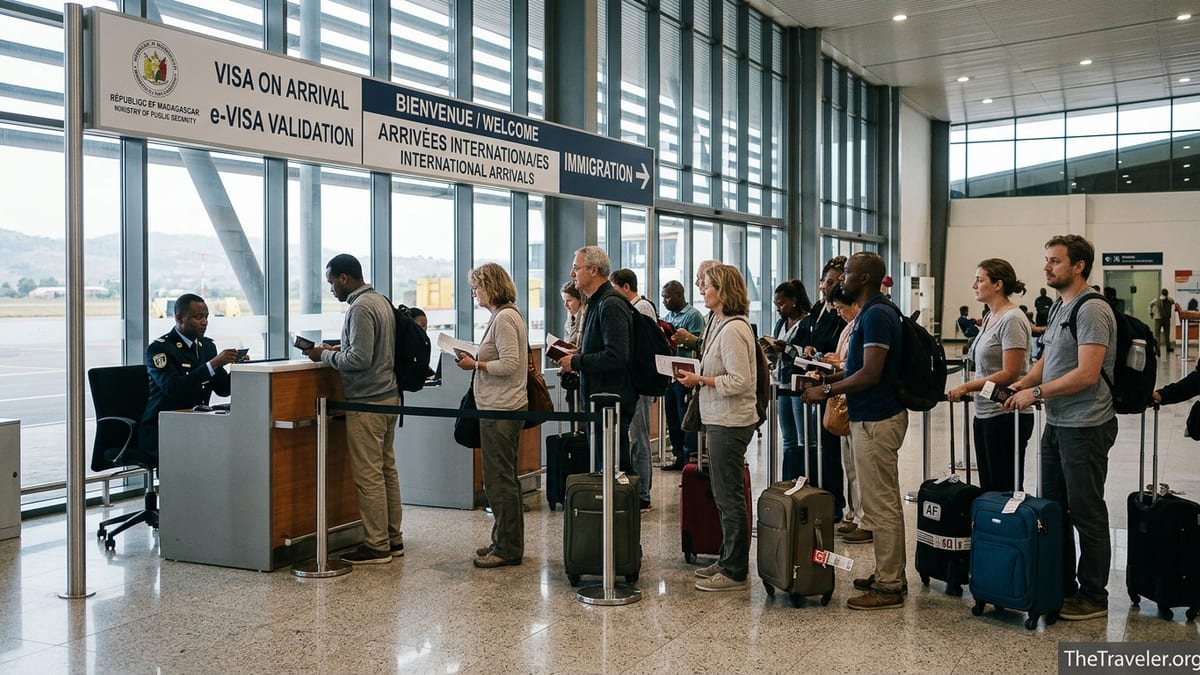
Visa on arrival remains a popular option too, especially for those booking last-minute trips or who prefer to handle everything face-to-face. At Ivato International Airport in Antananarivo and other international gateways such as Nosy Be or Mahajanga, travelers routinely queue at dedicated visa counters before proceeding to passport control. Here, you present your passport, fill in a short arrival form, declare the length of your intended stay and pay the fee, often in euros or US dollars, sometimes also in local currency.
In practice, both systems generally offer the same stay lengths, and the fees are usually aligned or very similar. The main differences lie in when you pay and how much time you spend at the airport. With an eVisa, you take care of payment before you leave home, which can shorten your time standing at the visa counter, although you will still need to pass through an eVisa validation point. With visa on arrival, you may wait longer if several international flights land around the same time, but you avoid online forms and can decide on the exact stay duration at the last minute if your plans are flexible.
Another subtle difference is reliability in the face of technical problems. If the eVisa website is experiencing issues on the day you want to apply, or your credit card payment does not go through, you might have to switch to a visa-on-arrival plan. Conversely, if you reach the airport late at night when staffing is thin and queues are long, having an approved eVisa can help speed things up. As a rule of thumb, first-time visitors and those on tight schedules often find the eVisa more reassuring, while repeat visitors and backpackers are more likely to rely on visas on arrival.
Current Visa Fees, Payments and Real-World Airport Experience
Visa fees for Madagascar were updated in 2026, particularly for short stays of up to 15 days. While exact amounts can fluctuate with government decisions and currency movements, tourists now typically pay roughly the equivalent of 30 euros or a similar amount in US dollars for the shortest stay, with higher fees for 30, 60 and 90-day visas. For example, in recent practice a 30-day tourist visa has commonly cost in the region of 35 to 40 euros, a 60-day visa around 40 to 45 euros, and a 90-day visa about 50 euros, whether obtained online or at the airport.
At Ivato International Airport, the process usually begins immediately after you leave the aircraft and follow signs marked Visa or eVisa. Travelers without an eVisa join the visa-on-arrival queue, where officers ask how long you intend to stay and quote the fee in euros, US dollars and sometimes the local currency, the ariary. Payment counters often accept crisp banknotes in major currencies, so an Italian couple arriving from Rome might hand over 100 euros for two 30-day visas and receive change in ariary. Card payments are sometimes possible at eVisa validation points, but systems can be inconsistent, so relying solely on a credit card is risky.
Nosy Be’s Fascene Airport and other smaller international gateways follow a similar pattern, though with fewer counters and less staff. During busy holiday periods, such as European summer or the southern hemisphere winter when whale watching peaks on Île Sainte-Marie, queues can stretch across the arrivals hall. Travelers who have printed their eVisa approve letters often report clearing the formalities faster than those applying from scratch at the counter, even when everyone lands from the same charter flight.
Real-world experience underlines two practical tips. First, carry exact or near-exact cash in clean, undamaged notes, because staff sometimes hesitate to accept torn or heavily marked bills. A solo traveler from Toronto who arrives at midnight with only a large US dollar bill may wait longer while officers find change. Second, keep proof of onward travel and hotel bookings easily accessible on your phone or in print, as immigration officials occasionally ask for confirmation of your first few nights and return ticket before finalizing your entry stamp.
Passport, Document and Entry Requirements
To enter Madagascar as a tourist, you will need a passport that is valid for at least six months beyond your planned departure date and that has at least one or two blank pages available for visa stickers and stamps. In practice, it is wise to have at least two completely blank pages. Frequent visitors to Madagascar often find that a single visa sticker or stamp can take up an entire page, so a traveler on a multi-country Africa trip who already has several large visas from Kenya and South Africa may need to renew their passport earlier than expected.
Immigration officers may also ask to see proof of onward or return travel. This could be a round-trip e-ticket from Paris to Antananarivo, a separate ticket onward to Mauritius, or even a printed itinerary showing an exit by boat or regional flight. Airlines sometimes enforce this requirement at check-in. For example, a backpacker with a one-way ticket from Johannesburg to Antananarivo but no onward reservation may be questioned at the boarding gate and asked to book at least a flexible or refundable ticket out of Madagascar within the maximum allowed stay.
Accommodation details are another common question. Having at least the first few nights of lodging confirmed is advisable, whether at a mid-range guesthouse in Isoraka in central Antananarivo or a beach bungalow in Nosy Komba. Many travelers simply show a printed hotel confirmation or a screenshot of their booking app. In rural areas and community-run eco-lodges where online reservations are less common, a confirmation email from a local tour operator or lodge owner is usually sufficient.
Finally, travelers should pay attention to health and customs considerations. While requirements can change, Madagascar has in the past required proof of yellow fever vaccination for arrivals coming from or transiting through certain countries with active transmission. Food, plants and wildlife products are also carefully controlled; for instance, attempting to bring home protected hardwood carvings or live reptiles is illegal and may result in confiscation or worse. Before traveling, visitors should check both the Malagasy government’s latest health advisories and their own country’s travel health recommendations.
Major Entry Points and What to Expect on Arrival
Most international visitors arrive in Madagascar by air. The primary gateway is Ivato International Airport, which serves the capital Antananarivo and handles long-haul flights from hubs such as Paris, Addis Ababa and Johannesburg. As you disembark, signage in French and English directs you toward visa services and passport control. During peak arrival times, the hall can become crowded, but the flow is generally clear: visa on arrival or eVisa validation first, then immigration, then baggage claim and customs.
Nosy Be’s Fascene Airport is another significant entry point, especially for beach and diving holidays in the northwest. European charter flights and regional connections from places like Réunion and Mayotte often land here. The arrivals area is much smaller than in the capital, and during busy months passengers sometimes queue outside on the tarmac before entering the terminal. Visa counters are typically located just inside the building, with a single carousel for bags. Travelers landing here should be ready for a slower, more informal pace and should not expect the same range of services or ATMs as at larger African airports.
Other airports, such as those serving Mahajanga, Toamasina or Toliara, occasionally handle international or regional flights, though routes can change from season to season. As a consequence, anyone planning to arrive from a neighboring island like Mauritius or Seychelles should double-check which airports currently process international arrivals and whether visas on arrival are offered there. Airlines or tour operators that specialize in Madagascar, such as those running regular flights from Réunion to Antananarivo or Nosy Be, can often provide up-to-date practical information.
Sea arrivals are less common but do occur, especially via cruise ships or private yachts. Cruise passengers normally clear immigration as a group, with ship staff coordinating visa formalities in advance or upon docking. Independent sailors who intend to clear into Madagascar at ports like Nosy Be or Diego Suarez should contact local authorities well ahead of time to verify current rules, as not every port is equipped to handle full immigration and customs checks for private vessels.
Step-by-Step Preparation Checklist for a Smooth Entry
A few weeks before departure, start by checking your passport. Confirm that it will remain valid for at least six months after the date you plan to leave Madagascar and that you have enough blank pages for new visa stickers and stamps. If your passport is due to expire sooner, prioritize renewing it before doing anything else. At the same time, review your rough itinerary to decide how long you will stay. For example, if you are planning three weeks between Antananarivo, the Avenue of the Baobabs and the beaches of Ifaty, a 30-day visa should comfortably cover your plans.
Next, choose whether to apply for an eVisa or rely on a visa on arrival. If you prefer the eVisa, visit the official online platform, create an application, enter your passport details and travel dates, upload any required documents, and pay the applicable fee by card. Keep a copy of the confirmation email, download the approved document and print at least one paper copy to carry with you. If you opt for visa on arrival, make a note of the most recent fee levels from an official source shortly before your trip, then set aside clean euro or US dollar notes in small denominations to cover the cost.
In the final week, gather supporting documents. Print your flight itinerary showing both arrival and departure, as well as confirmations for your first few nights of accommodation. If you are joining a guided tour, have a letter or email from the operator that outlines your route and contact information in Madagascar. Check health guidance regarding vaccinations or recommended medications for areas you will visit, such as antimalarial options if you are spending time in coastal or lowland regions. Store all paper documents in a travel wallet and back them up digitally on your phone or in cloud storage.
On travel day, carry your passport, visa documents and printed itineraries in your hand luggage. Before you land, cabin crew may distribute arrival forms; complete these carefully with your expected address in Madagascar, which can be the name and city of your first hotel. After disembarking, follow the signs for eVisa validation or visa on arrival, present your authorization or request the appropriate stay length, pay the fee and then proceed to passport control. Once you have your entry stamp, collect your luggage, pass customs and you are ready to begin your journey, whether that means heading into Antananarivo’s hills or connecting directly to a domestic flight.
The Takeaway
Madagascar’s tourist visa system is designed to be accessible, but it is not entirely friction-free. Travelers need to make early decisions about how long they intend to stay, whether to secure an eVisa in advance or rely on visa on arrival, and how to meet practical requirements at the airport. The process is not complex, yet travelers who ignore basics like passport validity, proof of onward travel or having enough cash for the visa fee can find themselves delayed at check-in or immigration.
For most visitors, the smoothest path is to confirm current rules from an official Malagasy government source, ensure that passport and supporting documents meet those rules, and choose the visa option that best fits their risk tolerance and travel style. A well-prepared visitor, whether they are a backpacker with a 60-day plan or a family on a 15-day holiday, will typically clear the formalities in less than an hour and be on their way to see ring-tailed lemurs or explore the red earth highlands.
Since entry policies, fees and technical platforms continue to evolve, especially in the years following global travel disruptions and domestic policy updates, it is critical not to rely solely on outdated blogs or second-hand social media posts. Before you finalize your flights, take a few minutes to verify your visa options and costs with official Madagascar immigration channels, embassies or consulates. Doing so can save you money, stress and precious time when you touch down on this extraordinary island.
FAQ
Q1. Do I need a visa to visit Madagascar as a tourist?
Most nationalities, including American, Canadian, European, Australian and many Asian passport holders, do need a tourist visa, which can usually be obtained either as an eVisa before departure or as a visa on arrival at major airports.
Q2. How long can I stay in Madagascar on a tourist visa?
Short-stay tourist visas are commonly available for up to 15, 30, 60 or 90 days, and you select the maximum duration when you apply online or request a visa on arrival.
Q3. Is it better to get an eVisa or a visa on arrival?
An eVisa is usually better if you want reassurance and shorter queues, since you apply and pay before departure, while a visa on arrival works well for flexible or last-minute trips if you are comfortable handling formalities at the airport.
Q4. What are the typical visa fees for Madagascar?
Fees change periodically, but as of 2026 tourists can expect to pay roughly the equivalent of 30 euros for the shortest 15-day visa, with higher amounts for 30, 60 and 90-day options, so always check the latest official rates shortly before you travel.
Q5. What documents do I need to present at immigration?
You should have a valid passport with sufficient remaining validity and blank pages, your eVisa approval if you applied online, proof of onward or return travel, and at least the first few nights of accommodation confirmed, all printed or easily accessible on your phone.
Q6. How much passport validity do I need for Madagascar?
Authorities generally expect your passport to be valid for at least six months beyond your planned departure date from Madagascar, and airlines may refuse boarding if you do not meet this standard.
Q7. Can I extend my tourist visa once I am in Madagascar?
In some cases extensions are possible through local immigration offices, especially in Antananarivo, but they are not guaranteed, may involve additional fees and paperwork, and depend on current policy and your individual circumstances.
Q8. Can I pay the visa fee by card at the airport?
Some visa and eVisa validation counters can process card payments, but systems are not always reliable, so you should carry enough clean euro or US dollar cash in small denominations to cover the full visa fee if card terminals are offline.
Q9. Do I need to show hotel bookings when I arrive?
Immigration officers often ask where you will stay, so having printed or digital confirmations for at least your first few nights, or a letter from a tour operator, is strongly recommended and sometimes required.
Q10. Why should I recheck visa rules before I travel?
Visa policies, permitted stay lengths, health requirements and fee levels can change with little notice, so you should always verify the latest information with official Madagascar immigration sources, embassies or consulates shortly before your departure date.