


Madagascar’s Route Nationale 7, or RN7, is the country’s classic overland journey. Stretching roughly 950 kilometers from the highland capital Antananarivo down to the warm southwest coast at Toliara, it threads together volcanic plateaus, rainforest, bare sandstone canyons and reef-fringed lagoons. This guide walks you through the Antananarivo to Toliara route in practical detail, covering realistic driving times, suggested overnight stops, where it is worth slowing down for two nights, and how to continue on to a beach stay once you reach the end of the road.
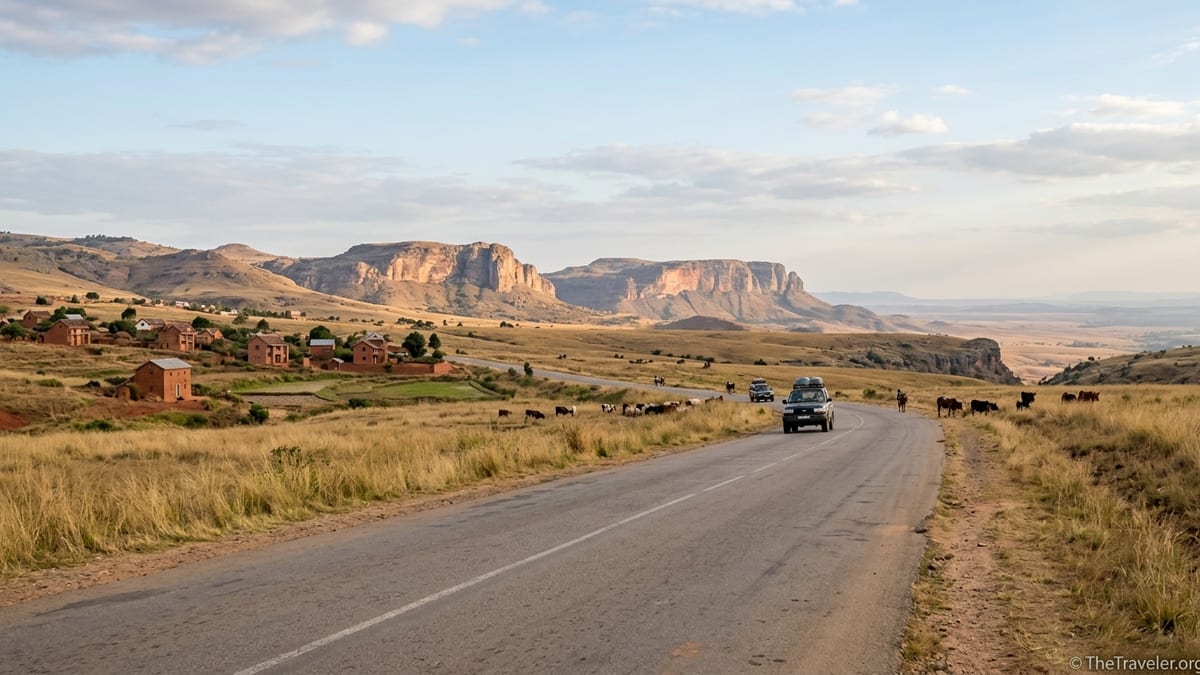
Understanding Madagascar’s RN7: Overview and Timing
RN7 is Madagascar’s backbone highway, running from Antananarivo to Toliara via Antsirabe, Ambositra, Fianarantsoa, Ambalavao, Ihosy and the gateway village of Ranohira for Isalo National Park. The total distance is around 930 to 980 kilometers depending on where you measure from in Antananarivo, and nearly all of it is paved. Road quality is broadly decent but surfaces can be patchy, especially around towns and in stretches that suffer from heavy truck traffic or seasonal rains, so progress is much slower than on highways in Europe or North America.
Most travelers treat RN7 as a one-way, 8 to 14 day journey with regular stops, rather than a continuous drive. While it is technically possible to cover Antananarivo to Toliara in two very long days of 10 to 12 hours of driving each, that would mean driving in the dark, which is strongly discouraged because of unlit vehicles, pedestrians, zebu carts and animals on the road. A comfortable pace for most visitors is at least 9 to 10 days one way, including two-night stays in Ranomafana and Isalo so you can experience the parks properly.
In practical terms, expect average speeds of 40 to 60 kilometers per hour between major towns. For example, recent travelers report that the 160 kilometer stretch from Antananarivo to Antsirabe can take four to five hours depending on congestion getting out of the capital and truck traffic on the climbs. A shorter 55 to 70 kilometer link, such as between Ranomafana and Fianarantsoa, might still take one and a half to two hours. It is common for travelers to underestimate how fatiguing these days can be, especially when you add photo stops, police checks and village slow-downs.
Because of these constraints, it is wise to sketch out your RN7 itinerary with conservative driving days of four to six hours wherever possible, punctuated with at least three “slow days” where you stay put and focus on hiking, wildlife or village visits. That usually means two nights in Ranomafana National Park, two nights at Isalo, and at least two to three nights on the southwest coast after Toliara, either at Ifaty or Anakao.
Antananarivo to Antsirabe: Leaving the Highlands Capital
The RN7 journey typically begins in Antananarivo, a dense, hilly city where traffic can be chaotic and parking scarce. Many visitors choose to spend one or two nights here to recover from their flight, organize local SIM cards and cash, and meet their driver or rental company in person. When you are ready to depart, it is best to leave the city early in the morning, ideally before 8 a.m., to avoid the heaviest congestion on the southern exit.
The first leg runs about 160 kilometers to Antsirabe, a former colonial spa town on the high plateau known for its cooler climate and thermal waters. Even though the road is paved and relatively straightforward, count on four to five hours including a short break. Traffic is a mix of trucks, minivans and local taxis, with frequent slowdowns near markets and villages. A typical traveler with a private driver might pay for fuel and driver meals on this day in addition to a fixed daily rate, while self-drivers should factor in fuel consumption of roughly 10 to 12 liters per 100 kilometers for a 4x4.
Antsirabe makes an excellent first overnight stop. The town has a decent range of midrange hotels and guesthouses with secure parking, hot showers and on-site restaurants. Many RN7 travelers choose properties in the quiet neighborhoods just outside the center, where courtyards are guarded at night and there is space for 4x4 vehicles. Spending one night here is usually sufficient, but if you want a slower start you can stay two nights and take a day to explore the crater lakes and rickshaw-clogged streets.
If you are traveling by public transport instead of in a private vehicle, this is also where you will likely change from one taxi-brousse cooperative to another. Companies based in Antananarivo run services to Antsirabe, where you then transfer to another regional cooperative headed further south. These changes add to the travel time and are a key reason why most visitors with limited days on RN7 opt for a driver rather than relying on shared vans for the entire journey.
Antsirabe, Ambositra and the Detour to Ranomafana National Park
From Antsirabe, RN7 continues south toward Ambositra, the heart of Madagascar’s woodcarving traditions. The distance is roughly 90 to 100 kilometers and usually takes about three hours. The scenery transitions from volcanic highlands into a patchwork of rice paddies and red-earth villages, with roadside stalls selling fresh fruit, local honey and carved zebu horn souvenirs. Many travelers stop for lunch in Ambositra and to browse the artisan workshops that line the main street.
Officially, RN7 continues south from Ambositra through Ambohimahasoa toward Fianarantsoa, but this is where many RN7 itineraries branch east toward Ranomafana National Park. The turn-off is a signposted junction near Alakamisy Ambohimaha, after which a secondary paved road winds for around 60 to 70 kilometers to the park entrance. While the distance is not huge, you should still allow two to three hours for the detour because of tight bends, occasional potholes and slow trucks climbing out of valleys.
Ranomafana National Park itself is best enjoyed over two nights. This montane rainforest is one of Madagascar’s premier primate destinations, with several species of lemur, including the golden bamboo lemur, as well as abundant chameleons, frogs and birdlife. A typical pattern is to arrive from Ambositra or Antsirabe by mid-afternoon, settle into a lodge along the main road near the park gate, then spend the next full day on guided hikes inside the park. Local park guides are mandatory and fees are posted at the entrance; English-speaking guides are usually available but should be booked early in the day.
If you are tight on time, it is physically possible to do Antsirabe to Ranomafana in a long day and then continue to Fianarantsoa the following morning. However, fitting in meaningful walks and night hikes becomes rushed. For most visitors, two nights in Ranomafana is the minimum to justify the detour, offering one full day for a longer circuit hike plus an evening walk along the roadside forest to search for nocturnal species.
Fianarantsoa, Ambalavao and Anja Community Reserve
After Ranomafana, RN7 resumes its southbound line through Fianarantsoa and Ambalavao, a stretch that combines highland culture with some of the easiest wildlife viewing along the route. Ranomafana to Fianarantsoa is roughly 70 kilometers and typically takes one and a half to two hours, including slow sections through small towns. Many itineraries schedule a coffee stop in Fianarantsoa’s upper town, known for its hillside churches and views over tiled rooftops, before continuing another 50 to 60 kilometers to Ambalavao.
Ambalavao is a compact town surrounded by dramatic granite domes and vineyards. Driving Fianarantsoa to Ambalavao usually takes one to one and a half hours. The town has a handful of characterful guesthouses and small hotels catering to RN7 travelers, with secure courtyards where drivers can park their vehicles overnight. This is a logical overnight stop if you want a shorter driving day between Ranomafana and Isalo, and it sets you up well for an early visit to Anja Community Reserve the following morning.
Anja Community Reserve lies about 12 kilometers south of Ambalavao, directly beside RN7. Managed by the local community, it protects a patch of forest and boulder fields that are home to habituated troops of ring-tailed lemurs. Entry fees are modest and support village projects, and a local guide is required but arranged on arrival. Most travelers spend two to three hours here walking an easy loop trail among the rocks, photographing lemurs and enjoying views over rice terraces. It is realistic to visit Anja in the morning, then continue south the same day to Isalo.
For those with more time, Ambalavao can also be a base for side trips into Andringitra National Park, a rugged mountain area popular with trekkers. Reaching Andringitra requires additional driving on rougher roads and at least one extra night, so it suits travelers who are comfortable with longer hikes and are building a two-week or longer RN7 itinerary. If you prefer a more relaxed schedule centered on wildlife and scenery rather than multi-day trekking, Anja Reserve and the Isalo area provide plenty of variety without leaving the main paved route.
Isalo National Park and the Descent to the Southwest Coast
South of Ambalavao, RN7 crosses a drier region of grasslands and low hills, passing Ihosy before reaching the small settlement of Ranohira, the gateway village to Isalo National Park. The Ambalavao to Ranohira segment is around 180 kilometers and usually takes four to five hours including stops. Because this is a relatively long stretch, many travelers depart Ambalavao by mid-morning, visit Anja Reserve for a couple of hours, then continue to arrive in Ranohira by late afternoon.
Isalo National Park is one of the visual highlights of any RN7 journey, a massif of eroded sandstone forming canyons, natural pools and sweeping plateaus. The dry, open landscape makes for spectacular sunrise and sunset views. This is another area where two nights are strongly recommended. With a full day in between, you can do a classic hike such as the Canyon des Singes or the Piscine Naturelle and still have time to rest by your lodge’s pool. Local park guides are required, and most lodges can help you arrange a guide and packed lunches.
From Isalo, RN7 continues west through Zombitse-Vohibasia National Park, a smaller dry forest reserve that can be visited in a few hours if you leave Ranohira early. The road then passes Sakaraha and finally descends toward Toliara on the coastal plain. Ranohira to Toliara is approximately 230 kilometers and commonly takes six to seven hours with a short stop in Zombitse and a lunch break. This is often one of the longest driving days on the route, so it pays to leave Isalo just after sunrise to arrive in Toliara mid-afternoon while there is still plenty of light.
Travelers who are keen birders or botanists might choose to add an extra night near Zombitse or Sakaraha to explore the dry forest more fully. However, most itineraries prioritize getting to the beach after several days inland. In that case, the goal is simply to reach Toliara in time to connect with a vehicle transfer north to Ifaty or to overnight in town before a boat transfer south to Anakao the following morning.
Toliara and the Southwest Coast: Ifaty, Mangily and Anakao
Toliara itself functions mainly as a transit hub at the end of RN7 rather than a destination. The town is hot, dusty and busy, with a working port, markets and a small selection of city hotels geared to overnight stays. The real appeal of the region lies along the nearby beaches, shielded from the open Mozambique Channel by the Grand Récif de Toliara, a barrier reef that creates calm lagoons around Ifaty, Mangily and Anakao.
To the north of Toliara, Ifaty and Mangily sit about 25 to 30 kilometers away along a paved stretch of RN9. The drive typically takes 45 minutes to an hour by private vehicle, longer if you are in a shared taxi. These villages offer sandy beaches, simple seafood restaurants and a range of accommodation from basic bungalows to comfortable beach lodges with fans or air-conditioning. It is common for RN7 travelers to book two to four nights here to relax after the long drive, arrange snorkeling or diving trips on the reef and visit the nearby spiny forest reserves at dawn to see baobabs and endemic birds.
South of Toliara, Anakao is a Vezo fishing village accessed primarily by boat across Saint Augustin Bay. Fast boat transfers usually leave Toliara in the morning, taking about an hour depending on sea conditions. Several local operators run these services, and hotels in Anakao often help coordinate tickets and pick-ups. Once there, you find a quieter, more remote atmosphere than in Ifaty, with beach lodges spread along a broad arc of sand and pirogues pulled up on the shore. Day trips by boat to the offshore islet of Nosy Ve are popular for snorkeling and seabird watching.
In practice, many RN7 itineraries end with three or more nights split between Ifaty and Anakao, for example two nights in Ifaty to enjoy easier road access and one or two nights in Anakao for a more secluded feel. Shorter trips might choose just Ifaty to keep logistics simple. Whatever you decide, plan to return to Toliara at least a day before any domestic flight departure, as boat transfers are weather-dependent and Madagascar’s internal flights are prone to delays or schedule changes.
Driver vs Self-Drive, One-Way vs Return and Vehicle Choice
One of the most important decisions when planning an RN7 trip is whether to hire a car with driver or attempt a self-drive. In Madagascar, most car rentals for tourists are bundled with a driver by default, and many agencies only rent with a driver. That daily rate typically includes the vehicle, driver, basic insurance and the driver’s food and accommodation, while you cover fuel and tolls. Although exact prices fluctuate with inflation and season, many recent visitors report that a private car with driver can work out similarly priced or even cheaper than a fully insured self-drive 4x4 rental once you factor in security deposits and higher self-drive insurance premiums.
Self-drive remains possible and is offered by a handful of specialist companies that maintain modern 4x4 fleets and provide emergency support along RN7. It tends to appeal to experienced overland drivers who are comfortable with unpredictable traffic behavior, livestock on the road, and basic mechanical troubleshooting. It is also important to understand that in Antananarivo itself, traffic can be stressful even for seasoned expatriates, with little parking and confusing one-way systems, so some self-drivers choose to have their rental company drop the vehicle at their guesthouse and meet them there to avoid navigating the center on arrival.
For most first-time visitors, a car with driver is the safer and more relaxing option. The driver handles police checkpoints, knows where fuel is reliably available and can recommend trustworthy roadside eateries. They also double as informal translators in rural areas. On RN7, the added cost of a driver is offset by the time you save not getting lost and the reduced risk of accidents. A commonly reported pattern is for couples or small groups to share the cost of a single vehicle and driver, making it relatively good value per person compared to booking a packaged group tour.
The other big structural decision is whether to travel RN7 one way or to return overland to Antananarivo. Most itineraries these days are one-way: either Antananarivo to Toliara with a domestic flight back, or the reverse. Returning by road effectively doubles your driving time, meaning you would need three weeks or more to avoid turning the second leg into a string of long, repetitive driving days. Vehicle choice for RN7 is typically a high-clearance vehicle or 4x4, which is useful for potholes, uneven shoulders and hotel access tracks, even though the main road is paved. A standard sedan is physically capable of the route in dry season, but a 4x4 gives more margin for error and comfort on broken sections.
Suggested RN7 Itineraries and Where to Spend Two Nights
An efficient but not rushed one-way RN7 itinerary from Antananarivo to Toliara might run to around 10 nights. One example would be: Antananarivo (1 night), Antsirabe (1 night), Ranomafana (2 nights), Ambalavao with Anja Reserve (1 night), Isalo / Ranohira (2 nights), Toliara transit (1 night) and Ifaty or Anakao (2 nights). This pattern keeps most driving days in the four to six hour range, allows meaningful time in both major national parks, and finishes with several days on the coast.
If you have 12 to 14 nights, you can insert second nights in more places. For instance, spending two nights in Antsirabe gives a gentle start and lets you explore crater lakes or cycling routes around the town. Adding an extra night in Ambalavao creates space for a full morning at Anja Reserve followed by an afternoon wine tasting or village visit, while a second night at the coast lets you factor in a full-day boat excursion without rushing back to the airport. The key principle is to cluster your two-night stays around natural highlights rather than in transit towns.
For travelers with only seven or eight nights, it becomes necessary to make trade-offs. Some choose to skip Ranomafana and focus on Isalo plus the coast, flying directly to another rainforest destination such as Andasibe from Antananarivo if they want a lemur-rich forest experience. Others reduce time on the beach, spending just one or two nights at Ifaty. Whatever your schedule, avoid packing in consecutive seven or eight-hour driving days. The combination of heat, constant overtaking and road conditions can be more tiring than the distances suggest on paper.
Families and older travelers in particular benefit from placing their two-night stays strategically to break up the journey. Ranomafana offers cooler temperatures and shaded trails, good for children who enjoy wildlife; Isalo is ideal for active teenagers and adults who like hiking and swimming in natural pools; the coast provides rest days with minimal required activity. Using two-night blocks in these three locations gives you a natural rhythm of effort and recovery throughout the trip.
Continuing Your Journey After Toliara
After reaching Toliara and enjoying a few days on the southwest coast, many travelers either fly back to Antananarivo or connect onward to another region of Madagascar. Domestic routes and schedules change frequently, so it is sensible to plan a flexible buffer night in Toliara or Antananarivo before any international departure. Airlines serving this route sometimes reschedule or consolidate flights, and weather can interrupt boat transfers from Anakao back to Toliara.
If you want to continue overland, one option is to follow RN9 north from Toliara beyond Ifaty to more remote coastal villages, but conditions quickly deteriorate and this is recommended only for well-prepared 4x4 trips with ample time. Another, more comfortable option is to end the road segment in Toliara and then focus on domestic flights to reach other hotspots such as Morondava for the Avenue of the Baobabs or Nosy Be and the northwest archipelagos for more beach time. Many RN7 travelers choose exactly this pattern: a one-way drive, a few days at Ifaty or Anakao, then a flight back to Antananarivo followed by another short flight to a different region.
The flexibility of RN7 is part of its appeal. Because the main road is reliable and towns along the way have basic services, you can adjust your pace on the ground if you find you are tiring or want to linger. However, accommodation in Ranomafana and Isalo sells out during peak months such as July and August, so those core nights should be booked in advance, especially if you want specific lodges with pools or family rooms. Coastal hotels around Ifaty and Anakao also fill up during local holiday periods, when Malagasy families travel to the beach.
In planning your exit from Toliara, keep an eye on how your chosen airline treats schedule changes and whether your ticket allows for rebooking. Consider buying local travel insurance that covers delays and lost nights of accommodation. Above all, resist the temptation to book a same-day international connection after a domestic RN7-related flight. Giving yourself at least one buffer night in Antananarivo significantly reduces stress and protects the time you invested in experiencing Madagascar’s overland heart.
The Takeaway
The RN7 journey from Antananarivo to Toliara is Madagascar’s signature road trip for good reason. Within a single overland route, you move from cool highlands and artisan towns through rainforest, granite domes and desert-like plateaus to a reef-sheltered coast. It is an immersive way to experience the country’s landscapes and cultures at human speed, with each day bringing gradual shifts in architecture, clothing and vegetation.
To make the most of RN7, plan for realistic driving times, avoid night travel and give yourself at least two nights at key highlights such as Ranomafana and Isalo. Use Ambalavao and Anja Community Reserve as a gentle mid-journey wildlife stop, and reward yourself with several slow days on the beaches around Ifaty or Anakao at the end. For most visitors, hiring a car with driver is the most practical and relaxing option, turning the journey into an evolving conversation with someone who knows the road intimately.
RN7 is not a quick highway sprint, and it is not polished luxury travel. It is a series of long, sometimes bumpy days that yield lemurs in low forest branches, orange sandstone glowing at sunset, and children waving from rice fields as you pass. With thoughtful pacing, a reliable vehicle and a willingness to embrace slow travel, the route from Antananarivo to Toliara becomes less a means of getting from A to B and more the backbone of a deeply memorable Madagascar journey.
FAQ
Q1. How many days do I need for an RN7 trip from Antananarivo to Toliara?
Most travelers are comfortable with 9 to 14 days one way, which allows two nights in Ranomafana and Isalo and a few nights on the coast without turning every day into a long drive.
Q2. Is RN7 suitable for self-drive, or should I always hire a driver?
Self-drive is possible for confident, experienced drivers used to rougher road conditions, but most visitors find hiring a car with driver safer, less stressful and often similar in cost once you include insurance and deposits.
Q3. Do I really need a 4x4 vehicle for RN7?
The main RN7 surface is paved, so a high-clearance sedan can physically make the trip in dry season, but a 4x4 is strongly recommended for comfort, ground clearance on broken patches and access tracks to lodges or side trips.
Q4. Where along RN7 is it worth spending two nights instead of one?
Ranomafana National Park and Isalo National Park are the top priorities for two-night stays, and many travelers also spend at least two or three nights on the coast around Ifaty or Anakao at the end of the journey.
Q5. What are realistic driving times between the main RN7 stops?
As a guide, Antananarivo to Antsirabe is about four to five hours, Antsirabe to Ambositra roughly three hours, Ranomafana to Fianarantsoa around one and a half to two hours, Ambalavao to Isalo four to five hours, and Isalo to Toliara six to seven hours, depending on traffic and stops.
Q6. Is it safe to drive RN7 at night?
Driving at night is strongly discouraged because of unlit vehicles, pedestrians, animals, and the risk of encountering broken-down trucks without warning signs, so plan your days to arrive before dark.
Q7. How do I get from Toliara to the beach areas of Ifaty and Anakao?
Ifaty and Mangily are reached by road in about an hour north of Toliara, while Anakao is normally accessed by a morning boat transfer that takes roughly an hour across the bay, arranged through local operators or your lodge.
Q8. Can I travel RN7 by public transport instead of a private car?
Yes, you can use taxi-brousse minibuses between major towns, but you will need to change cooperatives several times, schedules are flexible, and it becomes harder to stop at parks and reserves on your own schedule.
Q9. When is the best time of year to drive RN7?
The drier months from roughly April to November are usually best, with less rain-related disruption, cooler temperatures in the highlands and clearer hiking conditions in Ranomafana and Isalo.
Q10. How should I plan flights in and out around an RN7 itinerary?
It is wise to build in at least one buffer night in Toliara or Antananarivo before any international flight, because domestic flights and boat transfers to or from Anakao can be delayed or rescheduled at short notice.