


Hiring a private car and driver is one of the most popular ways to travel around Madagascar in 2026. Road conditions can be rough, public transport is slow, and distances are long. A local driver-guide can turn a demanding trip into a manageable, even memorable journey, especially if you are short on time or nervous about self-driving in unfamiliar conditions.
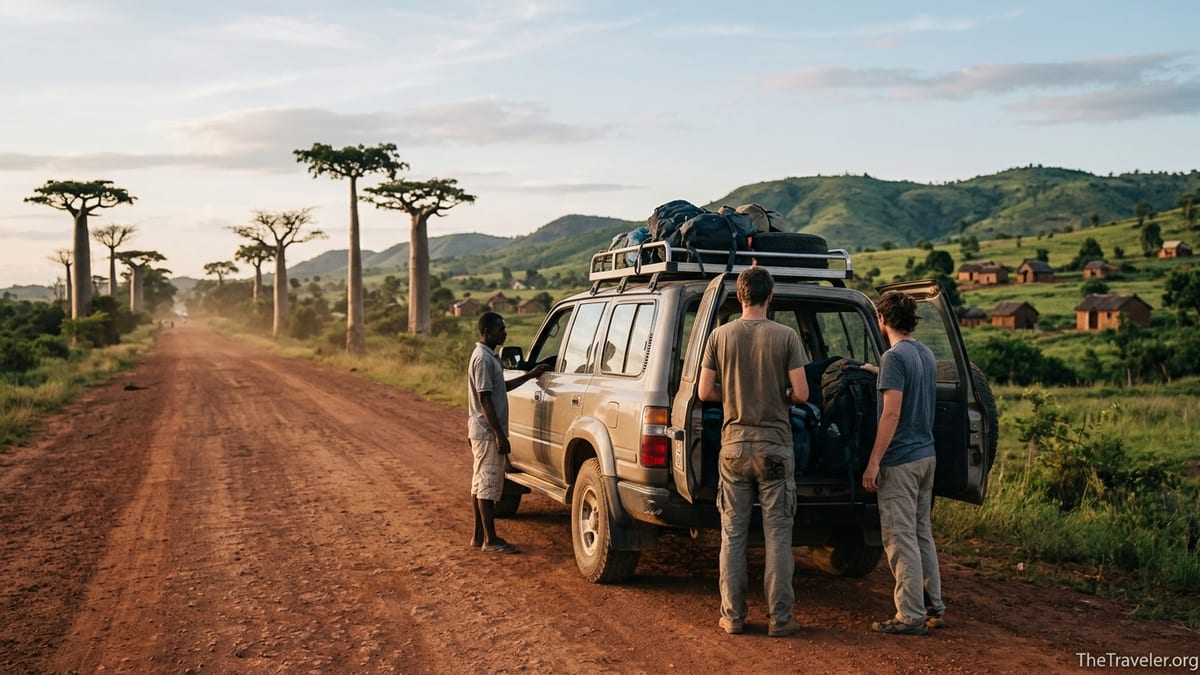
How Car Rental With Driver Works in Madagascar
In Madagascar, “car rental” almost always means a vehicle with a driver, rather than a self-drive contract. Even international brands at Antananarivo’s Ivato Airport, such as Hertz, advertise chauffeur-drive only, reflecting how the market works in practice. You book the car and a professional Malagasy driver together, usually for a multi-day itinerary, and pay a daily rate that depends on the vehicle type, route and fuel arrangement.
Most travelers either arrange a driver through a local tour operator based in Antananarivo, or book directly with small companies that specialize in private 4x4 circuits such as along the RN7 or to Tsingy de Bemaraha. Many of these operators package the car, driver and fuel together, and some can add hotels and park visits if you want something close to a private tour without group travel. Others offer a simple transport-only deal: they handle the wheels and road logistics, while you book your own accommodation and park guides.
Drivers typically stay with you throughout your circuit. On an RN7 trip from Antananarivo to Ranomafana, Isalo and down to Toliara, for example, the same driver will meet you at your hotel in Tana, handle all road formalities and checkpoints, drop you at lodges and park gates, and then wait or overnight nearby before continuing the next day. It feels more like having a personal road manager than a classic “chauffeur.”
English-speaking drivers are in shorter supply than French-speaking ones, and many are described as “driver-guides” because they know the main viewpoints, lunch stops and typical park entrance routines. For detailed wildlife guiding inside national parks, however, you still hire certified local guides at each park gate, as required by park regulations.
Vehicle Types and When You Really Need a 4x4
For the main paved highways, especially between Antananarivo, Antsirabe, Fianarantsoa and Toliara along the RN7, a conventional sedan or minivan can be enough in the dry season. French-built sedans and small minibuses still handle a lot of intercity travel. Operators sometimes price a 2WD sedan with driver slightly cheaper than a 4x4, which can make sense if you are staying on good tarmac and only doing short detours to nearby parks.
Once you leave the main asphalt, a high-clearance 4x4 is strongly recommended. Tracks to Tsingy de Bemaraha, the western coastal route between Morondava and Belo sur Mer, parts of the RN5 toward Maroantsetra, or many access roads in the rainy season can deteriorate into rutted mud, deep potholes and sand. Travelers report that for the loop from Morondava to the Avenue of the Baobabs, continuing on to Tsingy and back, drivers almost always insist on a Toyota Land Cruiser or similar robust 4x4, often with a snorkel for river crossings in the wet season.
In the north, many routes on the island of Nosy Be itself can be done in a normal vehicle, and some local agencies even offer 2WD rentals without a driver. However, if you are combining Nosy Be with the mainland north such as Ankarana or Montagne d’Ambre, a 4x4 is again the norm because of long stretches of poor or partially graded roads. Similarly, along the east coast, a sedan might be fine for Antananarivo to Andasibe, but if you go further toward Manambato, Palmarium or Sainte Marie overland, you will be glad of the extra clearance and traction.
A useful rule of thumb for a first-time visitor: if your route includes Tsingy de Bemaraha, western coastal tracks, remote eastern coastal stretches, or travel in the main rainy months, treat a 4x4 as essential rather than optional. For point-to-point transfers on major paved roads in the dry season, such as Tana to Andasibe or Tana to Antsirabe, a sedan or minivan with driver is usually adequate and more economical.
Typical Costs, Inclusions and Fuel Arrangements
Daily prices vary widely, but recent traveler reports and local operator quotes suggest that in 2025 and early 2026 a full-day hire of a private car with driver commonly falls in the range of about 180,000 to 350,000 Malagasy ariary per day for a standard vehicle, with higher rates for larger 4x4s or specialist routes. In practical terms, many visitors end up paying the equivalent of roughly 40 to 90 euros per day for a 4x4 with driver, depending on itinerary, season and negotiation, with fuel either included or charged separately.
On a typical two-week RN7 circuit in a sedan with driver, some French-language agencies quote ballpark totals of around 825 to 1,050 euros for the vehicle and driver alone, excluding hotels and meals. That works out to roughly 55 to 75 euros per day for a couple. In the north, a one-way journey with driver from Antananarivo to Ankify, the port for Nosy Be, has been reported by independent travelers at historically about 55 euros per day for several days of driving, though recent fuel and inflation pressures mean current prices are often higher.
What your daily rate includes is critical. Some operators sell “vehicle + driver” with the driver’s wage and his accommodation included, while fuel, tolls and park road fees are extra. Others offer “all-in” transport packages, particularly for standard loops such as Antananarivo – Andasibe – Morondava – Tsingy – Antananarivo, where the price per day includes fuel and sometimes basic road taxes. If you are comparing quotes, always ask for an itemized breakdown in writing, and clarify whether prices are per vehicle or per person.
Fuel is a major cost on any long itinerary due to the distances and frequent low gears on rough sections. Some research centers and NGOs in Madagascar publish internal transport rates that give a sense of real local costs, with daily 4x4 rental rates for staff logistics showing that fuel is billed separately per liter at market price. For tourists, a common approach is to agree that the driver will refuel as needed and present receipts, which you pay in cash, while the daily rental covers the car, driver, insurance and maintenance. Others prefer a fixed “fuel included” total so they do not need to track liters and receipts along the way.
Driver Meals, Accommodation, Deposits and Insurance
For multi-day journeys, travelers are normally responsible for the driver’s overnight accommodation and meals, but many operators roll this into the quoted daily rate so you do not have to handle it separately. When it is not included, drivers often have arrangements with guesthouses or staff rooms that are less expensive than tourist rates. In practice, many midrange and even budget hotels along the RN7 and in regional towns advertise a “chauffeur room” at a significantly reduced price that you pay directly or via the operator.
Meals work in a similar way. If driver meals are not included, a reasonable expectation is that you either give a daily allowance in cash or pay for the driver’s food at roadside restaurants and hotel staff canteens. Ask your operator what is normal for your route. On some itineraries, especially in very small villages, drivers eat with local hosts or at simple eateries that travelers are unlikely to use, so the practical cost for you might be modest even if not bundled into the rate.
Deposits are more common with formal agencies and for peak season bookings. Some Nosy Be transfer and vehicle hire companies, for example, ask for a 50 percent advance upon confirmation and the balance on the first day of rental. Smaller independent drivers may simply take a partial deposit by bank transfer or mobile money and the rest in cash on arrival. Always clarify refund conditions if you need to cancel or change dates, especially if traveling in the austral winter peak from June to September.
Insurance for the vehicle is usually held by the local company or owner, not by the traveler. Standard practice is that you are not expected to pay for normal wear, mechanical failures or minor repairs that occur on the road, provided you have not done anything clearly outside the agreed plan. It is still wise to confirm what happens in case of an accident, major damage or theft. Some agencies treat accidents as their responsibility as long as the driver was at the wheel, while others may seek a contribution from the client if the vehicle was being used outside the planned route or in explicitly excluded areas.
Private Driver vs Self-Drive, Tours and Taxi-Brousse
Compared with self-driving, hiring a driver in Madagascar usually costs more than a bare-bones vehicle-only rental but less than many fully guided international tour packages. Self-drive 4x4 rental is possible through specialist outfits that provide newer vehicles and detailed road briefings. This can be rewarding for experienced off-road drivers who speak at least some French and are comfortable handling police checkpoints, informal roadblocks, navigation and basic breakdowns. However, locals and recent visitors often caution that road conditions, security concerns at night and a language barrier make self-drive stressful for a first visit.
Organized small-group or private tours from international brands package almost everything: transport with driver, licensed guides, accommodation and some meals. They offer the greatest simplicity but come at a premium price and with less flexibility in day-to-day choices. By contrast, booking your own driver directly with a Malagasy company, then arranging your own lodges and park activities, often hits a middle ground: you still gain a local expert at the wheel but keep flexibility over where to stay and how long to linger in each park.
Taxi-brousse, the shared minibus and bush taxi system, is the main public transport for locals and budget travelers. It is by far the cheapest way to get around, with low per-seat fares on intercity routes, but it is slow, crowded and unpredictable. Vehicles sometimes wait for hours to fill, run late into the night, and can be uncomfortable on broken roads. For short hops such as Antananarivo to Andasibe, a taxi-brousse transfer might work fine if you have time and patience. For complex, multi-stop loops with national park visits and tight schedules, most visitors conclude that a private driver is worth the added cost for saved time and reduced stress.
Security and logistics are another differentiator. A trusted driver not only handles the driving but also negotiates checkpoints, helps with luggage, advises on safe places to stop and keeps an eye on the vehicle when you are inside parks or restaurants. Independent travelers who tried to self-drive long routes sometimes report that they would choose a driver next time simply to avoid bribe negotiations and the uncertainty of breakdowns far from services.
Key Routes Where a Local Driver Makes a Big Difference
The classic RN7 route from Antananarivo through Antsirabe, Ranomafana, Fianarantsoa, Isalo and on to Toliara is one of the circuits where having a local driver is particularly valuable. Distances are long, there are frequent speed checks and police posts, and diversions to small parks or viewpoints can be hard to spot without local knowledge. Many Madagascar specialists now routinely recommend this route as a private-car-and-driver itinerary, especially over a two-week period.
Western Madagascar is another region where driver-guided 4x4 travel is strongly advised. The track from Morondava to Tsingy de Bemaraha involves ferries, seasonal mud sections and sandy stretches. Travelers on this loop often report full days of rough driving and occasional route changes due to weather. Having an experienced driver who knows where to cross rivers, when to wait and which detours are viable can make the difference between a memorable expedition and an ordeal.
In the east, stretch routes like Antananarivo to Tamatave, onward to the Pangalanes Canal or remote coastal villages, benefit from a driver who understands local traffic rhythm, truck convoys and how the road behaves in heavy rain. Further north, itineraries combining Diego Suarez (Antsiranana), Ankarana, Montagne d’Ambre and Ankify are commonly sold as 4x4 circuits with driver, both because of variable road quality and because drivers are familiar with ferry timings and town traffic.
Even for shorter transfers, a driver can be helpful. Travelers moving from Antananarivo to Andasibe for a two or three day rainforest visit, or between coastal resort towns and airports, often find that a private car with driver, priced competitively with any combination of taxis and taxi-brousse tickets, gives them door to door convenience and flexibility for photo stops and quick side visits.
What to Ask Before You Book
Before confirming a booking, ask for a clear written quote that lists the vehicle type, model or equivalent, and what is and is not included. Check whether the daily rate covers the driver’s salary, his accommodation and meals, the vehicle’s insurance, regular maintenance and any road tolls, or whether these are extra. Clarify the fuel arrangement: is fuel included in the daily price up to a certain distance, or will you pay separately per liter based on actual consumption along your route.
Confirm the maximum daily driving hours you can reasonably expect. On challenging routes like Morondava to Tsingy, 12-hour road days are not uncommon, but you should agree on realistic start and end times so neither side feels pressured to drive dangerously at night. Ask what happens in case of breakdown: does the company have contacts along your route, will they send a replacement vehicle, and how are delays managed in terms of schedule and extra accommodation.
Language and role are also important. If you need an English-speaking driver, say so explicitly, as most drivers are primarily French-speaking. Ask whether your driver is considered a “driver-guide” who can comment on landscapes and local life, or predominantly a driver who focuses on the road while you rely on park guides and your own research for interpretation. For families, couples or solo travelers, it can also be helpful to know the driver’s smoking habits and whether they are comfortable with children or older travelers.
Finally, discuss payment terms in detail. Find out what deposit is required to secure the booking, how you can pay it, and when the balance is due. Ask whether you can pay the remainder in cash in euros, US dollars or ariary on arrival, and what exchange rate the company will use if quoting in foreign currency. Clarify tipping expectations, which are generally discretionary but appreciated at the end of a longer trip if service has been good.
How to Check the Vehicle and Operator
Reputation matters in a country where road conditions are tough and mechanical stress is high. Before committing, look for operators or drivers with recent, detailed reviews from travelers who have done similar routes. Because many Malagasy companies rely on word of mouth and travel forums rather than glossy marketing, forums and recent trip reports can be useful to identify names that come up repeatedly for reliability and safe driving.
Once you have chosen a provider, ask for recent photos of the exact or equivalent vehicle that will be used on your itinerary, including exterior, interior and luggage space. You want to see that the 4x4 or minivan has decent tires, working seatbelts, and enough room for passengers and bags without blocking visibility. If air conditioning matters to you, request written confirmation that it works, keeping in mind that some travelers report long dusty days in 4x4s without functioning AC, especially on the west coast and in the south.
On the first day of travel, do a simple walk-around check. Confirm that all doors and windows open and close properly, seatbelts latch, the spare tire is present and looks usable, and that there is at least basic equipment such as a jack and tools. If anything feels unsafe, raise it immediately with the driver and operator, before you leave Antananarivo or another major hub where a replacement vehicle is easier to arrange.
It is also reasonable to ask the driver about their experience on your specific route. A driver who regularly drives RN7, or who has done the Morondava to Tsingy road multiple times in recent seasons, is generally a safer bet than someone who is new to the terrain. Local drivers who know typical police checkpoints and informal rules of the road can also reduce your exposure to petty issues and delays.
The Takeaway
For many visitors, a private car and driver is the most practical way to unlock Madagascar’s long distances, rough roads and scattered national parks. It sits between budget taxi-brousse travel and fully packaged tours, offering considerable flexibility with an extra layer of safety and comfort. When road conditions are challenging or your time is tight, a driver’s local knowledge often proves invaluable.
If you decide to go this route, focus less on shaving a few euros off the day rate and more on choosing a reputable operator, the right vehicle for your itinerary, and a driver whose communication style suits your travel party. Clarify inclusions, fuel and driver costs in writing, agree realistic daily driving hours, and listen to local advice about when a 4x4 is truly necessary.
With those pieces in place, hiring a driver in Madagascar can turn demanding journeys to Ranomafana’s rainforests, Isalo’s canyons or Tsingy’s pinnacles into relaxed days of watching the landscapes and villages unfold outside your window, rather than worrying about potholes, paperwork and navigation.
FAQ
Q1. How much does it cost per day to hire a car with driver in Madagascar?
Recent quotes and traveler reports suggest that a private car with driver often costs in the region of 180,000 to 350,000 ariary per day for standard routes, with robust 4x4s on demanding itineraries typically priced higher, sometimes equivalent to about 40 to 90 euros per day depending on distance, season and whether fuel is included.
Q2. Is a 4x4 really necessary or can I use a normal car?
A normal sedan or minivan can be fine in the dry season on main paved roads such as Antananarivo to Antsirabe or Andasibe, but for Tsingy de Bemaraha, western coastal tracks, parts of the RN5, or for travel in the rainy months, a 4x4 is strongly recommended and often considered essential by local operators.
Q3. What is usually included in the daily rate for a driver and car?
The daily rate normally covers the vehicle, the driver’s wage and basic insurance, but fuel, road tolls, park access tracks, driver meals and accommodation may or may not be included, so always ask for a detailed written breakdown before you confirm.
Q4. Do I need to pay separately for the driver’s food and accommodation?
Sometimes yes and sometimes no: many agencies bundle driver meals and accommodation into the transport rate, while others expect you to cover a simple room and daily meals, often at modest “chauffeur room” prices in hotels along the route, so it is important to clarify this upfront.
Q5. How far in advance should I book a driver in Madagascar?
For popular circuits such as RN7 or trips during the busy June to September season, it is sensible to book several months in advance, while in shoulder or low season it may be possible to arrange a driver a few weeks before arrival or even on the ground in Antananarivo.
Q6. Is it safe to self-drive instead of hiring a driver?
Self-drive is possible with specialist rental companies, but first-time visitors often find the combination of poor road conditions, night driving risks, police checkpoints and language barriers stressful, so many prefer the safety and relative simplicity of traveling with a local driver who knows the roads.
Q7. How do I know if a driver or company is reliable?
Look for operators and drivers with recent positive reviews, clear communication, detailed written quotes, and willingness to share photos and details of the vehicle, and consider asking specifically whether they have recent experience on your planned route.
Q8. Can I customize my itinerary when traveling with a private driver?
Yes, within reason: private driver arrangements are typically flexible, allowing extra photo stops, minor detours and changes of timing, but large route changes or added long side trips should be discussed in advance as they may affect costs and driving hours.
Q9. What happens if the car breaks down during the trip?
Breakdowns do occur on Madagascar’s rough roads, so you should confirm before booking how the company handles repairs and delays, whether they have backup vehicles or local partners, and whether any extra accommodation or time costs fall on you or are absorbed by the operator.
Q10. Should I tip my driver at the end of the journey?
Tipping is not mandatory but is appreciated when service has been good; many travelers choose to offer a discretionary tip at the end of a multi-day itinerary, with the amount depending on trip length, overall cost and how satisfied they were with the driver’s skills and attitude.