

Madagascar looks simple on the map, but traveling around this huge Indian Ocean island is very different from a typical beach vacation. Distances are long, roads are slow, domestic flights change often and every region feels like its own mini country. For first-time visitors the key is not to see everything, but to understand how the island works and choose one or two circuits that match your time, budget and interests.
Why Madagascar Travel Feels Different
Most islands lend themselves to easy loops and quick hops between beach towns. Madagascar, the world’s fourth largest island, is closer in scale to a small continent. The main north to south highway, Route Nationale 7, runs roughly 950 kilometers from Antananarivo to the southwest coast and is considered the only long sealed road that is consistently drivable. Even on this flagship road you will often average 40 to 60 kilometers per hour in a private car and less on public transport, which means what looks like a half-day drive on a map can turn into a full day on the road.
Internal flights help, but they are not a magic solution. The domestic network has gone through repeated rebrandings and schedule changes in recent years, and travelers still report last-minute timetable shifts or cancellations on popular routes such as Antananarivo to Nosy Be or Sainte-Marie. It is common for visitors to build an itinerary around a specific flight, only to have to reshuffle hotel bookings when the flight time moves by a day. Planning Madagascar means keeping your route flexible, allowing at least one buffer day at each end of the trip, and avoiding same-day connections between domestic and international flights whenever possible.
Costs also feel different from many parts of mainland Africa or Southeast Asia. On paper Madagascar is an affordable destination, with simple guesthouses under the equivalent of 30 US dollars per night and local meals of rice and laoka for a few dollars. Yet logistics and park costs add up. A private car with driver along the classic RN7 route, taking five days between Antananarivo and the coast, is typically quoted around the equivalent of 800 to 1,000 euros for the vehicle, fuel and driver. National park fees have recently been revised with substantial increases for foreign visitors, and in most parks you must also hire a local guide, which turns each lemur walk into a paid excursion rather than a casual stroll.
All of this means that a two-week trip trying to “do it all” is rarely enjoyable. The travelers who leave Madagascar smiling are usually those who accept slower travel, pick two or three regions that connect logically, and build their days around early morning wildlife walks, long scenic drives and unhurried village or beach time instead of racing for a checklist of sights.
Antananarivo and the Central Highlands
Almost all international flights arrive in Antananarivo, often called Tana. The capital sprawls over steep hills, rice paddies and old royal neighborhoods, with traffic that can turn any crosstown journey into a test of patience. Most first-time visitors spend one or two nights here at the start or end of their trip, staying in mid-range hotels in neighborhoods such as Isoraka or Ivandry, where a standard double room with breakfast is often in the range of 50 to 120 US dollars depending on comfort and brand.
Antananarivo is not a city of blockbuster museums, but it rewards those who enjoy urban texture and daily life. You might spend a morning exploring the old palace complex at Ambohimanga, a UNESCO World Heritage hilltop about 20 kilometers from the center, then wander through Analakely’s markets and small shops. Cafes owned by French or Malagasy entrepreneurs serve good espresso and pastries, a legacy of colonial history, and you can try local specialties such as romazava stew or zebu steak in straightforward bistros.
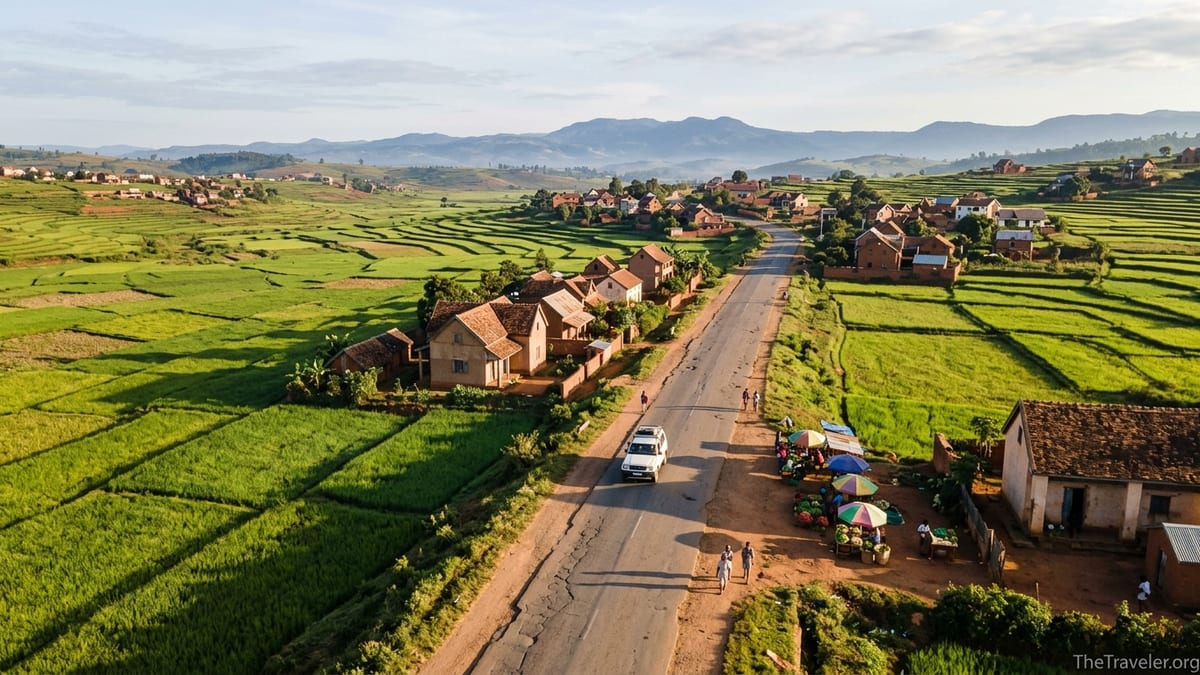
Beyond the capital, the Central Highlands reveal a very different Madagascar from the coasts and islands. Towns like Antsirabe and Ambositra along the RN7 sit at higher elevations, with cooler evenings, terraced rice fields and brick farmhouses that some travelers liken to a patchwork of Asia and rural Europe. Antsirabe is a common first overnight stop for those heading south, known for its pousse-pousse rickshaws, hot springs history and modest guesthouses. Ambositra, several hours further, is the wood-carving capital; here many travelers visit family-owned workshops to buy inlaid boxes or carved zebu before pushing on toward the rainforest belt.
For most itineraries, the Highlands are as much about the journey as specific attractions. Driving here gives a sense of the island’s population density, with children walking to school along the roadside, women carrying produce to market and constant small settlements. It is also where you start to understand why self-driving is not always recommended. Road markings and street lighting are minimal, livestock and pedestrians often share the pavement, and police checkpoints appear at the entrances to many towns. Most visitors therefore hire a car with a driver, either through a local agency or guesthouse recommendation, instead of renting a vehicle to drive themselves.
Rainforests and Lemurs: Andasibe and Ranomafana
Madagascar’s flagship rainforests are often the first priority for wildlife enthusiasts, and two parks in particular stand out for first-time visitors: Andasibe-Mantadia to the east of Antananarivo and Ranomafana along the RN7 further south. Both offer the classic experience of standing quietly on a forest trail, listening to the eerie calls of the indri or watching a bamboo lemur nibble on young shoots at arm’s length.
Andasibe is the easiest major rainforest to reach. It lies roughly three to four hours east of Antananarivo along Route Nationale 2, a paved but busy corridor with trucks and curves. Most travelers visit on an overnight trip or as a two to three night stop at the beginning of a longer circuit. The village of Andasibe has a cluster of lodges spread along the road, with standards ranging from simple bungalows around 30 to 50 US dollars per night to comfortable eco-lodges and small boutique properties that can exceed 150 dollars in high season. A typical day might include a morning guided walk in Analamazaotra reserve to see indri, common brown lemurs and chameleons, followed by a night walk along the road edge or in a community-managed forest to find mouse lemurs and leaf-tailed geckos.
Ranomafana National Park sits further south along RN7, usually reached after an overnight in Antsirabe or Ambositra. The road from the highway down to the park descends through lush hills on a narrower, partly patched surface that can slow to 20 kilometers per hour in places. The small town has guesthouses from basic to mid-range, and a few lodges set above the valley. Ranomafana is cooler and wetter than Andasibe, with misty mornings and frequent showers even in the dry season. Trails vary from gentle riverside paths to steep, muddy ascents, so sturdy footwear and a rain jacket are essential.
In both parks, hiring a local guide is compulsory and part of the experience. At the entrance you usually agree a route and duration, with rates structured per group and per hour or half day. While prices are in flux due to recent changes in national park fee policies, visitors should expect that a half-day guided walk for two people, including access fees, will often run to the equivalent of 40 to 80 US dollars or more, depending on the park and whether you add a separate spotter. Many travelers choose two different walks in each park, for example one at dawn for lemurs and birds and another at night for reptiles and nocturnal mammals, and quickly see how wildlife viewing becomes a central line in the budget.
Desert Canyons and Baobabs: Isalo, Morondava and Tsingy de Bemaraha
Southwest Madagascar brings a dramatic shift in scenery, from rainforest to eroded sandstone and thorny scrub. Isalo National Park, reached along the RN7 between Fianarantsoa and the coastal town of Toliara, is a favorite for those who enjoy hiking against a backdrop of rock formations and wide skies. Most visitors base themselves in or near the village of Ranohira, where there is a small cluster of hotels ranging from simple gîtes to comfortable lodges with pools. A guided day hike to the natural swimming pools or into the canyons might last four to six hours, with costs similar to the rainforest parks once guiding and park fees are included. Although you still see ring-tailed lemurs here, the appeal is as much the landscape as the wildlife.
Morondava, on the west coast, is the gateway to the famous Avenue of the Baobabs and to the Tsingy de Bemaraha National Park further north. Reaching Morondava from Antananarivo typically involves either a domestic flight, if available on your dates, or a long overland journey that is often broken with a stop in Antsirabe. Once there, many travelers time their visit to the baobab avenue for sunset, when the red dirt road and bottle-shaped trees glow in soft light and local children play between the trunks. Simple beach hotels line the coast, and seafood restaurants serve grilled fish and prawns at prices that can feel modest compared with Europe or North America, though still higher than local eateries.
Continuing to Tsingy de Bemaraha is a more serious undertaking. The access road north from Morondava is mostly unpaved, with seasonal river crossings and sections that become extremely muddy or even impassable after heavy rain. In the dry season, 4x4 transfers still take a full day or more each way, and it is normal to include at least two nights near the park to justify the effort. The reward is a labyrinth of sharp limestone pinnacles and hanging bridges, unlike almost anywhere else on earth, but this is a destination that suits travelers who are comfortable with physical effort, heights and basic infrastructure.
The combination of Isalo, Morondava and Tsingy highlights one of the key challenges of Madagascar trip planning: just because destinations are on the same side of the island does not mean they connect easily. It is rarely realistic to drive from the RN7 across to Morondava on a casual detour, or to try to fold Tsingy into an already busy two-week route. When agencies propose such combinations, it often means multiple ten-hour driving days and limited time actually on the trails or beaches. First-time visitors are usually happier choosing either the RN7 with Isalo or a west coast circuit with Morondava and Tsingy, rather than trying to stitch them into one rushed itinerary.
Island Time: Nosy Be and Sainte-Marie
For many travelers, Madagascar means beaches and islands, and two names come up again and again: Nosy Be off the northwest coast and Sainte-Marie (Nosy Boraha) off the northeast. Both are legitimate tropical getaways, but they offer very different atmospheres and practicalities compared with mainland circuits.
Nosy Be is the country’s most developed tourism hub, with its own international airport and a dense collection of small hotels, dive centers and excursion operators. Areas like Ambatoloaka and Madirokely have beach bars and guesthouses clustered along the sand, while quieter stretches host bungalow-style boutique hotels with higher price tags. You can arrange day trips to satellite islands such as Nosy Tanikely for snorkeling with turtles, Lokobe Reserve for black lemurs, or Nosy Iranja for white-sand beaches and turquoise water. On the ground, you move mainly by taxi, tuk-tuk or hired car, and you will see a mix of families on school holidays, French-speaking retirees and independent backpackers.
Sainte-Marie, reached by a combination of domestic flight and boat or by flight alone when schedules allow, feels slower and less built up. The main town has a handful of small hotels and local restaurants, and further north and south along the island you find rustic beach lodges, often with only a few bungalows facing the lagoon. Whale season, usually around July to September, is the busiest time, when operators run daily boat trips to look for humpbacks breaching off the coast. Outside those months the island is sleepy, with days built around cycling along sandy tracks, snorkeling from simple piers and reading in a hammock.
Prices on both islands vary widely. At the most basic level, rooms in small Malagasy-run guesthouses might start around the equivalent of 25 to 40 US dollars per night, while mid-range beachfront bungalows in established lodges are commonly in the 80 to 150 dollar range. Activities are additional; for example, a shared boat excursion from Nosy Be to a nearby marine reserve including lunch and snorkeling gear is often priced in the tens of dollars per person, while private charters, PADI dive trips and whale watching can quickly reach low three-figure sums for couples or families.
Nosy Be and Sainte-Marie also illustrate why choosing regions is essential. Each requires at least three to five nights to make the travel time worthwhile, and both sit far from the classic RN7 route. Trying to combine either island with a full south or west circuit in only two weeks often leads to rushed early morning flights, little margin for delays and very short stays in each location. Many first-time visitors are better served by a mainland trip that ends with three or four nights on a single island, accepting that the rest must wait for a future visit.
Road Conditions, Domestic Transport and Guides
Understanding how you will move around Madagascar is just as important as choosing where to go. Outside a few urban areas, road conditions are varied and can change quickly. Some main highways, including stretches of RN2 toward Andasibe and RN7 toward the south, are paved and in broadly decent condition, although they always have potholes, occasional roadworks and livestock. Others, particularly secondary routes like RN25 or the tracks to remote parks and coastal villages, are only partly paved or entirely dirt, with long sections that become rutted or flooded in the rainy season.
Google Maps and similar apps are notoriously optimistic about journey times. Travelers who see “five hours” on their screen for a leg like Antananarivo to Ranomafana often report eight hours on the road once fuel stops, slow trucks on mountain passes and village traffic are factored in. Long-distance public taxis-brousse, which are minivan or bus services connecting cities, are cheaper than private vehicles but substantially slower and less comfortable, sometimes leaving only when full and stopping frequently along the way. They are an option for experienced, patient travelers with flexible plans, but less suitable for those with tight schedules or a preference for pre-booked accommodation.
Domestic flights help bridge long distances but require caution. Routes such as Antananarivo to Nosy Be, Antsiranana or Toliara can reduce a two-day drive to an hour in the air, yet travelers and tour operators continue to report schedule changes, delays and occasional cancellations. It is wise to avoid planning an international departure the same day as a domestic flight, and to keep at least one low-commitment day in Antananarivo before flying home. Buying tickets through a reputable agency or local partner rather than an anonymous online reseller can make it easier to rebook if the airline adjusts the timetable.
For many first-time visitors, hiring a car with driver is the most practical solution. Local agencies and guesthouses can arrange 4x4s or sturdy sedans with English or French-speaking drivers who handle navigation, police checkpoints and mechanical issues. Daily rates vary, but it is common to see offers where the cost of the vehicle, fuel and driver combined comes to a figure that, for two or three people sharing, works out similarly to each buying long-distance bus tickets and then hiring local taxis and guides separately. Self-driving is possible for confident travelers familiar with African road conditions, but most still opt for a driver once they see the combination of unmarked hazards, night-time truck traffic and limited signage.
Guides are an integral part of travel beyond transport. In national parks, hiring a certified local guide is usually mandatory and supports community livelihoods as well as conservation. For example, in Andasibe or Ranomafana you are assigned a guide at the park entrance, and they will often carry a spotting scope or collaborate with other guides to locate indri, sifakas or rare birds. In cities and on islands, local tourism offices in places like Nosy Be or regional capitals can connect you with licensed freelancers for city walks, market visits or day trips. It is wise to be cautious of anyone approaching you unsolicited at bus stations or piers claiming to be a guide, and to confirm rates clearly before you set off.
Accommodation, Seasons, Money and Choosing Your Route
Accommodation in Madagascar ranges from basic rooms with shared bathrooms in small town hotels to boutique ecolodges with infinity pools and tasting menus. In many regional hubs you will find a middle band of simple but clean guesthouses with private bathrooms, mosquito nets and intermittent hot water, in the range of 25 to 60 US dollars per night for a double room. In capital city neighborhoods popular with visitors, beach areas around Nosy Be and some lodges near flagship parks, comfortable three-star style hotels often fall in the 70 to 150 dollar bracket, and a handful of high-end properties go beyond that.
Seasonality affects both prices and practicalities. The broadly dry period from around April to October is generally the most comfortable for road travel, hiking and wildlife watching inland, with cooler temperatures in the Highlands and fewer downpours to turn tracks into mud. July and August align with European school holidays and see higher demand, particularly on Nosy Be and in popular parks, so booking ahead for in-demand lodges makes sense. The wetter months from roughly December to March bring higher humidity, tropical downpours and, in some years, cyclones affecting coastal areas. Some remote lodges close, and access to places like Tsingy de Bemaraha can become impossible until conditions improve.
The Malagasy currency is the ariary, and it is not widely obtainable outside the country. Visitors typically arrive with euros or US dollars and exchange them in banks or authorized bureaux de change at airports and in cities. ATMs connected to international networks are present in Antananarivo and larger towns, but they may be absent or unreliable in smaller settlements. Card payments are increasingly accepted in mid-range and upscale hotels and some restaurants, especially in Nosy Be and the capital, but cash still dominates in rural areas, markets and for tipping guides and drivers. It is prudent to travel with a mix of cash and cards and to bring more than one debit or credit card in case of technical issues.
When assembling an itinerary, the central question is which regions to combine rather than how to fit every highlight into one visit. A realistic two-week trip for a first-time visitor might include, for example, Antananarivo, Andasibe and the RN7 as far as Isalo, with a return flight from Toliara to the capital at the end. Another option is a shorter Highlands and rainforest loop plus four or five nights on Nosy Be, using a domestic flight to bridge the distance. Those with three or four weeks can think about linking multiple circuits, such as RN7 plus a west coast extension to Morondava, or a northern route that combines Nosy Be with the limestone landscapes of Ankarana and the cool forests of Montagne d’Ambre.
Trying to add both Nosy Be and Sainte-Marie, plus Tsingy, multiple rainforest parks and a full RN7 drive into a single two-week holiday nearly always leads to disappointment, fatigue and a sense of having spent more time in cars and airports than in nature. A better approach is to decide first whether your priority is wildlife, landscapes, beaches or cultural immersion, then choose one mainland circuit and, if desired, one island that speak to that theme. The rest of Madagascar, with its unexplored peninsulas and little-known reserves, will still be there when you return.
The Takeaway
Madagascar is not the kind of island you “do” in a week, and that is exactly its appeal. Its rainforests, canyons, baobab avenues and coral-fringed islands are strung out along slow roads and unpredictable flight routes that resist the fast, multi-stop itineraries many travelers are used to. Those who accept this and build flexible plans, centered on two or three regions rather than the whole map, tend to leave with vivid memories: the haunting call of an indri echoing through morning mist in Andasibe, the last light catching the tops of baobabs near Morondava, or the quiet of a Sainte-Marie beach at low tide.
For a first-time visitor, success lies in matching expectations to reality. Budget for drivers and guides as part of the experience, allow more travel time than navigation apps suggest, accept that domestic flights might change, and choose a season that suits both your interests and the kind of roads you will be using. With that mindset, Madagascar becomes less a logistical puzzle and more an invitation to slow down, look closely and appreciate how different this vast island is from anywhere else in the Indian Ocean.
FAQ
Q1. How many days do I need for a first trip to Madagascar?
For a meaningful first visit that includes one mainland circuit and possibly a few days on an island, plan at least 12 to 16 days on the ground. This allows for long driving days, at least two national parks and some unhurried time in villages or at the beach.
Q2. Is it safe to self-drive in Madagascar as a foreign visitor?
Experienced drivers do self-drive, but most first-time visitors hire a car with driver. Road conditions, night truck traffic, limited lighting, livestock, police checkpoints and very optimistic navigation times make self-driving stressful unless you are already comfortable with similar conditions elsewhere in Africa.
Q3. How much should I budget per day for a mid-range trip?
Budgets vary, but many mid-range travelers find that after including accommodation, meals, guides, park fees and a share of a private vehicle with driver, daily costs often land somewhere between 100 and 200 US dollars per person, depending on how many internal flights and paid activities they include.
Q4. Do I need to book national park guides in advance?
In most major parks such as Andasibe, Ranomafana and Isalo you hire official guides at the park entrance on the day of your visit. During peak months it can be wise to arrive early in the morning or ask your hotel to note your preferred start time, but advance reservations are not usually required for individual travelers.
Q5. Which is better for beaches, Nosy Be or Sainte-Marie?
Nosy Be has more infrastructure, a wider choice of hotels and easy access to dive centers and day trips, so it suits travelers who want variety and comfort. Sainte-Marie feels quieter and more low-key, with simpler lodges and excellent whale watching in season, appealing to those who prefer a slower pace and fewer crowds.
Q6. Can I combine RN7, Tsingy de Bemaraha and an island in a two-week trip?
It is technically possible but not recommended. Each of those elements requires long travel days, and combining all three in only two weeks often means you will spend much of your time in transit. Most first-time visitors are happier choosing RN7 plus either Tsingy or one island, not both.
Q7. What is the best time of year to visit Madagascar for wildlife?
The generally dry period from about April to October is good for most regions, with comfortable temperatures and better road conditions. Wildlife is active throughout the year, but cooler, drier months make forest walks more pleasant and reduce the chance that heavy rain will close tracks or delay travel.
Q8. How reliable are domestic flights within Madagascar?
Domestic flights are very useful but can be unpredictable, with timetable changes, delays and occasional cancellations. Always keep a buffer of at least one day between a domestic flight and your international departure, and try to buy tickets through a local agency or airline office that can help you rebook if needed.
Q9. Will I be able to use credit cards widely?
Credit and debit cards are accepted in many mid-range and high-end hotels, some restaurants and dive centers, especially in Antananarivo and Nosy Be. However, cash in ariary is still essential for smaller guesthouses, markets, local transport and tipping, so plan to withdraw or exchange money in larger towns and carry enough for rural days.
Q10. Should I take malaria medication for Madagascar?
Most of Madagascar is considered a malaria risk zone, including many popular coastal and lowland areas. Travelers commonly consult a travel medicine clinic before departure to discuss prophylactic medication, insect repellent, long-sleeved clothing for evenings and other preventive measures tailored to their route and health profile.