

Budgeting a trip to Madagascar can be confusing. Daily averages do not help much when one day is a long driving stage in a 4x4 and the next is a quiet beach day. Costs also spike for domestic flights, national park fees and compulsory guides, while basic meals remain surprisingly affordable. This guide breaks down the real drivers of cost, then walks through sample budgets for three classic itineraries so you can build a realistic plan for your own journey.
How Much Does Madagascar Really Cost?
Madagascar is not as cheap as many travellers expect. Guesthouses and local food are relatively affordable, but transport is expensive and slow, and almost every wildlife experience involves park fees and mandatory local guides. A backpacker who moves slowly on public transport might get by on roughly 50 to 70 US dollars per person per day. A comfortable mid-range trip that uses private drivers, stays in clean lodges and visits several parks often lands closer to 120 to 200 dollars per person per day, depending on domestic flights and how many days are spent in remote areas. Higher-end itineraries that use 4x4s with experienced driver-guides, well-reviewed eco-lodges and internal flights can climb above 250 to 350 dollars per person per day.
Two things surprise visitors. First, transportation frequently consumes a third or more of the total budget, even when accommodation is modest. Hiring a car with driver on the main RN7 corridor, for example, commonly runs around 200,000 to 300,000 ariary per day plus fuel for a standard vehicle, and more for a 4x4, which quickly adds up over a two or three week itinerary. Second, park costs are layered: you pay a park entrance fee at national parks, then a compulsory local guide fee, and sometimes additional charges for spotters, porters or night walks. Once you understand these patterns, you can make conscious choices about where to spend and where to save.
In this guide, prices are given in broad current ranges rather than exact figures, because rates change often and vary by season. As a rough rule of thumb, 1 US dollar is approximately 4,200 to 4,500 Malagasy ariary in early 2026. Always reconfirm current prices when you book, but use these examples as a realistic framework for planning.
Core Cost Categories: Where Your Money Actually Goes
Accommodation is often the easiest category to predict. Across much of Madagascar, simple guesthouses and rural bungalows can cost roughly 20 to 40 dollars per night for a double room, sometimes including breakfast. Comfortable mid-range hotels and lodges, especially those used on popular itineraries, tend to fall around 50 to 120 dollars per night. In cities such as Antananarivo, a typical mid-range hotel might be 30 to 70 dollars for a standard double, while a well-known international-style hotel can run to 150 dollars or more per night. On the other end of the spectrum, luxury eco-lodges on private reserves or islands can start around 150 to 200 dollars and climb significantly higher, particularly in very remote or exclusive locations.
Transport is almost always the next largest expense. Independent travellers either rely on long-distance taxi-brousse minibuses or hire a private vehicle with driver. Taxi-brousse travel is inexpensive in purely monetary terms but can be very slow, cramped and unreliable, and is not ideal if you have limited time or need to reach several national parks. Most visitors who have 10 to 21 days and want to see more than one region end up hiring a car and driver. For a standard vehicle on paved routes, current fair rates usually fall somewhere around 200,000 to 300,000 ariary per day including the driver but excluding fuel. For a good 4x4 that can handle rougher roads, or for itineraries that include poor tracks or long distances, prices can climb toward the equivalent of 50 to 80 euros per day before fuel. Fuel itself is not cheap: recent reports from travellers quote pump prices that make a full day of driving a significant line item in the budget.
Domestic flights are the hidden wildcard. A one-way ticket between Antananarivo and Nosy Be, for instance, can cost the equivalent of several hundred US dollars in high season, and schedules are prone to change. In some cases, flying saves days of bumpy road travel and hotel nights, but it can also double the cost of a shorter itinerary. Park-related fees are another major category: most national parks have daily entrance fees payable in cash, and all require visitors to hire a local guide at the park office, with rates that vary by group size and length of the walk. Finally, food, drinks and tips tend to be comparatively light expenses. A simple local meal can cost only a few dollars, even in tourist hubs, while a three-course dinner with drinks at a mid-range lodge might be 10 to 20 dollars per person.
Accommodation & Beach Lodges: From Simple to Splashy
In Antananarivo, you can still find very basic hotel rooms for the equivalent of 20 to 30 dollars per night, often with private but simple bathrooms, variable hot water and limited English spoken. Many visitors opt for mid-range properties in safer central neighbourhoods, where 50 to 100 dollars buys a clean room, reliable hot showers, Wi-Fi and breakfast. A well-known business hotel can easily exceed 150 dollars per night in the capital. Outside the city, prices vary more by location than by star rating: a comfortable lodge in Ranomafana or Isalo might sit around 60 to 120 dollars per night for a double room, with leafy grounds and a restaurant on site, while a basic guesthouse near a little-visited reserve may charge less than half that.
Along the RN7, towns such as Antsirabe, Fianarantsoa, Ranomafana village and Ranohira have an informal ladder of accommodation options. Budget travellers can still find simple rooms in the 20 to 30 dollar range if they are willing to accept cold showers or intermittent electricity. Most international travellers now choose mid-range hotels like small boutique inns or comfortable lodges, where 60 to 100 dollars per night is typical for a double with breakfast and decent comfort. There are also a few characterful higher-end properties, especially near Isalo National Park, where stylish lodges with big views and pools can command 150 dollars or more per night.
On the coast and islands, prices rise quickly once you step into resort territory. Nosy Be, for example, has simple beach bungalows from around 40 to 70 dollars per night in smaller guesthouses, while mid-range beach hotels and dive lodges tend to hover around 100 to 200 dollars per night for a sea-view double. At the upper end, polished boutique lodges on smaller islands near Nosy Be can easily cost several hundred dollars per night, especially if they include half-board or full-board meal plans. If your trip includes a beach extension, the nightly rate in that final stop can have a noticeable impact on your total budget, particularly for longer stays of 5 to 7 nights.
Private Drivers, 4x4s & Why Transport Costs So Much
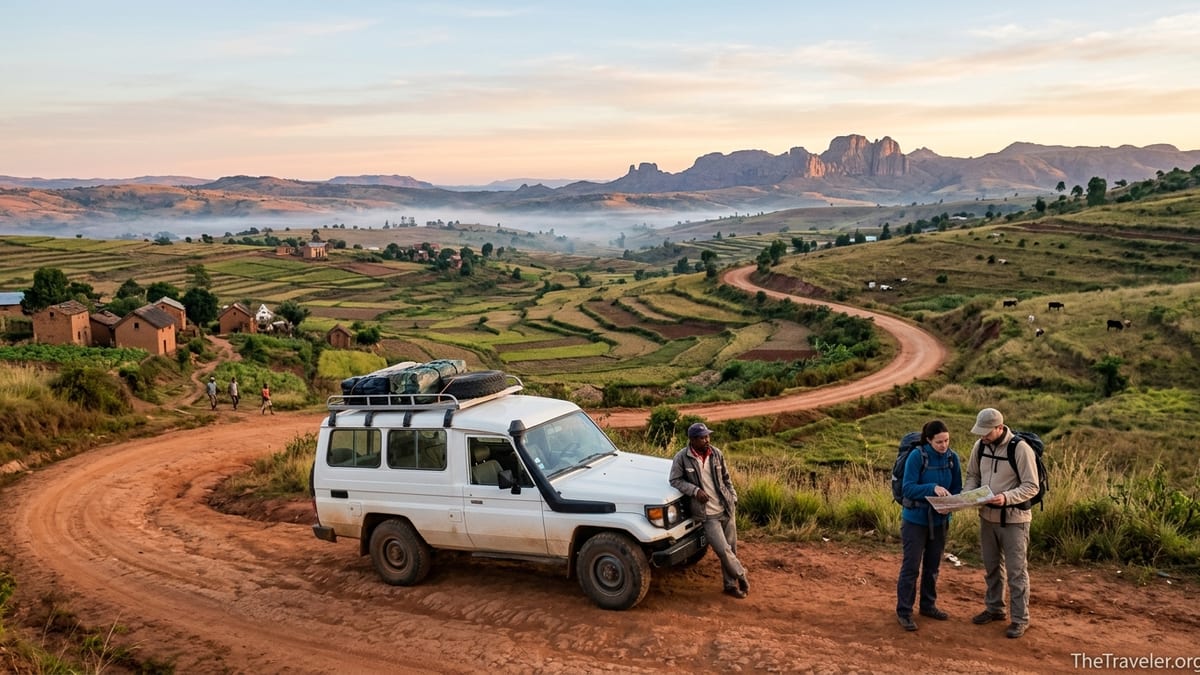
Most visitors who want to cover ground in Madagascar hire a car and driver, especially for the classic RN7 route between Antananarivo and Toliara. Self-driving is possible through specialist rental companies, but it requires a high tolerance for poor roads, police checkpoints and variable road etiquette. A private driver is not a luxury in Madagascar so much as a pragmatic necessity, especially outside main highways. You are paying not just for the person and vehicle but also for local knowledge, handling roadside negotiations, dealing with police stops and fixing minor mechanical issues when they arise.
Current real-world prices suggest that for a standard vehicle on paved roads you should budget roughly the equivalent of 40 to 70 euros per day including the driver but excluding fuel. For a reliable 4x4, especially on itineraries that include rough tracks or longer off-road diversions, reasonable rates tend to be higher, often around 50 to 80 euros per day or more depending on distance, season and negotiation. Some recent travellers have reported paying around 350,000 ariary per day for a trusted driver with a good 4x4 on challenging routes. Agencies that package a complete RN7 itinerary with car, driver, fuel and their commission may bundle these costs, so always ask what is included and whether the driver’s meals and accommodation are covered or need to be paid separately.
Fuel can nearly double your daily transport bill on long driving days. Pump prices in recent seasons have been high enough that a full day of driving between major RN7 towns can add the equivalent of tens of dollars in fuel alone. For example, if you drive from Antananarivo to Ranomafana with side stops, your driver might burn enough fuel to equal 30 to 60 dollars at current rates, in addition to the fixed daily hire cost. Over a 10 to 14 day itinerary this quickly mounts to several hundred dollars per vehicle. The result is that transport often becomes a surprisingly large share of your total budget, particularly if you are travelling solo or as a couple and cannot spread the cost across four people.
National Parks, Entrance Fees & Compulsory Local Guides
The landscapes and wildlife are the main reason most people come to Madagascar, but seeing them is not free. All official national parks and most reserves have entrance fees that are paid per person per day at the park office, usually in cash. On top of that, it is compulsory to hire a local guide accredited by the park, and often strongly recommended to hire spotters who help find lemurs, chameleons and birds along the trails. The cost for the guide is typically charged per group for a half-day or full-day circuit, with different rates for short, medium and long hikes.
In practice, a couple doing a half-day walk in a popular park such as Andasibe, Ranomafana or Isalo might spend the equivalent of 20 to 40 dollars together in guide fees alone, plus their park entrance charges, and perhaps a little extra if they hire a spotter. A family of four can sometimes pay only slightly more than a couple for the guide, because the fee is per group, but will still pay four individual entrance fees. Add in optional night walks, which are often organised just outside park boundaries with separate fees, and it is easy to spend 50 to 100 dollars per day per couple on park-related costs during the wildlife-heavy parts of your itinerary.
Crucially, these charges are rarely included in headline tour prices unless the itinerary is fully all-inclusive. Many local operators and driver-guides prefer to quote transport and accommodation and leave park fees and guides to be paid locally in cash. That can make their price seem lower at first glance, but it means you need to carry enough cash to cover several days of park visits. It is wise to ask any operator to estimate in writing how much you should expect to spend on entrance fees and guides for your chosen route, then add that amount into your working budget from the start.
Food, Domestic Flights, Transfers & Cash on the Ground
Compared with transport and park fees, food in Madagascar is often pleasantly affordable. In Antananarivo, a sit-down meal at a simple restaurant might cost the equivalent of 4 to 8 dollars, while a main dish in a mid-range restaurant could be 8 to 15 dollars, especially if you order imported items. In smaller towns along the RN7, hotel restaurants serve set menus or à la carte meals that fall in a similar range, with basic rice and laoka (side dishes) at local eateries costing only a few dollars. Beach destinations and isolated lodges can be more expensive because everything must be transported in, but even there daily food costs typically remain lower than in many European capitals.
Domestic flights, by contrast, can account for a large percentage of a short itinerary’s total spend. Fares on routes such as Antananarivo to Nosy Be or Antananarivo to Diego Suarez are frequently several hundred dollars return in high season, and schedules can change. Many experienced tour planners treat domestic flights as semi-flexible rather than guaranteed, building buffer days in Antananarivo or at a beach at the end of the trip to absorb delays. When comparing an overland itinerary with a fly-in one, always price your internal flights first, then see whether it might be cheaper overall to invest in more days of private driving instead of multiple domestic flights.
Airport transfers in Madagascar are usually not a huge expense but are worth budgeting for. In Antananarivo, a pre-booked private transfer from the airport to a central hotel might cost the equivalent of 15 to 30 dollars per vehicle, more if arranged via an upmarket hotel late at night. On islands such as Nosy Be, boat transfers to smaller satellite islands or private lodges can cost dozens of dollars per person depending on distance and whether the transfer is shared or private. These transfers are often paid in cash on arrival or included in lodge packages, so clarify in advance.
Cash is essential across most of Madagascar. Outside the capital and a few larger towns, card payment is unreliable. Many national park offices, local guides and smaller hotels accept only cash. ATMs are present in cities but can run out of money, and withdrawal limits are sometimes low. A practical strategy is to take out a larger sum in Antananarivo at the beginning of your trip, carry a mix of denominations, and keep an emergency stash of euros or US dollars as backup. Always factor in that you will need physical notes for park fees, guides, tips, smaller restaurants and fuel contributions if you are sharing costs with other travellers.
Three Realistic Trip Budgets: RN7, Wildlife Circuit & Nosy Be Combo
To turn these categories into something more concrete, imagine three sample itineraries for two people travelling together. These are not quotes from a specific agency but realistic composites based on current price patterns. All assume shared accommodation in a double room, private driver for overland segments, and a mix of park visits and relaxation days.
First, consider a 12-day RN7 road trip from Antananarivo to Toliara, visiting Antsirabe, Ranomafana and Isalo along the way, with a night or two in Toliara or nearby beaches at the end before flying back to the capital. A budget-minded version staying in simple guesthouses might average around 70 to 100 dollars per person per day, including a shared car and driver, basic accommodation and modest park time. A comfortable mid-range version with better lodges, more park walks and a couple of special dinners could sit around 120 to 170 dollars per person per day. A higher-end take that uses standout lodges near Ranomafana and Isalo, prioritises a good 4x4 and plans private guiding in parks could reach 200 to 250 dollars per person per day.
Next, picture a 14-day wildlife-focused itinerary that spends more nights near major lemur habitats. You might combine Andasibe-Mantadia, Ranomafana, Anja Community Reserve and perhaps an extra forest reserve, with longer stays in each to maximise sightings. Because this trip spends more days inside parks and less time driving, transport costs per day fall slightly, but park and guide costs rise. A realistic budget version using simple lodgings close to the parks and public or shared transport where possible might average 80 to 110 dollars per person per day. A mid-range option with a private driver and comfortable lodges could hover between 140 and 190 dollars per person per day after accounting for multiple days of guide fees. A higher-end version using specialist wildlife lodges, expert guiding and longer night walks might easily reach or exceed 250 dollars per person per day.
Finally, imagine a 15-day wildlife plus Nosy Be holiday. You spend a week on an RN7 or eastern rainforest circuit, then fly to Nosy Be for five or six nights of beach time before flying home. Here, domestic flights and beach accommodation push up the average. Even at the budget end, with simple bungalows and the cheapest available flight deals, an overall average of 100 to 140 dollars per person per day is realistic once flights are counted. A comfortable mid-range plan with a good driver, mid-range lodges and a solid beach hotel on Nosy Be may come out around 170 to 230 dollars per person per day. Add higher-end Nosy Be lodges or satellite island stays and the figure can climb well beyond that. The important thing is to see how flights and beach upgrades concentrate spending into a few high-cost days while the overland portion remains relatively modest.
Building Your Own Budget: Trade-offs & Smart Savings
When you sit down to sketch your own numbers, it helps to start from the fixed or semi-fixed costs: international flights, domestic flights if any, and the total number of private driver days. If you know, for example, that your RN7 trip requires 10 days with a car and driver at a given daily rate plus fuel, you can calculate a solid baseline for transport and then adjust accommodation and park days around that. Next, decide which national parks or reserves are non-negotiable for you and estimate at least one full day of entrance and guiding fees in each, with extra set aside if you love hiking or photography and are likely to want longer circuits.
Accommodation and food are where you can most easily flex your budget without sacrificing too much of the experience. On the RN7, you might splurge on a memorable lodge in Isalo or Ranomafana while choosing simpler guesthouses in transit towns like Antsirabe or Fianarantsoa. In Antananarivo, moving from a 150 dollar business hotel to a solid 60 to 80 dollar mid-range hotel can free up funds for an extra night’s stay or more time in a park. Because meals at local restaurants are good value, you can often enjoy Malagasy cuisine without breaking the bank, then reserve fine-dining experiences for a handful of special evenings.
Another powerful lever is group size. A private driver and vehicle cost roughly the same whether you are one person or four, so sharing the car with friends or family can halve or quarter the transport cost per person. The same is often true for guides in parks, where the fee is per group. This is why some solo travellers and couples choose to coordinate with others through guesthouses or online forums to share driver costs on specific segments like Morondava to Tsingy or stretches of the RN7. If you prefer to travel alone, accept that you will pay a premium for the flexibility and privacy.
The Takeaway
Madagascar is an extraordinary destination where your budget is shaped less by hotel luxury and more by how you move around and how deeply you engage with its parks and reserves. Private drivers, 4x4s and fuel are the quiet engines of most itineraries’ costs, while national park entrance fees and compulsory guides account for much of what you actually come to see. Accommodation and food can be tailored up or down to suit your style, from no-frills guesthouses to polished eco-lodges and beach resorts.
Instead of relying on a single daily average, break your trip into components: overland driver days, domestic flights, nights in each category of lodging and expected park days with guides. Build a conservative estimate for each, add a contingency for cash-based expenses and small surprises, and then see which elements you are willing to adjust. With realistic expectations and a clear sense of where the big numbers sit, you can design a Madagascar journey that fits your budget while still delivering the lemurs, baobabs and beaches you came for.
FAQ
Q1. Why does everyone say transport in Madagascar is so expensive?
Transport is costly because roads are slow, vehicles take a beating and fuel prices are high, so drivers must charge enough per day to cover wear, repairs and long hours.
Q2. Is it cheaper to self-drive than to hire a driver?
It can be cheaper on paper, but self-driving involves higher risk, deposits and responsibility for repairs. Many travellers find a driver better value once time and stress are considered.
Q3. How much should I budget per day for a private car and driver?
For a standard vehicle on main roads, a realistic range is roughly 40 to 70 euros per day, excluding fuel. For a robust 4x4 on tougher routes, expect higher daily rates.
Q4. Are national park entrance fees usually included in tour prices?
Often they are not. Many local operators quote transport and lodging only and expect you to pay park entrance and local guide fees in cash at each park office.
Q5. How many days in national parks make sense on a two-week trip?
A balanced two-week itinerary might include 5 to 7 full or half days inside parks, leaving the rest for travel days, cultural stops and some downtime in towns or at the beach.
Q6. Do I really need to carry a lot of cash in Madagascar?
Yes. Outside a few cities, card payments are unreliable. You need cash for park fees, local guides, tips, many hotels, small restaurants and some fuel or transfer costs.
Q7. How much more does a trip cost if I add Nosy Be at the end?
Adding Nosy Be usually means at least one domestic return flight and several nights in beach accommodation, which commonly raises the average daily cost by a noticeable margin.
Q8. Can I do Madagascar on a strict backpacker budget?
It is possible using taxi-brousse transport, basic guesthouses and limited park visits, but travel will be slower and less predictable, and you will still need to pay park and guide fees.
Q9. When is it worth paying more for a 4x4 instead of a sedan?
A 4x4 is worth the extra cost if your route includes rough tracks, long rainy-season drives, remote parks or western areas like Tsingy, where road conditions can be demanding.
Q10. How much contingency should I add on top of my calculated budget?
Adding roughly 10 to 20 percent on top of your planned budget is sensible to cover price changes, unexpected detours, extra park visits or domestic flight adjustments.