


Madagascar is one of the world’s great wildlife destinations, a biodiversity hotspot where lemurs leap through rainforest canopies, jewel-bright chameleons cling to mossy branches and rare birds call from misty ridges. Planning a trip can feel overwhelming, but if you start with the animals you most want to see, the route begins to fall into place. This guide sets out the key parks and reserves by flagship species, explains how to visit them and shows how to combine several areas into one coherent wildlife-focused journey.
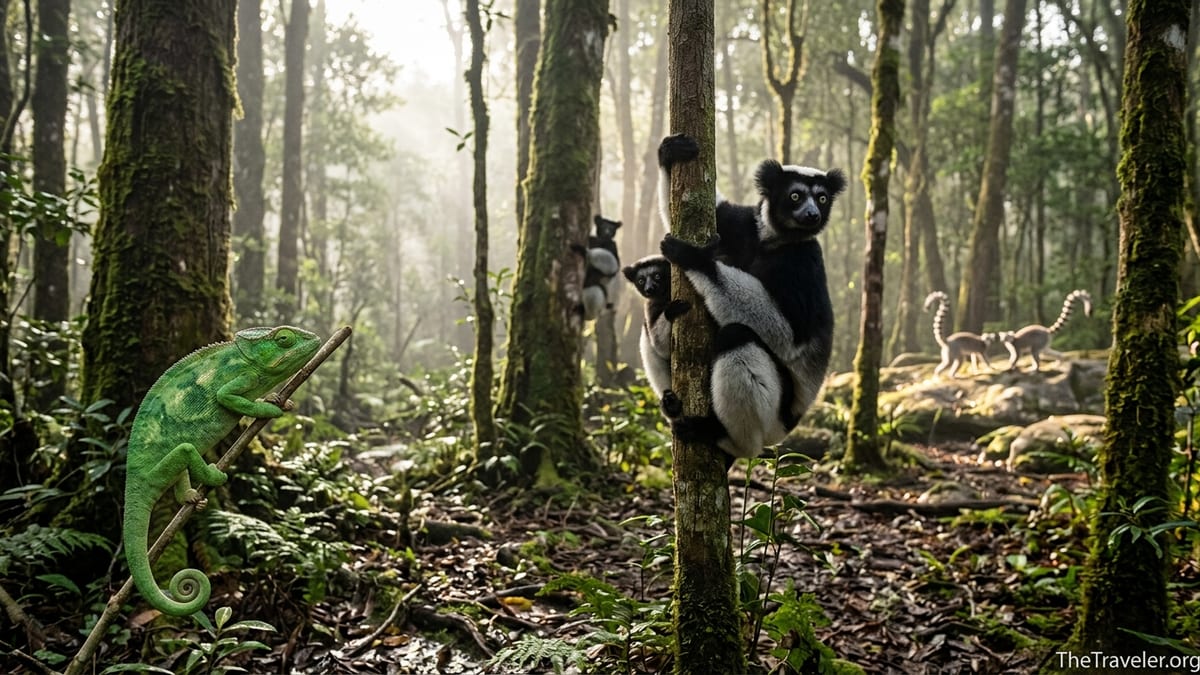
How a wildlife‑first Madagascar itinerary works
Most first‑time visitors to Madagascar anchor their plans on a handful of species: indri in the eastern rainforests, ring‑tailed lemurs in the south, bamboo lemurs in Ranomafana, sifakas somewhere along the way, and if possible a glimpse of a fossa or a giant chameleon. Because habitats are scattered along the island’s few main roads, you cannot see everything in a week. Focusing on two or three regions that match your priority species will give you richer encounters and less time stuck in vehicles.
A practical starting point is to map your must‑see animals against Madagascar’s main travel corridors. Indri and many chameleons pair naturally with an eastern loop to Andasibe–Mantadia. Bamboo lemurs, rainforest birds and night walks fit well around Ranomafana on the central RN7. Ring‑tailed lemurs and dancing sifakas line up neatly with community reserves and private parks further south, while fossas and dry‑forest wildlife require an extra detour west to Kirindy and Morondava. Once you know which animals matter most, you can decide whether to stick to the better‑serviced RN7 or add domestic flights or rougher roads.
Wildlife viewing is heavily structured. In all national parks and most community reserves, hiring a local guide is compulsory for entry. Guiding fees are typically modest compared with what you have already spent to get to Madagascar, and they are central to both conservation and community livelihoods. Independent travelers usually arrange accommodation and transport themselves, then hire park guides at the entrance gate for each walk. Organized wildlife tours build all of this into the package price and often pre‑book their favorite guides for specific target species, such as indri trackers in Andasibe or fossa specialists at Kirindy.
Season matters. The main dry season, from roughly May to October, offers easier hiking, fewer leeches, and often better chances of seeing lemurs with young. Birdlife peaks around September to November, when breeding plumage and song are at their best. The wettest months, typically January to March, can bring closed tracks, washed‑out roads and cyclone risks, so many operators avoid deep‑rainforest itineraries at that time. Night walks for chameleons and nocturnal lemurs are possible most of the year, although cooler winter nights can make reptiles less active.
Indri and rainforest specialists in Andasibe–Mantadia
For many travelers, the indri is the symbol of Madagascar: a teddy‑bear‑like black‑and‑white lemur whose whale‑like calls echo through the forest at dawn. The easiest place to see and hear them is Andasibe–Mantadia National Park, about three to four hours east of Antananarivo on the main RN2 highway. The park consists of two main sectors: the Analamazaotra Special Reserve (often just called Andasibe or Périnet) with relatively easy trails and very habituated indri groups, and the more extensive, wilder Mantadia sector a bumpy drive away, where sightings are more effort but crowds are thinner.
Analamazaotra is one of Madagascar’s most accessible wildlife sites, which makes it busy in peak months. On a typical morning walk, local guides lead small groups along forest paths, tracking indri by their calls. It is not unusual to watch several family groups feeding and calling at close range within a few hours. Other diurnal lemurs often encountered here include common brown lemurs and diademed sifakas, alongside an array of frogs and endemic birds in the understorey. Trails are generally manageable for anyone of average fitness, though they can be muddy after rain, so light hiking shoes and a rain jacket are sensible.
Night walks are one of Andasibe’s highlights. While national park rules usually prohibit after‑dark walks inside the core reserve, several community‑run forests bordering the park, such as VOIMMA and Association Mitsinjo’s forest station, offer guided night outings along well‑used paths or roadside verges. These are prime opportunities to spot mouse lemurs darting through low branches, sleeping chameleons glowing pale against the leaves and, with a keen guide, extraordinary cryptic species like the leaf‑tailed gecko. Many travelers arrange these walks directly through their lodges in Andasibe village, which often bundle transport, entrance and guiding fees.
For independent visitors, reaching Andasibe is relatively straightforward. Private drivers from the capital commonly quote full‑day rates that include waiting time while you explore the park, while budget travelers can use taxi‑brousse minibuses heading east and ask to be dropped near Andasibe village, then arrange onward lifts to accommodation. Most lodges can organise park entry and an English‑ or French‑speaking guide on arrival. Wildlife‑focused tour operators, meanwhile, often schedule two or three nights here at the start of an itinerary, balancing day walks in Analamazaotra with a full day in Mantadia for more elusive species, including black‑and‑white ruffed lemurs and sought‑after rainforest birds.
Ranomafana: bamboo lemurs, frogs and montane rainforest
Ranomafana National Park, in the hilly southeast along the RN7, is one of Madagascar’s classic rainforest destinations and one of the best places to look for bamboo lemurs. The park protects steep valleys cloaked in dense forest, cut through by rivers and waterfalls, and is cooler and wetter than Andasibe. Several species of bamboo lemur occur here, including the critically endangered golden bamboo lemur and the grey bamboo lemur, with dedicated field guides knowing the favorite bamboo thickets and feeding trees used by each group.
Day walks in Ranomafana follow a network of marked circuits ranging from short two‑hour loops to demanding all‑day hikes on often slippery, root‑strewn paths. Local guides are mandatory and are assigned at the park office near the village, where you pay conservation and guiding fees before entering. Because the terrain is steeper than in Andasibe, you should expect more strenuous walking, but the rewards include a rich mix of lemurs, endemic birds, frogs and orchids. Visitors on recent trips often report seeing multiple lemur species in a single day, along with striking reptiles such as bright‑green chameleons and leaf‑litter geckos.
Like in other national parks, night walks inside Ranomafana’s core area are usually not permitted, but there are well‑known spots along the main access road where local guides lead nocturnal outings. Under torchlight, they search roadside vegetation for mouse lemurs, sleeping chameleons and tree frogs. Lodges in and around Ranomafana village can arrange these walks, often at short notice, and will advise on appropriate clothing: long sleeves, trousers and light rain gear are useful in the damp night air. During the cooler austral winter months, reptiles can be less active, but nocturnal lemurs are still commonly seen.
Ranomafana combines naturally with other RN7 destinations. Many overland trips start in Antananarivo, head east briefly to Andasibe, then return through the capital and continue south on the RN7 to Antsirabe, Ranomafana, the Anja Community Reserve and beyond. Wildlife‑focused group tours often include several nights at a research station or comfortable lodge near the park, giving time for repeated outings with specialist guides to maximize chances of golden bamboo lemur sightings and sought‑after bird species such as ground‑rollers and vangas. Independent travelers typically arrange private cars with drivers between towns, since public minibuses, while cheaper, can be slow and unpredictable.
Ring‑tailed lemurs and southern reserves around Anja
Ring‑tailed lemurs, with their banded black‑and‑white tails and sociable behavior, are perhaps Madagascar’s best‑known primates. In the wild, one of the most reliable places to see them at close range is the Anja Community Reserve, near the town of Ambalavao on the RN7. This small, community‑run protected area sits at the base of dramatic granite domes, where woodland and rocky slopes shelter a dense population of habituated ring‑tailed lemurs. Visitor fees support local conservation and development projects, and the reserve is widely cited by travelers as a highlight of the central‑south route.
Guided walks at Anja are compulsory and typically last from one to three hours, depending on the circuit chosen. Even on the shortest loop, it is common to encounter several lemur groups feeding, sunbathing on rocks or carrying young on their backs. Because the habitat is relatively open and the animals are used to people, photography is straightforward if you keep a respectful distance and follow your guide’s instructions. Trails include some short, steep sections over rock slabs, but most reasonably fit visitors can manage them in sturdy trainers or hiking shoes.
Further south, private reserves and gallery forests near the towns of Ifaty, Berenty and other pockets of spiny or dry forest offer additional chances to observe ring‑tailed lemurs and Verreaux’s sifakas. Some of these sites sit on or near the coast, which makes them attractive for travelers wanting to combine wildlife with time on the beach. Wild populations here experience more pressure from habitat loss and local hunting than at Anja, so sightings can be more variable, but several long‑established lodges have resident or frequently visiting lemur groups on their properties or in adjacent forest fragments.
From a planning perspective, Anja fits neatly into any RN7 journey as a half‑day stop between Ranomafana or Fianarantsoa to the north and Isalo National Park further south. Many private drivers and small group tours schedule an afternoon walk at Anja, overnight nearby and continue south the next morning. Independent travelers often arrive by taxi‑brousse in Ambalavao, hire a tuk‑tuk or local taxi to the reserve and arrange a guide at the small visitor center. Because the reserve is community‑managed rather than a national park, rules and opening hours can be slightly more flexible, but the requirement to walk with a local guide still applies.
Sifakas, fossas and dry‑forest wildlife
While the humid eastern and southern rainforests harbor many lemur species, Madagascar’s dry forests are crucial if you want to see fossas and the athletic “dancing” behavior of certain sifakas. The best‑known dry‑forest site for wildlife watchers is Kirindy Forest, northwest of Antananarivo and inland from the coastal town of Morondava. Kirindy is a reserve of deciduous trees and sandy tracks rather than dense jungle, which makes animal spotting easier, particularly in the dry season when leaves are sparse.
Fossas, Madagascar’s largest carnivores, are notoriously elusive across most of their range. In Kirindy, however, regular research and habituation mean that careful guides can often locate individuals or at least fresh tracks, especially in the early morning and late afternoon during the breeding season. Travelers on recent small‑group tours frequently report daytime fossa sightings around the research camp or along main paths. Several species of lemurs live here too, including red‑fronted brown lemurs and Verreaux’s sifakas, whose sideways bounding across clearings has become an emblematic Kirindy sight.
Night walks in Kirindy are a major draw. Unlike the rainforests, where night outings often follow roads just outside park boundaries, here you usually walk inside the reserve itself with a local guide, searching tree trunks and branches for sportive lemurs, fat‑tailed dwarf lemurs and roosting chameleons. Because the habitat is open and the forest floor relatively clear, using a headlamp in addition to the guide’s spotlight helps you scan independently. Accommodation ranges from basic bungalows at or near the forest entrance to more comfortable beach hotels at Morondava, from which you can visit Kirindy as a full‑day excursion combined with the famous Avenue of the Baobabs.
Other dry‑forest and plateau sites worth considering include Isalo National Park, which, while more famous for its eroded sandstone scenery and hiking, also shelters ring‑tailed lemurs and sifakas in its canyons, and Ankarafantsika National Park in the northwest, important for both lemurs and birdlife. These areas tend to require either long overland drives or domestic flights and are usually best tackled with an organized itinerary or a pre‑arranged private driver, especially if you want to link them efficiently with the eastern and southern rainforest parks.
Chameleons, endemic birds and standout “smaller” wildlife
Chameleons are among Madagascar’s signature animals, from tiny leaf chameleons no larger than your thumbnail to the hefty Parsons chameleon, one of the largest in the world. You do not need to be in a specific park to see them, but certain sites have reputations for particularly high encounter rates. Around Andasibe, community forests such as Mitsinjo and VOIMMA are known among guides for reliable sightings of both Parsons chameleon and several leaf‑tailed geckos during night walks. In Ranomafana, guides often spot smaller green chameleons and tree frogs along the road‑edge vegetation after dark.
Birders will find Madagascar’s endemics sprinkled across multiple habitats. Andasibe and Mantadia hold rainforest specialists such as ground‑rollers and vangas, Ranomafana offers montane forest birds, while Ankarafantsika and the spiny forests of the southwest provide a different suite of dry‑country species, including couas and mesites. Local bird guides in these parks often work with specialist tour groups and can be hired privately by independent travelers at park offices. Early morning starts are the norm, with walks timed to coincide with peak bird activity and, in some parks, combined with lemur‑watching circuits so that mixed‑interest groups are well served.
Beyond the headline animals, Madagascar’s forests reward slow, attentive walking. Leaf‑tailed geckos blend perfectly into lichen‑covered trunks, stick insects mimic twigs and mantises sway like leaves in the breeze. On night walks near Andasibe or Ranomafana, guides habitually scan every few meters for the eye‑shine of tiny mouse lemurs and the pale glow of sleeping chameleons curled around branches. Many travelers describe these outings as highlights equal to, or even exceeding, their daytime lemur experiences, precisely because they reveal an entirely different layer of forest life.
For photographers, it is important to balance ambition with ethics. Flash photography is often restricted or discouraged at close range for nocturnal animals, and some parks have specific rules about its use, particularly with chameleons and lemurs. Asking your guide before shooting, using lower‑power settings and prioritizing the animals’ comfort over getting the perfect image will help ensure that wildlife remains undisturbed and that community‑run reserves continue to welcome nature photographers.
Seasonality, logistics and combining multiple wildlife areas
Choosing when to visit Madagascar is as much about your wildlife priorities as it is about weather. The cooler, drier months from roughly May to October are generally the most comfortable for hiking and travel, with clearer skies and fewer mosquitoes in many regions. Lemur viewing is excellent at this time, particularly when females carry young during parts of the winter and spring. Birders often target the late dry season and early rains around September to November, when many species are breeding and more vocal. The hottest, wettest period from December to March brings lush vegetation and active reptiles but can see some tracks closed, especially in Ranomafana and remote parks, and occasional cyclone‑related disruption on the east coast.
In practice, many travelers design a two‑ to three‑week itinerary that stitches together the RN7 corridor with an eastern extension. A classic wildlife‑first route might start with two or three nights in Andasibe for indri, diademed sifakas, chameleons and night walks, return to Antananarivo, then head south along the RN7 via Antsirabe to Ranomafana for bamboo lemurs and montane rainforest species. From there, continuing to Fianarantsoa and Ambalavao brings you to Anja for ring‑tailed lemurs, followed by Isalo for hiking among sandstone canyons and additional lemur encounters. Travelers with more time can add a side trip west to Morondava and Kirindy for fossas and dry‑forest wildlife.
Organized wildlife tours typically bundle these regions into seamless packages that include domestic flights where necessary, private vehicles, experienced naturalist guides and pre‑booked local park guides at each stop. Prices vary widely depending on group size, standard of accommodation and season, but wildlife‑specialist operators often justify their higher costs with more targeted guiding and smoother logistics. Independent travelers, by contrast, tend to trade time for money: using taxi‑brousse for long legs, hiring local drivers ad hoc and choosing simpler guesthouses close to park entrances. Both approaches rely on the same national park and community‑reserve infrastructure once you arrive.
Whichever style you choose, the non‑negotiables are time and flexibility. Road journeys routinely take longer than they look on a map, and wildlife does not perform on schedule. Building in extra nights at key sites such as Andasibe, Ranomafana or Kirindy increases your chances of encountering your target species under good conditions, whether that is hearing an indri chorus at first light, watching a fossa patrol through dry forest or seeing ring‑tailed lemurs silhouetted on granite domes at sunset.
Guides, park rules and planning a responsible wildlife trip
Local guides are the backbone of wildlife tourism in Madagascar. In state‑run national parks such as Andasibe–Mantadia and Ranomafana, hiring a licensed guide is compulsory for each walk. Fees are usually structured per group and per circuit, with different rates for shorter or longer routes. At community reserves like Anja and in privately managed forests around Andasibe, guiding is also obligatory, both for visitor safety and to ensure that tourism revenue flows into conservation and community projects. Tipping is customary and appreciated, particularly after successful sightings of rare species.
Park rules are designed to protect sensitive habitats and encourage respectful behavior. Common regulations include staying on marked trails, maintaining minimum distances from wildlife, not feeding animals and limiting group size. In some parks, guides may ask you to wear a face mask when observing closely related primates at short range, especially during or following respiratory disease outbreaks, to reduce the risk of disease transmission. Flash use may be restricted around nocturnal species. Following your guide’s instructions is not only courteous but often the difference between a fleeting glimpse and a relaxed, lingering wildlife encounter.
Responsible operators and independent travelers can also make a difference through their choice of accommodation and services. Lodges and guesthouses that employ local staff, source food locally and support nearby conservation initiatives help strengthen the link between healthy ecosystems and community livelihoods. Many Andasibe‑area community forests, for example, were created by local associations that now rely on visitor entrance fees and guiding income to fund reforestation and anti‑slash‑and‑burn projects. Asking simple questions about how your spending supports conservation can encourage more transparent and sustainable practices.
Finally, think about your own impact on the ground. Carrying reusable water bottles, minimizing single‑use plastics, dressing modestly in villages and asking before photographing people all contribute to more positive interactions. Wildlife‑first travel in Madagascar is about more than ticking species off a list; it is an opportunity to help protect one of the planet’s most distinctive natural heritage sites while experiencing it at close quarters.
FAQ
Q1. What is the best time of year to visit Madagascar for wildlife?
The cooler, drier months from about May to October usually offer the most comfortable conditions and reliable lemur viewing, with September to November particularly good for birdlife.
Q2. How many days do I need for a wildlife‑focused trip?
A minimum of 10 to 14 days allows you to combine Andasibe with the RN7 highlights such as Ranomafana and Anja; adding Kirindy or coastal areas generally requires two to three weeks.
Q3. Do I have to join a tour, or can I travel independently?
You can do either. Organized wildlife tours handle logistics and use specialist guides, while independent travelers typically hire local drivers and arrange park guides at each site.
Q4. Are local guides really compulsory in the parks?
Yes, in national parks such as Andasibe–Mantadia and Ranomafana, and in most community reserves like Anja, walking without an accredited local guide is not permitted.
Q5. Where are the best places to see indri in the wild?
The Analamazaotra sector of Andasibe–Mantadia National Park and nearby community forests are widely considered the most reliable sites for close, ethical encounters with indri.
Q6. Where can I most easily see ring‑tailed lemurs?
Anja Community Reserve near Ambalavao on the RN7 is one of the most dependable places, with habituated groups often seen at close range on relatively short walks.
Q7. Is it possible to see a fossa on a short trip?
Fossas are elusive everywhere, but visitors who include Kirindy Forest, especially in the dry season and around the breeding period, have a significantly better chance of sightings.
Q8. Are night walks safe and where are they allowed?
Guided night walks around Andasibe, Ranomafana and Kirindy are considered safe when arranged through reputable lodges or park offices, though they are usually outside strict national park cores.
Q9. What kind of fitness level do I need for these parks?
Most wildlife walks are moderate, but Ranomafana and Mantadia involve steeper, sometimes muddy trails; a reasonable level of fitness and sturdy footwear is recommended.
Q10. How can I ensure my wildlife trip is responsible and beneficial locally?
Travel with operators or stay at lodges that employ local staff and support conservation, always use local guides, respect park rules and minimize your environmental footprint.