


Madagascar looks compact on the map, but travel here moves at a different speed. Roads are slower than many visitors expect, domestic flights are limited and distances that look like a quick hop can swallow an entire day. A realistic itinerary is less about how many places you can pin and more about choosing one or two regions and giving them room to breathe. This guide breaks down practical 7, 10 and 14-day options that actually work on the ground, with clear travel times so you can see what has to be left out at each duration.
Why Madagascar Itineraries Need Extra Breathing Room
Most first-time visitors underestimate Madagascar’s size and infrastructure. Route Nationale 7 (RN7), the country’s main paved touring road, runs roughly 950 to 980 kilometers from Antananarivo to Toliara and is considered the “easy” road. In practice, the drive from the capital to Antsirabe, just 170 kilometers, routinely takes about four hours by private car because of traffic leaving Antananarivo, slow trucks and village speed controls. Further south, the road becomes more winding and speeds drop again. Driving after dark is strongly discouraged because of livestock, pedestrians and broken-down vehicles without lights.
Even shorter distances need generous time. Andasibe-Mantadia National Park, the classic first stop for rainforest and indri lemurs, is only about 150 kilometers east of the capital. On paper it looks like a two-hour drive. In reality, travelers and local agencies consistently report three to five hours each way on RN2, depending on city traffic and roadworks. That means a “simple” return transfer can easily take up most of a day, especially if your international flight arrives in the late morning or afternoon.
Domestic flights help link distant coasts, but schedules are limited and subject to change. Madagascar Airlines (formed from Air Madagascar and Tsaradia) currently runs most internal services, such as Antananarivo to Nosy Be in the northwest, Morondava on the west coast and Toliara in the southwest. These flights do not run every day on every route, and same-day connections after an overnight delay are not guaranteed, so you need buffer time around flight days. A missed domestic leg can derail an overpacked plan.
All this translates to a simple rule for planning: assume fewer regions and more nights in each place. A typical travel day between hubs often takes six to eight hours door to door once you factor in hotel checkout, fuel stops, lunch breaks and slow sections. Trying to stitch together rainforest, the RN7, the west coast baobabs and a northern beach like Nosy Be in one short trip guarantees exhausting days and a constant fear of missing your next flight.
How to Choose Your Regions for a First Trip
For a first visit under two weeks, it is helpful to think in terms of “one big backbone plus a side trip.” The backbone might be the RN7 overland circuit between Antananarivo and Toliara, or the eastern rainforest corridor around Andasibe. The side trip could be a west coast add-on like Morondava and the Avenue of the Baobabs, or a beach extension on the islands around Nosy Be or Sainte-Marie. Trying to include both the full RN7 and both coasts in 10 days means most of your time will be inside a vehicle.
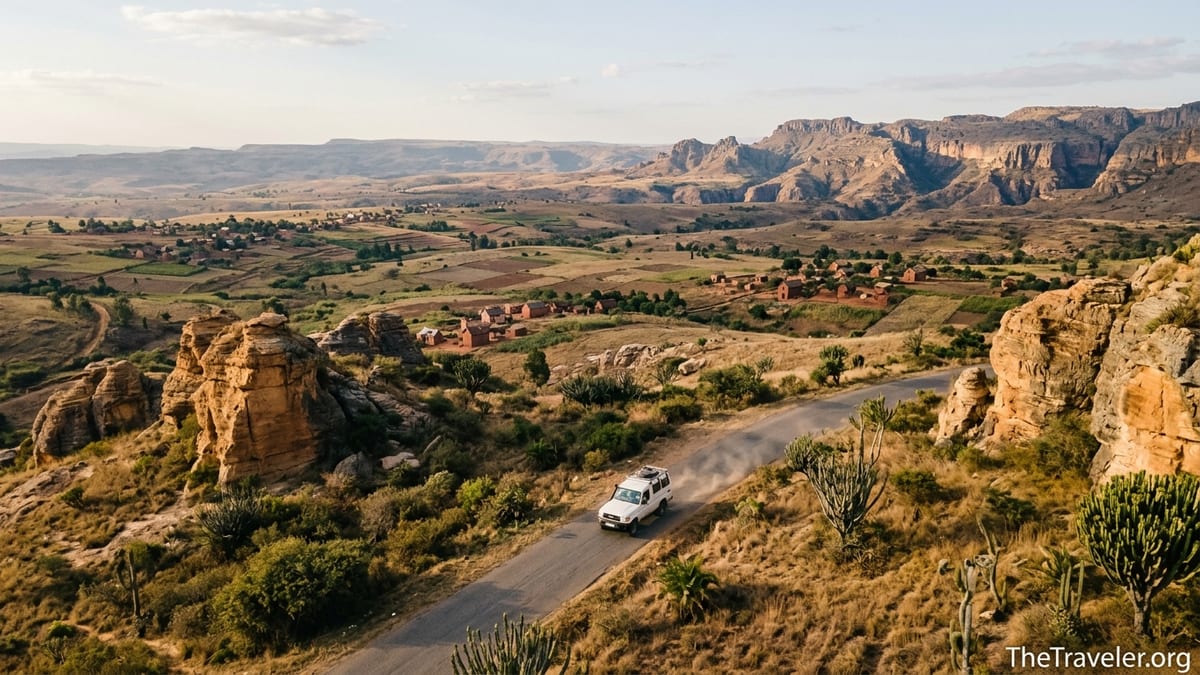
The RN7 is the country’s classic route because it strings together several distinct landscapes without leaving paved road. Over about 950 kilometers, you pass from the highland capital through the cooler spa town of Antsirabe, woodcarving villages near Ambositra, tea country and old stone houses around Fianarantsoa, rainforest near Ranomafana, then dry massif and canyons in Isalo before ending by the Mozambique Channel near Toliara. This route lends itself well to 10 to 14 days because you can break it into manageable four to six-hour daily stages.
By contrast, a rainforest-focused itinerary based around Andasibe trades long overland drives for more time on foot in the forest. Many travelers pair two or three nights near Andasibe-Mantadia with time exploring Antananarivo’s markets and hilltop views, plus perhaps a short hop to a closer beach like Mahambo or a domestic flight to Nosy Be if schedules align. This pattern works well for a seven-day trip because you avoid the multi-day road commitment of the RN7.
When choosing, think about your priorities in concrete terms. If you want to see indri, chameleons and nocturnal species at close range, a combination of Andasibe and one or two other parks is enough. If you imagine big open landscapes, long road journeys and varied scenery, the RN7 will feel rewarding. If a white-sand beach with resort comforts is non-negotiable, consider keeping your land routing simple and flying directly to Nosy Be or to the southwest coast rather than crossing half the island by road first.
A Realistic 7-Day Itinerary: Antananarivo and Andasibe
In seven days, the most practical first-trip option is to combine Antananarivo with the eastern rainforest. This keeps travel days short and avoids depending on multiple internal flights. A workable pattern is two or three nights in the capital and three nights around Andasibe-Mantadia, with one extra night as a buffer in case your international arrival or domestic schedule shifts.
One example: Day 1, arrive in Antananarivo and overnight near the airport or in the upper town. Many long-haul flights from Europe land in the evening, so you will not want to start a four-hour transfer immediately. Day 2, explore the city at a relaxed pace, visiting the Queen’s Palace and handicraft markets. Day 3, depart around mid-morning for Andasibe; even though the distance is roughly 150 kilometers, plan on three to five hours to reach your lodge depending on traffic east of the capital.
Days 4 and 5 can be devoted to guided walks in Andasibe-Mantadia National Park and the adjacent Analamazaotra Reserve, where early morning visits often reward travelers with close encounters with vocal indri, as well as sightings of sifakas, tree frogs and brightly colored chameleons. Night walks along the road margins with local spotters give a good chance of seeing mouse lemurs and other nocturnal species. With two full days you can visit both the main park and some smaller reserves without rushing from one trail to the next.
On Day 6, drive back to Antananarivo, again allowing up to five hours including a lunch stop in a roadside town such as Moramanga. The final night in the capital lets you pick up last-minute souvenirs and gives you a cushion before your international departure on Day 7. What you leave out with only seven days is significant: there is no realistic way to add the RN7, the west coast baobabs around Morondava or a remote beach like Ifaty or Nosy Be without turning the trip into a series of long transfers and flight risks.
Stretching to 10 Days: RN7 Highlights or Rainforest Plus Beach
With 10 days, you can either sample the RN7’s highlights or keep the eastern rainforest as your anchor and bolt on a short beach stay. The key is to accept that you still cannot see all of Madagascar in this timeframe. A popular option is to focus on the southern circuit between Antananarivo and Isalo, ending at the coast near Toliara, and then fly back to the capital.
One realistic RN7-based example might look like this: Day 1 overnight in Antananarivo after arrival. Day 2 drive to Antsirabe, around four hours, with stops in highland villages. Day 3 continue to Ranomafana via Ambositra and Fianarantsoa, a full day that commonly takes seven to eight hours with photo and lunch breaks. Day 4 spend a full day exploring Ranomafana National Park’s rainforest trails and hot springs. Day 5 drive to Isalo, usually another six to seven hours along RN7 as the landscape becomes drier and more open.
Day 6 and 7 can be based in or near Isalo National Park for canyon hikes, natural swimming pools and sunset viewpoints. Day 8 is a shorter three to four-hour drive to Toliara, then continue to a nearby beach area such as Ifaty or Anakao for two nights. Finally, Day 10 involves a domestic flight from Toliara back to Antananarivo for your onward international connection. This type of itinerary fills all 10 days; you are trading depth in each location for the satisfaction of seeing varied landscapes along one continuous route.
Travelers who prefer less overland time can instead build 10 days around Andasibe plus a beach extension. In that pattern, you might spend three nights in Antananarivo and Andasibe combined, then fly to Nosy Be or Sainte-Marie for five to six nights of snorkeling, whale-watching in season and relaxed village walks. You must plan around flight days because services to both islands typically run only a few times per week, and delays are not unusual. What you consciously leave out at 10 days is either the full RN7 down to the southwest or the iconic west coast baobab landscapes around Morondava, which would require yet another flight or a demanding side road.
Going Deeper in 14 Days: RN7, the West, and a Beach Finish
Two weeks opens up more ambitious combinations, but it is still important to remain realistic. A well-paced 14-day trip can comfortably include the RN7 from Antananarivo to Toliara, a few days in the west around Morondava, or a beach extension at either end of the route. Trying to do all three in only 14 days is technically possible but will leave very little buffer if a flight is rescheduled or a road is temporarily blocked by heavy rain.
One practical 14-day structure starts with a quick hop to the southwest. For example, Days 1 and 2 in Antananarivo, then on Day 3 a domestic flight to Toliara, followed by a transfer of one to two hours to a beach such as Ifaty. Spend Days 3 and 4 unwinding by the lagoon and exploring the spiny forest nearby. On Day 5, drive inland to Isalo, frequently a six-hour road day including a break at the Zombitse forest. Days 6 and 7 are dedicated to hiking Isalo’s canyons and visiting natural pools.
From there, Day 8 is a long push to Ranomafana via Fianarantsoa, often taking seven to eight hours with stops. Day 9 gives you a full day for guided rainforest walks and night spotting. Day 10 takes you back towards the highlands with a five to six-hour drive to Antsirabe. On Day 11, return to Antananarivo in about four hours, arriving mid-afternoon, and overnight near the airport. With Days 12 to 14 you can slot in a three-day Andasibe extension by road, or, if flight schedules cooperate, a quick Nosy Be beach finish, though the latter may require careful coordination of domestic timetables.
Another viable 14-day pattern is to pair the RN7 with a focused west coast section. For example, spend seven to nine days on the RN7 between Toliara and Antananarivo, then fly from the capital to Morondava for three or four nights. That allows time to see the Avenue of the Baobabs at sunset and sunrise, visit Kirindy Reserve for chances to see fossa and nocturnal lemurs, and still build in a buffer day in Morondava or Antananarivo in case the west coast flight is advanced or delayed. The trade-off is that you may skip Andasibe entirely in favor of the baobabs and western dry forest.
Understanding Travel Days, Roads and Domestic Flights
The single biggest shock for many visitors is how much time travel days consume. For planning purposes, it is sensible to treat a 150-kilometer drive on national roads as a three to five-hour journey, and a 300-kilometer stretch as a full six to eight-hour day. RN7 is mostly sealed and in better shape than many other routes, but there are still sections where slow trucks, potholes and village zones keep average speeds low. Google Maps driving times for Madagascar are generally considered unreliable by both travelers and local drivers.
To make the most of your time, structure days so that long transfers are followed by at least one two-night stay. For example, after the full-day run from Antananarivo to Ranomafana via Antsirabe and Ambositra, having two nights in Ranomafana ensures you are not immediately back on the road the following morning. Similarly, after arriving in Isalo from Toliara or Ranomafana, plan at least two full nights so you get one whole day for canyon hikes without worrying about onward logistics.
On the flight side, the current domestic network clusters around Antananarivo. Regular routes link the capital to Nosy Be, Toliara, Morondava, Diego Suarez, Sainte-Marie and other regional centers, but not all towns are connected to each other. For example, there have recently been no regular direct flights from Morondava to Toliara, so travelers wanting to connect the west and southwest usually have to route back through Antananarivo or commit to long off-RN7 road stages. This is why many itineraries are built as “spokes” from the capital rather than true loops around the island.
Budget also plays a role. A full-day private car with driver on RN7 often costs in the region of what you might pay for a mid-range hotel night in Europe, once fuel and the driver’s expenses are included. Internal flights with Madagascar Airlines are typically priced more like regional routes in Africa than domestic hops in Europe; one-way fares between Antananarivo and coastal hubs can easily be in the low hundreds of US dollars per person. Factoring these into your plan encourages a more selective approach: it usually makes better sense to pay for one or two strategic flights and then explore deeply in that region, rather than chaining many short flights just to tick off names on a map.
Wildlife Itinerary Plus Beach Extension: Putting It Together
For many travelers, the dream Madagascar trip combines close wildlife encounters with time on a warm, calm beach. A common pattern is to spend the first half of the trip in the forests and highlands, then finish at the coast so you fly home rested. In practice, that means at least 10 days to allow three to five days of wildlife viewing plus four to five days by the sea, with travel days in between.
One grounded example with 12 to 14 days might be: Days 1 and 2 in Antananarivo and Andasibe, focusing on indri sightings and night walks. Days 3 and 4 in the highlands around Antsirabe, visiting crater lakes and artisan workshops, then Day 5 and 6 exploring Ranomafana’s rainforest. Day 7 and 8 could be spent around Isalo for canyon hikes and panoramic viewpoints. On Day 9 you reach the coast near Toliara and transfer to a beach such as Ifaty or Anakao. Days 10 to 13 are then dedicated to snorkeling on the reef, pirogue trips with Vezo fishermen and relaxed time on the sand, ending with a flight back to Antananarivo.
If your time is closer to 10 days, a simpler wildlife-plus-beach combination centers on Andasibe and a single island. You might spend four nights split between Antananarivo and Andasibe, then fly to Nosy Be for five nights. On Nosy Be, many mid-range lodges offer day trips to Lokobe Reserve for more lemur viewing, as well as boat excursions to Tanikely Marine Reserve for snorkeling with turtles. The domestic flights to Nosy Be generally require you to pass through Antananarivo at some point, so you may need to finish with an overnight near the capital before your international departure.
The main sacrifices in these wildlife-plus-beach itineraries are the west coast baobabs around Morondava and some of the lesser-known parks inland. You trade the drama of Avenue of the Baobabs at sunset for simpler logistics and more unhurried stays. For many first-time visitors, that is a worthwhile choice, especially given the high likelihood of schedule changes in both domestic flights and long road journeys.
The Takeaway
Planning Madagascar is an exercise in subtraction. The map suggests an island you can cross in a day; the reality is a country where 300 kilometers often equals a long, slow road trip and where domestic flights follow limited, changeable schedules. Seven days is enough for a rewarding combination of Antananarivo and Andasibe, but not for the RN7, Morondava and a beach finale. Ten days lets you either sample RN7 highlights or pair the eastern rainforest with one coastal base. Fourteen days finally gives you room to breathe, linking the RN7 with either the west coast or a proper beach extension, provided you build in buffers.
The itineraries that work best are those that pick one main region and perhaps one secondary area, then accept that the rest will wait for another trip. You might combine Andasibe’s morning indri calls with Nosy Be’s quiet bays, or let the RN7 lead you from misty highlands to Isalo’s canyons and the Toliara lagoon. Whatever you choose, slow the pace, assume every travel day takes longer than it looks and prioritize time on the ground over the number of lines you draw on the map. Madagascar rewards that patience with experiences that feel far richer than any checklist.
FAQ
Q1. Is 7 days in Madagascar enough for a first trip?
Seven days is enough for a focused first trip if you choose one main region, such as Antananarivo plus Andasibe, and resist the urge to add long RN7 drives or multiple coasts.
Q2. How long does it really take to drive from Antananarivo to Andasibe?
The distance is roughly 150 kilometers, but most travelers report three to five hours each way by private car because of city traffic, slow trucks and curves on RN2.
Q3. How many days do I need for the RN7 between Antananarivo and Toliara?
To drive RN7 one way with time for key stops like Ranomafana and Isalo, plan at least seven to nine days. With less time you end up spending most days in the car.
Q4. Can I combine the RN7, Morondava and Nosy Be in 10 days?
It is technically possible but not practical. You would rely on multiple domestic flights and long road days with almost no buffer if schedules change or roads are disrupted.
Q5. Are domestic flights in Madagascar reliable?
Domestic flights are essential for reaching distant coasts but schedules are limited and can change. It is wise to build in buffer days before international departures.
Q6. Should I self-drive or hire a driver on RN7?
Many visitors hire a car with driver because of long distances, livestock, pedestrians and night hazards. Self-drive is possible but more stressful and strongly discouraged after dark.
Q7. What is a realistic two-week itinerary for a first visit?
A realistic 14-day plan often links the RN7 between Antananarivo and Toliara with either an Andasibe side trip, a few days in Morondava or a short beach stay near Toliara or Nosy Be.
Q8. Can I visit Andasibe as a day trip from Antananarivo?
Day trips are possible but tiring, as you may spend six to ten hours on the road. Most travelers prefer at least one or two nights near the park to enjoy early morning and night walks.
Q9. When is the best time of year to follow these itineraries?
The cooler, drier months from roughly May to October offer more comfortable road conditions and hiking, though exact timing can vary by region and climate patterns.
Q10. How should I prioritize if I love wildlife and beaches equally?
If you have around 10 days, focus on Andasibe or Ranomafana for wildlife plus one beach base such as Nosy Be or the Toliara area, instead of trying to cover every famous site.