


In Madagascar, getting from A to B is rarely straightforward. Distances look short on the map, but a 300 kilometre drive can easily become a full day on the road. Paved highways suddenly turn to potholes and laterite tracks, rainy season washouts cut off entire regions, and domestic flights are convenient until a last minute schedule change. To make the most of your time on the island, you need to build your itinerary around how you will move, not the other way around. This guide explains the main ways to get around Madagascar and shows, with real examples, which options make sense on key routes such as Antananarivo to Andasibe, the RN7, Morondava and the Tsingy de Bemaraha, Nosy Be and Sainte Marie.
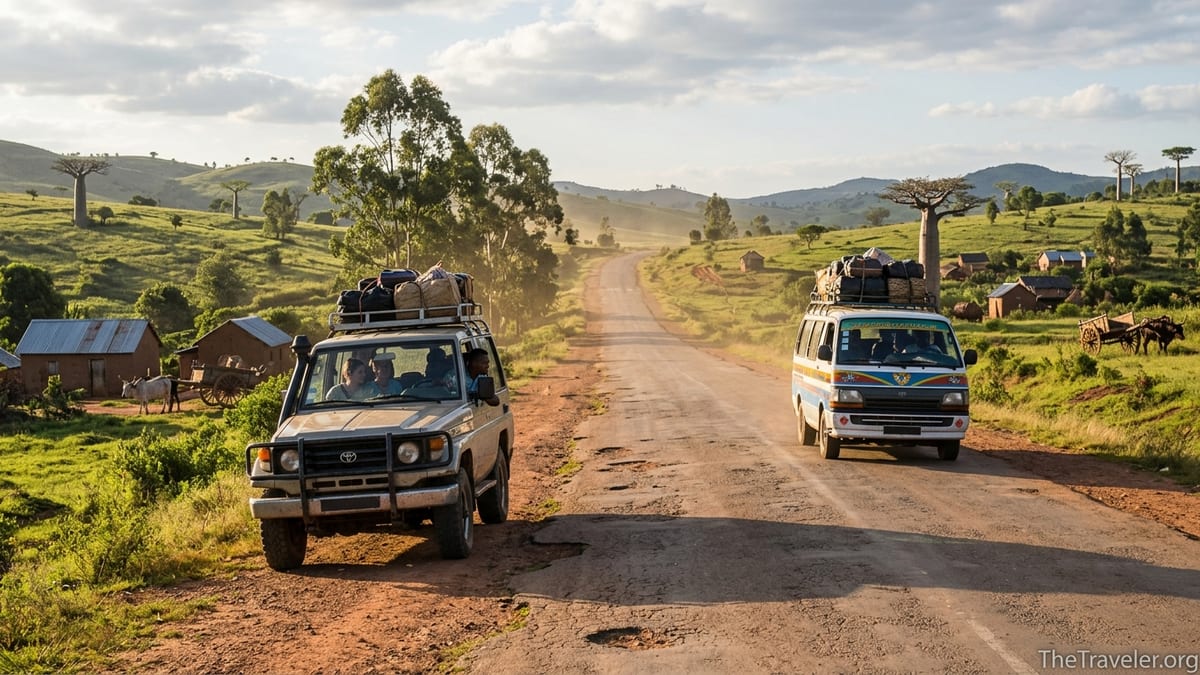
Understanding Distance, Time and Road Reality in Madagascar
The first thing to understand about travel in Madagascar is that distance does not translate neatly into driving time. Only a small fraction of the country’s road network is paved, and even “good” national roads are often narrow, winding and shared with zebu carts, pedestrians and market traffic. A stretch of 150 kilometres on the main RN7 between Ambositra and Fianarantsoa, for example, is typically a 3.5 to 4 hour drive in dry season conditions, even though it might look like a quick hop on the map. On rougher tracks, such as the 200 kilometre piste between Morondava and Bekopaka for the Tsingy de Bemaraha, travellers should expect a full day of jolting 4x4 travel, with river crossings and delays.
Seasonality makes an enormous difference. The rainy and cyclone season generally runs from about November to April, with the heaviest disruptions often between January and March. During these months, unpaved roads can become waterlogged, ferries may be halted, and even sections of main highways can be washed out temporarily. For instance, the piste north from Morondava to the Tsingy often becomes impassable for weeks at a time in peak rains, regardless of whether you are in a private 4x4 or a local taxi brousse. Planning ambitious overland itineraries in this period is risky and requires extra buffer days.
Urban congestion is another hidden time sink. Crossing Antananarivo to reach the start of either the RN2 to Andasibe or the RN7 to the south can easily add one to three hours in traffic to your day. A common experience for travellers is landing at Ivato International Airport around midday, then needing most of the afternoon just to clear the city before beginning the intercity drive. When locals and tour operators quote journey times, they often separate “Tana traffic” time from “highway” time for this reason.
Finally, night travel by road is strongly discouraged across Madagascar, both by local drivers and foreign embassies. Ill lit roads, livestock, pedestrians, broken down vehicles without lights, and a higher risk of roadside crime all contribute. Many reputable drivers will refuse to be on the road after dark outside major towns. This means you should plan your days as dawn to mid afternoon journeys, arriving before sunset rather than squeezing in evening transfers.
Private Cars with Drivers: Comfort and Flexibility
For most travellers with a mid range or higher budget, hiring a private car with a local driver is the most practical way to get around Madagascar. You typically pay a daily rate that covers the vehicle, driver, and their accommodation, with fuel either included or billed on top. In 2026, realistic mid range rates for a sedan on paved routes might start around the equivalent of 70 to 100 US dollars per day, while a proper 4x4 suitable for rougher roads is often from 100 to 150 dollars per day or more, depending on distance and routing. Prices vary by operator, season and negotiation, but anything far below these figures may signal poor maintenance or informal arrangements.
The value of a local driver really shows on routes like the RN7 from Antananarivo to Toliara, roughly 900 to 950 kilometres. Instead of attempting this in two exhausting marathon days, a driver will naturally break it into three or four legs, for example Antananarivo to Antsirabe, then to Ranomafana or Fianarantsoa, then to Isalo, and finally to Toliara. Along the way they will time departures to avoid the worst of Tana’s traffic, know where to refuel before fuel scarce stretches, and stop at trusted roadside eateries. If there is a protest blocking the road outside a town or a bridge under repair, they will usually hear this on driver networks and suggest alternatives or timing adjustments.
For the shorter Antananarivo to Andasibe run, about 150 kilometres east on the RN2, a private transfer turns what can be a tiring local journey into a manageable 3 to 4 hour drive, depending on city traffic. Several agencies today offer direct hotel or airport pickups and drop offs in Andasibe, often in mid sized SUVs. An early morning departure can get you into the forest in time for a late lunch and afternoon walk, without the stress of changing vehicles in crowded taxi brousse stations with luggage.
On trickier routes like Morondava to Bekopaka for the Tsingy, a private 4x4 with driver is not a luxury but a necessity. This journey involves ferries across the Tsiribihina and Manambolo rivers, mud sections, and long days without reliable services. Experienced drivers know how high the water can get at ford crossings during the season, how long queues at the ferries can be, and where to overnight if there are delays. Many lodges in Morondava and Bekopaka can recommend drivers they trust and sometimes bundle the transport into Tsingy packages.
Self Drive 4x4: Adventure With Real Risks
Self drive 4x4 hire exists in Madagascar, particularly in Antananarivo, but it is not comparable to picking up an SUV in Europe or North America and following a satnav. Rental companies may require significant deposits, restrict where you can take the vehicle, and expect you to pay cash for any damage. Daily hire for a 4x4 is often not much cheaper than hiring one with a driver once you factor in fuel and insurance. In practice, most visitors who think they want self drive change their minds after seeing real road conditions and traffic norms on the ground.
Self driving the RN7 is a possibility for experienced overland travellers who are comfortable with basic mechanical checks and defensive driving. You would still want to keep to conservative daily distances, for instance Antananarivo to Antsirabe on day one, Antsirabe to Ranomafana or Fianarantsoa on day two, and so on. You also need to be ready to handle situations such as negotiating with police at roadblocks, buying fuel from drums when a filling station runs dry, and navigating poorly signposted detours. A paper map or downloaded offline maps are essential, since mobile data coverage can be patchy away from towns.
More demanding routes like Morondava to Bekopaka, or any attempt to follow the broken RN5 north from Toamasina towards Maroantsetra, are best avoided as self drive unless you are highly experienced in African off road conditions and recovery. On the Morondava to Tsingy journey, for example, even local drivers frequently help each other out with stuck vehicles on muddy sections and coordinate regarding ferry capacity and river levels. A solo visitor in a rental vehicle faces real risks of being stranded or damaging the car far from mechanical support.
In coastal areas around Nosy Be or on islands like Sainte Marie, self drive is typically limited to small scooters, quad bikes or local rentals for very short hops. The roads are often narrow and shared with pedestrians, and rain can turn simple tracks into slippery clay. If you choose to rent a scooter for a day to explore Nosy Be’s beaches, take it slowly, wear a helmet, and be aware that many rental contracts provide minimal insurance cover. Even here, many visitors prefer to hire a local driver for a day tour rather than self drive.
Taxi Brousses and Local Transfers: Budget and Authenticity
Taxi brousses, the shared minibuses that crisscross Madagascar, are the backbone of local long distance transport and the cheapest way for visitors to travel between major towns. Fares are usually quoted in ariary and can be surprisingly low for the distance covered. A seat from Antananarivo to Antsirabe, for example, might cost the equivalent of under 10 US dollars, while longer rides such as Antananarivo to Fianarantsoa or Toliara are still far cheaper than private options. Departures, however, are typically based on filling the vehicle rather than fixed schedules, and comfort levels can be basic, with crowded seating and limited space for luggage.
For Antananarivo to Andasibe, taxi brousses leave from eastern stations in the capital and drop passengers near Andasibe village or at the roadside junctions. Travellers commonly report that, while the RN2 itself is in reasonable condition, the combination of waiting time at the station, frequent stops to pick up and drop off passengers and loads, and Tana traffic means this budget route often takes a good part of the day. It is an excellent way to experience local life if you have time, but less ideal if your schedule is tight or you are carrying bulky camera gear.
On the RN7, taxi brousses run in stages between main towns: Antananarivo to Antsirabe, Antsirabe to Ambositra, Ambositra to Fianarantsoa and so on down to Toliara. Many Malagasy travellers break the journey into multiple days, staying in simple guesthouses in each town. For visitors, this can be an interesting slow travel option, but you should be prepared for departures at awkward hours, cramped conditions and no air conditioning. Luggage is often tied to the roof, so bring a rain cover or plastic sheeting for your bags in the wet season.
Within towns and around hubs such as Nosy Be’s Hell Ville or Sainte Marie’s main village, local transfers range from tuk tuks and pousse pousse (rickshaws) to informal shared taxis. Short rides tend to be inexpensive but you should agree the price in advance and carry small notes. On Nosy Be, for example, tuk tuk rides between Hell Ville and the popular Ambatoloaka beach area are usually only a few dollars, rising if you travel late at night or during heavy rain. On Sainte Marie, simple 4x4 pickups often act as shared taxis along the island’s coastal track, but journey times can be slow when the road is muddy.
Domestic Flights: Essential Shortcuts With Caveats
Domestic flights are often the only way to link distant regions of Madagascar without losing several days to bumpy roads. Routes change frequently, but in recent years airlines such as Tsaradia, the domestic arm of Air Madagascar, have operated regular services from Antananarivo to main gateways like Nosy Be in the northwest, Toliara in the southwest, Diego Suarez (Antsiranana) in the far north and Sainte Marie off the east coast. Flight times between Antananarivo and these hubs are usually around one to one and a half hours, turning multi day overland journeys into short hops.
The practical challenge is reliability. Schedules can shift, flights may be rescheduled or occasionally cancelled, and last minute changes are not uncommon. Travellers flying, for instance, from Antananarivo to Nosy Be to connect with a boat transfer to islands like Nosy Komba or Nosy Sakatia are often advised to build in plenty of time between landing and boat departure, or even overnight on Nosy Be before heading onward. Similarly, if you fly to Toliara at the end of an RN7 road trip, it is wise to leave at least a full day in Antananarivo before any onward international flight.
Linking island destinations directly by air is sometimes possible but usually seasonal and limited. There have been services connecting Nosy Be with Sainte Marie in recent years, but these are not daily and can change from year to year, so you should check current routes when planning. More commonly, travellers route back through Antananarivo: for example, flying Nosy Be to Antananarivo and then Antananarivo to Sainte Marie on separate tickets. This adds cost but avoids very long combinations of boats and poor coastal roads.
Domestic airfares in Madagascar are not cheap relative to local incomes and can consume a significant portion of a holiday budget, especially on round trips. However, when you compare them with the cost of, say, three extra days of 4x4 hire, fuel and accommodation to drive from Toliara back to Antananarivo, flights often make sense. They are particularly worthwhile when your itinerary combines the south’s RN7 with time on Nosy Be or Sainte Marie, or when you want to reach remote areas like Diego Suarez without spending multiple days on the road.
Boats and Island Hops: Nosy Be, Sainte Marie and Coastal Routes
Madagascar’s islands and coastal regions rely heavily on boats, from simple wooden pirogues to modern speedboats. Around Nosy Be, transfers between the main island, the port of Ankify on the mainland and nearby islands like Nosy Komba and Nosy Tanikely are routine. Travellers arriving by road from the north, for example from Diego Suarez via Ambanja, typically take a taxi or arranged transfer to Ankify and then a speedboat to Nosy Be. The crossing to Hell Ville usually takes around 45 minutes by fast boat in good conditions, with multiple departures through the day.
On Nosy Be itself, boat trips are the primary way to visit offshore snorkelling spots and beaches. Many hotels and guesthouses can arrange shared or private day excursions that include transfers to coral reefs, turtle spots and sandbanks, with lunch on a beach. These boats are usually simple but adequate in settled weather. During the cyclone and rainy season, however, sea conditions can deteriorate quickly, and trips may be postponed or cancelled on safety grounds. If you are scheduling a romantic or once in a lifetime excursion, consider having some flexibility in your dates.
Sainte Marie, off Madagascar’s east coast, can be reached by both air and sea. In recent years, a handful of operators have run ferries and fast boats between the mainland port near Soanierana Ivongo and Sainte Marie, with crossing times typically a few hours in calm seas. These services are very weather dependent and can be suspended during heavy swells or storms. Many travellers, especially those prone to seasickness, prefer to fly between Antananarivo and Sainte Marie and then use local 4x4 pickups or motorbikes to move along the island’s length.
Further south, in areas like Belo sur Mer or along the west coast between Morondava and Toliara, boats sometimes provide alternative access to remote fishing villages and nature reserves when tracks become too poor for vehicles. These are generally informal arrangements in small motorised pirogues and should be approached with caution: lifejackets may be limited, and there is rarely any formal safety oversight. Only travel in such boats with trusted local operators recommended by your lodge or guide, and avoid departures in poor weather or after dark.
Route by Route: What Makes Sense Where
On the Antananarivo to Andasibe route, the decision is fairly simple. A private car with driver is the best option for most visitors, turning the 3 to 4 hour drive into a reasonably comfortable half day transfer. It allows for photo stops and a more relaxed schedule, and drivers are used to the winding RN2 and its truck traffic. Budget travellers or those wanting an immersion in daily Malagasy life might choose taxi brousses from Tana’s eastern station, but should accept that the total door to door journey is likely to fill much of the day and be less predictable. Self drive is possible in theory but still involves grappling with Tana’s traffic and local driving habits.
Along the RN7, private cars with drivers are again the default recommendation, especially if you want to weave in stops at Ranomafana National Park, the highland craft towns around Ambositra, the vineyards near Fianarantsoa and the sandstone canyons of Isalo. You can comfortably design a one to two week journey that uses a single vehicle and driver all the way from Antananarivo to Toliara, with side trips along the way. Taxi brousses make sense for patient budget travellers who are comfortable piecing together the route in sections, staying in simple local accommodations, and not being tied to fixed timings.
For Morondava and the Tsingy de Bemaraha, the combination that works for most visitors is a domestic flight between Antananarivo and Morondava, then a private 4x4 and driver between Morondava and Bekopaka. This spreads the journey between air and road and keeps the roughest segment in the hands of local experts. The alternative of driving from Antananarivo all the way to Morondava, then north to Bekopaka, is theoretically possible but adds several long days on the road and is strongly influenced by season. Taxi brousses operate between Antananarivo and Morondava, but the onwards piste to the Tsingy is not realistically manageable in public transport for most travellers.
Nosy Be works best as a hub reached by domestic flight from Antananarivo or occasionally other cities, combined with short boat rides to neighbouring islands. Road access via Ankify and a speedboat to Nosy Be is an option for those exploring the north by land, for example after visiting Ankarana or Montagne d’Ambre. Once on Nosy Be, local transfers by taxi, tuk tuk and boat are straightforward to arrange through accommodations or tour desks. Self drive scooters are possible for confident riders but not necessary.
Sainte Marie fits naturally with either a domestic flight from Antananarivo or a combination of road and boat via the east coast. The road approach, often following RN2 towards Toamasina and then north along rougher coastal roads before the boat crossing, can take at least a full day and is tiring. For most holidaymakers, a flight to Sainte Marie, followed by local transfers along the island, is the pragmatic choice. Connecting Sainte Marie and Nosy Be in the same trip almost always involves routing through Antananarivo at least once, whether by air or overland.
The Takeaway
Planning travel in Madagascar means working with the island’s rhythm rather than trying to force your usual pace on it. Distances are deceptive, roads can be unpredictable, and the rainy season reshapes entire regions. For many visitors, the sweet spot is a mix of private cars with local drivers for key overland routes, selective domestic flights to bridge vast gaps, and boats to unlock islands and coastal corners, with the occasional taxi brousse ride to taste everyday Malagasy life.
When sketching your itinerary, start by plotting not just where you want to go, but how you will get from one stop to the next in real time. Ask yourself how many hours you genuinely want to spend in a vehicle on any given day, whether you are comfortable with night arrivals, and how much uncertainty you are willing to accept in exchange for savings or more authenticity. Build in buffer days, especially in the rainy season, and remember that a well planned slow journey, with space for road side discoveries and conversations with your driver, often becomes the highlight of a Madagascar trip.
Most importantly, stay flexible. Flight schedules can shift, a bridge may be under repair, or a sudden storm might delay a ferry. Local drivers, guides and hotel staff usually have the best up to date sense of what is happening on the ground. Check in with them before committing to long transfers, and be ready to adjust. In Madagascar, how you move is not just a logistical detail but an integral part of the adventure.
FAQ
Q1. Is it safe to drive at night in Madagascar?
Night driving outside major towns is generally discouraged due to unlit roads, livestock, pedestrians, stalled vehicles without lights and a higher risk of roadside crime. Most reputable drivers plan to arrive before dark, and visitors are strongly advised to do the same.
Q2. How long does it really take to drive the RN7 from Antananarivo to Toliara?
The RN7 is about 900 to 950 kilometres. In practice, most travellers take three to four days, stopping in towns like Antsirabe, Ranomafana or Fianarantsoa, and Isalo, rather than attempting one or two very long and exhausting days.
Q3. Can I visit Andasibe as a day trip from Antananarivo?
It is technically possible but not recommended. The one way drive is typically 3 to 4 hours including city traffic, so a same day return would mean 6 to 8 hours on the road. Most visitors stay at least one night in or near Andasibe to enjoy night walks and early morning wildlife activity.
Q4. Do I need a 4x4 for the RN7?
For the main RN7 itself in dry season, a regular sedan can be sufficient. However, if you plan side trips on rougher tracks, or you are travelling in the rainy season, a 4x4 provides more comfort and margin for bad patches, especially near national parks and rural lodges.
Q5. Are domestic flights in Madagascar reliable?
Domestic flights are essential for covering long distances quickly, but schedules can change and occasional delays or cancellations occur. Build in buffer time before international departures and avoid very tight same day connections, especially when combining different airlines.
Q6. How comfortable are taxi brousses for long journeys?
Taxi brousses are cheap and authentic but basic. Expect crowded seating, limited legroom, no air conditioning and luggage often tied to the roof. For journeys of several hours or more, they can be tiring, though many budget travellers find them worthwhile for the cultural experience.
Q7. What is the best way to reach the Tsingy de Bemaraha?
Most visitors fly between Antananarivo and Morondava, then use a private 4x4 with a local driver to reach Bekopaka, the gateway village. The piste includes river crossings and rough sections, so local driving experience and a robust vehicle are essential, especially outside the driest months.
Q8. How do I get to Nosy Be and move around once there?
Nosy Be is usually reached by domestic flight from Antananarivo or by road to Ankify followed by a speedboat. On the island, travellers rely on taxis, tuk tuks, arranged transfers and boats to visit beaches and nearby islands, with scooter rental an option for confident riders.
Q9. Is it better to fly or take a boat to Sainte Marie?
Flying from Antananarivo to Sainte Marie is generally more comfortable and predictable, especially in the rainy or cyclone season. Boats from the east coast are an option in calmer weather but crossings can be rough and services are more easily disrupted by sea conditions.
Q10. How should I plan for rainy season disruptions?
If travelling between about November and April, especially January to March, allow extra days for delays, choose 4x4s for unpaved routes, and keep itineraries flexible. Check road and ferry conditions locally before long transfers, and be prepared to adjust plans if sections become temporarily impassable.