


Madagascar’s central highlands are often treated as a long transfer corridor between the capital and the southern beaches. In reality, the stretch from Antananarivo to Fianarantsoa and Ambalavao can be a rewarding standalone journey, with terraced rice paddies, volcanic lakes, craft towns and vineyard country. This guide focuses on a practical highlands-only route, explaining where it makes sense to overnight, which stops work best as day trips, and how to pace the long RN7 and RN43 roads so that the highlands feel like a trip in their own right instead of a blur through the windscreen.
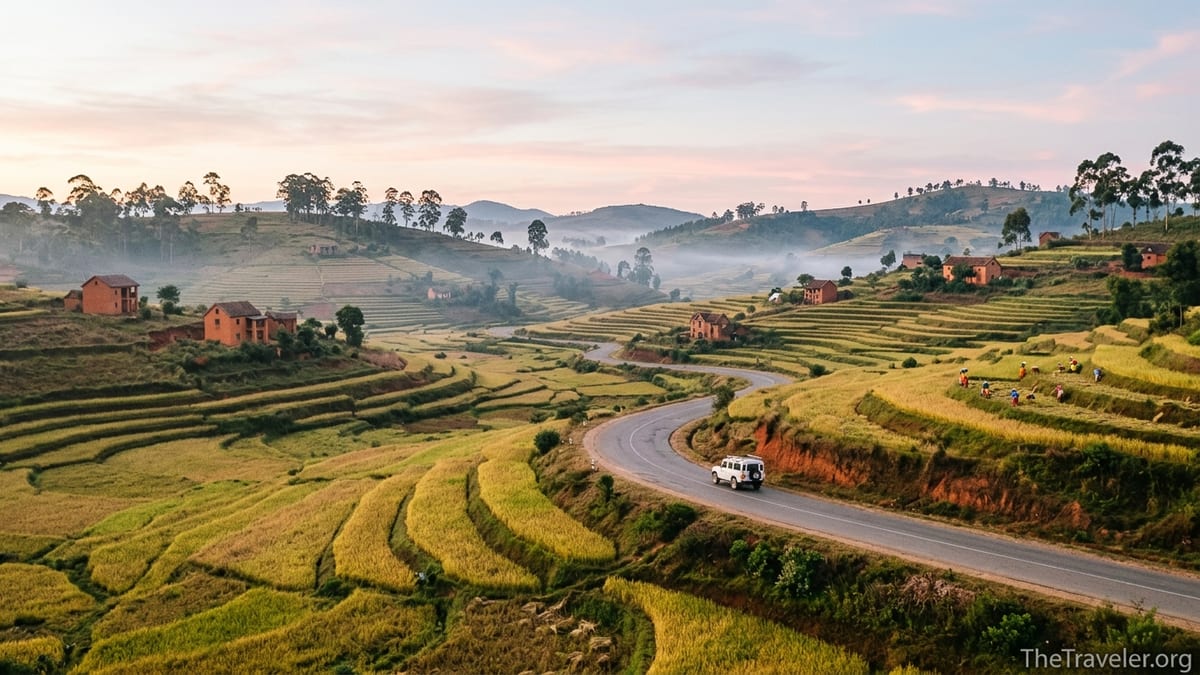
Understanding Distances and Road Reality in the Highlands
On a map, the highlands route looks deceptively compact. Antananarivo to Antsirabe is around 170 kilometers on the RN7, and Fianarantsoa to Ambalavao is only about 60 kilometers. In practice, road conditions, congestion and slow-moving trucks stretch these distances significantly. Recent local and tour operator reports put Antananarivo to Antsirabe at around 3 to 4 hours by private car in normal daytime traffic, even though mapping tools might suggest just over 2 hours. Travellers who drove the RN7 in 2024 and 2025 commonly report average speeds of 35 to 50 kilometers per hour once you factor in village zones, speed bumps and road works.
From Antsirabe southwards, the RN7 threads through a string of highland market towns. Antsirabe to Ambositra is roughly 90 kilometers and typically takes about 2.5 to 3 hours for private vehicles, longer in a taxi-brousse. Continuing onward, Ambositra to Fianarantsoa, about 190 kilometers, can easily take 5 to 6 hours because the tarmac is more broken in places and there are steep, winding sections. These timings matter because it is entirely possible to design a rich 6 to 10 day highlands journey that never reaches the coast, but only if you accept a slower pace and avoid stacking multiple long drives back to back.
Side routes such as the RN43 toward Ampefy also require realistic planning. The RN43 links the RN1 near Analavory to the RN7 near Ambohibary and passes Ampefy in the volcanic Itasy region. Distances are short on paper, but you should still budget 3 to 4 hours for Antananarivo to Ampefy via the RN1 and RN43, depending on where you start in the capital and how quickly you clear city traffic. It is common for visitors to underestimate these durations, then find themselves arriving after dark or turning sightseeing stops into rushed photo breaks.
Finally, remember that drive times vary by vehicle type. Tourist itineraries that quote 3.5 hours from Antananarivo to Antsirabe assume a private car with an experienced driver. Shared taxi-brousse minibuses are slower because they depart only when full, load and unload cargo en route and often stop at roadside markets. What looks like a 3 hour transfer in a private 4x4 can easily stretch to 5 or 6 hours by shared transport, which makes it even more important to concentrate your overnights in a few hubs rather than changing beds every night.
Starting in Antananarivo and Ambohimanga
Most highlands-only itineraries will begin and end in Antananarivo, since this is where international flights arrive. The capital itself is intense, with steep hills, traffic jams and crowded markets, but it is worth at least one or two nights at the beginning of your trip. Staying in the central districts around Isoraka or Antaninarenina puts you within easy reach of colonial-era architecture, the Analakely market area and a range of midrange and boutique hotels. Many visitors choose a comfortable guesthouse with airport transfers included for the first night, so they can adjust after a late arrival and avoid navigating the city on day one.
Ambohimanga, the hilltop royal complex northeast of Antananarivo, works best as a day trip from the capital rather than an overnight base. It lies roughly 20 kilometers from central Antananarivo, but the drive typically takes 45 to 90 minutes each way because you must pass through suburban traffic and climb into the hills. A common pattern is to devote one full day in the capital to Ambohimanga and the city’s historic upper town. For example, you could spend the morning exploring the royal village and sacred forest at Ambohimanga with a local guide, have a simple Malagasy lunch nearby, then return to central Antananarivo for afternoon visits to the Rova ruins or the craft market.
Because your onward highlands drive will be significant, it often makes sense to spend your second night again in Antananarivo rather than trying to leave for Antsirabe late in the day. Many travellers find that an afternoon departure from the capital results in heavy outbound traffic and an after-dark arrival in Antsirabe, which is not ideal on a road that has livestock, pedestrians and poorly lit stretches. A smoother pattern is: Day 1 arrival and rest in Antananarivo, Day 2 full day for Ambohimanga and the capital’s sights, and Day 3 an early start south on the RN7.
If you are using a private driver, this is also the time to finalize practicalities. In 2025 and 2026, typical day rates for a vehicle with driver in the highlands hover around the equivalent of 60 to 100 US dollars per day, plus fuel, depending on vehicle size and whether you book through a local agency. Clarify whether the driver’s meals and accommodation are included, check that the car has functioning seatbelts, and agree the broad route: Antananarivo to Antsirabe or Ampefy first, then onward through Ambositra and Fianarantsoa, with optional Ambalavao.
Choosing Between Ampefy and Antsirabe as Your First Base
After leaving Antananarivo, many travellers face a strategic choice. Do you detour west into the volcanic landscapes of Ampefy, or head straight south on the RN7 to Antsirabe, the classic highlands hub For a highlands-only route, both are valid options, but they serve slightly different travel styles. Ampefy is a compact rural region of crater lakes, waterfalls and patchwork fields, ideal if you want gentle walks and village life within 3 to 4 hours of the capital. Antsirabe, about 3 to 4 hours south of Antananarivo, is a bustling spa town with more accommodation choice and easier onward connections.
If you choose Ampefy, plan to overnight there rather than attempting a rushed day trip from Antananarivo. A realistic pattern is to depart the capital by around 8 am, reach the RN1 toward Analavory, then turn onto the RN43 for the final stretch through rolling hills. With photo stops and a roadside lunch, you are likely to arrive in Ampefy mid-afternoon. Simple lakeside hotels and guesthouses around Lake Itasy or near the waterfalls at Chutes de la Lily provide atmospheric bases. The next day, you can explore Mont d’Ilafy viewpoints, take a pirogue ride on the lake or walk between small villages, then either spend a second night or loop back via the RN43 to join the RN7 near Ambohibary and continue to Antsirabe.
Antsirabe, by contrast, works better as a multi-night base for people planning to travel further south. Once you arrive after the 3 to 4 hour drive from Antananarivo, you have the benefit of reliable ATMs, a wide range of hotels from simple guesthouses to historic properties, and amenities such as bicycle rentals and hot springs. Many itineraries give Antsirabe at least two nights, which allows one full day for nearby volcanic lakes like Tritriva and Andraikiba, plus time to wander the Avenue de l’Indépendance, sample street snacks and visit local workshops. Trying to use Antsirabe as a day trip from Antananarivo generally turns the visit into a long highway slog with only a brief look at the town.
For travellers with limited time, you do not need to visit both Ampefy and Antsirabe. If you are after calm scenery and simple village walks without committing to the longer RN7 journey south, a two or three night loop from the capital through Ampefy and back can be satisfying. If your goal is a more extensive highlands route that reaches Fianarantsoa and Ambalavao, prioritize Antsirabe as your first proper base and consider saving Ampefy for a future trip, rather than squeezing it into the same week and spending most of your days in the car.
Antsirabe, Ambositra and Fianarantsoa: Craft Towns and Highland Culture
Once you have established yourself in Antsirabe, the highlands begin to feel like a coherent region rather than a transfer. Antsirabe itself merits at least one full day. Travellers often hire a local guide for a loop to Lake Tritriva or Lake Andraikiba, with short walks around the crater rims and stops in small villages where zebu carts and brick kilns line the road. Back in town, pousse-pousse rickshaws ferry locals and visitors along the tree-lined main avenue, and it is easy to visit small workshops producing zebu horn crafts, embroidery or gemstone polishing. Prices for guided half-day excursions in 2025 and 2026 typically fall in the range of 80,000 to 150,000 Malagasy ariary for two people, depending on distance and whether transport is included.
South of Antsirabe, the road to Ambositra is a gradual descent through rice terraces and eucalyptus plantations. While the distance is manageable in half a day, it is best not treated as a simple drive-through. Ambositra is the center of Madagascar’s Zafimaniry wood carving tradition, and spending at least one night here lets you visit workshops without watching the clock. A practical pattern is to leave Antsirabe after breakfast, arrive in Ambositra by early afternoon, drop your bags at a guesthouse and then walk the compact town center, dropping into ateliers that produce marquetry boxes and carved furnishings. You might commission a small jewelry box and collect it the next morning before continuing south.
From Ambositra, the onward drive to Fianarantsoa is longer and more tiring, so resist the temptation to push all the way to Fianarantsoa in one day from Antsirabe unless you are very short on time. Many experienced drivers and tour planners recommend dividing the journey into Antsirabe to Ambositra one day, then Ambositra to Fianarantsoa the next. This way, you avoid an 8 to 9 hour marathon on a road where sudden potholes and blind corners demand constant concentration. In Fianarantsoa, a minimum of two nights is advisable if you want to experience the old upper town, visit surrounding vineyards or ride the historic train toward Manakara when it is operating.
Fianarantsoa is an important regional center, so it also works as a resupply point on a highlands-only itinerary. ATMs here are more reliable than in small towns, and supermarkets carry basics such as bottled water, snacks and sunscreen that may be hard to find elsewhere. Accommodation ranges from simple city hotels to characterful guesthouses in the old town. A realistic rhythm might be to arrive from Ambositra in mid-afternoon, enjoy a sunset viewpoint over the tiled roofs of the upper town, then spend the next day on a vineyard visit or an excursion into nearby Betsileo villages before deciding whether to add Ambalavao and the mountains to your route.
Extending to Ambalavao and the Highlands Peaks
Fianarantsoa to Ambalavao is a relatively short leg compared with earlier stages. The distance is around 60 kilometers on the RN7, and recent travel guides suggest a driving time of 1 to 2 hours in a private vehicle, depending on roadworks and stops. That brevity makes Ambalavao an attractive extension even on a highlands-only trip, because you can reach it without another full day in the car. However, it remains important to avoid the mindset of “just popping down and back” in one day from Fianarantsoa. Ambalavao’s setting among granite outcrops and vineyards, plus its access to the Anja Community Reserve and higher plateau landscapes, justifies at least one night, preferably two.
Many travellers structure this extension as follows. On Day 1, depart Fianarantsoa after breakfast and arrive in Ambalavao by late morning. Check into a small hotel or lodge that offers views of the rocky hills, then spend the afternoon visiting the town’s paper-making workshops and silk weaving collectives. The following day, you can dedicate a full morning to Anja Reserve, about 12 kilometers south of town. This community-managed forest at the base of towering boulders is known for traditional tombs and families of ring-tailed lemurs. A typical visit involves 2 to 3 hours of walking with a local guide, and entrance plus guiding fees together are usually in the range of a few tens of thousands of ariary per person.
For hikers with more time, Ambalavao can also serve as a gateway to the higher peaks and massifs that frame the southern edge of the highlands. Multi-day treks in the Andringitra region, reached by rougher tracks beyond Ambalavao, offer steep ascents to granite domes and high plateaus. These routes require more logistics, including 4x4 transport, camping gear and local porters, and are better arranged through a specialist operator or local guide association based in Ambalavao or Fianarantsoa. If you are keeping your itinerary strictly highlands-only and have no interest in the drier southern landscapes beyond, you can still enjoy a taste of the mountains by limiting yourself to Anja and shorter walks around Ambalavao’s vineyards.
In terms of road logistics, it is feasible to travel from Ambalavao back to Antsirabe in a single day, but this would likely take 7 to 8 hours of driving and leave little room for stops. A more comfortable pattern is to return north in stages, overnighting again in Fianarantsoa or Ambositra. For example, you might spend two nights in Ambalavao, return to Fianarantsoa for a final night in the old town, then drive to Antsirabe the next day. This way, your longest single stretch is around 5 to 6 hours and you avoid spending your final highlands days locked inside the vehicle.
How to Shorten the Route Without Turning It Into a Blur
Not everyone has ten days to wander through the highlands. The key to designing a shorter route without reducing every destination to a drive-through is to identify two or three strategic overnight hubs and accept that you will skip some secondary stops. For instance, with about six or seven days available in Madagascar and a focus on the highlands only, many travellers choose a pattern such as: Antananarivo (2 nights), Antsirabe (2 nights), Fianarantsoa (2 or 3 nights), then back to Antananarivo. In this version, Ambositra becomes a lunch stop and craft detour on the way south or north, rather than an overnight.
A practical example would be leaving Antananarivo early, reaching Antsirabe by late morning, checking into your hotel, and using the afternoon for a short town walk and hot springs visit. The next day, you devote entirely to lakes and rural surroundings. On the third travel day, you depart for Fianarantsoa, stopping in Ambositra for 2 to 3 hours to visit woodcarvers, have lunch in a local restaurant and stretch your legs. You arrive in Fianarantsoa before sunset, then use the following days for vineyard country, old town visits and perhaps a day trip toward Ambalavao without overnighting there. This still gives each main base at least one full day of exploration rather than reducing them to quick overnight stops.
If you have even less time, say four or five days in the highlands, it often makes more sense to limit your geographic spread rather than racing south. For example, you could focus entirely on Antananarivo, Ambohimanga and Antsirabe or Ampefy. One realistic pattern is two nights in Antananarivo with an Ambohimanga day trip, followed by two or three nights in Antsirabe, using the town as a base for nearby lakes and highland villages. This scenario avoids Fianarantsoa altogether but results in a deeper experience of the northern highlands, with shorter drives and more flexibility if bad weather affects road conditions.
Another way to keep things manageable is to think in terms of maximum daily drive times rather than fixed distances. Many visitors to Madagascar find that 4 to 5 hours per day of driving on RN7 and RN43 roads is close to their comfort limit. Once you go beyond 7 hours, even in a private vehicle, fatigue sets in and there is little appetite for exploration upon arrival. Using this rule of thumb, you might decide that you will not combine Antsirabe and Fianarantsoa into a single day’s push if you also want to stop in Ambositra, or that you will not try to reach Ambalavao and then continue to Antsirabe on the same day. Designing your itinerary around these subjective limits leads to fewer rushed evenings and more unhurried mornings in the places you came to see.
Practical Tips for Transport, Season and Safety
Transport choice shapes how your highlands route will feel. Private car with driver is the most flexible option and remains affordable compared with many other African destinations, particularly if you are two or three people sharing costs. Companies based in Antananarivo and Fianarantsoa typically provide vehicles such as Toyota station wagons or 4x4s, with fuel and driver included or billed separately. For example, a couple travelling in 2025 might pay the equivalent of 80 US dollars per day for a vehicle and driver, then add fuel at local pump prices. In return, you gain the ability to stop at viewpoints, leave early to avoid traffic, and detour to less visited lakes or villages without worrying about catching the last taxi-brousse.
Budget travellers, meanwhile, often rely on the taxi-brousse network that links Antananarivo with Antsirabe, Ambositra, Fianarantsoa and Ambalavao. Fares between major towns are typically in the range of a few tens of thousands of ariary per leg, considerably cheaper than private hire, but journeys take longer and comfort is basic. Vehicles depart from large, chaotic bus stations, and it is wise to buy a seat a day in advance during busy periods such as local holidays. Once in town, you can use local taxis or pousse-pousse to reach your guesthouse. This style of travel works best if you are not bound to tight schedules and can accept unpredictability in departure and arrival times.
Seasonality is another key factor. The highlands sit at a higher elevation than the coasts, so temperatures are cooler year-round. From roughly May to October, days are often sunny and crisp, with chilly nights in Antsirabe, Ambositra and Fianarantsoa. This is a comfortable time for walking among rice paddies or exploring old town streets. From November to April, the rainy season brings heavier showers and the risk of localized flooding or landslides that can slow road travel. If you travel at this time, build in spare days so that an unexpected road closure does not derail your entire itinerary, and consider choosing fewer bases, allowing you to wait out bad weather rather than feeling compelled to move on.
Safety on the roads is mostly about timing and common sense. Whenever possible, plan to arrive in your next overnight town before dusk. This gives you margin if there are delays and avoids the risk posed by unlit vehicles, livestock and pedestrians after dark. Break up long days with short rest stops at roadside cafés. In Antananarivo and larger towns, follow standard urban precautions: use registered taxis at night, keep valuables discreet, and store passports and larger sums of cash in your hotel safe. In villages and craft towns like Ambositra, the main risk is more likely to be overpaying for souvenirs than encountering serious crime, but it is still wise to confirm prices in advance and carry small bills.
The Takeaway
A highlands-only itinerary in Madagascar works best when you treat the journey as the destination rather than as the prelude to beaches further south. Distances between Antananarivo, Antsirabe, Ambositra, Fianarantsoa and Ambalavao look modest on a map, yet real-world road times and the many reasons to stop along the way argue strongly for a slower pace. By concentrating your overnights in key hubs such as Antananarivo, Antsirabe and Fianarantsoa, with optional additions like Ampefy, Ambositra and Ambalavao, you can build a route that balances movement with immersion.
Instead of chasing fixed 7 or 14 day templates, start by deciding how many long driving days you are comfortable with, then choose two or three main bases that fit within those limits. If you have a week, you might simply link Antananarivo, Antsirabe and Fianarantsoa. With more time, you can fold in Ampefy and Ambalavao for a richer portrait of the highlands. Either way, the goal is the same: to trade hurried highway marathons for early morning market wanderings, calm evenings in cool upland air, and a sense that Madagascar’s highlands are not just the road between places but a rewarding destination in their own right.
FAQ
Q1. How many days do I need for a highlands-only itinerary in Madagascar
For a meaningful highlands-only trip, most travellers find that 6 to 10 days works well. Around a week allows time for Antananarivo, Antsirabe and Fianarantsoa without turning every day into a long drive. With 10 days or more, you can comfortably add Ampefy, Ambositra and Ambalavao while still giving each base at least one full day of exploration.
Q2. Is it realistic to do Antananarivo to Antsirabe as a day trip
It is technically possible but not recommended. The one-way drive usually takes 3 to 4 hours in a private car, longer by taxi-brousse, so a same-day return can mean 7 to 9 hours in transit. You would have only a short window to see Antsirabe itself. Staying at least one night in Antsirabe gives you time for the lakes and town without feeling rushed.
Q3. Should I visit Ampefy as well as Antsirabe
Visit both only if you have enough time and enjoy slow travel. Ampefy is best for a quiet rural escape close to the capital, while Antsirabe is a larger hub with better onward connections. With limited days, it often makes sense to choose one or the other so you are not constantly packing and unpacking or spending most of your trip on the road.
Q4. Is Ambalavao worth adding if I am not going all the way to the south
Yes, if you have at least two or three extra days to spare. Ambalavao offers striking granite scenery, vineyards and easy access to the Anja Community Reserve, all within 1 to 2 hours’ drive of Fianarantsoa. Adding one or two nights there gives you a taste of southern highland landscapes without committing to the full RN7 journey to the coast.
Q5. Can I travel this route by taxi-brousse instead of a private car
Yes, the RN7 corridor between Antananarivo, Antsirabe, Ambositra, Fianarantsoa and Ambalavao is well served by taxi-brousse. This is much cheaper than hiring a car with driver, but also slower and less predictable. To make it work, build in buffer days, avoid very tight connections and be prepared for crowded vehicles and basic conditions at bus stations.
Q6. When is the best season to explore Madagascar’s highlands
The dry, cooler months from roughly May to October are generally the most comfortable, with sunny days and chilly nights that suit walking and town exploration. The rainy season from November to April can still be rewarding but brings heavier showers that may slow travel or temporarily affect road conditions, so you should allow extra time and keep your route flexible.
Q7. How can I shorten the route without missing everything
Focus on fewer bases and accept that you will skip some stops. For example, with about a week you might concentrate on Antananarivo, Antsirabe and Fianarantsoa, using Ambositra as a craft and lunch stop rather than an overnight. Limiting your daily drive time to around 4 or 5 hours helps ensure you still have energy to explore on arrival.
Q8. Is it safe to drive or be driven along the RN7 at night
It is generally discouraged to travel these routes after dark. Livestock, pedestrians and unlit vehicles can make night driving hazardous, and response times in an emergency are slower in rural areas. Plan your departures so you arrive before sunset, even if that means cutting short a visit or adding an extra overnight stop to break up the journey.
Q9. Do I need to book accommodation in advance along this route
In smaller towns like Ambositra and Ambalavao, it is wise to reserve at least your first-choice guesthouse, especially in the dry high season and around local holidays. In larger hubs such as Antananarivo, Antsirabe and Fianarantsoa you can often find a bed on arrival, but booking ahead gives you more choice, especially if you want midrange or boutique options with secure parking.
Q10. Can I combine this highlands route with a short beach stay
Yes, but only if your overall time in Madagascar allows it. A common pattern is to spend a week in the highlands, then fly from Antananarivo to a coastal area such as Nosy Be or Tulear for several days of beach time. Trying to drive from the highlands to the coast and back within a short highlands-focused itinerary usually means sacrificing depth for distance, so flights are preferable if you want to keep the highlands leg relaxed.