


Travel between Diego Suarez (Antsiranana) and Nosy Be in northern Madagascar can be a simple hop by plane or an adventurous journey by road and boat via Ankify, with the option to explore Ankarana National Park along the way. This guide explains, step by step, how to choose between flying and overland travel, how the Diego Suarez–Ambilobe–Ambanja–Ankify route works in practice, and how to turn a basic transfer into one of the most memorable multi-day trips in the country.
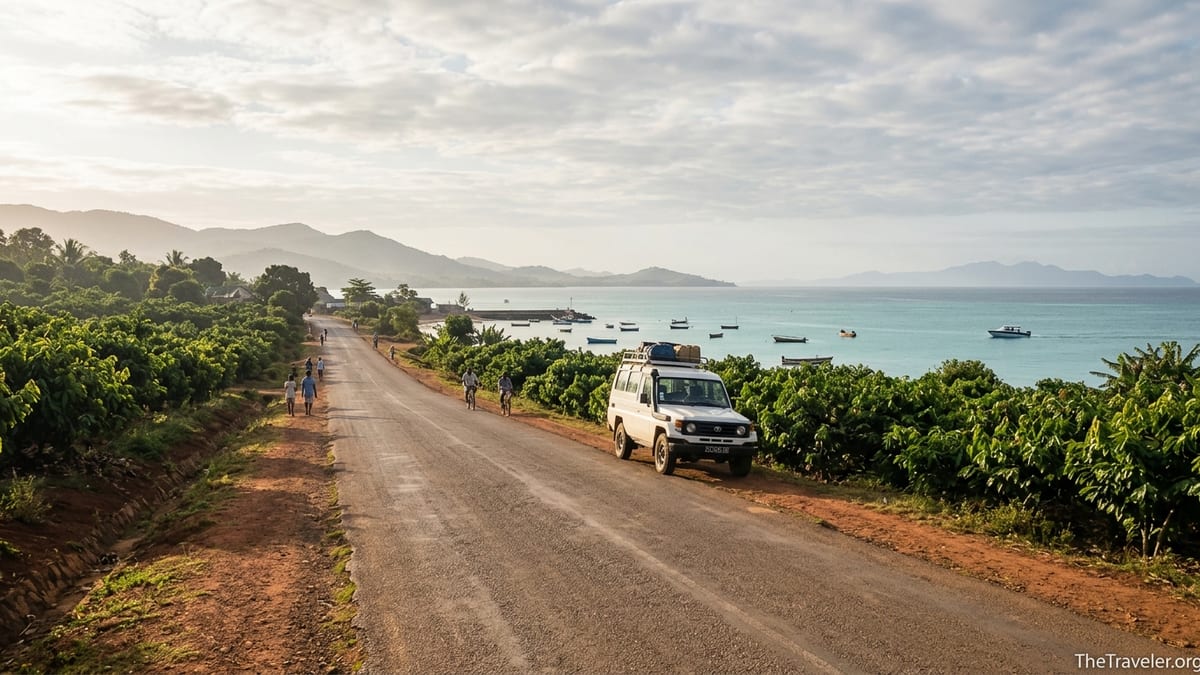
Diego Suarez to Nosy Be at a Glance: Two Main Options
For most travelers, getting from Diego Suarez to Nosy Be comes down to a choice between flying and combining road plus boat. The direct flight, when it operates, is the fastest option, often taking less than an hour in the air between Antsiranana’s Arrachart Airport and Nosy Be’s Fascene Airport. It suits visitors short on time, or those who want to avoid long road journeys on Madagascar’s sometimes unpredictable highways.
The overland and boat route along the RN6 to Ankify, followed by a speedboat or local boat across to Hell-Ville on Nosy Be, is slower and more exposed to delays, but it offers a close look at northern Madagascar’s landscapes and communities. Cacao and ylang-ylang plantations, small roadside markets, and a chance to visit Ankarana National Park all lie along this corridor. For travelers who see transport as part of the adventure, this route can easily become a highlight in its own right.
In practical terms, flying is usually more expensive per person than hiring a private car and booking a boat, especially for couples or groups. However, once you factor in a night or two at a lodge in Ankarana and a driver’s daily fees, the cost difference can narrow. The decision often comes down to your appetite for long drives, your travel dates in relation to the rainy season, and whether Ankarana is on your wish list.
Availability is another key factor. As of mid-2026, there is typically one scheduled weekly flight between Antsiranana and Nosy Be, operated by the national carrier under the Madagascar Airlines brand, and this schedule can change at short notice. Meanwhile, road transport on the RN6 and informal boat services at Ankify operate daily in some form, though not always to fixed timetables. Building in buffer time is essential whichever option you choose.
Direct Flights: Fast but Limited Connections
Direct flights between Diego Suarez (DIE) and Nosy Be (NOS) run on a limited basis, generally around once a week in the current schedule. Flight times are usually under one hour, and services are often timed to connect with other domestic routes such as Antananarivo, allowing travelers to link capital, far north, and island beaches without setting foot on a long-haul taxi-brousse. Because capacity is modest and demand spikes in high season, booking well in advance is strongly recommended.
Fares fluctuate according to season and how early you book, but a one-way ticket can easily sit in the range of a few hundred euros. Prices should always be checked directly with the airline or a trusted local agent before committing to the rest of your itinerary. In addition to base fares, remember to factor in checked baggage allowances, which can vary by fare class and aircraft type. Oversized baggage like surfboards or diving gear often requires advance notification and may incur extra fees.
When flights run smoothly, the time savings are significant. Instead of a full day or longer by road and boat, you can leave a hotel in Diego Suarez after breakfast, take a short transfer to Arrachart Airport, and be at your beach accommodation on Nosy Be by lunchtime. This simplicity is particularly appealing at the end of a trip, when travelers want to minimize the risk of missing an international departure from Antananarivo due to an overland delay.
The trade-off is vulnerability to schedule changes. Domestic flights in Madagascar can be rescheduled or even canceled at short notice, particularly in the low season or when aircraft are reassigned to busier routes. Many experienced travelers arrange at least one spare day in Antananarivo before any long-haul departure, even if they have flown internally. If your dates are inflexible or you dislike uncertainty around flights, the RN6 and Ankify route, slow as it is, may actually feel more predictable.
The Overland Route on RN6: Diego Suarez to Ambilobe and Ambanja
The classic surface route from Diego Suarez to Nosy Be begins on Route Nationale 6, the arterial road that links Antsiranana with the rest of northern Madagascar. From Diego, the RN6 heads south through dry deciduous forests, savannah, and small towns in the direction of Ambilobe and Ambanja. Much of this road is paved and in workable condition, although potholes, occasional unpaved stretches, and slow-moving trucks can extend travel times.
Most travelers tackle this leg in a private 4x4 with driver, arranged through a local agency or hotel. For example, a Diego Suarez based operator may quote for a direct transfer to Ankify, covering around 450 kilometers in a long but doable day, or split the journey over two days with a night near Ankarana. Daily rates for a vehicle and driver often include fuel but not meals or accommodation for the driver, so clarify in advance what is covered. Bush taxis also ply the RN6, but they are slower, more crowded, and operate on irregular departure times based around filling all seats.
The first major town on this route is Ambilobe. From Diego Suarez to Ambilobe is roughly 4 to 5 hours in reasonable conditions, though this can stretch during the rainy season or if there are roadworks. Many itineraries from Diego include a detour to Ankarana National Park just south of Ambilobe, either for a single day hike or a night or two in a lodge near the park’s Mahamasina entrance. This detour turns what would otherwise be a monotonous transfer into a chance to explore Madagascar’s famous tsingy limestone formations and cave systems.
Continuing south, the RN6 reaches Ambanja, a town surrounded by cacao and ylang-ylang plantations. Historically, vehicles traveling from Diego to Ankify would pass through Ambanja and then follow a side road out to the coast. In recent years a newer connecting road branches off the RN6 a short distance north of Ambanja, skirting plantations and mangroves on the way out to Ankify. Your driver will usually be aware of the most efficient current route, which can vary depending on recent weather and maintenance work.
From Ambanja to Ankify: Last Leg by Road
From the RN6 turn-off north of Ambanja, the road to Ankify runs westwards through a patchwork of villages, plantations, and eventually mangrove fringed coastline. Distances are relatively short: drivers often quote around 25 to 40 kilometers depending on the exact route taken, which translates to roughly 30 to 60 minutes of driving in dry conditions. However, sections of the access road can become rutted or muddy in the rainy season, so schedules should allow for slower progress at that time of year.
Ankify itself is more a cluster of small settlements and jetties than a single large port town. The main embarkation point for Nosy Be bound boats is a simple harbor area with a sandy shore, informal ticket sellers, and small offices or shaded shelters. There are a handful of basic guesthouses and small hotels in and around Ankify, some right on the beach, making it possible to overnight here if you do not want to attempt the full Diego Suarez to Nosy Be journey in a single day. Travelers with early morning boat crossings often find it easier to sleep in Ankify the night before.
On arrival in Ankify by private car, your driver will normally pull directly up to the area where boats depart. If you are using a local agency, they may have coordinated with a boat operator so that your transfer feels seamless. Independent travelers arriving by bush taxi from Ambanja or Ambilobe can expect to be dropped at the main junction and then transfer to a tuk-tuk or local taxi for the last stretch if the taxi-brousse does not go all the way to the jetty.
Because vehicle traffic and facilities in Ankify are limited, it is wise to keep luggage manageable. A couple with two medium suitcases and small daypacks will find it easy to navigate the short distance between car and boat. Travelers with large hard-shell cases, bulky dive equipment, or camera cases should allow extra time and be prepared for luggage to be carried by hand or trolley across sand, planks, or uneven ground. Protective covers for bags are useful in case of splashes when boarding.
Boat Crossings from Ankify to Nosy Be: Schedules, Durations, and Luggage
Boats linking Ankify with Hell-Ville on Nosy Be are a mix of small, fast passenger boats and slower local vessels. Crossing times vary with sea conditions and boat type, but fast boats typically make the journey in about 40 to 60 minutes. Departures tend to be most frequent in the morning, tapering off towards mid-afternoon, with few or no regular services in the evening. As a result, travelers aiming for the same day Diego Suarez to Nosy Be journey usually try to leave Diego early enough to be boarding a boat in Ankify by early or mid-afternoon.
There is no rigid, nationwide timetable system for these boats. Many fast boats operate on semi-regular schedules in practice, leaving once they have enough passengers to make the trip worthwhile. In high season this can mean departures every hour or even more frequently in the early morning. In low season or during poor weather, you may wait longer. Some boats are chartered in advance by hotels, tour operators, or private groups, which guarantees a departure time but costs more per person than a shared service.
Luggage is usually stored at the front or rear of the boat, sometimes under a tarpaulin. Travelers commonly place backpacks, soft duffel bags, and mid-size suitcases here, while keeping small daypacks on their laps for valuables. It is wise to pack important documents, electronics, and medicines in waterproof pouches or dry bags inside your hand luggage. On busy days, porters in Ankify and Hell-Ville may offer to carry bags to and from the boat for a small tip; agree the amount in advance and keep an eye on your belongings.
Shared boat fares are generally modest by international standards, while private charters command a higher price depending on the type of boat and the number of people. For example, a couple traveling on a shared fast boat might pay the equivalent of a few euros each for the Ankify to Hell-Ville crossing, whereas a private speedboat arranged through a Nosy Be hotel or a mid-range lodge in Ankify could cost many times more but include flexible departure times and direct service to a hotel jetty. Always confirm payment currency, inclusions, and any luggage surcharges before boarding.
Shared Transfers, Private Cars, and Bush Taxis: Choosing Your Overland Style
Overland travel between Diego Suarez and Ankify falls into three broad categories: private transfers booked through agencies or hotels, shared transfers where travelers split a privately hired vehicle, and public bush taxis. Each offers a different balance of cost, comfort, and control over the schedule.
A private 4x4 with driver is the most comfortable and flexible option. With this arrangement, you can leave Diego early, stop for snacks or photos along the RN6, pause for a short visit at Ankarana, and still reach Ankify in time for an afternoon boat, assuming road conditions cooperate. Private vehicles are also the best choice for those carrying more luggage, traveling with children, or planning to stay overnight in Ankarana before continuing south. Agencies often bundle the car, driver, and boat crossing into a single quote, which simplifies logistics but can make it harder to see individual cost components.
Shared private transfers are sometimes arranged through guesthouses or online forums where independent travelers link up to split vehicle costs. In practice, this might mean three or four people who do not know each other sharing a Diego Suarez to Ankify transfer for a per-person fee that is higher than a bush taxi but significantly lower than hiring the whole vehicle alone. Such arrangements require flexibility and trust, but they can reduce expenses for solo travelers who still prefer a more controlled schedule than public transport.
Bush taxis, or taxi-brousse, are the most budget-friendly option but demand patience. Services from Diego Suarez usually depart from a designated taxi-brousse station once all seats are full, which can take some time. Vehicles may be older minibuses or pickup trucks fitted with bench seating, with limited space for luggage and legroom. You are unlikely to be able to stop for sightseeing or to time your arrival neatly to match a particular boat departure from Ankify. For travelers on a tight budget and with ample spare days, however, the cost savings are substantial.
Turning a Transfer into a Journey: Ankarana and Multi-Day Itineraries
Instead of treating the Diego Suarez to Nosy Be transfer as a single long day of transit, many travelers break it into a two or three day journey centered on Ankarana National Park. Located roughly halfway along the RN6 corridor between Diego Suarez and Ankify, Ankarana is known for its dramatic tsingy pinnacles, deep canyons, bat-filled caves, and rich populations of lemurs and reptiles. The park’s main entrance at Mahamasina is close to the RN6, making it easy to incorporate even on a relatively tight schedule.
A common two day itinerary starts with a morning departure from Diego Suarez, a drive of around three to four hours to Ankarana, and an afternoon hike with a local park guide exploring short circuits near the entrance. Travelers then stay in a lodge or simple hotel near the park gate, where accommodation often includes dinner and breakfast. The following morning is reserved for a longer exploration of the tsingy or cave systems, after which the journey continues along the RN6 to Ankify, normally reaching the coast in time for a late afternoon boat to Nosy Be.
With three days, the route becomes even more relaxed. One approach is to spend a full day and two nights in Ankarana, allowing visits to different sections of the park and varied circuits. For instance, one day could focus on tsingy viewpoints and suspension bridges, while another takes in caves, sinkholes, and wildlife-rich forest edges. On the third morning, the drive to Ankify is relatively short compared to the Diego Suarez to Ankarana stretch, which makes the schedule more forgiving if roads are slow or if you prefer a leisurely start to the day.
Integrating other northern highlights is also possible. Some itineraries approach Ankarana from Diego via Joffreville and Montagne d’Ambre National Park, spending a day or two in the rainforest and then moving on to the dry limestone landscapes of Ankarana before continuing to Ankify and Nosy Be. Done this way, the Diego Suarez to Nosy Be journey becomes a mini north Madagascar circuit rather than a simple A to B transfer.
Seasonality, Weather, and Safety Considerations
Road and boat conditions on the Diego Suarez to Nosy Be route are strongly influenced by the seasons. The dry season, broadly from May to October, typically brings easier driving on the RN6 and calmer seas around Ankify and Nosy Be. During these months, daytime temperatures in the interior can be hot, but humidity is often lower than in the wetter season, and visibility for views of tsingy and coastal landscapes is generally good.
The rainy season, usually spanning November to April, can complicate travel. Heavy rains may erode parts of the RN6, creating potholes or muddy segments that slow vehicles significantly. Access roads to villages and trailheads can become slippery, and occasional flooding may temporarily cut off side roads or sections of the Ankarana trail network. At sea, stronger winds and rougher water can cause delays or cancellations of some boat departures from Ankify, especially smaller or lightly powered vessels.
Safety planning should reflect these seasonal realities. Travelers driving in the wet season are wise to use experienced local drivers and robust 4x4 vehicles instead of small city cars. Leaving Diego Suarez early in the morning increases your margin for dealing with unexpected delays and still reaching Ankify in daylight. On the water, choosing boats that provide life jackets for all passengers, and postponing crossings in clearly stormy conditions, is basic prudence.
Regardless of season, carrying sufficient water, sun protection, and snacks is important. Gas stations and roadside stalls exist along the RN6, but the range of options may be limited, and delays can quickly turn a five hour drive into a much longer day. If you plan to explore Ankarana en route, ensure you have sturdy footwear, a hat, and a small backpack ready at the top of your luggage so that you can transition from vehicle to hiking with minimal fuss.
The Takeaway
Traveling from Diego Suarez to Nosy Be is more than a logistical hurdle; it is a chance to connect two of northern Madagascar’s signature destinations through a landscape rich in culture and biodiversity. The direct flight offers speed and simplicity for those short on time or energy, but it also skips the tsingy, caves, and villages that make the RN6 corridor so rewarding for slow travelers.
By contrast, the overland and boat route via Ambilobe, Ankarana, Ambanja, and Ankify demands more time and flexibility, yet it allows you to turn a necessary transfer into a compact overland journey. With a couple of extra days and a thoughtful plan, the road between Diego Suarez and Nosy Be becomes a highlight rather than an obligation, stitching together rainforest, limestone massifs, plantations, and turquoise seas into a single coherent trip.
Whichever option you choose, building in buffers for weather and schedule changes, booking reputable drivers and boat operators, and traveling with realistic expectations will go a long way. Northern Madagascar rewards patience, and those who give this region the time it deserves often find that the journey between destinations is just as memorable as the places themselves.
FAQ
Q1. Is it realistic to travel from Diego Suarez to Nosy Be via Ankify in one day?
It is possible in the dry season if you leave Diego Suarez early, use a private vehicle, and aim for a mid-afternoon boat from Ankify, but delays from roadworks, weather, or waiting for a shared boat mean many travelers prefer to add a night in Ankarana or Ankify to avoid arriving after dark.
Q2. How do I decide between flying and taking the road plus boat route?
If your priority is saving time and avoiding long drives, and a flight is available on your date, flying is usually best. If you want to visit Ankarana or prefer a slower, more scenic journey with more control over stops along the way, the RN6 and Ankify route makes more sense.
Q3. Are there regular timetables for boats between Ankify and Nosy Be?
Most boats operate on informal schedules, generally leaving in the morning and early afternoon once enough passengers have gathered. Some hotel or agency charters run to set times for their guests, but in general you should expect flexible rather than precise departure times.
Q4. Can I book Ankify boats in advance, or do I just show up?
Travelers staying at mid-range or higher-end hotels in Nosy Be or Ankify often have boat transfers organized for them in advance. Independent travelers usually arrange crossings on the spot at the harbor, though in peak holiday periods it can be worth asking your accommodation to prebook a place on a fast boat.
Q5. What kind of luggage is most practical for the Diego Suarez to Nosy Be journey?
Soft duffel bags and backpacks are easier to stow on boats and in vehicles than very large hard-shell suitcases. Whatever you bring, keep a small daypack for valuables and essentials, and consider using waterproof covers or dry bags for electronics and documents during boat crossings and sudden rain showers.
Q6. Is it safe to do this route with children?
Many families travel this route, particularly by private car and fast boat. Allow extra time for breaks, choose reputable operators that provide life jackets in children’s sizes, and consider an overnight stop in Ankarana or Ankify instead of a very long single travel day.
Q7. Do I need to book Ankarana accommodation in advance if I plan a stopover?
In high season and around local holidays, it is wise to reserve at least one night near Ankarana’s main entrance in advance, especially if you want a specific lodge. In shoulder or low seasons there is often more flexibility, but booking ahead still helps ensure you can coordinate park visits and onward transport smoothly.
Q8. Can I do Ankarana as a day trip from Diego Suarez on the way to Nosy Be?
You can visit Ankarana on a long day trip from Diego Suarez, but combining that with continuing all the way to Ankify and Nosy Be the same day would be very rushed. Most travelers who want to see the park en route choose at least one night near the park to avoid driving in the dark and to have time for meaningful hikes.
Q9. What happens if bad weather cancels boats from Ankify?
If conditions are unsafe, boat operators may delay or cancel crossings. In that scenario you can usually find basic accommodation in or near Ankify and wait for the next safe window. This is another reason to avoid planning tight same-day connections with international flights when using the road and boat route.
Q10. Is it possible to travel this route entirely by public transport?
Yes, but it is slow and unpredictable. You can take taxi-brousse services from Diego Suarez to Ambilobe, Ambanja, and towards Ankify, then transfer to a local boat. This works best if you have several spare days, speak at least some French or Malagasy, and are comfortable with basic conditions and flexible arrival times.