


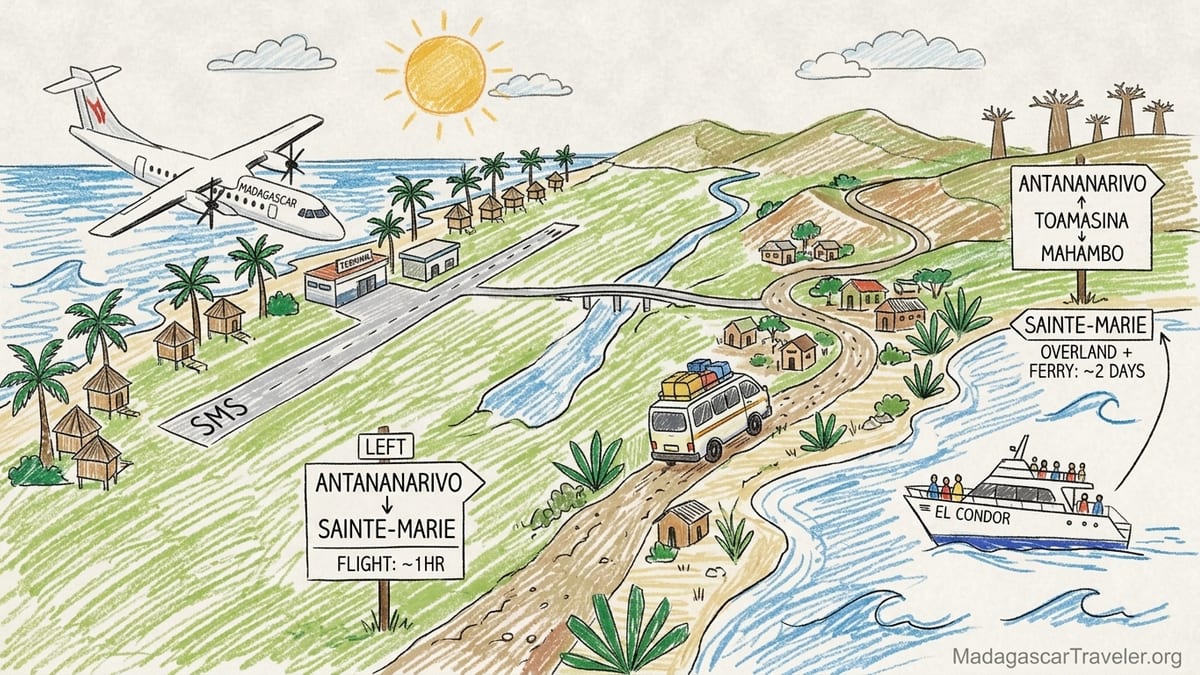
Reaching Île Sainte-Marie (Nosy Boraha) on Madagascar’s northeast coast is part of the adventure. Most travelers choose between a short domestic flight from Antananarivo to Sainte-Marie Airport or a longer but scenic combination of road and sea via Toamasina, Mahambo and the El Condor ferry. Each route has its own rhythm, risks and rewards, and which one works best will depend on your budget, luggage, tolerance for bumpy roads and rough seas, and how Sainte-Marie fits into your wider Madagascar itinerary.
Understanding Your Two Main Routes to Sainte-Marie
For leisure travelers, there are two practical ways to reach Sainte-Marie: flying directly into Sainte-Marie Airport from Antananarivo, or traveling overland to the east coast and taking the El Condor catamaran ferry from Mahambo, usually with a shuttle link from Toamasina (Tamatave). Both options are well established. Domestic flights are typically operated by Madagascar Airlines or its domestic brand, serving the TNR–SMS route several times per week with turboprop aircraft. The El Condor service currently runs several days a week between Mahambo and Sainte-Marie, with a sea crossing of around four hours and organized connections from Toamasina.
In practice, many visitors combine both modes. For example, a couple arriving in Antananarivo might fly straight to Sainte-Marie at the start of their holiday to relax on the island, then return via ferry and drive south along the coast from Toamasina. Others will save the more time-consuming ferry route for the middle of a longer overland journey, using quick flights at the very beginning and end of their trip to match international schedules.
Whichever route you pick, booking early and building in buffer time is essential in Madagascar. Domestic flight schedules change seasonally and can shift at relatively short notice, and ferry departures are subject to sea conditions and port authority decisions. Treat all published timetables as indicative and keep at least a one-day safety margin around any long-haul international flight.
Flying Antananarivo to Sainte-Marie: How It Works in Reality
Flying is by far the quickest and most straightforward way to reach Sainte-Marie from Antananarivo. Scheduled non-stop flights from Ivato International Airport to Sainte-Marie Airport typically take around 1 hour 5 minutes on ATR turboprops, with several weekly departures in the main season. On many recent schedules, there have been roughly 4 to 12 direct flights per week depending on the month, often concentrated on popular travel days like Friday to Sunday. These services are usually run by Madagascar Airlines or its domestic arm, with flight numbers such as MD530 or MD534 showing up in online timetables.
In real terms, you need to allow far more than the one-hour airborne time. Most hotels in central Antananarivo are 40 minutes to an hour from Ivato in light traffic, and it can take significantly longer at peak times. Airlines generally recommend arriving at least two hours before domestic departures, especially if you are checking bags. From your Antananarivo hotel door to your Sainte-Marie hotel, a realistic total journey time is 4 to 6 hours: transfer to the airport, check-in and security, the flight itself, baggage claim at Sainte-Marie, and then a short taxi or pre-arranged transfer to your lodge.
Prices fluctuate widely. In recent seasons, one-way fares for non-residents on TNR–SMS have often ranged from roughly 150 to 300 euros equivalent, sometimes higher in peak whale-watching months (July to September) or around local holidays. Promotional fares are rare and conditions can be restrictive, so if you see a schedule that fits your itinerary and a price within your budget, it is wise to lock it in. Many travelers book through local tour operators or Malagasy travel agencies, who are often better at tracking last-minute schedule changes than foreigners trying to manage everything online.
The El Condor Ferry via Mahambo and Toamasina
The alternative to flying is to reach Sainte-Marie by sea. The current benchmark service is the El Condor catamaran ferry operated by Blue Marine, running between Mahambo on the east coast and Sainte-Marie. Official tourism information notes that Mahambo is about 86 kilometers from Sainte-Marie by sea, with the crossing typically taking 3 to 4 hours in calm conditions. Recent operator information describes a morning departure set-up in Mahambo around 9:00 with arrival on Sainte-Marie in the early to mid-afternoon, roughly 15:00, although exact times vary by day and season.
To reach Mahambo, most travelers start in Toamasina (Tamatave), Madagascar’s main east coast city and commercial port. The road distance from Toamasina to Mahambo is around 90 kilometers, usually taking 2 to 3 hours by minibus or 4x4 depending on traffic and road conditions. El Condor typically offers an integrated road shuttle between Toamasina and Mahambo coordinated with the boat schedule. In practice this means an early start from Toamasina, a bumpy but scenic drive north past roadside villages and coastal scenery, and then boarding the ferry at Mahambo for the sea leg to Sainte-Marie.
In many recent seasons the El Condor has been operating around three days per week, with more frequent departures in the high season and fewer outside it. However, sea conditions govern everything. If the Indian Ocean swell becomes too strong or storms are forecast, the maritime authorities can suspend crossings for safety, sometimes for several days in a row. There are numerous reports from travelers of 2 to 10 day stretches with no sailings in June or during cyclone season, leaving people stranded at either Mahambo or Sainte-Marie. Any plan that depends on the ferry must therefore be flexible.
Total Journey Time: Door-to-Door Reality Check
From Antananarivo, a domestic flight is almost always faster door to door than any overland-plus-ferry combination. A typical timetable might look like this: hotel pick-up at 05:00, arrive at Ivato around 06:00 for check-in, flight at 08:00, landing at Sainte-Marie around 09:05, and at your beach bungalow around 09:45. Even allowing for moderate delays, you are comfortably on the island before lunch. By contrast, traveling from Antananarivo to Sainte-Marie via Toamasina and Mahambo is usually at least a full day and more realistically two.
A common real-world overland itinerary looks like this. On Day 1 you leave Antananarivo in the morning for the roughly 350 to 370 kilometer drive to Toamasina, which involves 7 to 10 hours on National Route 2 depending on traffic, trucks and weather. You overnight in Toamasina. On Day 2 you join the early shuttle up the coast to Mahambo, taking 2 to 3 hours, board the El Condor and spend about 4 hours at sea, arriving in Sainte-Marie by mid-afternoon if all goes smoothly. That is a two-day journey with roughly 13 to 17 hours in vehicles and on the water.
For travelers already on the east coast, the calculus is different. If you are finishing a rainforest circuit around Andasibe or Akanin’ny Nofy and heading east anyway, adding the Toamasina shuttle and El Condor ferry can make sense. In that case, Toamasina to Sainte-Marie in one travel day is realistic: 2 to 3 hours to Mahambo, boarding formalities, and 4 hours on the catamaran. However, you still need to factor in potential holds for bad sea conditions, which can turn a 1-day plan into several unplanned days in Mahambo or Toamasina.
Luggage, Comfort and Seasickness Considerations
Luggage limits and comfort are major factors for many visitors choosing between air and sea. On the TNR–SMS flights, checked baggage allowances for international-ticketed passengers are typically 20 to 23 kilograms per person in economy, plus a smaller hand luggage allocation, though exact rules depend on your ticket and airline. Excess baggage on domestic flights can be accepted but often at relatively high per-kilo fees, which add up quickly if you are carrying dive gear, camera equipment or heavy research supplies. Cabins on ATR aircraft are narrow with simple seating, but flights are short and the ride is usually smooth, with some turbulence during the wet season.
On El Condor, practical luggage limits are more generous but less standardized. The catamaran can handle bulky suitcases, surfboards or backpacks that would be awkward on a small aircraft, and staff are used to loading cargo, supplies and even motorbikes. In practice, as long as you can carry it and have paid the appropriate fare, it usually goes on board. However, you need to load and unload bags multiple times: onto the shuttle in Toamasina, off again at Mahambo, across the beach or small pier depending on tide and infrastructure, onto the ferry, and finally ashore at Sainte-Marie. This makes soft-sided bags with wheels, dry bags and waterproof covers particularly useful, especially in rainy months when you might be boarding in drizzle or spray.
Seasickness is another real concern on the ferry route. The northeast coast of Madagascar can see significant swells, and even with a modern catamaran, the ride can be choppy. Travelers regularly describe the crossing as smooth and pleasant in calm July mornings, sometimes even with humpback whale sightings in season, but very rough and tiring when the wind picks up. If you are prone to motion sickness, flying is usually the more comfortable option. If you do choose the ferry, bring strong motion sickness medication, avoid heavy meals beforehand, sit toward the center of the vessel, and have a waterproof bag handy just in case.
Reliability, Weather Risks and Seasonal Patterns
Neither option is immune to disruption, but the type of risk differs. Flights between Antananarivo and Sainte-Marie can experience schedule changes, delays or cancellations due to technical issues, crew availability or weather. However, since the route is an established domestic link served by one main carrier, operations tend to be relatively consistent outside of major disruptions. In the dry season (roughly May to October), early morning departures are often more punctual, with clearer weather and fewer thunderstorms building up over the highlands.
Sea crossings, by contrast, are highly dependent on ocean and wind conditions. In Madagascar, the maritime authority has the final say on whether ferries can operate. If the swell is too high or a weather system is moving through, El Condor and other boats are simply not allowed to sail. Travelers have reported sequences of days, even up to two weeks, with no crossings during periods of strong swell in June or around cyclone season (typically January to March). When this happens, passengers are either stuck on Sainte-Marie waiting to leave or stranded on the mainland with non-refundable hotel bookings on the island.
Seasonal patterns matter. If you are traveling in the peak whale season from roughly July to early September, both flights and ferries can be busy. Airfares are often higher, seats sell out far in advance, and El Condor may add extra crossings to meet demand. In cyclone season, ferry schedules become especially unpredictable, and many risk-averse travelers avoid planning a crucial Sainte-Marie leg for those months. For a once-in-a-lifetime honeymoon or a tightly scheduled holiday, the flight option usually provides a more reliable backbone, with the ferry used as a scenic extra rather than a dependency.
Transfers, On-the-Ground Logistics and Itinerary Design
One of the strongest arguments for flying is the simplicity of transfers at both ends. In Antananarivo, you can arrange a private taxi or hotel shuttle to Ivato International Airport and check in with your luggage in one step. On Sainte-Marie, most mid-range and upscale lodges south of Ambodifotatra offer airport pick-up, and even budget guesthouses can arrange a tuk-tuk or 4x4. Within an hour or so of landing, you can be in a beachfront bungalow near Ile aux Nattes, cocktail in hand, with minimal stress.
By comparison, the Toamasina–Mahambo–ferry route is more logistically involved. You must first reach Toamasina: either by a long road transfer from Antananarivo, by a domestic flight into Toamasina when available, or as part of a broader east coast loop. In Toamasina, your accommodation or the ferry operator will typically arrange a morning pickup in a shared minibus or 4x4 to Mahambo. At Mahambo, you check in again, load luggage onto the catamaran, and wait for boarding. On arrival in Sainte-Marie, you retrieve your bags and connect once more to a local taxi or pre-booked transfer, which might be organized by your lodge.
These extra steps are not necessarily a disadvantage. For slow travelers on a three or four week itinerary, the layered journey can become part of the experience: an overnight in colonial-era Toamasina, a morning coffee in a beach bar in Mahambo with the boat anchored offshore, and a sea approach to Sainte-Marie that reveals the island’s reefs and palm-fringed coast. However, for visitors with one week in Madagascar, or those traveling with young children or limited mobility, the convenience of flying often outweighs the charm of the ferry route.
Which Option Works Best at the Start or End of Your Trip?
At the very start of a Madagascar itinerary, flying usually makes the most sense. After a long-haul overnight flight to Antananarivo, most travelers are tired and jet-lagged. The idea of immediately tackling a 7 to 10 hour road transfer to Toamasina and navigating ferry logistics is rarely appealing. Instead, many choose to spend one night in Antananarivo to rest and then catch an early domestic flight to Sainte-Marie the following day, arriving mid-morning to recover on the beach. This strategy is particularly wise if your international arrival is in the late afternoon or evening, leaving little margin for missed connections.
In the middle of a longer itinerary, the ferry route comes into its own. A classic three-week east coast circuit might look like this: Antananarivo to Andasibe for rainforest and lemurs, on to the Pangalanes Canal and lakeside lodges, then down to Toamasina. From there you travel by road to Mahambo and El Condor to Sainte-Marie, spend several days on the island, and finally fly back to Antananarivo for your onward international flight. This way, the longer, less predictable sea and road segments are buffered by flexible days in the middle of the trip rather than up against a departure deadline.
For the end of your trip, risk management is key. Many experienced tour operators and guidebooks advise avoiding any route that depends on a single daily service or weather-sensitive crossing the day before an international flight. This is especially true for ferries. If you plan to end in Sainte-Marie and fly home from Antananarivo, the safest pattern is to leave the island by plane at least one full day, ideally two, before your long-haul flight, and spend your last night in the capital. If you do opt to return via El Condor and an overland journey, build in at least 48 hours of buffer time in case of cancellations or road delays.
Cost Comparison and Practical Booking Tips
Purely on ticket price, the ferry route can seem cheaper than flying, but the full cost picture is more nuanced. A one-way domestic air ticket between Antananarivo and Sainte-Marie for foreigners often costs the equivalent of several hundred US dollars in high season. By contrast, the combined price of an El Condor ticket plus shuttle from Toamasina to Mahambo is typically significantly lower. However, when you add the cost of getting from Antananarivo to Toamasina by road or plane, one or two nights of accommodation en route, meals and incidentals, the savings can shrink or even disappear.
Booking logistics also differ. Domestic flight tickets are commonly sold through Malagasy travel agencies, airline offices in Antananarivo, and some international booking sites. Many travelers find it easier to use a local tour operator who can issue tickets and re-confirm schedules in Malagasy, especially helpful if there are last-minute time changes. For El Condor, reservations are usually made via the company’s local contacts or by email or phone, sometimes through your hotel in Toamasina, Mahambo or Sainte-Marie. In high season, crossings can sell out several days in advance, so securing seats early is important if your dates are not flexible.
An effective strategy for many visitors is to mix and match: fly one way and take the ferry the other. For example, a couple on a two-week trip might fly from Antananarivo to Sainte-Marie at the start, spend five days on the island, sail back on El Condor with shuttle to Toamasina, and then continue by road to Andasibe before returning to the capital. This spreads the cost and risk between different modes and turns the journey itself into part of the experience.
The Takeaway
Choosing between a domestic flight and the El Condor ferry route to reach Sainte-Marie is not just a question of price. It is about how you want your journey to feel and how much uncertainty you are prepared to accept. Flights from Antananarivo to Sainte-Marie are fast, relatively straightforward and usually reliable, making them ideal at the very beginning and end of a trip or for travelers with limited time, young children or mobility constraints. The overland and sea route via Toamasina and Mahambo is slower and more vulnerable to weather-related disruption, but it can be more immersive, flexible for luggage and memorable for those who enjoy offbeat travel.
For most visitors on a short itinerary, flying both ways is the safest and simplest solution, with at least one spare day in Antananarivo before any international flight. For those with two or three weeks and an appetite for adventure, combining both options often delivers the best of all worlds: a quick hop when you need certainty and a day of roads and ocean when you want the romance of arriving by sea. Whichever path you choose, plan conservatively, build in buffers, and let the island’s slower rhythm guide the rest.
FAQ
Q1. Is it faster to fly or to take the ferry to Sainte-Marie from Antananarivo?
Flying is much faster. Door to door from Antananarivo to a hotel on Sainte-Marie typically takes 4 to 6 hours by plane, compared with at least two days via road to Toamasina, shuttle to Mahambo and the El Condor ferry.
Q2. How often do flights operate between Antananarivo and Sainte-Marie?
Flight frequency varies by season but there are usually several direct flights per week, with more departures in peak months like July to September and fewer in the low season. Schedules and days of operation can change, so always check close to your travel dates.
Q3. How reliable is the El Condor ferry service from Mahambo to Sainte-Marie?
In calm weather, El Condor is generally reliable and runs around three days per week or more in high season. However, crossings are suspended whenever sea conditions are unsafe, which can lead to several days in a row without sailings, especially around cyclone season or during periods of strong swell.
Q4. Can I get seasick on the Mahambo–Sainte-Marie crossing?
Yes, seasickness is common when the sea is rough. Even on a modern catamaran, swell and wind can make the 3 to 4 hour crossing uncomfortable. If you are prone to motion sickness, bring appropriate medication and consider flying instead.
Q5. Which option is better at the start of my Madagascar trip?
For most travelers, flying is better at the start. After a long international journey, a short domestic flight from Antananarivo to Sainte-Marie the next day is far more manageable than an immediate full-day road trip and ferry connection.
Q6. Which option is safer if I need to catch an international flight home?
Flying is usually safer as long as you build in a buffer. Plan to leave Sainte-Marie by air at least one day, preferably two, before your international departure from Antananarivo to allow for any delays or schedule changes.
Q7. Is the ferry cheaper than flying?
The ferry ticket and shuttle from Toamasina to Mahambo are generally cheaper than a direct flight. However, once you include the cost of traveling from Antananarivo to Toamasina, overnight stops, meals and extra time, the total saving may be smaller than it first appears.
Q8. Can I take large or heavy luggage on the ferry?
Yes. The ferry is usually more flexible for bulky items like surfboards, diving equipment or large backpacks. You will need to load and unload bags multiple times, so use robust, water-resistant luggage and be prepared to handle it yourself.
Q9. Is there a direct ferry from Toamasina to Sainte-Marie?
Currently, the main public route is via Mahambo, with El Condor operating between Mahambo and Sainte-Marie and offering shuttle connections from Toamasina. Direct passenger ferries from Toamasina itself to Sainte-Marie are not standard for tourists.
Q10. Should I book flights and the ferry in advance?
Yes. Domestic flights on the Antananarivo–Sainte-Marie route and El Condor ferry crossings both fill up, especially during whale season and holidays. Booking early through a local agency, your hotel or directly with the operator reduces the risk of being stranded or forced to change your itinerary at the last minute.