


Eastern Madagascar is where dripping green rainforest meets a warm, surf-tousled Indian Ocean coast. For a first-time visitor, the region can feel both inviting and confusing: Andasibe’s famous indri calls, boats sliding through the Pangalanes Canal, and beach towns like Foulpointe and Mahambo all sit along the same eastward axis, yet many itineraries treat them as a quick add-on to Antananarivo rather than a destination in their own right. This guide shows how the forests, waterways and beaches connect, how to move between them, and how to build an eastern route that stands on its own.
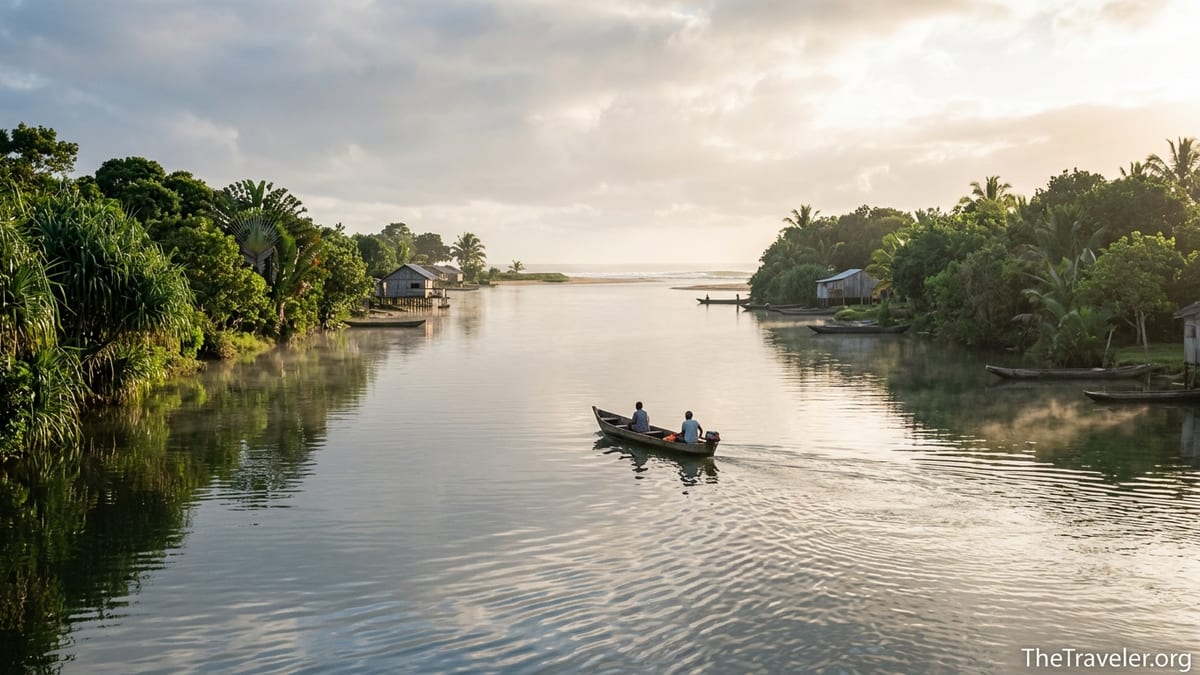
How the East Fits Together: Forest, Canal and Coast
The eastern flank of Madagascar follows a simple geographic logic that is not always obvious on a first look at the map. From Antananarivo you descend along Route Nationale 2 through cool highlands into lowland rainforest around Andasibe, then continue to the port city of Toamasina. Just inland from the ocean runs the Pangalanes Canal, a chain of natural lakes and man-made channels, with quiet bases such as Manambato and Akanin’ny Nofy. From Toamasina, the RN5 leads north along sandy coves and lagoons to Foulpointe and Mahambo. In practice, one long road and one sheltered waterway link most of the region you are likely to visit.
This geography creates a clear rhythm for travel. The first section is about encountering rainforest close up: damp trails, the calls of indri at Andasibe and quieter, wilder forest in Mantadia. The second section, usually reached by a short detour from the RN2, is about the waterways of the Pangalanes Canal, where you move at the pace of wooden pirogues and small motorboats, watching villages and fishermen slip by. The third section is coastal: Toamasina’s busy port and markets, then the gentler beach towns of Foulpointe and Mahambo, where coral reef, surf breaks and seaside dining come into focus.
Because the east sits conveniently between the capital and the ocean, many visitors see only a compressed version: one night in Andasibe, a glimpse of the canal and perhaps a rushed beach stop. With a week or more, you can let each environment breathe. Two or three nights in Andasibe, two nights on the canal, and another two or three along the coast let you experience how rainforest and sea are tied together by the same flow of water and people, rather than as isolated postcard scenes.
Understanding this pattern also helps you plan around seasons. The east is wet year-round, but the drier and more stable months from roughly July to November usually offer more comfortable forest walks and calmer conditions on the canal and coast. Even then, showers are common and the contrast between misty, cool Andasibe evenings and the warm, humid coast means packing for both fleece and flip-flops on the same trip.
Traveling the RN2 Corridor: From Antananarivo to Andasibe and Beyond
The RN2 is the spine of eastern travel. Officially it runs from Antananarivo to Toamasina, but for visitors the most important stretch is the 150 to 350 kilometer section between the capital, Andasibe and the coast. In good conditions, most drivers quote three to five hours from Antananarivo to the Andasibe area, depending on traffic leaving the capital and roadworks. Continuing from Andasibe to Toamasina typically adds another four to five hours. Road surfaces are paved but narrow and slow, with frequent trucks and occasional potholes, so daily distance sounds modest but feels long on the ground.
First-time visitors rarely self-drive here, and that is usually wise. Hiring a car with driver, either through a local agency in Antananarivo or a hotel, is the norm. As of mid 2026, travelers commonly report paying in the region of 70 to 100 US dollars per day for a vehicle with driver, fuel included, for a simple eastbound loop, with prices rising for 4x4s or highly experienced English-speaking guides. Shared taxis-brousse also ply the RN2, costing far less, but journey times can double, vehicles are often crowded, and they are less practical if you want to stop for forest hikes and side trips.
Along the RN2, Andasibe is the key base for the rainforest. The village area includes several small lodges such as Feon’ny Ala near the Analamazaotra reserve, where you can hear indri calls from the bungalows at dawn, and midrange options like Mantadia Lodge or Vakona Forest Lodge. These properties regularly arrange park guides and night walks. Planning at least two nights here is advisable so you can dedicate one full day to the Analamazaotra section of Andasibe, another to the wilder Mantadia sector if road conditions and budget allow, and still have time for a night walk and relaxed meals.
Past Andasibe, the RN2 descends through smaller settlements toward the coastal plain. Many travelers continue straight to Toamasina, but if you are heading to the Pangalanes Canal you will usually turn off earlier at Brickaville or a later junction for Manambato, where sandy tracks lead to the lakeshore. Because this leg involves slower driving on dirt roads, agencies commonly build in a stop or early start from Andasibe, reinforcing why it makes sense to treat the RN2 as a corridor with multiple overnight points rather than simply a long transfer from the capital to the sea.
Andasibe and Mantadia: Rainforest, Indri and Night Walks
Andasibe-Mantadia National Park is the most accessible window into Madagascar’s eastern rainforest. The Analamazaotra section, often just called Andasibe, sits a short drive from local lodges and offers half-day walking circuits where sightings of the indri, the largest living lemur, are common. Visitors regularly report hearing the haunting calls echo across the valley from as early as 5:30 in the morning, and local guides are adept at tracking family groups that stay relatively near the established trails.
On a typical first morning, you might leave your lodge around 7:30, pay park fees and hire a mandatory guide at the entrance, and then spend three to four hours on a loop tailored to your fitness. Prices vary but many travelers mention guide fees around the equivalent of 12 to 25 US dollars for a small group, plus park entrance charges that are usually collected per person. On these walks you are likely to see not only indri but also diademed sifakas, common brown lemurs, and a supporting cast of chameleons and tree frogs that guides pick out with remarkable precision.
Mantadia, about 15 to 20 kilometers north of Andasibe on a rougher track, is more demanding. You almost always need a 4x4 to reach its primary forest, and agencies often charge a supplement for the extra fuel and wear. In return you get wilder, older forest with fewer visitors on the trails. Birdwatchers value Mantadia for species such as the pitta-like ground roller and velvet asity, while patient walkers may encounter black-and-white ruffed lemurs high in the canopy. Because of the added effort, many travelers either dedicate a full day excursion to Mantadia or choose to skip it on their first short trip in favor of more time on the canal or coast.
Night walks are another highlight and tend to take place in private reserves or along roadside forest strips near Andasibe rather than inside the main national park. After dinner, usually around 18:30 or 19:00, guides lead you with headlamps in search of mouse lemurs, woolly lemurs and sleeping chameleons clinging delicately to branches. Expect a modest separate fee per person; lodges often offer package rates that bundle a daytime Andasibe visit and a night walk, which can simplify logistics. Two nights in the area is the bare minimum to do one day walk and one night walk without feeling rushed, while three nights lets you add Mantadia or a slower second morning on the same trails.
Manambato and Akanin’ny Nofy: Gateway to the Pangalanes Canal
Leaving the RN2 for Manambato marks a distinct shift from forest to water. The final stretch, reached via sandy tracks that can become muddy after heavy rain, ends on the shore of Lake Rasoabe. Simple lakeside hotels here, such as Hotel Pangalanes or other small bungalows, act as staging posts. Some travelers choose to spend a night at Manambato to break up the journey, especially if arriving late from Andasibe, while others treat it as a transit point, heading straight onto a boat once they arrive in late morning or early afternoon.
Boat transfers from Manambato to Akanin’ny Nofy, also known as Palmarium, are a core part of the eastern experience. Small motorboats usually take around one to one and a half hours to cover the lake and canal sections between the two. As of 2026, many hotels and local operators quote round-trip transfer costs in the region of 25 to 40 US dollars per person, sometimes higher if you are alone and chartering the boat. Since there is no fixed public timetable, most travelers arrange these transfers through their lodge at Akanin’ny Nofy or a trusted driver-guide before arrival.
Akanin’ny Nofy itself is a compact promontory between the canal and a lake, scattered with midrange bungalow lodges and a few more simple guesthouses. Palmarium Reserve is the main attraction, offering close-up views of several lemur species that are habituated to humans, including black-and-white ruffed lemurs and crowned lemurs that often come down to the lodge lawns. Some operators also arrange evening boat trips across the canal to small islands where, with patience and luck, you can glimpse the elusive aye-aye by torchlight. While purists sometimes debate whether these encounters feel too curated, for many first-time visitors they provide memorable, low-effort wildlife viewing that complements the wilder feel of Andasibe.
Because of the effort involved in reaching Akanin’ny Nofy, two nights is generally recommended, with three ideal if you enjoy slow days by the water. A typical program might include a morning walk in the reserve, an afternoon swimming or canoeing in the sheltered lakes, and one evening aye-aye excursion. The atmosphere here is markedly quieter than along the RN2, with electricity sometimes limited to certain hours and internet intermittent, which many visitors see as part of the canal’s charm.
The Pangalanes Canal: Life Along the Waterway
The Pangalanes Canal itself runs for hundreds of kilometers along Madagascar’s east coast, but as a first-time visitor you are most likely to see only the section between Manambato and Akanin’ny Nofy, and perhaps a little farther north toward Toamasina on longer boat trips. Even this short stretch gives a tangible sense of how important the waterway is for local communities. You will pass dugout pirogues laden with bananas or fuel, small villages that rely on the canal for transport, and children waving from sandy banks as you glide by.
Most visitors experience the canal in short segments rather than as a multi-day cruise. Day trips by motorboat from Akanin’ny Nofy often include stops at nearby lakeside villages, swimming spots and stretches of empty beach where the canal opens near the ocean. Prices are typically negotiated on site but often fall somewhere between 40 and 80 US dollars per boat for a few hours, depending on distance and fuel. Traveling with others is a simple way to keep costs manageable and can be arranged by asking your lodge to pair you with another small group.
Nights along the canal are quiet. After dark, the main sounds are frog calls, distant surf and the thrum of generators. Expect simple but atmospheric dining based on fresh fish, rice and locally grown fruit, sometimes served by candlelight during power cuts. Travelers who are used to city comforts sometimes underestimate how limited services can be here: cash machines are absent, card payments unreliable and mobile reception spotty. With planning, though, these constraints encourage you to slow down and focus on the setting rather than logistics.
From a route-planning perspective, the canal section breaks up the journey between the forest and the coast, and makes the east feel like a complete trip rather than a straight in-and-out from the capital. Instead of racing back to Antananarivo after Andasibe, you can flow naturally onward: forest walks, then boat rides and lakeside sunsets, then the bustle of Toamasina and the beaches beyond. This is the key mental shift for many first-timers who want to give the east the same weight they might automatically give to the south’s RN7 or the baobab coast.
Toamasina, Foulpointe and Mahambo: The Indian Ocean Coast
Toamasina, often still called Tamatave, is Madagascar’s main commercial port and the largest city on the east coast. It is not a resort in the classic sense, but it is a useful and interesting stop between the canal and the northern beaches. Many travelers spend one or two nights here to break the journey, stock up on cash from banks and ATMs, and explore the markets and colonial-era avenues with their clusters of cafes and street food stalls. The city’s seafront is lively but the surf and currents often make swimming unsafe directly in town, so locals tend to head north for proper beach time.
About 60 kilometers north of Toamasina along the RN5 lies Foulpointe, officially Mahavelona, a low-key beach town sheltered by an offshore coral reef. Because the reef breaks the surf, the lagoon here is calmer than many east coast beaches, making it popular with Malagasy families, especially on weekends and holidays. Simple guesthouses and a few more established hotels sit close to the sand, and you can rent basic snorkel gear locally or arrange a pirogue trip out to the reef for better visibility. Prices for these short boat excursions are often modest by international standards, although negotiation is expected and conditions vary with the tides.
Another hour or two up the coast brings you to Mahambo, a smaller village that has developed a reputation among surfers and independent travelers. Here the beach is longer and more exposed to swell, with a handful of surf camps and rustic bungalows dotted along the shore. Surfboard rental and lessons are available through local outfits, and the atmosphere is more laid-back than Foulpointe, with fewer day-trippers and more long-stay visitors. From Mahambo, boats depart several times a week in the dry season to the island of Sainte Marie farther north, which is another reason some travelers include it in an eastern route.
Choosing where to overnight along the coast depends on your interests and time. If you have a single night to spare after Toamasina, Foulpointe works well as a family-friendly stop with shallow water and wide beaches. If you have more time, two or three nights in Mahambo let you settle into a slower rhythm, try surfing and enjoy long walks along relatively undeveloped sands. While you could technically sleep only in Toamasina and day-trip to one of the beaches, the relaxed evenings, seafood grills and simpler pace in Foulpointe or Mahambo are a strong argument in favor of staying at least one night out of town.
Building a Standalone Eastern Itinerary
For a first-time visitor who wants the east to be a clear, self-contained chapter of a Madagascar trip rather than a footnote, it helps to think in terms of building blocks. The minimum that still feels coherent is about seven nights: two or three in the Andasibe area, two at Akanin’ny Nofy on the canal, one or two split between Toamasina and a beach town. That already gives you rainforest walks, canal boat rides and Indian Ocean sunsets without any internal flights and with only a moderate amount of road travel.
A common pattern for a week to ten days might look like this in practice. Day one, drive Antananarivo to Andasibe in four to five hours and take a short afternoon walk near your lodge. Day two, a dedicated morning in Analamazaotra with an official park guide and a night walk after dinner. Day three, either Mantadia as a full-day 4x4 excursion or a slower second morning in Andasibe before transferring to Manambato and onward by boat to Akanin’ny Nofy. Day four, explore Palmarium Reserve and relax by the water. Day five, optional canal excursions and another night by the lake. Day six, boat back to Manambato and continue by road to Toamasina for a city evening. Day seven and eight, head to Foulpointe or Mahambo for one to two nights on the beach before looping back to Antananarivo by road or, if schedules and budget allow, a domestic flight from Toamasina.
Within this framework you can expand or contract elements to suit different travel styles. Those more interested in wildlife might add a third or even fourth night in Andasibe-Mantadia to allow repeat dawn walks and more time in Mantadia’s primary forest. Canal enthusiasts might extend their stay at Akanin’ny Nofy or add another lodge farther along the waterway. Beach-focused visitors may choose to spend four or five nights divided between Foulpointe and Mahambo at the end, turning the coast into a true relaxation phase after the more active forest and canal days.
Crucially, building an eastern route like this stops the region from feeling like a single night’s detour off the main southern RN7 corridor. Even if you later add another region such as the baobab-studded west or the dry south, the east can stand alone as its own journey with a clear narrative: highlands to rainforest, rainforest to canal, canal to city, city to coast. Keeping transfers manageable, allowing for at least two nights in each main base, and accepting that a missed sight due to rain or road delays is normal in Madagascar will make the trip feel rewarding rather than rushed.
Practical Tips for First-Time Travelers in the East
Travel in eastern Madagascar still requires a degree of flexibility. Rain can affect road conditions, especially on the sandy tracks to Manambato and the rougher access road to Mantadia. When planning your route, avoid stacking long transfers back-to-back and try to schedule key wildlife activities in the morning, when rain showers are often lighter and animals more active. Having one “buffer” afternoon or day somewhere in the middle of your itinerary allows for delays without immediately cutting experiences.
In terms of budget, the east is not as expensive as some remote western regions that require charter flights, but costs add up through repeated park fees, guide payments and boat transfers. A midrange traveler might reasonably expect to spend the equivalent of 80 to 150 US dollars per day per person once accommodation, meals, guiding and transport are factored in, depending heavily on room choices and whether you are sharing vehicle and boat costs. Cash remains important, especially around Andasibe, Manambato, Akanin’ny Nofy and the beach towns, where card machines are unreliable or absent. Many visitors withdraw their main cash reserve in Antananarivo and top up in Toamasina if needed.
Language and guiding are central to a smooth trip. French is widely spoken in this part of Madagascar, while English is less common outside tourism services. Booking an English-speaking driver-guide through a local agency in Antananarivo or Toamasina can simplify negotiations at park entrances and boat docks and help manage expectations about travel times and conditions. Several recent travelers remark that having a bilingual driver during the Tana to Andasibe leg made both the road and later arrangements in Manambato feel less intimidating, particularly when traveling with children.
Finally, do not underestimate the climate contrasts. Andasibe evenings can feel cool and damp, with light fleeces and rain jackets very useful, while Toamasina, Foulpointe and Mahambo are warm and humid, calling for light clothing, sun protection and plenty of drinking water. Quick-drying clothes, a small travel umbrella, insect repellent and a compact dry bag for boat rides on the canal can all make day-to-day travel more comfortable. With these basics covered, you can focus less on managing conditions and more on listening for indri at dawn, watching pirogues on the canal and feeling Indian Ocean sand underfoot at the end of the day.
FAQ
Q1. How many days do I need for an eastern Madagascar trip that includes Andasibe, the Pangalanes Canal and the coast?
Most first-time visitors should plan at least seven nights to experience Andasibe, Akanin’ny Nofy on the canal and one coastal stop without feeling rushed.
Q2. Is it realistic to visit the east only as a side trip from Antananarivo?
While some travelers make a quick two- or three-day Andasibe excursion, the region is richer when treated as a standalone journey of a week or more.
Q3. Do I need a 4x4 for Andasibe and the Pangalanes Canal?
You do not need a 4x4 for the paved RN2, but a higher-clearance vehicle is very useful for the rough road to Mantadia and the sandy track to Manambato.
Q4. Can I travel by public transport along the RN2 and still visit these areas?
Yes, taxis-brousse run between Antananarivo, Andasibe and Toamasina, but they are slower and less flexible, and arranging local transfers to parks and boat docks becomes more complex.
Q5. Is Akanin’ny Nofy suitable for children and less active travelers?
Yes, Akanin’ny Nofy works well for families and those who prefer gentle walks, as much of the wildlife viewing is close to the lodges and boat rides are short.
Q6. When is the best time of year to visit eastern Madagascar?
The east is wet year-round, but conditions are generally more pleasant from about July to November, with slightly drier weather and calmer seas.
Q7. How safe is swimming along the east coast around Toamasina, Foulpointe and Mahambo?
Swimming in Toamasina itself is often discouraged due to waves and currents, while Foulpointe’s reef lagoon is calmer and Mahambo has stronger surf that suits confident swimmers and surfers.
Q8. Can I continue from Mahambo to Sainte Marie Island?
Yes, seasonal boats connect Mahambo to Sainte Marie several times a week in the drier months, but schedules change regularly and should be confirmed locally before you travel.
Q9. Should I book my accommodation and transfers in advance?
Booking ahead for Andasibe, Akanin’ny Nofy and coastal lodges is recommended, especially in July, August and around local holidays, and also helps secure reliable boat and car transfers.
Q10. Do I need to worry about malaria and other health issues in the east?
Malaria is present outside Antananarivo, so most travelers take prophylaxis and use mosquito protection, and it is important to consult a travel clinic before departure for up-to-date advice.