


Eastern Madagascar offers one of the country’s most achievable overland journeys: rainforest, quiet lakes, palm-fringed canals and mellow Indian Ocean beaches, all stitched together by a mix of road and boat transfers. This guide explains how to build a realistic route around Andasibe, Manambato, Akanin’ny Nofy on the Pangalanes Canal, and Toamasina, with Foulpointe or Mahambo as optional coastal extensions. It focuses on what is practically possible: which sections need a car, where you must use a boat, typical transfer times, and where it is worth staying two nights versus simply passing through.
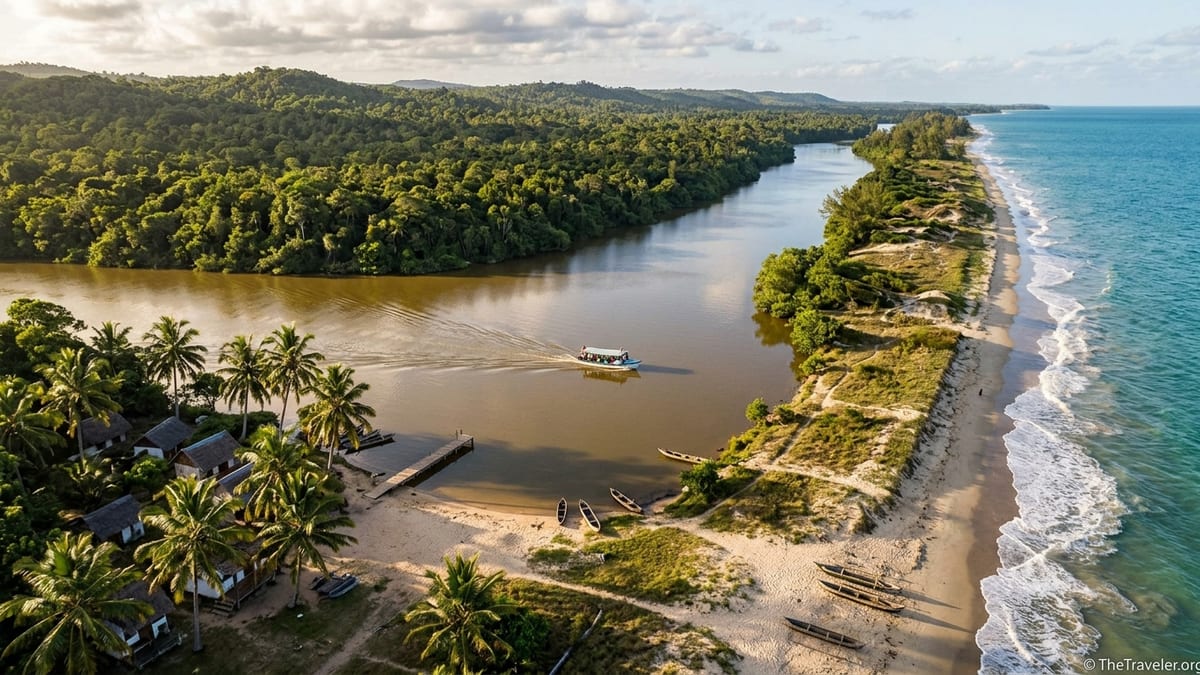
Understanding the Eastern Madagascar Corridor
The classic eastern route runs in a gentle arc from Antananarivo to Andasibe on the RN2, then down a side road to Manambato on Lake Rasoabe, across the Pangalanes Canal by boat to Akanin’ny Nofy, and onward to Toamasina (Tamatave). From Toamasina, travelers either end their circuit in the port city or continue north along the RN5 to the beach towns of Foulpointe (Mahavelona) and Mahambo. Each segment is short on the map but slower in reality because of road quality, weather and the informal pace of local transport.
In practice, this is a mixed-transport itinerary. You will normally travel by private car or organized vehicle between Antananarivo, Andasibe and Manambato, then board a motor boat to cross the calm waters of the Pangalanes Canal to Akanin’ny Nofy. From there, boats run north to riverside jetties near Toamasina. Beyond Toamasina, you return to the road network, using a private car, hotel-arranged transfer or taxi-brousse to reach Foulpointe or Mahambo. Having a clear sense of which legs are by road and which are by water is essential when you start requesting quotes from agencies or negotiating directly with local operators.
For most visitors, the full loop requires about 7 to 10 days, with two-night stays at Andasibe, Akanin’ny Nofy and at least one beach stop. With less time, you can still see a representative slice of the region by focusing on Andasibe plus the Pangalanes or on Andasibe plus Toamasina alone. The sections below walk through each segment in order, highlighting realistic timings and suggesting how to shorten the route if you are tight on days or budget.
Antananarivo to Andasibe: First Step into the Rainforest
The journey usually starts in Antananarivo (Tana) with a road transfer to Andasibe on the RN2. The distance is around 140 to 160 kilometers depending on your exact starting point and lodge location, but road conditions and traffic make this a 4 to 5 hour drive in a private vehicle. Travellers using reputable intercity minibus companies such as Cotisse Transport often report similar timings of roughly half a day between Tana and the eastern corridor, including rest stops and traffic delays on the way out of the capital.
This section is entirely by road and does not require a 4x4. A standard sedan or minivan is sufficient in the dry season, though a higher-clearance vehicle is more comfortable when rain has caused potholes to deepen. Many lodges in Andasibe can arrange a private transfer from Tana airport or city hotels, typically costing the equivalent of around 80 to 150 US dollars per vehicle depending on comfort level and whether the car waits with you for park visits. Budget travelers can book seats on scheduled minibuses, which are cheaper but depart on fixed schedules and may be slower to fill and depart.
Andasibe deserves at least two nights. One full day allows you to visit Analamazaotra Special Reserve to hear the haunting calls of the indri indri, and to join a guided night walk along the road near Mitsinjo Forest Station for mouse lemurs and chameleons. A second full day lets you attempt Mantadia National Park, which usually requires a one-hour 4x4 transfer from the village along a rough track, or to slow down and enjoy the lodge surroundings. Many travelers who try to do Andasibe in a single night find they are rushed and miss either the early-morning lemur activity or the nocturnal wildlife.
Andasibe to Manambato: Switching from Highway to Lakeshore
From Andasibe, the route continues east along the RN2 before turning off southwards to Manambato on the shores of Lake Rasoabe. The total distance from Andasibe to Manambato is approximately 120 to 130 kilometers, commonly scheduled as a 3.5 to 4.5 hour drive including breaks. Most organized itineraries from established agencies plan this as a half-day road transfer, leaving Andasibe after breakfast and arriving in Manambato by early afternoon to catch a mid-afternoon boat to Akanin’ny Nofy.
Until the junction, the RN2 is paved, though it is prone to potholes, slow trucks and occasional roadworks. The final approach to Manambato is the section where vehicle choice matters. The last several kilometers are on a dirt track that can become muddy and rutted, particularly after heavy rain. Many local operators specify a 4x4 or at least a high-clearance vehicle for this portion, and some itineraries explicitly call for a four-wheel drive to handle the track into Manambato during the wetter months. In the dry season, experienced drivers sometimes manage with sturdy two-wheel-drive vehicles, but visitors are generally more comfortable in a 4x4.
Manambato itself is a small lakeside settlement used mainly as a departure point for boats to Akanin’ny Nofy. Basic lakeside accommodations exist, and some travelers choose to spend a night here to break the journey, enjoying the quiet beach and freshwater swimming. However, with good coordination, it is usually more efficient to continue directly to the boat. If your driver reaches Manambato around midday, you can often connect with scheduled lodge boats or charter a local motor canoe, allowing you to sleep that same night on the Pangalanes Canal.
Boat Journeys on the Pangalanes: Manambato to Akanin’ny Nofy and Toamasina
From Manambato, the road ends and the waterway begins. The crossing to Akanin’ny Nofy, on the shores of Lake Ampitabe, is by motor boat along the tranquil Pangalanes Canal. Typical transfer times quoted by lodges and recent travelers range around 45 minutes to one hour for the direct boat ride. The water is usually calm, sheltered from ocean swell, and the journey is considered suitable for children and nervous sailors, with lifejackets commonly provided.
Boat transfers are usually arranged through your accommodation. Mid-range properties such as Palmarium and other lakeside lodges often schedule one or two daily services, timed to coincide with expected arrivals from the RN2. Some travelers choose to charter private boats if their arrival does not align with scheduled departures, which naturally increases costs. As a rough indication, older forum posts mention total packages for several people that bundled boat transfers and park visits at a few hundred euros; in current terms, travelers typically budget tens rather than hundreds of US dollars per person for a one-way shared boat transfer when arranged locally, though exact prices fluctuate with fuel costs and season.
Once based in Akanin’ny Nofy, you are in the middle of the canal network. The standard pattern is to spend at least two nights, giving one full day for exploring private reserves, visiting lakeshore villages or taking shorter boat excursions to nearby sandbars and forest fragments. Lemurs are often habituated around the lodges here, providing intimate wildlife encounters. When ready to move on, boats can continue north along the canal system to river jetties that provide access to Toamasina. Organized mini-cruises along the Pangalanes have itineraries that run from Brickaville through Ambila-Lemaitso and Akanin’ny Nofy before reaching Toamasina, typically over two nights, showing that a multi-day water journey is possible if you prefer a slower, cruise-style approach.
If your time is limited, the most efficient option is to take a direct or near-direct boat from Akanin’ny Nofy to a river port near Toamasina, then transfer by road into the city. This combined boat and car segment usually occupies most of a day, depending on where along the canal you join the road, but it saves you backtracking to Manambato. Travelers on tighter budgets sometimes return by boat to Manambato and then use road transport to Toamasina via Brickaville, but this adds hours and complexity. For first-time visitors, it is generally easier to let a local operator or lodge coordinate the precise boat routing and corresponding road pick-up point.
Toamasina: Port City Hub and Gateway to the Coast
Toamasina, often called Tamatave, is the main port on Madagascar’s east coast and a natural hub between the Pangalanes Canal and the Indian Ocean beaches to the north. It is accessible by a mix of boat and road from Akanin’ny Nofy or by the RN2 directly from Antananarivo in around 8 to 10 hours by private vehicle depending on conditions. The city’s Ambalamanasy airport also receives domestic flights, typically around 40 minutes from Antananarivo, offering an option to fly one leg of your itinerary if you wish to avoid a long road day.
Within Toamasina, road transfers are handled by taxis, tuk-tuks and hotel shuttles. The RN5 begins on the northern side of the city and heads toward Foulpointe and Mahambo. Many visitors use Toamasina as a one- or two-night stop to catch up on practicalities such as banking, shopping and laundry, while also exploring the seafront promenade, local markets and colonial-era architecture. Mid-range hotels cluster near the seafront and close to the airport, and some can arrange onward transport north along the coast on request.
In terms of itinerary structure, Toamasina is a natural place to pause. If you have around a week in the region, you might spend one night in Toamasina after leaving the Pangalanes, then continue to Foulpointe for the beach before looping back to Antananarivo by road or domestic flight. With more time, Toamasina can also be the jumping-off point for onward journeys to Sainte Marie Island via Mahambo, though that typically requires at least several extra days and a separate planning effort.
Foulpointe and Mahambo: Optional Coastal Extensions
North of Toamasina, the coastal road (RN5) leads first to Foulpointe, then further to Mahambo. Both are realistic, low-stress extensions to an itinerary that already includes Andasibe and the Pangalanes, provided you allow an extra two to four days. Road conditions vary, but the distances are relatively short: Foulpointe is roughly 60 kilometers north of Toamasina, while Mahambo lies around 85 to 90 kilometers further along the same road. Under ideal conditions, driving times can be around one and a half to two hours to Foulpointe and roughly two hours or a little more to Mahambo, but potholes, weather and slow traffic often stretch these durations.
Travelers typically choose between Foulpointe and Mahambo depending on their priorities. Foulpointe is closer to Toamasina and popular with local holidaymakers, with a shallow lagoon protected by a reef, simple beach restaurants and the historic Fort Manda nearby. Mahambo, further north, has a quieter atmosphere and is known as a good surfing area, with a larger lagoon and more space to spread out. Some travelers simply visit one or the other; others spend two nights in Mahambo and use a taxi-brousse or private transfer back to Toamasina on their departure day, allowing around half a day for the return.
Transport options for this segment are fully road-based. You can hire a private car and driver from Toamasina, which is more comfortable and flexible, or head to the northern taxi-brousse station and look for shared minibuses heading toward Foulpointe, Mahambo or further along the RN5. Recent traveler accounts mention taxi-brousse fares that are modest by international standards, though departures can be unpredictable and vehicles often wait to fill before leaving, so it is wise to avoid trying to connect on the same day with flights or fixed commitments. For a short beach extension at the end of a trip, many visitors find that paying extra for a private transfer is justified by the time saved and the reduced stress.
How Many Nights Where: Building a Realistic Route
For a balanced 8 to 10 day itinerary focused on this eastern corridor, a common pattern is: two nights in Andasibe, one night in Manambato or directly on to Akanin’ny Nofy, two or three nights in Akanin’ny Nofy, one night in Toamasina, and two or three nights at either Foulpointe or Mahambo. This allows for unhurried wildlife viewing in the rainforest, at least one full day on the Pangalanes Canal, and ample time to enjoy the coast without spending every second day in transit.
Two-night stops are particularly worthwhile at Andasibe, Akanin’ny Nofy and at your chosen beach destination. In Andasibe, the extra night lets you experience both daytime and night walks, and possibly the remote Mantadia sector if conditions and budgets allow. At Akanin’ny Nofy, staying two or more nights means you are not just passing through between boats but can explore the surrounding canal, visit lakeshore villages and enjoy the lodge setting. At the coast, two or three nights let you slow down after the logistics of moving between city, forest and canal, and also act as a buffer in case of minor transport delays.
Shorter single-night stops are most useful in transit hubs such as Antananarivo and Toamasina, or at Manambato if your schedule requires it. For example, a traveler arriving late to Antananarivo might overnight there, transfer to Andasibe the next morning, then move on to Manambato and Akanin’ny Nofy over the following days. Another traveler might arrive back to Toamasina from the Pangalanes in late afternoon, spend a night in the city, then continue north to Foulpointe the next morning. In both cases, the overnight stay is less about sightseeing and more about absorbing the unpredictability of travel.
When costing the route, remember that each segment involves separate arrangements: road transfers, boat transfers and accommodation. A practical approach is to ask two or three local tour operators or lodges for sample quotes covering the exact segments you plan to travel. For instance, someone might request a package from an Andasibe lodge covering the transfer to Manambato plus the lake boat, and a second package from an Akanin’ny Nofy lodge covering boat onwards to Toamasina. Comparing these concrete proposals gives a clearer understanding of real-world pricing than theoretical day-by-day budgeting.
Shortening the Itinerary for Limited Time
Travelers with only 5 to 7 days available can still capture the essence of eastern Madagascar by trimming the route. One efficient option is to focus on Andasibe and the Pangalanes, skipping the coastal extension. In practice, this might look like: two nights in Andasibe, two nights in Akanin’ny Nofy, and one night in Toamasina at the end before flying or driving back to Antananarivo. This keeps your transport pattern simple: road from Tana to Andasibe, road to Manambato, boat to Akanin’ny Nofy, boat and road to Toamasina, then a single long road or short flight back to the capital.
If you are especially drawn to beaches and less to canals, another shortened version keeps Andasibe and the coast while omitting the Pangalanes overnight. In that case, you could spend two nights in Andasibe, then continue by road directly to Toamasina and on to Foulpointe or Mahambo for three or four nights, using Toamasina mainly as a transit stop. You would still see rainforest and the Indian Ocean, but you would experience the Pangalanes only from the road where it parallels the canal rather than by boat.
For travelers on very tight schedules or those arriving on late flights, consider using domestic flights between Antananarivo and Toamasina in one direction. For example, you might fly to Toamasina on arrival, spend one or two nights there and at Foulpointe, then travel overland via Andasibe back to Antananarivo. This pattern reduces duplicated road segments and gives you both coastal and rainforest experiences without having to fit every possible combination into a single week.
Whichever shortened pattern you choose, build in at least one “buffer” night somewhere non-essential, such as Toamasina or the capital. In the real world, landslides can slow traffic on the RN2, and boats on the Pangalanes may depart later than planned. Having a night that can absorb delays means you are less likely to miss an international flight or have to sacrifice a key wildlife experience due to lost time.
The Takeaway
The eastern Madagascar corridor from Andasibe to the Pangalanes Canal, Toamasina and the northern beaches is one of the country’s most accessible combinations of rainforest, inland waterways and sea. It is realistic for independent travelers provided they respect the slow pace of local transport, understand which legs are by car and which by boat, and allow generous margins in their day-to-day plans. Most visitors benefit from a mix of pre-arranged transfers and flexible local bookings made through lodges once on the ground.
In broad strokes, expect road travel between Antananarivo, Andasibe, Manambato, Toamasina and the coastal towns, with a crucial boat link between Manambato and Akanin’ny Nofy and further boat options along the Pangalanes. Plan on half-day blocks rather than point-to-point timings measured in minutes, and prioritize three key two-night stops: Andasibe for rainforest, Akanin’ny Nofy for canal life, and one beach destination for rest. If you must shorten the route, choose whether canals or coast matter more, and shape the itinerary accordingly.
With this structure in mind, you can talk to local operators, compare example quotes and refine the plan into a concrete schedule that fits your budget and time frame. The reward is a journey that feels rich and varied without being rushed: waking to indri calls in misty forest, gliding past palms on glassy canal water, and finishing your days with your feet in the sand on Madagascar’s quieter east coast.
FAQ
Q1: Do I need a 4x4 vehicle for this itinerary?
For most of the RN2 and RN5, a standard car or minivan is usually sufficient in the dry season, but the dirt track into Manambato and the access road to Mantadia National Park are often rough. Many travelers and local operators therefore prefer or require a 4x4 for those specific sections, especially after rain.
Q2: How long does it take to travel from Antananarivo to Andasibe?
The distance is around 140 to 160 kilometers, and in real conditions it generally takes 4 to 5 hours by private car, including getting out of Antananarivo’s traffic and allowing for roadworks or slow trucks on the RN2.
Q3: How much time should I plan for the boat from Manambato to Akanin’ny Nofy?
Most lodge-operated motor boats take roughly 45 minutes to one hour for the crossing along the Pangalanes Canal. It is wise to arrive in Manambato by early afternoon to connect with scheduled departures.
Q4: Is it possible to visit the Pangalanes Canal as a day trip from Toamasina?
Yes, some local operators offer day excursions by boat from Toamasina to nearby sections of the Pangalanes, but this will only give you a brief taste. To experience the quieter stretches around Akanin’ny Nofy, an overnight or two-night stay is strongly recommended.
Q5: How many nights should I spend in Andasibe?
Two nights is a good minimum. It allows one full day for the main Analamazaotra Reserve plus a night walk, and the option of a second daytime hike or a trip toward Mantadia National Park without feeling rushed.
Q6: Which is better for beaches, Foulpointe or Mahambo?
Foulpointe is closer to Toamasina with a shallow reef-protected lagoon and a livelier local holiday atmosphere, while Mahambo is further north, usually quieter and known for better surfing and a larger lagoon. Your choice depends on whether you prefer convenience and bustle or a more laid-back feel.
Q7: Can I do this itinerary by taxi-brousse instead of private car?
It is possible to use taxi-brousse on the main roads between Antananarivo, Toamasina, Foulpointe and Mahambo, which lowers costs but increases uncertainty around departure times and comfort. For the side road to Manambato and the boat coordination to Akanin’ny Nofy, many travelers still rely on lodge-arranged vehicles or local tour operators.
Q8: Is it safe to travel on the Pangalanes Canal with children?
The Pangalanes Canal near Manambato and Akanin’ny Nofy is generally calm and protected from ocean swell, and lodges typically provide lifejackets. Families regularly report the boat ride as a highlight for children, though normal precautions such as staying seated in the boat and supervising kids at jetties still apply.
Q9: When is the best time of year to do this route?
The drier months from roughly May to October usually bring better road conditions and more comfortable humidity levels, making transfers to Manambato and coastal driving easier. The wetter months can still be rewarding but may involve muddier tracks, more rain on boat days and a higher chance of transport delays.
Q10: How should I shorten the route if I only have one week?
With about seven days, focus either on Andasibe plus the Pangalanes Canal, or on Andasibe plus the coast. A practical pattern is two nights in Andasibe, two nights at Akanin’ny Nofy or a beach town, and one or two nights in Toamasina or Antananarivo as buffer and transit stops, rather than trying to include every destination.