


Few journeys in Madagascar are as rewarding, or as frequently underestimated, as the drive from Antananarivo to Andasibe along the RN2. On paper it is a modest distance of roughly 140 to 160 kilometers from most central Tana hotels to the village of Andasibe. In practice, traffic, roadworks, weather and city congestion mean the trip can take anywhere from three to five hours one way. Planning your transport carefully, and knowing where to break the drive with worthwhile stops such as the reptile reserves around Marozevo, can transform a simple transfer into one of the highlights of your trip.
Understanding the RN2 from Antananarivo to Andasibe
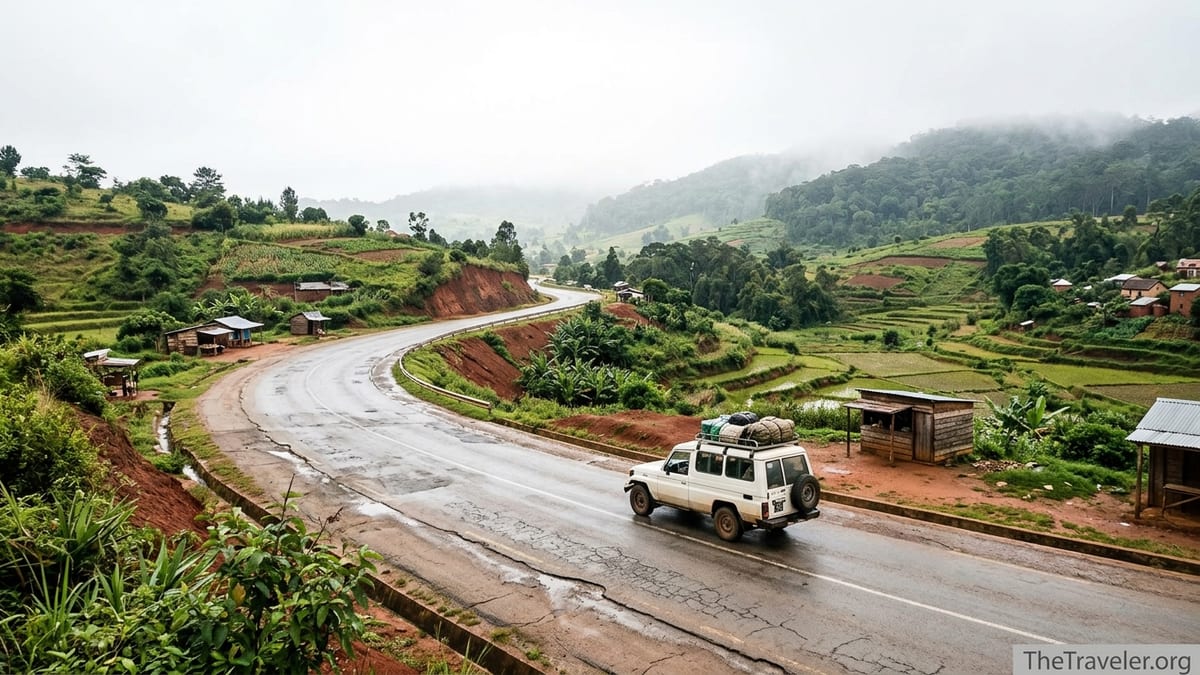
The RN2 is the main highway linking Antananarivo with the east coast and the port city of Toamasina. Andasibe lies just off this road, near the small settlement of Andasibe (sometimes still called Périnet), around 140 kilometers from central Antananarivo and roughly 160 kilometers from Ivato International Airport. Most of the route is paved, but the combination of heavy truck traffic, frequent curves and local village life along the roadside keeps average speeds low.
From downtown Antananarivo, it typically takes 45 minutes to 1.5 hours just to clear the capital’s traffic and reach the outskirts where the RN2 starts in earnest. Once on the open road, you pass rice paddies, eucalyptus-clad hills and small towns such as Manjakandriana and Moramanga. The last 25 to 30 kilometers from Moramanga to Andasibe are generally quieter and more forested, but you still share the road with taxi brousse vans, trucks and pedestrians.
Under ideal conditions with a private vehicle, many local drivers still quote around three hours one way from central Tana to Andasibe. In reality, four hours is a more realistic planning figure, and five hours each way is not unusual during heavy rain, roadworks or peak traffic around the capital. When you are deciding whether to attempt a day trip or stay overnight, use four hours as a conservative baseline and treat anything faster as a bonus.
The RN2 surface itself is mostly sealed but variable. You can expect sections of smooth tarmac alternating with potholes, subsidence and occasional unmarked speed bumps as you pass through villages. Driving after dark is strongly discouraged for visitors because of poor lighting, livestock on the road and the risk of unlit vehicles, so most itineraries aim to complete the journey in daylight.
Private Driver: Flexible and Time-Efficient
For most travelers, hiring a private car with a driver is the most practical way to travel between Antananarivo and Andasibe, especially if you want to build in stops such as the Peyrieras or Madagascar Exotic reserve near Marozevo. Private transfers can usually pick you up directly from your hotel in the city or from Ivato Airport and drive you door to door to your lodge in Andasibe.
Pricing varies with vehicle type and how many days you keep the car, but as of 2025 and 2026 many travelers report paying in the region of 200,000 to 300,000 Malagasy ariary per day for a standard car and driver on sealed roads, excluding fuel. That often works out to somewhere around 40 to 60 euros per day at recent exchange rates, though longer itineraries and better quality vehicles can be higher. A dedicated one-way Tana to Andasibe transfer in a comfortable 4x4 is commonly priced higher than that day rate, so it is worth asking for an exact quote and confirming whether fuel and tolls are included.
The major advantage of a private driver on RN2 is control over your schedule. You can depart Antananarivo as early as 5:00 or 6:00 in the morning, which helps you avoid the worst city traffic and gives you time for a relaxed stop at a reptile reserve and a sit-down lunch in Moramanga before reaching Andasibe in the early afternoon. On the return, you can leave after a final morning walk in Andasibe and still be back in the capital before dark. This flexibility is difficult to match with any other mode of transport.
Another advantage is safety and comfort. A reputable driver used to RN2 traffic will know the blind corners, where trucks tend to overtake, and how to handle sudden obstacles like zebu cattle or a broken-down lorry on a hill. Air conditioning, the ability to stop for photos, and a secure place to leave luggage during roadside visits all add to the appeal. For small groups or families, splitting the cost among three or four people often makes a private driver similar in per-person cost to better quality shared transport, but with far more flexibility.
Organised Tour Transfers and Day Trips
Many Andasibe lodges and tour operators based in Antananarivo offer package transfers that include a vehicle, driver and sometimes an accompanying guide. These can be arranged as simple one-way transfers, as part of a broader circuit around Madagascar, or as dedicated Andasibe excursions. Prices often bundle in guiding services inside the parks, park entrance fees and sometimes meals, so direct comparisons with bare transport quotes can be tricky.
Pre-arranged tour transfers are particularly popular with travelers who prefer not to negotiate directly with individual drivers on arrival. For example, a common package sold through international agents might include an early morning pickup in Antananarivo, a stop at Peyrieras Reptile Reserve in Marozevo, lunch in Moramanga and a late afternoon guided walk in Analamazaotra Special Reserve, followed by night walk arrangements outside the park. The next day, you might continue on to Mantadia National Park before returning to the capital, or carry on east toward the coast.
Some operators advertise ambitious same-day Andasibe tours from Tana that depart before dawn and return late at night. These typically involve seven to ten hours of road time plus several hours of walking in the forest. While logistically possible in the dry season and with a disciplined schedule, it is a long and tiring day that leaves little margin for delays and often misses the most atmospheric evening and early morning wildlife activity.
When evaluating tour packages, ask very specific questions about departure time from Tana, the order of stops, how much time you will actually spend in the forest, and what happens if there are delays on the RN2. Also check whether the driver is the same person as your naturalist guide or whether a local park guide will join you on arrival, which is the norm in Andasibe. Clarifying these details helps ensure your expectations align with what is realistically possible in a single day.
Renting a Vehicle and Self-Driving RN2
Self-driving in Madagascar is an option but not one to take lightly. Rental agencies in Antananarivo do exist, usually offering compact cars and 4x4s with manual transmission. However, many local companies strongly prefer to rent vehicles with a driver included, partly due to insurance and liability reasons on challenging roads like RN2. Pure self-drive contracts tend to be more expensive than in many other countries and may involve significant deposits.
If you do secure a self-drive rental, the RN2 east of Antananarivo is one of the more manageable major routes in the country, thanks to its fully paved surface and frequent traffic. Even so, expect narrow lanes, aggressive overtaking by taxi brousse vans, slow-moving trucks on hills and pedestrians and animals drifting across the roadway. The combination of steep sections, sharp curves and inconsistent road maintenance means that you need to drive defensively at all times.
Navigation is straightforward: from central Tana you follow signs toward Toamasina, pass through the outskirts and simply stay on RN2 until the signed turnoff to Andasibe, a few kilometers after Moramanga. Mobile coverage is present in many stretches but not continuous, so offline maps or a pre-downloaded navigation app are recommended. Fuel stations with card facilities are limited outside the capital, so it is sensible to start the day with a full tank and some cash in local currency.
For most visitors, the main drawback of self-driving is fatigue. Managing the traffic out of Tana, then concentrating through several hours of winding highway, leaves many drivers too tired to fully enjoy an afternoon in the rainforest. Unless you are very comfortable driving in similar conditions elsewhere, a car with a local driver usually offers a more relaxing and not dramatically more expensive alternative, while still preserving the freedom to stop whenever you choose.
Shared Transport: Taxi Brousse and Company Shuttles
For budget travelers, taxi brousse shared vans remain the classic way to travel between Antananarivo and the eastern highlands. Services to Moramanga and onward to Andasibe typically depart from dedicated taxi brousse stations in the capital, such as those around the Ampasapito area, with companies like Compima commonly mentioned by recent travelers. You buy a seat rather than the whole vehicle, and the van only departs when full.
A typical pattern is to take a taxi brousse from Antananarivo to Moramanga first, which can take around three hours under favorable conditions but longer if there are delays or frequent stops. From Moramanga you transfer to a second, usually smaller, vehicle for the final 45 minutes to one hour on to Andasibe. Fares reported in recent years suggest that the Moramanga to Andasibe leg costs only a few thousand ariary, keeping the overall journey cost very low by international standards, even if inflation continues to push prices upward over time.
The trade-off is time and comfort. Delays of seven to eight hours from Tana to Andasibe are not unheard of when you factor in waiting for departures, loading of goods, intermediate stops and the transfer at Moramanga. Seating can be cramped, luggage often rides on the roof, and there is little control over intermediate stops for sightseeing. Safety standards vary, and some experienced visitors consider the risk on crowded long-distance taxi brousse services higher than they are personally comfortable with.
In addition to traditional taxi brousse, there are more structured shuttle-style operators that link Antananarivo with key towns along RN2. Some publish indicative journey times of around two to three hours from Tana to Andasibe under good conditions, though this usually assumes direct travel with minimal stops and favorable traffic. These services may offer safer driving and more predictable schedules than informal vans, but they seldom allow the flexibility of a private transfer for stopping at places like Peyrieras or lingering over a long lunch in Moramanga.
Departure Timing, Road Conditions and Useful Stops
When traveling from Antananarivo to Andasibe, timing is everything. Leaving the capital between 5:00 and 7:00 in the morning dramatically reduces the time you spend in city traffic and maximizes your daylight hours in Andasibe. Departing after 9:00 often means battling congestion, particularly on weekdays, and can easily add an extra hour to your journey. On the return, most travelers aim to leave Andasibe by early afternoon to avoid driving into Tana after dark.
Weather has a direct impact on RN2 conditions. In the dry season, usually from May to October, the road surface is generally smoother and visibility is better, though dust and smoke from roadside fires can reduce clarity in some stretches. During the wetter months, heavy rain can create standing water, increase the risk of landslides in steeper sections and slow down truck traffic. Occasional roadworks can also create temporary single-lane bottlenecks with wait times that vary from a few minutes to over half an hour.
The classic scenic and wildlife stop on this route is Peyrieras Reptile Reserve, also known as Madagascar Exotic, near Marozevo around 70 to 75 kilometers east of Antananarivo. Set in a small valley with rice fields, mango and lychee trees, this private reserve introduces visitors to many of Madagascar’s signature reptiles and amphibians, including colorful chameleons, geckos, frogs and crocodiles. Guides usually lead short walks through several enclosures and forested areas, and habituated sifaka and brown lemurs often appear for feeding, which makes it popular with photographers and families.
Visiting Peyrieras typically adds about 60 to 90 minutes to your journey, including time to park, pay the entrance fee in ariary and take a guided circuit. For many travelers, this stop is worthwhile as a first encounter with Madagascar’s wildlife before heading into the more natural habitats of Andasibe’s national parks. If you prefer more open, less captive-style experiences, you may choose to skip Marozevo and instead plan for a longer afternoon or an additional night walk once you arrive in Andasibe.
Arrival in Andasibe: What to Expect
As you approach Andasibe from Moramanga, the roadside scenery gradually shifts from patchwork farmland to denser vegetation, with roadside stalls selling fruit and local snacks. The village itself is modest, spread along the main road, with a handful of guesthouses, basic shops and small eateries. Most visitors stay in lodges and hotels set slightly back from the main highway, some along the river and others near the forest edge, which offer quieter surroundings and easy access to the parks.
Two protected areas form the heart of most itineraries here: Analamazaotra Special Reserve, often still called Périnet Reserve, and the larger Mantadia National Park. Analamazaotra is closest to the village and is where many first-time visitors go to seek the haunting calls of the indri, the largest living lemur species. Trails range from easy one to three hour circuits to more demanding half-day routes. Mantadia lies a little further away on a rougher track that forks off the RN2, and rewards those with more time with wilder forest and fewer crowds.
On arrival, most lodges will help you arrange official park guides for walks inside Analamazaotra and Mantadia. Guiding is mandatory in these protected areas and is usually paid per group, not per person, making it economical for couples or small parties. Night walks, which are typically organized along the roadside forest corridors outside the park boundaries, are one of the highlights of Andasibe. They offer the chance to see mouse lemurs, chameleons and a variety of nocturnal insects under the beam of a guide’s flashlight.
Practicalities in Andasibe are straightforward but basic. There is usually mobile network coverage in the main village, though data speeds can be slow. Bring enough cash in ariary for park fees, guiding, meals and any tips, as card payments may not be reliably accepted outside the higher-end lodges. Electricity supply can be subject to outages, especially during storms, but most well-established lodgings have back-up generators. Nights are often cooler than Antananarivo, so a light jacket is useful, and rain is possible at any time of year in these highland rainforests.
Day Trip or Overnight: What Is Realistic?
Because Andasibe is relatively close to Antananarivo by Madagascar standards, many travelers wonder if a day trip is enough. Technically, with a private car and very early start, it is possible. A typical plan would be to depart Tana around 5:00, reach Peyrieras by 7:30 or 8:00, spend an hour there, arrive in Andasibe around late morning, do a three to four hour guided walk in Analamazaotra, and then depart by mid-afternoon to arrive back in the capital between 19:00 and 21:00. Some tour operators offer exactly this schedule, especially in the dry season.
However, such a day is long and leaves little room for delays, extended wildlife sightings or rest. If city traffic is bad in the morning, if there is roadwork on RN2, or if rain slows progress, you quickly compress your time in the forest. You are also likely to miss two of Andasibe’s most magical moments: the early morning chorus of the indri and the atmosphere of a night walk in the forest margins, when nocturnal life emerges.
For these reasons, most experienced visitors and local guides recommend at least one night in Andasibe, and ideally two. With an overnight stay, you can arrive in the afternoon, settle into your lodge, enjoy a night walk after sunset, then wake early for a morning trek when the forest is at its most active. A second night gives you time to visit both Analamazaotra and Mantadia or to return to a favorite trail at a more relaxed pace. The extra day also provides a buffer if your outbound journey is slower than expected.
If your time in Madagascar is very limited and a day trip is your only option, choose a reputable operator, confirm that they are willing to skip optional stops if delays threaten your time in the reserve, and be realistic about how physically demanding the day will feel. Ensure you have warm layers for the early start and late return, snacks and water for the road and a clear understanding that traffic and weather can still force adjustments even in the best-planned itinerary.
The Takeaway
Traveling from Antananarivo to Andasibe via the RN2 is one of the most accessible ways to experience Madagascar’s iconic rainforests and lemurs, yet it requires more time and planning than the modest distance suggests. A realistic one-way journey time of three to four hours in a private car, and often longer by shared transport, means that same-day trips are possible but compressed, while overnight stays unlock the true magic of dawn calls, misty forest trails and nocturnal wildlife.
Choosing between a private driver, organized tour transfer, rental vehicle or taxi brousse hinges on your budget, appetite for adventure and tolerance for unpredictability. Private options offer comfort and flexibility, particularly if you wish to stop at Peyrieras Reptile Reserve or other roadside attractions, while shared transport keeps costs low at the price of time and control over your schedule. Whichever you choose, planning an early departure, allowing buffer time, and treating the journey itself as part of the experience will help ensure that your first glimpse of Madagascar’s eastern forests feels like the beginning of an adventure, not the end of your patience.
FAQ
Q1. How long does it really take to drive from Antananarivo to Andasibe?
Under good conditions with a private car, expect around three to four hours one way from central Antananarivo to Andasibe, though traffic, weather and roadworks can stretch this to five hours.
Q2. Is Andasibe realistic as a day trip from Antananarivo?
It is possible with a very early start and private transport, but it makes for a long, tiring day. Staying at least one night is strongly recommended to enjoy both day and night walks.
Q3. What is the safest and most comfortable way to travel on RN2?
Hiring a reputable private driver or booking an organized transfer with a well-reviewed tour operator is generally the safest and most comfortable option, especially if you are unfamiliar with local driving conditions.
Q4. How much does a private driver from Antananarivo to Andasibe cost?
Prices vary, but many travelers report paying the equivalent of roughly 40 to 60 euros per day for a standard car and driver on sealed roads, with fuel and longer itineraries adding to the total.
Q5. Are there interesting places to stop between Antananarivo and Andasibe?
Yes, the most popular stop is Peyrieras Reptile Reserve near Marozevo, which showcases chameleons, geckos, frogs and lemurs and typically adds one to one and a half hours to the journey.
Q6. What are road conditions like on the RN2?
The RN2 is fully paved but narrow and winding, with sections of potholes, unmarked speed bumps and slow trucks. Driving requires constant attention, and night driving is best avoided.
Q7. Can I take public transport from Antananarivo to Andasibe?
Yes, you can use taxi brousse services, usually changing vehicles in Moramanga. This is inexpensive but often takes much longer and is less comfortable and predictable than private transport.
Q8. Is it necessary to book transport to Andasibe in advance?
For private drivers and tour transfers, advance booking is advisable, especially in the high season from June to September. Taxi brousse places are usually bought on the day but may require patience and flexibility.
Q9. What should I bring for the journey and stay in Andasibe?
Bring cash in ariary, a light rain jacket, comfortable walking shoes, insect repellent, warm layers for cool evenings, snacks for the road and a headlamp for night walks.
Q10. Are guides required in Andasibe’s parks?
Yes, official local guides are mandatory inside Analamazaotra Special Reserve and Mantadia National Park. Your lodge or driver can help arrange them, and the cost is usually per group, not per person.