


On paper, the journey from Antananarivo to Andasibe looks deceptively simple: about 140 kilometers east along the RN2, often advertised as a three-hour drive. In reality, with traffic leaving the capital, roadworks on this key national artery and a route that winds from dry highlands into wet eastern rainforest, the trip feels far longer than the number on the odometer. On my most recent run out to Andasibe in mid-2026, I timed the journey door to door, noted every bottleneck and bend, and came away convinced that how you choose to travel matters as much as where you are headed.
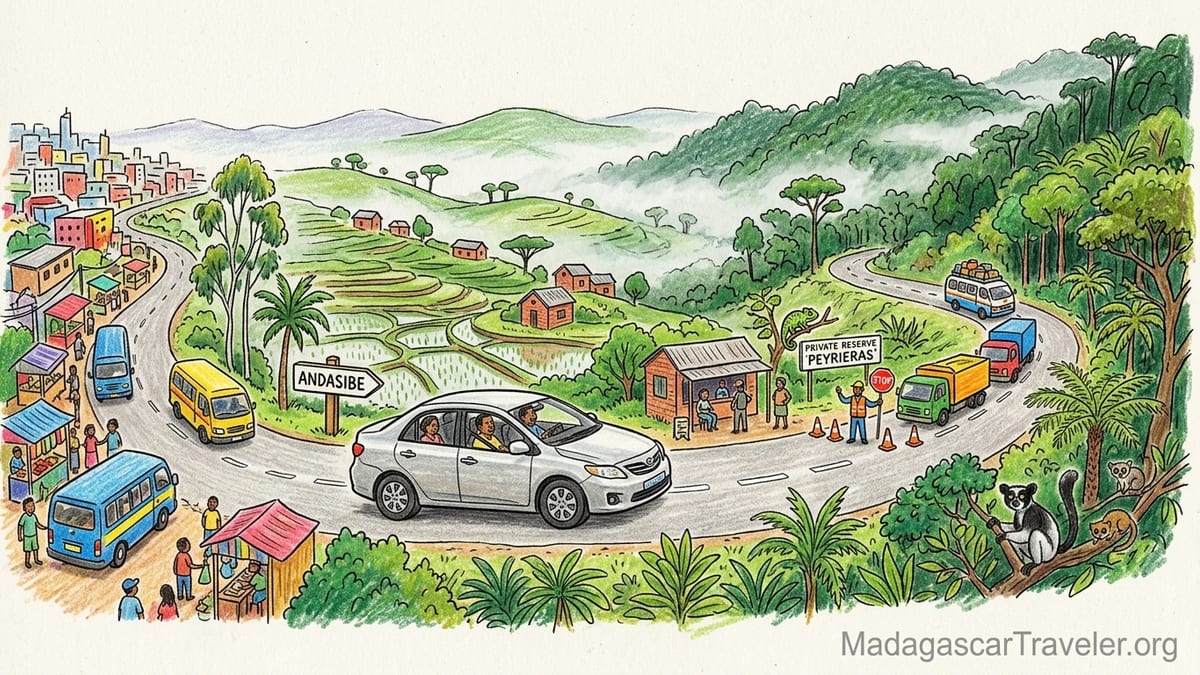
Setting Off From Antananarivo: Departure, Vehicle and Driver
I travelled from Antananarivo to Andasibe in June 2026 in a hired sedan with a local driver, arranged through a city-based agency that frequently runs the RN2 corridor. The car was a recent Toyota Corolla-type sedan, not a 4x4, and that detail matters because the road is paved all the way to Andasibe and, in the dry season, a high-clearance vehicle is not strictly necessary. What proved far more important was having a driver who knew the RN2 well, understood the current roadworks and could anticipate police checks and congestion points.
We left from the Ankorondrano district on a weekday morning at 7:10 a.m. I chose this time deliberately. An earlier departure, around 5:30 to 6:00 a.m., would have helped avoid some of the commuter crush, but I also wanted to avoid arriving at my lodge before reception opened for arrivals. Based on official itineraries that still quote around four to five hours of driving time for the 140 to 150 kilometer run, and recent reports showing the RN2 in fair but busy condition up to Moramanga, I expected three and a half to four hours of actual driving, plus traffic delays at each end.
From the first roundabout, it was clear that any “three-hour” promise ignores the reality of leaving Antananarivo by road. Inbound and outbound trucks, local buses known as taxi-be, street vendors and pedestrians all compete for space, and enforcement is light. Even with an experienced driver and a reasonably early start, the first 12 kilometers from Ankorondrano through the eastern suburbs took us just under 50 minutes. By 8:00 a.m. we had barely cleared the outer neighborhoods and reached the last clusters of roadside stalls.
Had I attempted this same journey by taxi-brousse, the shared minibus that is the backbone of intercity travel in Madagascar, I would have needed to start even earlier. Travellers using eastbound taxi-brousse services typically report seven to eight hours to reach Andasibe via a change in Moramanga because of waiting times and slow loading. For this trip, I chose comfort and predictability over cost, and the difference showed immediately in how much of the morning was spent negotiating traffic rather than sitting at a bus station.
Clearing the Capital: Traffic, Checkpoints and Early Road Conditions
Once past the last dense suburbs, around 8:05 a.m., the RN2 began to open up. The first police checkpoint appeared near the edge of the main built-up area. Our driver slowed, greeted the officers and showed his paperwork. The stop took less than two minutes, but these little pauses accumulate. A private driver expects them and keeps registration, insurance and identity documents conveniently at hand. In a taxi-brousse, the same process can take longer as the assistant driver shuffles through folders and negotiates with officers.
Between Antananarivo and Manjakandriana, the road surface was generally paved and in fair condition, though patched in places. Official communications from the public works ministry note ongoing resurfacing and “treatment of black points” along this stretch of the RN2, and you feel that history in the alternating rhythm of smooth tarmac, rougher repairs and occasional narrowed sections around active or recently completed works. We passed at least two spots where one lane had been coned off to protect fresh asphalt; in each case, temporary lights or flaggers managed traffic.
Traffic density remained high for about an hour after leaving the city. Long-distance trucks bound for Toamasina, smaller lorries hauling produce, and a steady stream of personal vehicles meant that safe overtaking opportunities were limited. In this first hour, our average speed hovered around 40 to 50 kilometers per hour, sometimes dropping lower on uphill sections. Once past Manjakandriana, the flow eased slightly and the road started to feel more like a highway and less like an elongated suburb.
By 8:50 a.m., roughly 1 hour and 40 minutes after our door-to-door departure, we had covered just over 60 kilometers. The RN2 was still more highland plateau than rainforest highway, but already the traffic mix and the condition of the tarmac were telling me that any three-hour claim for this journey would only work with perfect conditions and almost no stops. My driver quietly confirmed what I was seeing: in 2026, he rarely reaches Andasibe in less than four hours, and five hours is common during peak holiday periods or if heavy trucks stall on the climbs.
From Highlands to Rainforest: Scenery and Winding Sections
The most enjoyable part of the RN2 drive comes as the high plateau starts to give way to the wetter eastern escarpment. Somewhere after Mandraka, the landscape begins to fold and green, and the sky, which can feel big and pale over the highlands, lowers with thicker clouds. On my June trip, thin morning mist hung in the valleys while the ridges remained clear, and the contrast between the terraced rice paddies near the villages and the darker, forested slopes beyond was striking.
This is also the section where the road becomes noticeably more winding. The RN2 follows the contours of the hills, with a series of sweeping bends, tighter S-curves and occasional hairpins around steeper spurs. Our driver dropped his speed here, both because of the geometry of the road and because of the mix of slow-moving trucks in low gear and impatient drivers attempting risky overtakes. Although the tarmac was mostly intact, patched sections and small potholes on the inside of bends required constant attention.
If you are prone to motion sickness, this middle third of the journey is where you are most likely to feel it. The combination of low-speed curves, frequent braking and acceleration, and the shifting horizons as you snake along ridge lines can unsettle even those who usually tolerate mountain roads. I took a preventive motion sickness tablet about 30 minutes before we reached the first serious descents and made a point of focusing on the distant hills rather than the immediate foreground. The air also felt more humid as we descended, with the scent of wet vegetation drifting into the car whenever we opened the windows.
Visually, the transition into the eastern forest is unmistakable. Eucalyptus groves give way to denser, more varied vegetation. Tree ferns appear in the gullies. Roadside stalls begin to sell bunches of bananas and litchis in season, alongside small piles of charcoal and bundles of firewood. Somewhere on these curves the psychological distance from Antananarivo increases sharply. The capital feels far away, and the idea that you can pop to Andasibe and back in a day starts to seem more like a marketing line than a practical suggestion.
Stops, Snacks and Realistic Door-to-Door Timing
We made one planned stop and one unplanned halt on the way to Andasibe. The planned break came a little before Marozevo at a roadside café frequented by drivers heading to the coast. It was 9:30 a.m., about two hours and twenty minutes after our departure. The café served strong Malagasy coffee, bottled water and simple breakfasts. This is also the area where many travelers visit the small private reserve often called Peyrieras or Madagascar Exotic, known for its chameleons and reptiles. Stopping here adds at least an hour, and often more, so we limited ourselves to coffee, a quick stretch and use of the facilities.
The unplanned halt came half an hour later near a temporary one-lane section controlled by flaggers where resurfacing works were underway. A queue of trucks had built up along the shoulder. We waited around 15 minutes before our column was waved through. This kind of minor delay is typical on the RN2 at the moment, particularly between Antananarivo and Moramanga, where rehabilitation efforts are concentrated. None of these individual pauses feel serious while they are happening, but they push your arrival steadily later in the day.
We reached the junction for Andasibe just before 11:05 a.m. and turned off the main highway onto the short access road leading to the village and the cluster of lodges near Analamazaotra Reserve. This last section is narrower and rougher, with more patched tarmac and potholes, but still navigable in a sedan. I arrived at my lodge at 11:20 a.m., having left Ankorondrano at 7:10 a.m. The total door-to-door time was 4 hours and 10 minutes, including approximately 30 minutes of stops and waiting.
That figure places my journey closer to the more conservative four to five hour estimates still used by some official itineraries than the optimistic “three hours” quoted in many tourism brochures. It also reflects reasonably favorable conditions. There were no serious accidents, breakdowns or weather disruptions, all of which can, and frequently do, turn parts of the RN2 into long static queues. In August 2024, for example, a single broken-down truck near the Maromizaha area caused kilometers of backed-up vehicles for hours. On another day, that could just as easily have been my story.
Comparing Private Transfer, Cotisse and Taxi-Brousse
Experiencing the route in a private sedan gave me one perspective on the RN2, but conversations with other travelers in Andasibe and recent reports from transport forums highlight that the way you choose to travel can dramatically alter your day. The most comfortable shared option on this corridor is generally considered to be Cotisse Transport, a company that runs scheduled minibuses between Antananarivo and coastal cities like Toamasina. Travelers can sometimes book seats to be dropped at or near the Andasibe junction, paying closer to the full fare to Toamasina in exchange for better quality vehicles and more predictable departure times than standard taxi-brousse services.
In practice, those who have used Cotisse or comparable companies on this axis report three to four hours of driving time to the Andasibe turnoff, not counting time to reach the bus station in Antananarivo and any additional transfer from the junction to their lodge. One recent traveller described paying roughly the Toamasina fare to be dropped at the Andasibe junction and then walking or arranging a local transfer for the final five kilometers. Another noted that services toward the east can take four to five hours just to reach the area around Andasibe in 2025 because of frequent congestion and roadworks.
Standard taxi-brousse shared minibuses are cheaper but come with significant trade-offs. To reach Andasibe by regular taxi-brousse, you typically travel first from Antananarivo to Moramanga, then connect to a secondary vehicle to Andasibe. One advisor recently suggested allowing at least seven to eight hours for this combined journey, largely because of the unpredictable waiting time in Moramanga. While the ticket price might fall in the range of a few tens of thousands of ariary, seats are cramped, luggage handling is rougher and departure schedules are more aspirational than guaranteed.
Set against these shared options, the private car and driver I used cost substantially more than a taxi-brousse but allowed a mid-morning pause, a direct drop at my lodge and full control over departure time. It also avoided the problem that many agencies and car hire companies in Madagascar strictly discourage or prohibit their drivers from traveling after dark outside urban areas. For a route like RN2, where delays are common and lighting is poor, this caution is justified. A private morning departure ensured that even if we had faced another hour of delays, we would still have arrived well before nightfall.
Is Andasibe Really a Day Trip from Antananarivo?
On maps and in some travel marketing, Andasibe appears as an easy day trip from the capital. My experience on the RN2 and the realities of park visiting hours strongly suggest otherwise. Even if you managed the journey in a theoretical three hours each way, you would still spend at least six hours in transit for, at best, a few hours in the forest. More realistically, using my 4 hour and 10 minute door-to-door timing as a baseline, a return trip would consume over eight hours of your day, not counting time spent getting to and from your accommodation and the park entrance.
The main protected areas around Andasibe are designed to reward overnight stays. Indri, the emblematic lemur of the region, are most vocal in the early morning, which is when guided walks into Analamazaotra Reserve are at their most atmospheric. Night walks along the road margins or in private reserves reveal a completely different set of nocturnal species, from tiny mouse lemurs to chameleons sleeping on branches. Arriving around noon, as I did, allowed me to rest, join a late afternoon walk and then a guided night outing. Attempting to cram both a morning and night experience into a single day while commuting from Antananarivo would have been impossible.
There is also the question of fatigue and safety. Even in a comfortable sedan, the RN2 demands focus from the driver and attention from passengers. The combination of twists, trucks and occasional poor surfaces is tiring. Arriving back into Antananarivo after dark, when visibility drops and urban traffic becomes dense and chaotic again, would add further stress to an already long day. Many reputable drivers and agencies simply decline to undertake a same-day Andasibe round trip from the capital unless both client and driver are prepared to accept a very early start and a late finish.
In Andasibe itself, I found that sleeping in the village or at a nearby lodge transformed the experience. Waking to the distant calls of indri, stepping onto the path while morning mist still clung to the forest canopy, and then returning to a hot shower and a simple dinner before venturing out again after dark created a rhythm that matched the environment. The journey on the RN2 became the prelude rather than the main act. Compressing that into a day trip would have turned one of Madagascar’s most accessible rainforest experiences into a rushed box-ticking exercise.
When to Leave Antananarivo Next Time
Having completed the route once and spoken with both my driver and lodge staff about seasonal patterns, I would plan my next departure from Antananarivo even earlier. For a comfortable arrival in Andasibe well before dark and with time to check in, have lunch and join an afternoon or early evening activity, I would now aim to leave the capital around 6:00 a.m. at the latest, and 5:30 a.m. would be better during busier periods.
Leaving at 6:00 a.m. would, in typical dry-season conditions, place you on the RN2 ahead of the worst of the commuter traffic and some of the heavier trucks. Even if you then experienced similar delays to my June journey, including a half-hour stop and short roadwork waits, you could reasonably expect to reach Andasibe between 10:30 and 11:00 a.m. That window gives you enough margin for lunch and a short rest before organizing a guided afternoon walk, which often starts around 2:00 or 3:00 p.m., and then a night walk after dark.
I would not choose to leave Antananarivo later than 9:00 a.m. for an arrival the same day, unless I was prepared to skip any structured afternoon activity and accept the risk of meeting darkness on at least the final part of the journey. The RN2 has minimal lighting outside towns, and night driving comes with hazards: unlit carts, pedestrians on the roadside, stray animals and trucks parked partially on the carriageway. Several agencies I spoke to treat “no driving after dark outside cities” as a hard rule, and that is a useful guideline for independent travelers too.
For visitors scheduling longer itineraries across Madagascar, it is worth tying your Andasibe leg to your international flights. If you arrive in Antananarivo in the late afternoon or evening, stay in the capital that night and depart for Andasibe early the next morning. On your return, build in at least one buffer night in Antananarivo before any onward international departure. The RN2 carries a large share of the country’s freight to and from the main port, and a single badly placed truck or weather-related disruption can easily double travel times.
The Takeaway
Driving from Antananarivo to Andasibe along the RN2 in 2026 is less about distance and more about rhythm. Official documents may still frame the 140 to 150 kilometer run as a four-hour tarred-road transfer, and tourism summaries often repeat the phrase “three hours from the capital,” but the lived reality involves slow exits from the city, unpredictable roadworks, queues behind trucks and a winding approach into the eastern escarpment that both delights the eye and challenges the stomach.
On my own journey, a 7:10 a.m. departure from an inner suburb in a private sedan with an experienced driver translated into a 4 hour and 10 minute door-to-door trip, with modest traffic and only minor interruptions. That timing alone makes Andasibe a poor candidate for a same-day return from Antananarivo. Factor in the early-morning and nighttime wildlife experiences that define the park, and the argument for at least one, preferably two, nights in or near Andasibe becomes overwhelming.
Choosing how to travel also shapes your day. Private transfers give you control over departure and stops. Scheduled services like Cotisse offer a compromise between cost and comfort, though drop-offs at the Andasibe junction mean arranging final transfers. Regular taxi-brousse vehicles are the most economical but can turn the route into a full-day endeavor with long waits and cramped conditions. Whichever option you pick, planning your departure time around both city traffic and the immovable fact of sunset will do more for your trip than any theoretical travel time on a brochure.
Most importantly, treating the RN2 journey as part of the experience rather than a hurdle to clear changes how you see it. Watching the highlands give way to misty hills, smelling the damp earth of the eastern forest through an open window and arriving in time to hear the first indri calls of the afternoon becomes a story in itself. The road from Antananarivo to Andasibe is not quick, but when approached with realistic expectations and the right schedule, it is an evocative prelude to Madagascar’s rainforest world.
FAQ
Q1. How long did your actual journey from Antananarivo to Andasibe take door to door?
My June 2026 trip took 4 hours and 10 minutes door to door, leaving Ankorondrano at 7:10 a.m. and arriving at a lodge near Andasibe at 11:20 a.m., including one coffee stop and a short wait at roadworks.
Q2. What type of vehicle and driver did you use for the RN2 journey?
I used a recent sedan similar to a Toyota Corolla with a professional local driver arranged through a city agency. The car was not a 4x4, which was sufficient for the mostly paved RN2 in dry-season conditions.
Q3. How bad was the traffic when leaving Antananarivo in the morning?
Even with a 7:10 a.m. departure on a weekday, the first 12 kilometers through the eastern suburbs took almost 50 minutes due to dense commuter traffic, trucks, taxi-be buses and frequent slowdowns at junctions and police checkpoints.
Q4. What are the road conditions like on the RN2 between Antananarivo and Andasibe?
The RN2 is paved along this stretch but shows its importance and age, with resurfaced sections, patched tarmac, occasional potholes and temporary one-lane zones around roadworks. Overall it was passable in a sedan but demanded careful driving, particularly on curves.
Q5. Did you experience motion sickness on the winding sections toward Andasibe?
I did not become ill but could feel the potential for motion sickness once the road began to twist along the escarpment. I took a preventive tablet about half an hour beforehand and focused on the distant scenery, which helped a lot.
Q6. Is it realistic to visit Andasibe as a day trip from Antananarivo?
Based on my 4 hour and 10 minute one-way journey and current conditions, I do not consider Andasibe a practical day trip. A realistic same-day return would involve eight to nine hours of travel and leave little time for meaningful time in the forest, especially for early-morning or night walks.
Q7. How early would you leave Antananarivo next time to reach Andasibe comfortably?
Next time I would aim to leave between 5:30 and 6:00 a.m. This should put you ahead of the worst city traffic, keep you on schedule even with moderate delays and allow arrival before midday with enough time to rest and join afternoon and night activities.
Q8. How does a private car compare with Cotisse or taxi-brousse for this route?
A private car and driver cost more but give you full control over departure times and stops and drop you directly at your lodge. Cotisse-type services offer more comfort and predictability than regular taxi-brousse but often only drop at the Andasibe junction. Standard taxi-brousse options are cheapest yet frequently take seven to eight hours door to door with changes and waiting time.
Q9. Did you feel safe on the RN2, and would you drive it yourself?
With an experienced local driver and a daytime schedule, I felt broadly safe, though the mix of trucks, curves and variable surfaces requires constant attention. I would hesitate to self-drive unless very confident in similar conditions and would avoid driving this route after dark.
Q10. Why is it worth sleeping in Andasibe instead of returning to Antananarivo the same day?
Staying overnight lets you join dawn walks to hear indri calling, rest in the middle of the day and then explore again after dark on a night walk. It turns the RN2 journey into a gateway to the rainforest rather than an exhausting commute wrapped around a rushed visit.