


Andasibe looks deceptively simple on paper. Guidebooks repeat the same line that Analamazaotra and Mantadia are open year-round, with a drier season from May to October and a wetter one from November to April. It was only when I actually walked those forest trails in May and again in November that the neat seasonal labels gave way to something messier and much more useful for planning. The rain patterns, the state of the mud, the cool bite of the early mornings and the sheer volume of wildlife calls all shifted in ways I would never have understood from a climate chart alone.
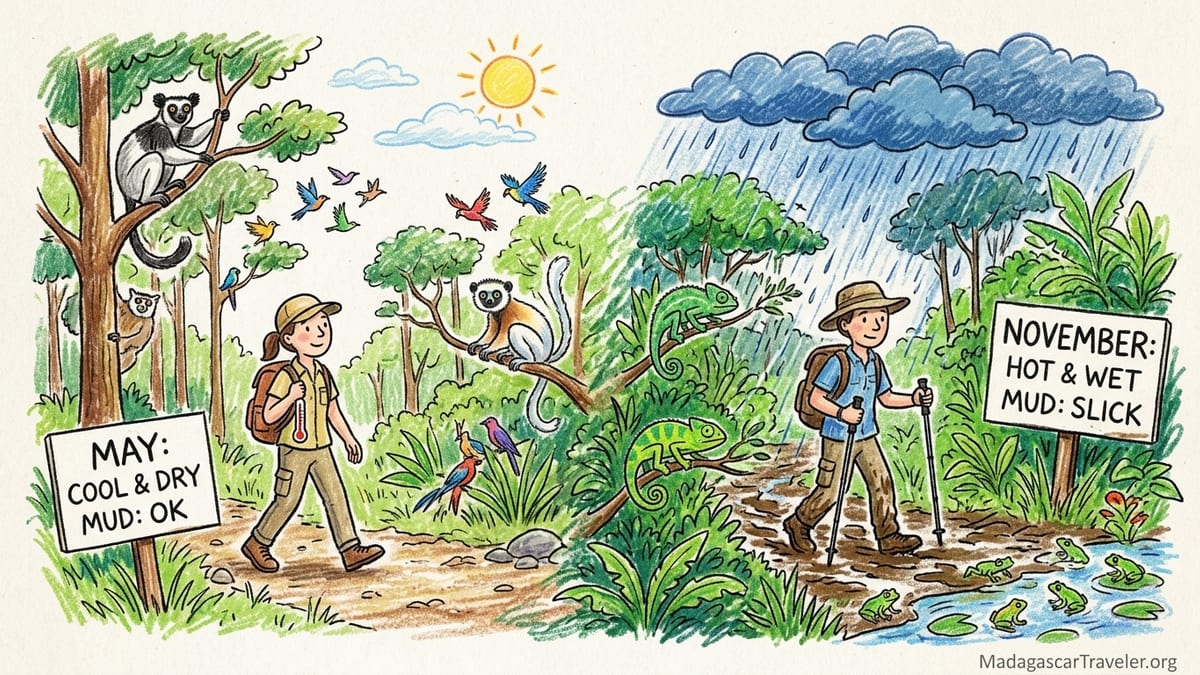
When I Went: Grounding This Guide in Real Trips
Before getting into advice, it is important to be clear about what I have actually experienced in Andasibe, and what I have only researched. I spent five days based in Andasibe village and around the Analamazaotra Special Reserve in mid May, at the start of the so-called drier period. A few years later I returned for three days in early November, just as the wetter season was starting to build but before the heaviest cyclone months. My time on both trips focused on Analamazaotra (often still called Périnet), nearby community-managed forest for night walks, and a day trip to Mantadia on the May visit.
Everything in this article that relates to May and November conditions comes directly from those visits: how often it rained, how muddy the trails really were, how cool the mornings felt, what dried and what stayed damp, and how easy it was to spot wildlife in the forest. When I mention other months such as January or July, that information is based on ranger comments, local guides, and cross-checking with recent climate data and trip reports, rather than my own boots-on-the-ground experience.
Andasibe’s climate numbers suggest a rainforest without a truly dry month, which the weather statistics for the park support, with rain spread over well above half the days of the year. Walking the trails confirmed that reality. Even at the “driest” time, this is still a place where you plan your day around showers, mist and mud, rather than hoping to avoid them altogether.
What varied far more than I expected were the intensity and timing of those showers, and their impact on trail conditions, leeches, bird activity and the mood of the forest. May and November both gave me extraordinary wildlife encounters, but they felt like completely different trips.
May in Andasibe: Cool Mornings, Manageable Mud and Clear Forest Views
My May visit fell in the middle of the month. Early mornings leaving my bungalow in Andasibe village felt almost cold after the heat of Antananarivo. A simple digital thermometer on my backpack strap showed temperatures hovering around 14 to 16 degrees Celsius at 6 a.m., and I usually started walks in a light fleece and long hiking pants. By late morning it warmed into the low twenties, and by mid-afternoon I was comfortable in a breathable long-sleeve shirt without a jacket.
Across five days in May, it rained at some point on four of them, but those showers were short and surprisingly polite. Most fell in the late afternoon or at night, lasting from about twenty minutes to an hour. Only one day brought a more serious downpour during a morning walk in Analamazaotra. Even then, it came as a single heavy burst rather than hours of continuous rain. The result was that trails were damp or muddy in sections, but not the ankle-deep slog I had expected in a rainforest that receives well over a metre of rain in a year.
On the well-used circuits inside Analamazaotra, the path surface in May was mostly compacted earth and leaf litter with occasional slick patches where tree roots crossed. A few steeper sections had turned into smooth clay slides, but my trail runners with a grippy sole were enough; I never wished for full mountaineering boots. Mantadia, which has rougher and less-maintained tracks, was muddier than Analamazaotra, especially on the approach to some of the waterfalls. There I was glad to have mid-ankle boots, largely for stability rather than because water threatened to pour over the top.
One unexpected advantage of May was how well things dried between showers. Shirts washed in the sink at night and hung under the bungalow eaves were dry or close to it by the next evening, even on days with some rain. Inside the forest, leaf surfaces often felt dry to the touch during late-morning birding, and I rarely finished a walk with my trousers soaked from brushing against vegetation. This made May feel like a forgiving month for travelers who do not want to pack large amounts of spare clothing.
Wildlife Activity in May: Loud Indri, Active Birds and Fewer Insects
If your main goal is general wildlife watching rather than a particular flowering event, May in Andasibe offers a strong balance between comfort and activity. The cool early mornings were ideal for long, slow forest walks. On three out of four morning excursions in Analamazaotra, the calls of indri lemurs started between 7:30 and 8:00 a.m., echoing clearly through the forest without being muffled by heavy rain. On one misty morning we heard at least three distinct family groups calling from different slopes.
Visibility into the forest in May was better than the lush, postcard images of tropical green might suggest. The canopy was fully leafed but undergrowth along the main paths had enough gaps to see several metres to each side. On a single morning circuit we were able to watch a troop of common brown lemurs cross above us, follow a Diademed sifaka along the mid-canopy for several minutes, and still have time to stop at small clearings where mixed bird flocks passed through. Small details, such as the white patches on the chests of Blue couas or the chestnut tones of a Tylas vanga, were easy to see without binoculars when birds moved into shafts of light.
Insects and mosquitoes, often a concern in wet tropical forests, were less aggressive during my May stay than I had feared. In the village and around the bungalows, I received a handful of bites at dusk when I forgot to reapply repellent, but there was no constant humming cloud. On the trails themselves, especially in Analamazaotra, mosquitoes were present but far from overwhelming. I wore lightweight hiking pants and a long-sleeve shirt, with repellent around my wrists and neck, and finished most walks with only a few bites. Leeches, which some travelers dread in wetter months, were absent on all my May walks, both in Analamazaotra and Mantadia.
Other wildlife responded positively to the cooler, slightly drier conditions. Chameleons were easier to find than I expected in daytime, especially along edges and low branches drooping over paths. Night walks along the roadside forest produced mouse lemurs, sleeping chameleons and several species of tree frog. Because the ground was damp but not waterlogged, we could step a little off the path to line up photographs without sinking or slipping badly, an important detail for anyone carrying a camera with a long lens and limited weather sealing.
November in Andasibe: Humid Heat, Sudden Downpours and Slick Trails
My November visit began in the first week of the month, when the official guidance already shifts toward wetter-season expectations, but before the heavy cyclone risk of January to March. From the moment I stepped out of the car in Andasibe village, the change from May was obvious. The air felt heavier, with afternoon temperatures in the high twenties and humidity that clung to clothing even in the shade.
Across three days in early November, it rained hard on two of them and drizzled on the third. Showers were less predictable than in May. One day began with blue patches of sky and bright sun over Analamazaotra, only for a violent downpour to crash down around 10:30 a.m., forcing us to huddle under a large pandanus for nearly forty minutes. Another day brought on-and-off drizzle that never quite stopped, leaving the forest in a continual state of moistness. Night walks were still possible but often started or ended in light rain.
The impact on trails was immediate. Sections of path that had been firm in May turned into slick, glossy mud in November. Tree roots became slippery ladders, especially on descents. On one section of the main Analamazaotra circuit in November, nearly every member of our small group slipped at least once, even with trekking poles and boots with good tread. Small side paths to viewpoints or fig trees were sometimes avoided entirely by the guide because they had become too churned and hazardous.
Drying anything in November was a losing battle. Shirts soaked in a downpour stayed clammy for a day and a half, even when hung under cover. Trail shoes that took in water during a particularly wet morning walk were still damp on departure day, despite being stuffed with newspaper. Inside the forest, the vegetation never truly dried between showers. Leaves brushed past with a constant cool wetness, and there was a film of moisture over tree trunks and lianas that made gripping for balance a more cautious act.
Wildlife in November: Lush Forest, Amphibians and Patience for Birders
The November forest felt entirely different from May, even in the same reserve. Understory plants were denser and greener, new leaves pushed out at the tips of branches, and small flowers dotted the edges of clearings. This made the forest extraordinarily beautiful and photogenic at close range, but it came with trade-offs for certain types of wildlife watching.
Indri still called most mornings, but the soundscape was more crowded. Rain on leaves, dripping water and constant cicada noise filled the background. On one morning, heavy drizzle continued through the prime calling period, muffling the indri’s iconic wails so they felt closer than they were. Finding the animals themselves in November often took more time, with guides scanning thicker foliage and asking visitors to stay very quiet so they could triangulate soft calls.
Birding in November was a lesson in patience. The lush foliage gave birds more places to hide, and the intermittent rain meant they often stayed still for long periods. We still saw several endemic species, including vanga and coua, but encounters were more often brief glimpses than the open views I had in May. Photography through this dense, damp vegetation was challenging, with autofocus hunting among wet leaves and light levels dropping suddenly when clouds rolled in.
On the other hand, amphibian and reptile activity was superb. Night walks in early November, especially on drizzly evenings, produced a chorus of frogs so loud that guides had to raise their voices to be heard. Tiny, jewel-like tree frogs clustered on low vegetation and along roadside drainage ditches. Several species of chameleon, including bright green and blue individuals, appeared on branches at eye level. The constantly wet leaf litter also seemed to suit invertebrates; stick insects, large spiders and luminous fungi were all more conspicuous than in May.
Mosquito pressure increased compared with my May visit, particularly at dusk around standing water near village guesthouses and along slow-moving streams in the forest. Wearing long clothing and strong repellent became non-negotiable, especially for travelers concerned about mosquito-borne illness. I did not encounter leeches personally in November around Analamazaotra, but local guides mentioned that they appear more often later in the rainy season and in some of the wetter patches of Mantadia’s primary forest.
Costs, Logistics and How Weather Shapes a Typical Day
Weather does not only affect trails and wildlife; it also shapes the rhythm of each day and some of the practical details of a stay in Andasibe. Reaching the area from Antananarivo usually takes about three to four hours by road, and both of my trips used a private car arranged through local operators in the capital. In May, the road surface between Antananarivo and Andasibe was dry and in reasonably good condition. In November, short stretches had more potholes filled with water, and a couple of roadside stalls had set up under additional tarps to cope with frequent showers, a small but telling change.
Entrance fees to Analamazaotra and Mantadia follow a national park tariff system that Madagascar National Parks updates periodically. At the time of my research for this article, foreign adults were paying on the order of tens of euros per day to enter a major park, plus mandatory local guiding services that added a similar amount for a half or full day, depending on group size and chosen trail length. I found that guides in Andasibe were very open about adjusting routes each morning based on overnight rain. In May, this usually meant choosing slightly longer loops and including viewpoints, while in November, guides steered us toward safer main paths and warned in advance when a section might be particularly slippery.
Daily schedules adjusted sharply with the season. In May, I typically started with a 6:30 or 7:00 a.m. breakfast, left for the park soon after, and walked through until around midday or early afternoon, with a simple packed lunch organized by the lodge or picked up from a small restaurant near the park entrance. Short afternoon showers often coincided neatly with a rest period back at the bungalow. Night walks began around 6:30 p.m., under mostly dry skies, and finished by 8:30.
In November, mornings also began early, but the decision to push for a longer or shorter route depended heavily on the latest forecast and how ominous the sky looked. On my wettest day, our guide shortened the morning loop and added a rest stop under a shelter near a known indri territory, explaining that once the downpour arrived, visibility for wildlife would drop dramatically and footing would become treacherous. Night walks still ran, but guests wore full rain jackets and often carried dry bags for cameras. Some evenings, we delayed departure by thirty minutes for a passing shower to ease, rather than walking straight into heavy rain.
Weather also influenced small spending choices. In May, I was content to rely on a single quick-drying hiking outfit, a fleece and a simple rain jacket. In November, I paid a little more for laundry service at the lodge, mainly to have clothes dried near a proper heat source rather than relying on the humid air. The cost was modest by international standards, but it became one more line item directly driven by the intensity of the wet season.
How Other Months Compare: Researched Guidance Beyond My Visits
Although my personal experience is limited to May and November, conversations with park staff and guides, along with recent climate data and current trip reports, help sketch the rest of the year. It is important to underline that what follows is researched guidance, not first-hand observation, but it may still help frame your decision if your travel dates are fixed outside my visit months.
Guides consistently described January through March as the most challenging period, citing heavier and more prolonged rainfall, more frequent storm systems and occasionally flooded sections of trail. Some tour operators even avoid Mantadia’s rougher 4x4 access road during these peak wet months, focusing instead on Analamazaotra and nearby community forests where infrastructure is slightly more resilient. Cyclone risk is also at its highest in this window, which can disrupt both road access and electricity in Andasibe village.
April and June are often portrayed locally as transition months, with rain still frequent but usually shorter or less intense than at the peak of the wet season. Several birding and wildlife groups schedule trips in these shoulder months, seeking a mix of active forest life and slightly more manageable conditions underfoot. July and August are considered the coolest and relatively drier months, with morning temperatures sometimes dropping into the low teens Celsius and more visitors wearing light beanies or additional layers at dawn. September and October often see continued good conditions for lemur viewing, according to guides and tour dossiers, with fewer heavy storms than the heart of the wet season but gradually building humidity as November approaches.
Throughout the year, one constant that local experts stress is the variability of day-to-day weather. Even in what is considered a drier stretch, showers remain normal and the forest never becomes fully dry. Likewise, rainy months still contain windows of sunshine and productive wildlife watching. What changes is the likelihood of long, soaking downpours, the persistence of mud and the relative comfort of spending many hours in saturated clothing.
When I Would Return: Wildlife, Birding, Photography and Easier Hiking
Having experienced both a shoulder month on the drier side and a month at the front of the wetter stretch, I would make different choices depending on my primary goal for a future return to Andasibe. For a general wildlife trip where the priority is a mix of lemurs, chameleons and the overall forest experience, I would choose May again without hesitation. The combination of cool mornings, manageable mud and excellent visibility into the forest made those days deeply rewarding without being punishingly wet.
If I were planning a bird-focused return, I would look at May or possibly June, based on guide recommendations and trip reports, rather than November. The clearer sight lines, more predictable showers and softer morning light in May made birds easier to locate and photograph. In November, dense foliage and unsettled weather reduced the number of clean views, even though the forest felt wonderfully alive. For birders willing to trade some comfort for the chance of certain breeding behaviours or vocal activity, other months might be interesting, but for a balance of conditions, I would anchor my plans around late May.
For photography, my answer splits in two. For photographers focused on classic lemur portraits, forest mammals and birds, I would again choose May. Cool temperatures meant I could carry equipment for hours without overheating, and the drier spells made it more realistic to use cameras that are not fully weather sealed. However, if my main priority were macro photography of frogs, insects, fungi and lush vegetation textures, I would seriously consider another early wet-season visit like my November trip. The constant dampness, dripping leaves and active amphibians created a world of close-up subjects, even if wider forest scenes were more difficult to capture through rain and mist.
For travelers who simply want easier hiking and are less concerned with squeezing every species possible into their checklist, the drier side of the year has a clear edge. My May hike in Mantadia, while still involving slippery spots and moderate exertion, felt within reach for anyone with basic fitness and suitable footwear. Guides I spoke with cautioned that in the heart of the wet season, some of those same trails can become demanding even for confident walkers, with long sections of churned mud, additional leeches in the leaf litter and a higher risk of falling on wet rocks and roots.
In the end, the “best” time to visit Andasibe depends on how you weigh comfort against intensity. My May trip felt like the gentler introduction to a rainforest that rewards long hours on foot. My November days were more tiring, sweatier and wetter, but also filled with rich textures and a sense of the forest at full growth. If I had to choose one month to revisit for a single all-round trip, I would go back in May, but I would pack a good rain jacket regardless of what the climate charts suggest.
FAQ
Q1. Is May really drier in Andasibe, or did I just get lucky with the weather?
From my five days in mid May, I did notice fewer and shorter showers than in November, with only one heavy downpour during a morning walk. Climate data and guide feedback also point to May as part of a relatively drier stretch, but it is still a rainforest and you should plan for rain on most days.
Q2. How muddy were the trails in May compared with November?
In May, Analamazaotra’s main circuits were mostly firm with some slick patches and occasional muddy steps, while Mantadia was muddier but still manageable in mid-ankle boots. In November, several sections in Analamazaotra turned into smooth, slippery mud, and side paths were sometimes skipped entirely because footing had become too hazardous after repeated downpours.
Q3. Did I need warm clothing for cool mornings?
Yes, particularly in May. Early morning temperatures in the forest hovered around the mid-teens Celsius, and I was glad of a light fleece and long hiking pants at the start of dawn walks. By late morning I often stripped down to a single long-sleeve shirt. In November, mornings were milder but humidity made even light layers feel warm once walking started.
Q4. How bad were mosquitoes and leeches during my visits?
In May, mosquitoes were present but not intense, and I had only a few bites when using long clothing and repellent. I did not see leeches at all on either the May or November trips around Analamazaotra and Mantadia, though guides warned that they can appear more often deeper into the wet season and in some of Mantadia’s wetter gullies.
Q5. Was wildlife easier to see in May or November?
For lemurs and birds, May felt easier. Forest visibility was better, rain interrupted walks less, and we had several extended views of indri, sifakas and mixed bird flocks. In November, foliage was lusher and denser, which made many birds and small mammals harder to spot, although frogs, insects and chameleons were especially active on damp nights.
Q6. Could clothes and shoes dry properly during my stays?
In May, clothing washed in the evening was usually dry or nearly so by the following night, even with some rain, and shoes that picked up surface mud dried reasonably well under cover. In November, once something was soaked, it often stayed damp for days, and I ended up paying for lodge laundry a couple of times just to get items properly dried.
Q7. Did rain ever cancel activities outright?
On my visits, rain changed plans more often than it cancelled them. In May, one heavy shower cut a morning walk slightly short, but we still spent several hours in the forest each day. In November, guides occasionally shortened routes or delayed the start of a night walk by half an hour to let a downpour pass, yet we still managed at least one substantial outing daily.
Q8. How did camera gear cope with the different conditions?
In May, I felt comfortable carrying a mid-range mirrorless camera and telephoto zoom with a simple rain cover, and I could shoot for long stretches between showers. In November, high humidity and sudden rain meant keeping gear in a dry bag when not actively shooting, wiping condensation from lenses and accepting that some moments would be missed rather than risking damage.
Q9. Is November a bad time to visit Andasibe?
Not necessarily, but it is a wetter and more humid time that demands realistic expectations. Trails are slick, clothes dry slowly and some wildlife is harder to see through dense foliage. On the positive side, the forest looks incredibly lush, amphibians and invertebrates are very active and there is an atmospheric quality to walking through mist and light rain that many visitors love.
Q10. If I can choose any month, when would I personally return?
For a balanced trip focused on general wildlife, comfortable hiking and photography of lemurs and birds, I would choose May again. It offered cool mornings, more forgiving mud levels and excellent forest visibility, while still feeling every bit like a true rainforest experience.