


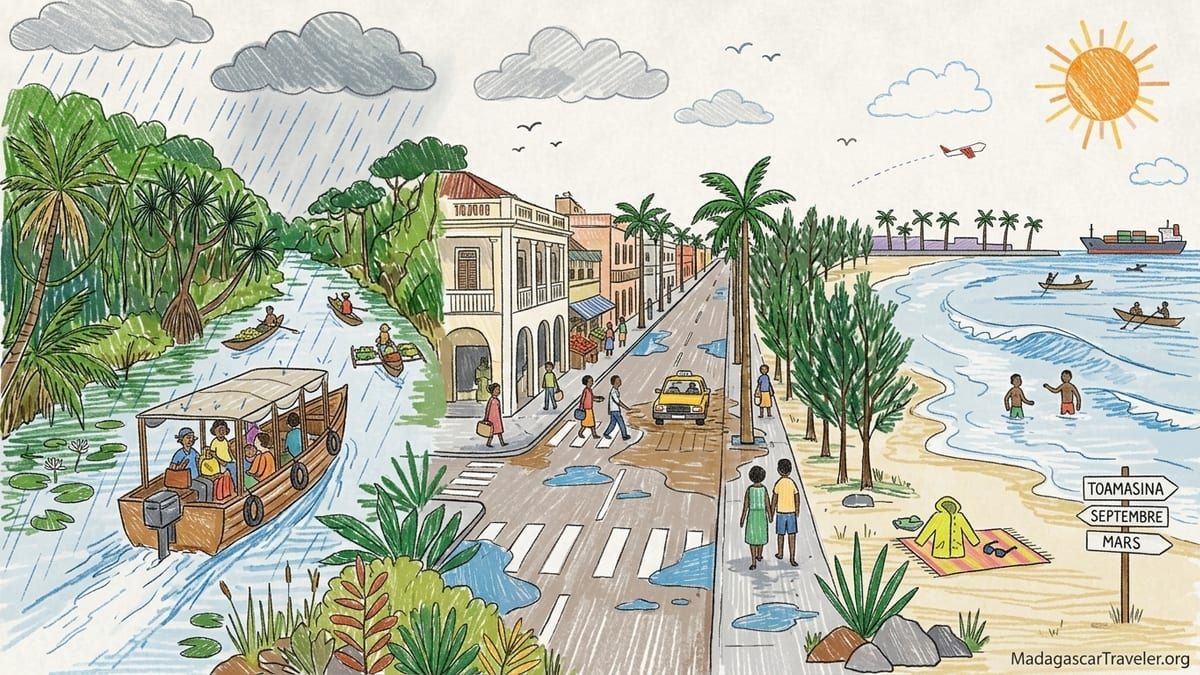
I planned Toamasina as a laid-back coastal break on Madagascar’s east coast and discovered instead that here, weather is not background atmosphere but the main character. Across two visits, one in late March edging out of cyclone season and another in mid-September at the start of the relatively drier period, I learned that rain, humidity and sea conditions quietly rewrite your itinerary. What follows is a practical account of what those months were actually like on the ground, and how I would time a future trip for the city, the beaches and the Pangalanes Canal.
When I Went and What the Forecasts Did Not Say
My first stay in Toamasina was in late March, with nights in the city and two days on the Pangalanes Canal south toward Akanin’ny Nofy. This is still within Madagascar’s official rainy and cyclone season, which typically runs from November through March along the east coast. Forecasts showing thunderstorms every single day felt almost melodramatic when I booked, but they turned out to be a fair, if incomplete, picture of what March actually feels like outdoors.
The second visit came in mid-September, again using Toamasina as a base but this time keeping mostly to the city and nearby beaches such as Ivoloina and the Plage de Toamasina. By September, the east coast is moving into its drier stretch of the year, although Toamasina never has a true dry season. Long-term climate data shows that the city records rain on more than twenty days in a typical month, even in its relatively drier months, and annual totals above three meters of rain underline just how wet this coast is compared with much of Madagascar’s interior and west.
The contrast between those two trips was not subtle. March was hot, saturated and restless, air heavy with storms and sea swell. September was still humid by most standards but noticeably more comfortable, with some evenings where I did not immediately break a sweat walking from the hotel to a simple restaurant. For city wandering and beach time, I would choose my September conditions again in a heartbeat. For the Pangalanes, it is more nuanced, because the wet season greens the banks and fills the canals at the exact moment that wind and storms complicate boat logistics.
Everything that follows about March and September is drawn from these two stays. For other months I will flag clearly when I am relying on researched patterns rather than personal days on the ground, using long-term climate normals and regional travel guidance as the basis for planning advice.
Late March in Toamasina: Heat, Heavy Air and Sudden Downpours
In late March, Toamasina felt like stepping into a bathroom just after a hot shower, only the steam never thinned. Daytime temperatures were in the high twenties Celsius and low thirties, but it was the humidity that dictated comfort. Within ten minutes of leaving my guesthouse near Boulevard Joffre, my cotton shirt would cling to my back. Sitting on a concrete step in the shade near the market, sweat beaded on my arms without any effort at all.
Rain came most days, sometimes twice. Mornings often started bright or with thin cloud, enough to tempt me into leaving my rain jacket behind. Then, within an hour, a wall of dark cloud rolled in from the ocean and the sky simply opened. These were not light showers. For thirty to forty minutes the rain roared on the tin roofs, the hotel courtyard flooded ankle-deep, and water sheeted off the palm fronds lining the street. Power flickered once but never stayed off long on my particular days, although staff at my guesthouse mentioned that longer outages are not unusual after stronger storms earlier in the season.
Between these deluges, the pattern shifted to a kind of on-and-off drizzle. I remember one afternoon when I tried to walk from the old port area back to my room, a stretch that would normally take fifteen minutes. It became a forty minute shuffle as I ducked into arcades and roadside kiosks whenever the rain thickened from mist to pelting drops. The pavement turned slick with a film of mud tracked in from unpaved side streets, and street vendors shifted their tables back from the gutter as streams of brown water ran along the edge of the road.
Even inside, the humidity never really eased. My simple fan-cooled room had tiled floors and concrete walls, and the air felt permanently damp. A pair of socks washed in the sink in the evening was still clammy the next afternoon. A thin cotton shirt hung by the window took nearly forty-eight hours to dry fully. The only items that dried overnight were those placed directly in front of the fan, and even then they felt slightly cool and moist when I put them on. Paperbacks developed a light wave in their pages after two days, and my camera lenses fogged momentarily every time I walked out of air conditioning into the open air.
Roads, Sea and City Life Under Late-Season Rains
The wet March weather made its presence most obvious in the streets and along the approach roads. Within Toamasina itself, surfacing on main avenues was generally intact, but every heavy downpour left large puddles that swallowed kerbs and filled potholes. On a short taxi ride across town after one particularly violent rain burst, the driver slowed to a crawl as we eased through brown water that reached halfway up the wheel rims. Motorbikes wove a nervous path between the deepest sections, and pedestrians rolled their trousers above the knee to cross intersections.
On the RN2 between Toamasina and the junction toward Brickaville and Andasibe, road conditions had clearly suffered from months of moisture even if the surface remained drivable. I shared a seat in a bush taxi for the segment out of town. The driver hit frequent patches where the asphalt had slumped slightly, creating shallow troughs that collected water long after the last shower. We passed one section where workers were shovelling stones into a hole that had formed near a bridge culvert, evidence of how fast water can chew away at weak spots. Official advisories consistently warn that roads across Madagascar become more hazardous and prone to washouts between November and April, and although I did not encounter a complete closure, the scars of earlier storms were visible in each patched section of tarmac.
At the seafront, the Indian Ocean mirrored the unsettled sky. Across several March mornings the waves were short and choppy, with whitecaps close to shore and a visible longshore drift that tugged floating debris quickly along the beach. Swimming conditions felt marginal at best. On the day I walked to the main town beach, a hotel guard discouraged guests from going in beyond knee depth, pointing at the confused waves and shaking his head. Wind blew fine spray off the breakers and left a film of salt on sunglasses within minutes.
The sea state had an obvious knock-on effect on boats. I had booked my Pangalanes trip with a local operator that combined a 4x4 transfer south of Toamasina with a motorised canal boat onward. On the original schedule we were meant to head out on a small open boat earlier, closer to the river mouth. Instead, choppy coastal conditions that week meant shifting the embarkation point farther inland on a more sheltered section of canal. The operator told me this kind of adjustment is routine from January through March, when wind, swell and river outflow near the ocean often make the outer sections impractical for small craft.
On the Pangalanes in March: Lush Banks and Damp Everything
Once on the Pangalanes Canal in March, the reward for enduring such humidity became obvious. The banks were intensely green, a deep wet color that looked as though someone had rinsed the forest that morning. Pandanus trees, raffia palms and thick undergrowth leaned right over the water. In places, vines hung so low that our boatman brushed them aside as we passed. Water lilies bloomed in quiet backwaters, and small pirogues loaded with firewood or bananas slid past, their hulls dark with constant moisture.
Rain on the canal followed a similar on-off rhythm to Toamasina but felt less oppressive because of the moving air. One long morning on the way to a lakeside lodge began under solid grey cloud, the kind of ceiling that suggests rain is inevitable but not yet urgent. After about an hour, the first drops became a curtain. Our boat had a simple canvas roof but no side protection, and spray blew in whenever the wind shifted. For nearly two hours the rain never truly stopped, fluctuating between steady and heavy. The air temperature remained warm, so I did not feel cold, but every exposed surface, from the wooden benches to my daypack, turned slick.
At the lodge that night, several guests strung improvised washing lines on their verandas. Shirts and quick-dry trousers that would normally be ready to pack the next morning were still wet at breakfast. Staff explained with a smile that in March, “you wash once, the sky washes again,” a neat summary of how persistent moisture changes simple routines. Sand paths around the bungalows turned to sticky mud where they met grass, and you could see exactly where guests had walked by the pattern of footprints between reception, restaurant and the lake edge.
Insects were part of the March experience. Mosquitoes were numerous at dusk and again in the early hours before sunrise, especially close to the waterline. In my bungalow, which had mosquito nets over the beds, I found half a dozen persistent insects between the inner and outer layers each evening. Ants appeared quickly on any spilled sugar at breakfast, and a single slice of mango forgotten on a terrace table drew a trail within minutes. None of this felt intolerable, but it did require diligence with repellent and a habit of shaking clothes and shoes before putting them on.
City Life and Beaches in September: Still Humid, Gently Calmer
Arriving back in Toamasina in mid-September felt as though someone had dialed down a constant background volume. The air was still moist, and relative humidity figures for this period remain high by global standards, but the combination of slightly lower temperatures and fewer torrential bursts made it feel much easier to simply be outside.
Over a week in and around the city, I experienced some rain on most days, but often as short showers or light drizzle rather than thundering downpours. One afternoon, a shower passed while I drank coffee under a simple awning near the market. By the time I finished, water was already draining off and the main street was merely damp, not submerged. Another day, a grey morning cleared into broken cloud by midday, with shafts of sun warming the palm-lined boulevards. I walked the length of the seafront promenade without once needing to shelter, something that would have been improbable in March.
Inside my hotel, the difference in humidity showed in small ways. A synthetic t-shirt rinsed in the sink after dinner was dry enough to wear the next evening, hung in a tiled bathroom with the exhaust fan on. Paper maps stayed flat rather than curling at the edges. I still woke up with that faint stickiness familiar to anyone who has slept in a tropical coastal city, but one ceiling fan kept the room comfortable without the constant feeling of dampness seeping into clothes and electronics.
At the beach, the ocean looked more inviting. Surf was still present, but waves rolled in longer sets with more predictable rhythm, and there were several mornings when local swimmers were out chest-deep, chatting between waves. On one late afternoon, the sea was calm enough that small fishing pirogues worked quite close to shore beyond the breakers. The sky leaned toward high, thin cloud with pastel light near sunset, rather than the towering thunderheads that had dominated many March horizons.
How Weather Changed My Plans and Preferences
Across both visits, weather did not just color the edges of the trip. It reshaped the itinerary itself. In March, I cancelled a planned afternoon visit to Parc Ivoloina after learning that the access track had become churned up following several days of heavy rain. A local driver said that while a 4x4 could probably get through, smaller vehicles sometimes bogged down in rutted sections. With lightning still flickering inland, I opted to stay in town and visit a covered market instead. My time outdoors in Toamasina proper became concentrated in shorter bursts between storms, with more pauses for sheltered coffee and tea than I would normally take.
By contrast, in September I happily walked long distances through the city, threading from the port area to outlying neighborhoods without constantly scanning the sky. I visited Parc Ivoloina on a day when the access road was firm enough for a standard taxi to use, and trails inside the park were damp but not waterlogged. Leaf litter rustled underfoot instead of squelching, and lemur spotting was far more pleasant without rain dripping steadily off the canopy.
These experiences shaped clear preferences. For city exploration, including markets, port walks and nearby parks, I would deliberately target the early dry season months, roughly from June through September, based on both my September stay and researched climate data that show somewhat lower rainfall and marginally cooler temperatures in this period. I would still pack a light waterproof jacket and accept daily showers as part of the deal, but the lower risk of all-day deluges makes long walks and street photography realistically enjoyable.
For beach extensions, particularly if you prefer swimming or simply sitting under casuarina trees watching the ocean, the same window makes the most sense. The sea is rarely as flat as a lagoon along this coast, but in September I found more swimmable mornings and fewer warnings from hotel staff about strong currents and confused surf. That being said, anyone coming specifically for the vivid green of the rainy season might accept March conditions, provided they are comfortable limiting sea swimming and leaning heavily on hotel pools where available.
Choosing a Season for the Pangalanes Canal
My March journey on the Pangalanes Canal showed me the lushness that months of rain produce, along with the trade-offs. High water levels meant that our boat could use side channels that, according to our guide, sometimes become too shallow later in the year. We slid past stands of reeds alive with bird calls and into backwaters where small villages sat almost at water level, canoes pulled up to the foot of front steps. The combination of grey sky, warm air and damp vegetation gave everything a saturated, almost cinematic feeling, even though there was nothing staged about daily life along the banks.
Yet this beauty came with operational fragility. My original itinerary allowed for two nights at a lakeside lodge. The operator added a note saying that schedules might flex by several hours in case rain, wind or upstream runoff slowed progress along exposed stretches. While I personally encountered only delays of thirty to forty minutes, guides were clear that between January and March, strong storms can occasionally force a full day’s postponement of movements or keep smaller boats close to sheltered sections of canal and lakes.
Speaking with canal operators in Toamasina and looking at regional travel guidance afterwards, a pattern emerges. Many organized multi-day Pangalanes trips concentrate on the period from May through October, when cyclone risk is lower, rainfall is somewhat reduced and winds are less violent, even though showers remain frequent. This does not mean you cannot travel the canal in March, as my own trip proves, but it does mean you should build slack into your schedule and accept that nature may veto tightly timed connections back to flights or onward tours.
If I were planning specifically around the Pangalanes in future, I would target late August or September. My March experience gave me the rainforest walls and wet reflections I craved but limited spontaneity. Based on how September felt in Toamasina and on researched climate patterns for the broader east coast, late dry-season months seem to offer a comfortable compromise between greenery, navigable water levels and manageable weather risks. I would still expect cloudy mornings and regular showers on the canal, but perhaps fewer prolonged downpours that turn every piece of fabric and wood into a sponge.
Other Months: Researched Patterns without Pretending Firsthand Days
I did not personally visit Toamasina in the peak cyclone window of January and February, nor in the transition weeks of April, May or the hot build-up of October and November. For those months, my comments rely on long-term climate records and east-coast travel advisories, not on lived experience. Official climate normals for Toamasina indicate that January and February are usually the wettest months, with average monthly rainfall totals that can exceed four hundred millimetres and rain recorded on well over twenty days per month. Cyclone analyses identify the east coast, including the Toamasina region, as particularly exposed during this time.
Travel advisories for Madagascar consistently recommend that visitors in these months be prepared for transportation disruption, particularly on roads and on coastal boat routes. The RN2 linking Antananarivo and Toamasina is a major artery that tends to be kept open, but side roads often deteriorate quickly after intense rain. Canal levels are usually high, and vegetation extremely lush, which is visually appealing yet comes with an elevated chance that itineraries will be adjusted around weather windows and safe navigation conditions.
From about April into May, rainfall begins to ease slightly, though Toamasina remains very wet by any measure. This shoulder period likely offers a mix of lingering storms and gradually more stable spells, which can be attractive for travelers prioritizing greenery over predictability. By June, July and August, statistical data show a noticeable, if modest, drop in rainfall and slightly cooler average temperatures, which mirrors what I felt on the ground in September. These middle-year months are widely considered favourable for east-coast circuits linking Andasibe, the Pangalanes and coastal bases like Toamasina or Foulpointe, because the probability of cyclone-scale events is low even though showers stay common.
October and November, again based on climate tables rather than personal experience, appear as a warm-up period. Rainfall begins to increase compared with July and August, and temperatures climb toward their late-year peaks. The landscape stays green, and sea temperatures are pleasant for swimming, but humidity and the chance of convective afternoon storms increase as the calendar rolls toward the formal start of cyclone season. Anyone targeting this period should think of it as a reintroduction of risk rather than a guaranteed washout, and plan city and canal days with some flexibility rather than rigid back-to-back scheduling.
The Takeaway
Toamasina is not a destination where you can ignore the weather. The city and its waterways sit on one of Madagascar’s wettest coasts, a place where more than two hundred days of recorded rain a year is normal rather than exceptional. Having visited in late March and again in mid-September, I would summarize the difference like this. March delivered towering clouds, intense downpours and a sense that clothes never entirely dried, in exchange for the greenest banks and fullest canals I have seen anywhere in the region. September brought kinder skies, shorter showers and the freedom to walk or sit by the sea without constantly checking for the next storm cell.
If your priority is wandering Toamasina’s streets, visiting Parc Ivoloina and adding a day or two by the beach, I would aim squarely at the early dry-season band from June to September, with my own September experience as a reference point for comfort. Expect humidity and regular showers but not the relentless cycle of soak and steam that dominates late wet-season weeks. For multi-day Pangalanes journeys, particularly those linking lakeside lodges and small canal villages, I would favour late dry-season months when operators run fuller schedules and navigation tends to be more predictable, while keeping in mind that this is a rainforest coast where the term “dry” is always relative.
Conversely, if you are drawn to the saturated greens and moody skies of the true wet season and comfortable with cancelled outings or flexible itineraries, March can be rewarding. Just pack quick-drying fabrics, waterproof protection for electronics, and a mindset that treats rain not as an interruption but as part of Toamasina’s character. Having sweated through markets under slate clouds and watched sheets of rain blur the canal banks into watercolour bands of green and grey, I came away with a deep respect for how this coast is shaped, day by day, by the weather that defines it.
FAQ
Q1. Is March a terrible time to visit Toamasina because of rain?
March in Toamasina is hot, very humid and undeniably wet, but not automatically terrible. On my late March visit it rained in some form on most days, including several intense downpours that flooded streets for an hour or two. Between storms there were workable dry windows for short walks, market visits and boat travel on the Pangalanes, but plans needed to stay flexible and clothes took a long time to dry.
Q2. When did the weather feel most comfortable for walking around the city?
Mid-September felt markedly more comfortable than late March. Temperatures were still warm and humidity high, but showers were often shorter and less intense, and I could walk for an hour or more along the seafront and through markets without being driven indoors by heavy rain. Evenings in September were pleasant enough for casual strolls without arriving everywhere drenched in sweat.
Q3. How bad was the humidity inside hotels and lodges?
In March the humidity inside my fan-cooled guesthouse and a lakeside lodge felt constant. Clothes stayed damp, paper curled slightly and camera lenses fogged when moving between air conditioning and open air. Items washed in the sink sometimes needed two days to dry. In September, rooms still felt humid compared with drier parts of Madagascar, but light clothing usually dried overnight and I did not notice the same persistent dampness in bedding and books.
Q4. Did rain make the roads unsafe or unusable?
During my March trip, main roads such as the RN2 were passable, but heavy showers left large puddles and revealed patched sections where earlier storms had bitten into the tarmac. City streets flooded temporarily around intersections. I chose to skip one side trip to Parc Ivoloina because local drivers reported the access track had become muddy and rutted after several days of rain. In September, the same routes felt firmer and easier to use, although some potholes remained.
Q5. What were sea conditions like for swimming near Toamasina?
In March, the ocean off Toamasina looked rough and unsettled on most days, with short choppy waves and visible currents. Hotel staff generally discouraged swimming beyond paddling depth. By September, I saw more locals in the water on calmer mornings and waves had a more regular pattern, although this coast still has surf and is not a classic flat-water swimming beach. For safer swimming many visitors use hotel pools or combine Toamasina with a calmer beach destination.
Q6. How did the weather affect your Pangalanes Canal trip?
On the March canal journey, rain shaped the rhythm of each day. We had at least one long spell of steady to heavy rain while on the boat, which meant wet seats, damp clothes and slower progress. The operator also shifted our embarkation point to a more sheltered section of canal because coastal swell and river outflow made the original departure area less practical. The trade-off was spectacularly lush scenery and high water levels that allowed side-channel detours.
Q7. Which months would you personally choose for a future Pangalanes cruise?
Based on my March experience and the more comfortable September conditions in Toamasina, I would aim for late August or September for a future multi-day Pangalanes cruise. This period usually has lower cyclone risk and somewhat lighter rainfall while the landscape remains green. I would still expect frequent showers but hope to avoid the most persistent deluges and storm-driven disruptions that are more common from January to March.
Q8. Are insects, especially mosquitoes, a serious issue?
In March, mosquitoes were numerous near the canal and around lakes at dusk and dawn. Using repellent, wearing long sleeves in the evening and sleeping under a proper net were important, and I routinely found a handful of mosquitoes inside the outer layers of the net before tucking in. Ants also appeared quickly on any sweet food. In September in the city I noticed fewer mosquitoes, although I still used repellent at night as a basic precaution.
Q9. How should I pack for Toamasina’s east-coast weather?
From my trips, the most useful items were lightweight quick-dry clothing, a compact but genuinely waterproof jacket, dry bags or zip pouches for electronics, and sandals or shoes that can handle puddles and mud. In March especially, having at least two changes of clothes was important because nothing dried fast. In September, a similar wardrobe worked, but I could cycle clothes more easily since they dried overnight.
Q10. Overall, what is the single best time to visit Toamasina?
There is no perfect month, but if I had to pick one period balancing comfort and the region’s lush character, I would choose the early dry-season stretch from about June to September, with a personal preference for September. This window offered me manageable humidity, fewer intense storms, more pleasant city walks and workable beach and canal conditions, while still showcasing the greenery that makes Madagascar’s east coast so distinctive.