


Arriving in Toamasina with no rental car booked felt bold when I first stepped out into the humid evening air. Madagascar’s biggest port city is busy, sprawling and humid, framed by the Indian Ocean on one side and long straight avenues on the other. Yet over several days moving entirely by pousse-pousse, taxi, walking and a few arranged transfers, I learned that Toamasina is one of those places where a car can be more burden than benefit, as long as you understand how local transport really works on the ground.
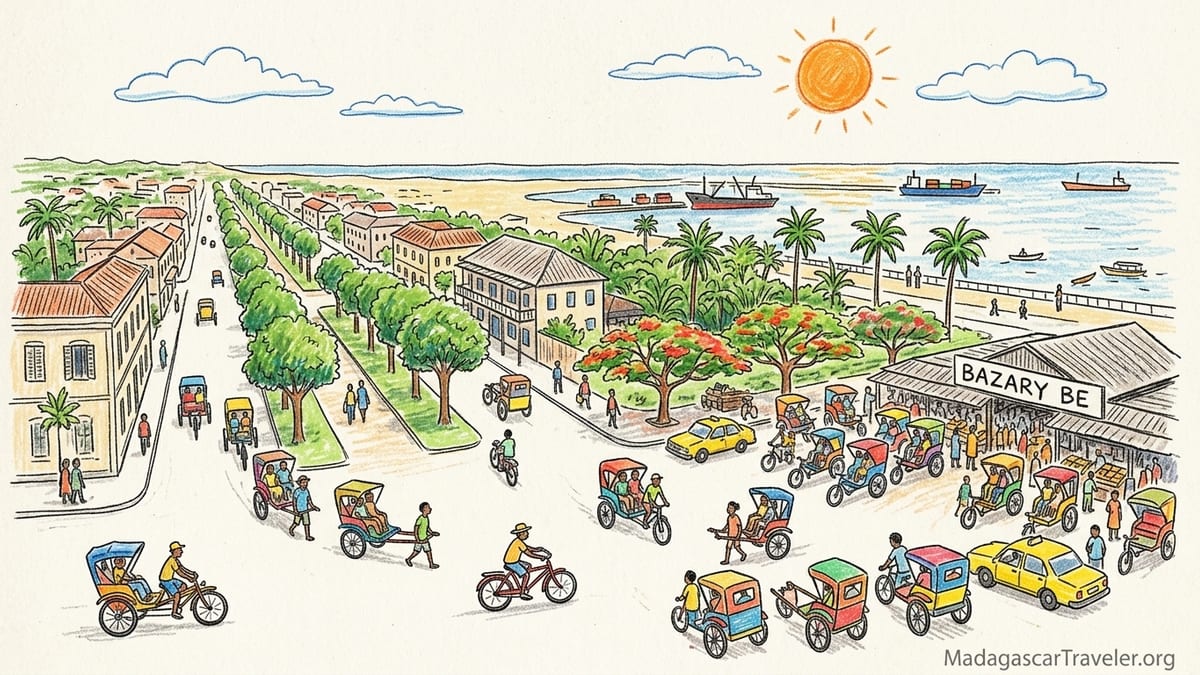
First Impressions: A Port City Built for Human-Powered Transport
Toamasina, still often called Tamatave, stretches along a flat sandy peninsula on Madagascar’s east coast. It is the country’s main commercial port and second-largest city, but its scale feels horizontal rather than vertical: wide boulevards, low-rise buildings and long straight streets that seem to run directly into the sea. Instead of traffic jams of private cars, the first thing I noticed were the bright, human-powered pousse-pousse lined up in clumps near markets, hotels and intersections, alongside a smaller number of yellow city taxis and a few tuk-tuks.
The regional tourism office actively promotes pousse-pousse rides as part of the Toamasina experience, suggesting that visitors use them to explore the waterfront, the “Bazar Be” central market and the older colonial streets inland. That marketing picture is mostly accurate. In the core area between the port, the Bazaar Be market and the seafront promenade, distances are short, streets are reasonably shaded by palm and flamboyant trees, and you are rarely more than a few minutes from a rickshaw willing to take you where you want to go.
What I learned quickly is that Toamasina’s layout favors soft mobility inside the city center. You can walk from the market to the main waterfront in around ten to fifteen minutes at a moderate pace, and most of the mid-range hotels cluster within this triangle. Yet the tropical climate changes the equation. Midday heat and sudden coastal downpours can turn a seemingly easy twenty-minute stroll on the map into a sweaty or soaked battle. That is where pousse-pousse and short taxi hops become less a novelty and more a practical tool.
Unlike some capitals where public buses or minibus taxi-be dominate urban transport, Toamasina today relies mostly on these small-scale options. Official sources note that the city no longer has a formal urban bus network equivalent to Antananarivo’s, and you will feel that when you look for a clearly signed bus stop and find none. Instead, the city functions on a mosaic of pousse-pousse, individual taxis, tuk-tuks and longer-distance taxi-brousse vehicles that serve only intercity routes.
My Airport and Hotel Transfers: Starting and Ending with Taxis
My car-free Toamasina story began at the local airport just outside town. After collecting my bag, I walked past a small rank of taxis operated under an airport cooperative system. In 2025, a schedule of fees published for airports in Madagascar showed a typical airport taxi fare band starting around 70,000 ariary for transfers into town, and that matched the first quote I received when I asked for “centre-ville, près du Bazar Be.” Drivers span between Malagasy and French; English is less common, but simple phrases and writing down your hotel name on paper work well.
I negotiated from an opening offer a little above that band down to 70,000 ariary by smiling, repeating the figure I was comfortable with and being ready to wait for another driver. In practical terms, that was roughly what I had expected from research before arrival, and the ride into town took about twenty minutes in early evening traffic. There is no meter, so agreeing the price before you sit down in the taxi is essential. Payment is in cash, in ariary; cards are not accepted and drivers rarely carry change for large notes, so smaller denominations saved me time and awkwardness.
The luggage situation in these taxis is straightforward. Most are compact sedans with a functional boot, and my medium checked suitcase plus daypack fit easily. If you are part of a couple with two full-size bags, ask the driver to open the boot before agreeing so you can see if everything fits. Occasionally you will see luggage tied in the trunk half-open with rope, which is normal for local standards but can be unnerving if you are not used to it. I kept my valuables bag with me on the back seat just in case.
For the return trip to the airport, my hotel arranged a trusted taxi the night before departure at a very similar rate to what I had paid on arrival. That removed the need to negotiate at 5 a.m. in the dark. In my notebook, those two taxi transfers bookended the stay. They were the only times in Toamasina when I missed the predictability of a metered car, but they also showed that with a few numbers in mind and willingness to bargain politely, independent travelers can manage just fine.
Learning the Language of Pousse-Pousse
The rest of my time in Toamasina, pousse-pousse took center stage. These are human-powered rickshaws, usually painted in primary colors with decorative motifs, two wheels and a simple bench seat. You will see both hand-pulled and bicycle-assisted versions around town. Tourism materials describe them as emblematic of Toamasina’s streets, and that matches reality. They wait in unofficial stands near the market entrances, big intersections and outside popular hotels.
My first ride was a short hop from my central hotel to the Bazary Be, the “big market” that sprawls between two busy streets inland from the port. Google Maps suggested a walk of just over one kilometer. At 10:30 in the morning, the sun was already heavy, humidity close to the ocean was intense, and the narrow pavements forced pedestrians into the side of the road. When a pousse-pousse driver caught my eye and said “Bazary Be?” with an expectant look, I hesitated only briefly before asking “ohatra firy?” the Malagasy phrase for “how much?”
On that first ride I paid 5,000 ariary for a ten-minute trip, which is a modest tourist premium compared with what locals might pay for very short hops. Over the next days, I learned that for distances under fifteen minutes within the center, most initial quotes for foreigners cluster somewhere between 4,000 and 8,000 ariary, depending on time of day, weather and how many other drivers are idle. At night or in pouring rain, or when I had visible luggage, quotes drifted higher and I either accepted the convenience premium or bargained down a little.
Fare negotiation is simple and face-to-face. Drivers rarely speak more than basic French, but numbers are universal. I would quote a figure slightly below what I was actually willing to pay, often using fingers as well as words, and either get an immediate nod or a counteroffer only 1,000 or 2,000 ariary higher. Once the price is agreed, you climb in and pay at the end, in cash. Tipping is not expected but rounding up by a few hundred ariary for a friendly driver feels appreciated, especially if you have asked them to wait for you outside a shop or market stall.
One dimension that surprised me was how easy it was to explain destinations just by naming a landmark. Drivers are used to hearing “Hôtel Joffre,” “Boulevard de l’Indépendance,” “Bazar Be,” “Bazar Kely,” or simply “front de mer” for the waterfront strip. When I needed to go somewhere more specific, like a small guesthouse on a side street, staff would usually help by explaining the crossroads in Malagasy to the driver before I set off. Written addresses mean little; intersections, markets and known hotels matter more.
Walking the City: When Maps Lie About Distance and Weather
On paper, central Toamasina looks made for walking. The streets form a loose grid, most blocks are low-rise and the main sights a short distance apart. My first morning, with overcast skies and a gentle breeze off the Indian Ocean, I set off on foot along one of the palm-lined avenues from my hotel towards the port area, planning to loop inland to the markets and back via the waterfront. That loop was around five kilometers according to my map, a distance I would not think twice about in a temperate city.
For the first hour, walking felt rewarding. I passed clusters of street food grills, stalls loaded with litchis and bananas, and children on their way to school. But just before midday, the cloud cover vanished and the sun came out hard. Heat bounced off the pale sand and concrete, and humidity surged. The roughly two-kilometer stretch I had left on my planned route suddenly felt much longer. Shade is intermittent, pavements appear and disappear, and traffic kicks dust into the air.
On another day, I misjudged an approaching rainstorm. The forecast had mentioned a chance of afternoon showers, which on the east coast often means intense but short-lived tropical downpours. Around 3 p.m., with bright sky overhead, I started what I thought would be a comfortable thirty-minute walk back from the smaller “Bazary Kely” market near the station to my hotel. Ten minutes in, the sky turned slate gray and then opened. Within seconds, the road was ankle-deep in water, and covered shop verandas filled with people taking shelter. My light rain jacket was no match for the sheer volume of water. When a passing pousse-pousse swerved under the awning and the driver gestured, we both knew the walk was over.
These episodes taught me to treat Google Maps walking times in Toamasina as a fair-weather baseline only. Add at least fifty percent to whatever the app suggests if you are moving around close to midday between November and March, when heat and tropical rains are common. For any walk longer than fifteen minutes on a sunny day, I began to build in a mental backup plan: know approximately what a pousse-pousse fare should be for that distance, carry small notes in an accessible pocket and have a landmark phrase ready in French or Malagasy to cut the walk short when comfort or safety demanded it.
City Taxis, Tuk-Tuks and Night Moves
While pousse-pousse shine for short, slow daytime hops, taxis become more attractive at night, in heavy rain or when carrying bulky luggage. Toamasina’s city taxis are usually older sedans painted in shades of yellow or cream. Local travel guides describe typical city fares in the 10,000 to 20,000 ariary range for cross-town trips, and my own rides lined up with that. A mid-afternoon ride from my hotel near the boulevard to a residential quarter beyond the market cost 12,000 ariary after a brief haggle. A later night ride back along roughly the same route, with heavier traffic and rain, settled at 20,000.
There are no functioning meters in the taxis I used, so once again negotiation before departure is crucial. I found it useful to say my destination, wait for the driver’s first price, then respond with a small discount. If we could not agree, there was always another taxi behind. Most drivers accept that bargaining is normal. Payment is again in cash, and while drivers sometimes have more change than pousse-pousse operators, I still tried to avoid handing over the largest notes.
Tuk-tuks, small three-wheeled motorized rickshaws popular in several Malagasy cities, appeared intermittently on my routes. They tended to be cheaper than taxis for short journeys, especially for one person, but many focused on specific corridors between the market area and residential neighborhoods rather than responding to random hails. On one occasion, a tuk-tuk ride that might have cost 10,000 ariary by taxi came to 7,000. The vehicle was more exposed to spray during a passing squall, though, and the bench seat was not ideal with a big backpack.
At night, I avoided pousse-pousse except for the shortest hops along well-lit boulevards and the waterfront where there were plenty of people around. In a port city with fluctuating economic fortunes, petty theft can be an issue after dark. City taxis felt more secure for moving between the waterfront restaurants and hotels or between a friend’s guesthouse and my lodging. Drivers knew the nightlife spots by name and often suggested safer drop-off points if the direct front door was on a dim side street. Rides between 8 p.m. and midnight across the central area rarely took more than ten to fifteen minutes, but heavy tropical downpours occasionally slowed everything as water pooled across intersections.
Reaching Markets, Waterfront and Everyday Errands Without a Car
Most visitors come to Toamasina to experience daily Malagasy life rather than a checklist of big-ticket monuments, and local transport suited that focus. The big market, Bazary Be, became my anchor. Twice a day I found myself there, either grabbing fruit and snacks or simply people-watching among the spice stalls and textile alleys. From my mid-range hotel, a pousse-pousse cost between 3,000 and 5,000 ariary each way depending on time and weather. On cooler mornings, I sometimes walked in about fifteen minutes and rode back when loaded with fruit or tired from the humidity.
The waterfront, with its wide seafront road, palm trees and views northwards along the coast, was another frequent destination. Walking from Bazary Be to the promenade took ten minutes in relaxed conditions. When the sun was intense or I wanted to arrive less sweaty for dinner, a pousse-pousse covered the same trip in roughly five minutes for 3,000 ariary. Unlike the capital, there was no sense that cars were required to reach the sea; it exists at the end of several main streets, always within easy pedal or walking distance of the central neighborhoods.
For more practical errands, such as buying a local SIM card or visiting a small supermarket, I again relied on the pousse-pousse and my feet. Many services cluster around the central boulevards, but they are spread out enough that stringing them together in a single walking loop in the heat can be tiring. On one afternoon, I combined three stops. I walked the first short leg, used a pousse-pousse for the silently lengthening second, and then flagged a taxi for the last stretch when a sudden squall turned the streets into shallow rivers. The driver understood “supermarché Shoprite” immediately, illustrating again how brand names and landmarks carry more weight than street names.
One thing I did not do in Toamasina was ride any city bus. Local contacts and reference sources confirmed that the city’s tram and formal bus services were discontinued some years ago, and there is no taxi-be style minibus network like the one in Antananarivo. If you see larger vans loading passengers in town, they are likely operating as taxi-brousse for intercity routes, not as hop-on urban transport. For intra-city movement, then, the realistic options are walking, pousse-pousse, taxi or tuk-tuk.
Getting Out of Town: Wildlife, Beaches and When a Car Helps
Inside Toamasina itself, I never once felt that renting a car would have made life simpler. The opposite might be true. Traffic near the port can be chaotic, parking is inconsistent, and the cost and hassle of a rental would have provided little benefit over the handful of short taxi rides and multiple pousse-pousse trips I used. The equation shifts, though, as soon as you want to leave the city for wildlife or beach excursions.
One popular outing is to Parc Ivoloina, a former research station and small wildlife park inland from Toamasina that hosts lemurs and other species. Distances given by local operators put it at roughly 20 kilometers from the city along a partially paved road. In theory, you could reach the turnoff by taxi-brousse or a combination of tuk-tuk and shared car. In practice, most independent travelers I met either arranged a half-day trip via their hotel, including a driver and vehicle, or hired a taxi for the return journey at a negotiated rate. Quotes I heard for such excursions sat in the band of 150,000 to 250,000 ariary for a car and driver, depending on duration and waiting time.
Heading to proper swimming beaches reinforces the value of private transport. Toamasina’s immediate beachfront is more a working and walking waterfront than a classic bathing shore. For calmer, reef-protected waters, Foulpointe (Mahavelona) is the usual target, a coastal town north of Toamasina described widely as the nearest “real” beach resort. The road distance is on the order of sixty kilometers. You can travel there by taxi-brousse from the main gare routière for a comparatively low per-seat fare, often cited around 10,000 to 20,000 ariary, but schedules and comfort are variable and minibuses depart when full rather than at fixed times.
On one of my days in the city, I followed a traveler’s story in reverse. They had attempted to ride a tuk-tuk all the way towards Foulpointe, only to be stopped at a roadside checkpoint and told that the vehicle was not allowed to carry foreign passengers that far out of town. They eventually transferred to a taxi-brousse. Hearing that tale convinced me to use more conventional transport for any out-of-town jaunts. If you are two or three people with luggage, negotiating directly with a private driver in Toamasina for a same-day return to Foulpointe or for a one-way drop at a beach hotel can be worth the premium, both for comfort and for having your bags under your own eyes.
Farther afield, Toamasina is a starting point for trips south along the Pangalanes Canal and for transfers to the boat routes to Île Sainte-Marie. Those longer journeys are almost always organized through tour operators, guesthouses or boat companies that include road transfers in a package. Even independent travelers who usually rely on taxi-brousse often pivot to arranged vehicles for these segments because road conditions, police checkpoints and time-sensitive boat departures make predictability valuable. After several days enjoying the informality of pousse-pousse in the city, I understood why a structured transfer or private 4x4 makes sense once you leave the urban grid.
A Realistic Car-Free Strategy for 2 to 4 Days in Toamasina
By the time I left Toamasina, I had settled into a rhythm that I would recommend to any traveler planning a two to four day stay without renting a car. Start by choosing accommodation within or just off the central grid of streets that runs between the port, Bazary Be and the waterfront. Many mid-range hotels cluster there, and being central reduces both your reliance on motorized transport and your exposure to long hot walks.
For airport transfers, accept that taxis are the simplest option. Use the published fee bands as a reference, confirm the price upfront at the airport and again for your return journey arranged through the hotel. Keep enough small notes in ariary to pay without drama, and write your hotel name clearly on a piece of paper or show it on your phone in case pronunciation becomes a barrier.
Within the city, walk for pleasure in the early morning and late afternoon when temperatures are gentler. Use those windows to explore Old Toamasina’s colonial streets, the port frontage and the seafront promenade. Keep walking stretches under thirty minutes and build in pauses for shade and hydration. For midday and for any route that looks longer than a couple of kilometers, default to pousse-pousse or taxi rather than trying to prove something to your step counter. Carry a basic phrase or two in Malagasy and French, know the going range for short rides and treat fare negotiation as a friendly ritual rather than a confrontation.
For night movements between restaurants, bars and your hotel, lean on city taxis or tuk-tuks and minimize dark, isolated walks, especially if carrying cameras or phones. If possible, ask restaurant or hotel staff to call a trusted driver. In my experience, a ten to fifteen minute night ride in the central area was inexpensive compared with the peace of mind it provided. Only use pousse-pousse late if the distance is short, the route is familiar and there are plenty of people around.
For any wildlife or beach excursion beyond the urban perimeter, decide in advance how much independence versus comfort you want. A budget-conscious solo traveler can combine tuk-tuk and taxi-brousse journeys from the gare routière to reach Foulpointe or inland towns, but should expect variable departure times and simple conditions. Couples or small groups who value time and predictability are usually better off negotiating with a private driver through their accommodation. Either way, there is no real advantage in maintaining a full-time rental car solely for a few sightseeing outings. One or two targeted day transfers, plus taxis, pousse-pousse and walking the rest of the time, cover almost everything.
FAQ
Q1. Is it realistic to visit Toamasina without renting a car?
Yes. For a stay of two to four days focused on the city, markets and waterfront, walking, pousse-pousse, taxis and occasional tuk-tuks are entirely sufficient.
Q2. How much should I expect to pay for a pousse-pousse ride in Toamasina?
For short trips within the central area, expect opening quotes between about 3,000 and 8,000 ariary depending on distance, weather and time; agree the fare before departure and pay in cash.
Q3. Are pousse-pousse safe and comfortable for travelers with luggage?
They are fine for light luggage such as daypacks or small duffels, but for heavy suitcases or long distances city taxis are safer and more practical, especially in rain.
Q4. How do I communicate my destination to a driver if I do not speak Malagasy?
Most drivers recognize landmarks like Bazary Be, the waterfront or major hotels when named in French; showing the name written down or on your phone also works well.
Q5. What is the best way to get from Toamasina airport to the city center without a car?
Use the official taxis waiting outside arrivals, confirm the destination and fare band with the driver before boarding and pay in cash in ariary at the end of the ride.
Q6. Is it safe to walk around Toamasina at night?
Short walks along busy, well-lit streets and the main waterfront are generally fine, but for longer distances after dark it is safer to use a taxi or tuk-tuk.
Q7. Can I reach Parc Ivoloina and Foulpointe using public transport only?
It is possible to combine tuk-tuks and taxi-brousse, but many visitors prefer to arrange a private driver or hotel-organized transfer for comfort, timing and security.
Q8. Are there city buses or taxi-be minibuses operating within Toamasina?
No formal urban bus network currently operates in Toamasina; intercity taxi-brousse leave from the main gare routière, but within the city you rely on walking, pousse-pousse, taxis and tuk-tuks.
Q9. How does rain or heat affect getting around without a car?
Strong sun and sudden heavy showers can quickly make walking uncomfortable; in those conditions short pousse-pousse or taxi rides are the most practical and widely used alternative.
Q10. For a short stay, where should I book my hotel to minimize transport hassles?
Choose a hotel within the central area between Bazary Be, the port and the seafront, where most sights, markets and restaurants are within a short walk or quick pousse-pousse ride.