


I arrived in Toamasina after dark, dusty and a little wired from nine hours on the RN2 from Antananarivo. The taxi-brousse from the Ambodivona station had rattled past red laterite hills, rainforest-cloaked slopes and truck convoys before dropping us at a chaotic forecourt on the edge of Madagascar’s principal port city. I had booked three nights in advance at a modest guesthouse a few blocks off Boulevard Joffre, imagining a slightly sleepy seaside town. Instead, my first glimpse of Toamasina was headlights bouncing off puddles, the hum of generators, the clatter of pousse-pousse carts and the salt-heavy smell of the Indian Ocean carried inland on humid air that felt like opening a greenhouse door.
Arriving in Madagascar’s East-Coast Gateway
Overland from Antananarivo, Toamasina feels farther than the map suggests. The RN2 connects the capital to the port over roughly 350 kilometers, but the twisting route, dense traffic and frequent checkpoints mean most travelers should expect a journey of 7 to 10 hours by taxi-brousse or private car. Shared vans leave from Antananarivo’s Ambodivona station for Toamasina throughout the day, with recent fares reported in the region of 40,000 to 60,000 ariary per seat for a standard taxi-brousse, and more for so-called VIP services with fewer passengers. By the time we rolled into town, the sky was black and the air was thick with the smell of diesel, fried snacks and sea salt.
I had chosen to come by road instead of flying so I could see the interior give way to the east coast. Earlier in the day, we had crawled uphill out of Antananarivo, then descended through green hills toward Moramanga and the Andasibe forests before the scenery flattened and the air grew heavier. On the final hour into Toamasina, the road straightened and lorries full of containers began to dominate the traffic. Even from inside the crowded van, I could sense the shift to a port city, the informal stalls giving way to warehouses and fuel depots as we approached Madagascar’s economic capital.
My base was a small hotel in the grid of streets between Boulevard Joffre and the seafront, an area that puts you close to the city’s markets and to the ocean breeze without being right on the busiest strip. Night check-in was brisk. The receptionist warned me that walking felt safe in the early evening along the main avenues but advised using a taxi or tuk-tuk later at night, especially around the bus stations and port gates. Outside, the air buzzed with two-stroke engines from tuk-tuks and the ringing bells of pousse-pousse pullers looking for late fares.
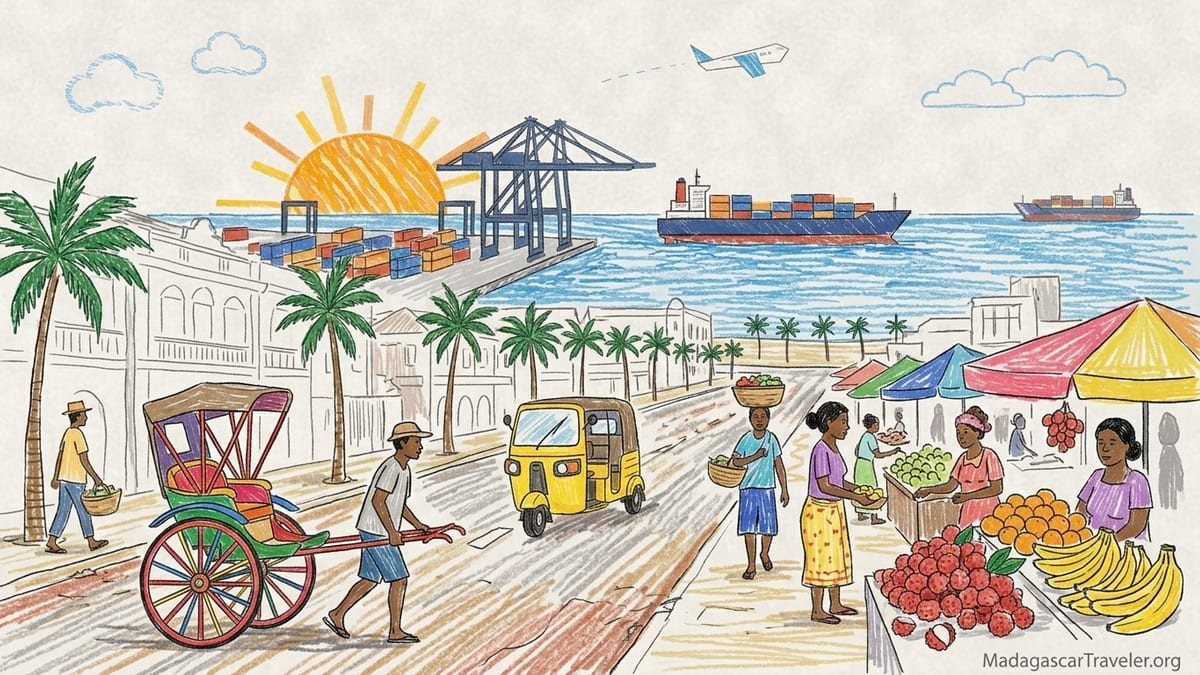
Before visiting, I had pictured Toamasina as a low-key beach town with a bit of port infrastructure attached. In reality, the port is the backbone of everything. Containers stack against the skyline, cranes silhouette at dusk and trucks grind through the streets at all hours. The city beach exists, but in many places it sits behind fences, low seawalls and port installations. The ocean is always present in the taste of the air and the roar of waves on the reef offshore, yet you are very clearly in a working city rather than a resort.
Boulevard Joffre and the Seafront: First Impressions on Foot
Boulevard Joffre is the spine of Toamasina. By mid-morning on my first full day, the avenue was already in full motion: tall palms lining the central strip, faded colonial-era buildings under deep verandas, and a constant flow of pousse-pousse and tuk-tuks threading between pedestrians and parked cars. Walking here felt surprisingly manageable compared with other Malagasy cities. The sidewalks are uneven in places, and after heavy rain puddles can span entire corners, but traffic moves slowly enough in the central section that crossing is more about patience than daring.
The sensory impression is immediate. Street vendors sell pineapples, lychees in season and small mountains of bananas, the sugar-sweet fragrance thick in the humid air. Open-front snack stalls fry mofo gasy and mofo akondro, rice and banana fritters that give off a warming scent of oil and caramelized batter. Mixed into all this is the tang of exhaust, especially where tuk-tuks idle near intersections, and a faint briny note from the sea one or two blocks away. The soundscape combines honking minibuses, bicycle bells from pousse-pousse drivers, music from mobile phones and the occasional clank of container operations drifting inland.
From the boulevard, short streets run east toward the seafront. In some stretches, fences and port walls block direct beach access, reinforcing Toamasina’s identity as a working harbor. In others, especially nearer the more residential stretches, low seawalls look out toward the reef. Here the air cools slightly, and the taste of salt intensifies. Joggers pass in the early morning, and families stroll in the late afternoon. Even so, this is not a beach where visitors typically swim, partly because of currents and partly because of cleanliness concerns. For travelers picturing a turquoise lagoon at the city’s doorstep, this reality can be a surprise.
What the seafront does provide is a sense of place. Watching waves break against the reef as cargo ships queue offshore, you see why Toamasina grew here. The port’s constant movement contrasts with more languid scenes along the promenade, where snack stands sell grilled brochettes and cold soft drinks, and teenagers take pictures against the backdrop of palms and freight cranes. I spent a lot of time on this strip in the late afternoon, when the sun softened and a breeze picked up off the ocean, cooling the sticky heat that dominates midday.
Old Toamasina, Markets and Everyday Life
One of the most rewarding parts of Toamasina lies just behind Boulevard Joffre, where the older grid of streets houses markets, low-rise colonial buildings and a dense maze of small shops. Here, the city feels at its most lived-in. Bazar Be, the “grand market,” stretches between the boulevard and Avenue des Hovas, a loose complex of indoor and outdoor stalls where everything from vanilla beans and cloves to second-hand clothes and plastic buckets is for sale. The air inside the covered sections is thick, humid and layered with scent: sharp spices, sun-warmed fruit, raw fish from the morning catch, and the occasional diesel fume drifting in from a passing delivery truck.
Walking through Bazar Be can feel intense but not hostile. Paths are narrow, and you often turn sideways to let a porter pass with sacks of rice or charcoal. Piles of litchis, oranges and jackfruit brighten dim corners, and you will almost certainly brush past raffia baskets and hats aimed at both locals and visitors. Unlike craft markets in more touristy parts of Madagascar, very little here feels curated for foreigners. Most stallholders are simply doing their daily trade, and a few may call out politely to show you spices or vanilla bundles. Haggling is expected, though prices for basic items remain relatively modest compared with the capital.
A little farther back, around the smaller bazary kely near the station area, the focus shifts to everyday produce and household goods. Here I saw women squatting behind neat lines of tomatoes, greens and fiery chilies laid directly on tarps, and men repairing flip-flops and bicycle tires on the roadside. The smell shifts again: more earth and herbs, less fish, punctuated by the occasional whiff of grilled meat from street-side skewers. Footing in these neighborhoods can be tricky after rain. Puddles gather in ruts, and open drainage ditches demand attention. Waterproof sandals or sturdy shoes that you do not mind getting muddy make exploration far more comfortable.
The older architecture around these markets hints at Toamasina’s history as a French colonial outpost and commercial center. Weathered facades with balconies and columns stand beside newer concrete blocks. Many buildings have peeling paint and patched shutters, but the proportions and verandas give the streets a distinctive character. I often found myself looking up to catch the interplay of dappled light through trees and the soft pastel colors of aging walls, even as I navigated the practicalities of not stepping in puddles or getting clipped by a bicycle.
Pousse-Pousse, Traffic and Getting Around Town
If you only know rickshaws from postcards, Toamasina’s pousse-pousse scene feels very immediate and human. Colorful, high-wheeled carts line up along central intersections, their pullers resting in the shade until someone waves them over. They move at a brisk jogging pace when in motion, bells chiming to warn pedestrians. For short hops between the markets, Boulevard Joffre and the seafront, they are often quicker than cars stuck behind trucks or buses. Fares are usually negotiated in advance, and even a conservative traveler budget can accommodate a few rides, but it is worth asking a local or hotel staff for current price ranges to avoid misunderstandings.
Alongside pousse-pousse, tuk-tuks and regular taxis serve most of the city. Tuk-tuks tend to dominate in and around the central grid, weaving between slower carts and pedestrians. Their small engines add a high-pitched hum to the broader soundscape. Taxis, often older sedans, cluster near bus stations, markets and larger hotels. Distances inside Toamasina’s core are relatively short. Walking from Boulevard Joffre to the seafront usually takes less than 10 minutes, and even the markets and bus station can be linked on foot if you are comfortable with heat and occasional uneven sidewalks.
Traffic itself feels different from Antananarivo. It is busy, but the geometry of wide avenues and the relative flatness of the city reduce the feeling of gridlock. What you do feel, especially between late morning and early evening, is the humidity. The combination of heat, minimal shade on some streets and the reflective surfaces of buildings and asphalt can make even moderate walks feel draining. I found myself structuring my days to explore in the early morning and late afternoon, and to use tuk-tuks or pousse-pousse more freely during the brightest hours, especially if I had already spent time out at the markets.
At night, the transportation picture shifts. Some pousse-pousse and tuk-tuks continue to work, but drivers may be more selective about routes. Local advice consistently stressed avoiding isolated stretches near the port gates and using taxis at night for longer distances, particularly if carrying cameras or daypacks. I followed that guidance and generally confined my after-dark walking to the better-lit sections of Boulevard Joffre and adjacent streets, where restaurants and bars drew a steady flow of people.
Food, Nights Out and Toamasina After Dark
Toamasina’s food scene reflects its position between sea and hinterland. Around the markets and bus stations, street food dominates: skewers of zebu beef sizzling over small charcoal grills, banana fritters dusted with sugar, and samosa-style snacks filled with meat or vegetables. The smell of grilling fat and woodsmoke hangs over certain corners for much of the day, mingling with the sharper notes of frying oil from dough-based snacks. For a quick, very local lunch, I often bought a couple of brochettes, a handful of bananas and a soft drink from one of the many stall-side fridges, then found a shady spot near the seafront wall to eat.
Closer to the central and coastal hotels, small restaurants and cafés offer a mix of Malagasy staples and simple international dishes. Plates of ravitoto with rice, fish in coconut sauce and grilled prawns appear frequently on menus, often at prices that feel low compared with European standards but higher than street food. Portions are generous, and seafood quality benefits from the port’s active fishing trade. Several places along or near Boulevard Joffre serve cold Three Horses Beer and basic pizzas and steaks, catering to a mix of local families, port employees and travelers.
Evenings in Toamasina are shaped by both the port schedule and the climate. Heat lingers on the pavements long after sunset, so many people come out after dark to walk, eat and socialize when the air becomes marginally more comfortable. Some stretches of Boulevard Joffre take on a carnival feel as vendors push carts with snacks and mobile music stands compete in volume. In side streets, small bars with plastic chairs spill onto the pavement, neon signs reflecting in puddles after any afternoon rain. This is where I spent most of my evenings, nursing a drink, eating grilled fish or chicken and watching families, young couples and groups of friends drift past.
Toamasina does have areas that visitors describe as red-light districts, particularly toward the busier northern reaches of its main boulevard and near certain port-side streets. I passed through early in the evening and did not feel unsafe, but the atmosphere shifts: louder music, more alcohol-focused venues and a visible presence of transactional nightlife. For many travelers, these sections are better observed in passing than used as bases for going out. If you want a calm night, look for restaurants and cafés in the central corridor south of the liveliest clusters, or near the better-known hotels where lighting and informal security are more consistent.
From Commercial Port to Green Coastline
Perhaps the biggest surprise in Toamasina is how quickly the concrete and containers give way to greenery once you leave the urban core. Within a short drive north of the city, coconut palms and coastal forest reclaim the horizon and the ocean appears in its postcard colors. This is where Toamasina truly becomes a gateway rather than an end point, especially for travelers who want beaches, quieter villages and access to canals and nature reserves.
North of town, Foulpointe, also known as Mahavelona, functions as a beach resort by east coast standards, with a reef-protected lagoon, white sand and a cluster of hotels and restaurants spread along the shore. The sea here is generally calmer than directly in front of Toamasina, and visitors come for swimming, snorkeling and long, lazy lunches of grilled langoustines and fish in simple beachfront eateries. Just inland sits Fort Manda, a 19th-century Merina fort built under King Radama I a short distance north-west of the village, which adds a cultural layer to a beach day. Shared taxis and taxi-brousse connect Toamasina and Foulpointe, and the journey typically takes around two hours depending on stops and road conditions.
Farther up the coast, Mahambo draws surfers and backpackers. While developments remain relatively small compared with mainstream surf destinations, the presence of a few laid-back lodges and surf schools has put this stretch of coast on more itineraries. Sea conditions can be stronger here, and anyone planning water activities should speak with local operators about currents, tides and recent weather. From Toamasina, it is possible to combine a couple of nights in town with onward travel to Mahambo, especially if you are continuing by boat or organized transfer toward the more remote island of Sainte Marie.
Inland from Toamasina, Parc Ivoloina offers a very different escape. Operated as both a conservation breeding center and a forest reserve, it lies within day-trip distance of the city on a road that leaves the RN2 north of town. The site combines enclosures for lemurs that cannot be released with trails through rehabilitated forest, as well as environmental education facilities. Recent publicly available tariff tables show entrance and accommodation prices set in ariary, with options ranging from simple dormitory beds to more comfortable lodging, making it accessible to domestic visitors and international travelers on varying budgets. Given seasonal weather and the potential for muddy trails, a visit here works best when you plan for early departure and allow flexibility in case roads become difficult after heavy rain.
Onward Access: Pangalanes Canal, Logistics and Mistakes
Beyond roads, Toamasina serves as a southern entry point for parts of the Pangalanes Canal system, the chain of natural lakes and man-made waterways that parallel Madagascar’s east coast. Several local operators and hotels in and around the city arrange day trips or multi-day journeys on sections of the canal, using motorized barges or traditional boats adapted for passengers. Itineraries change with water levels and local conditions, but common options include day excursions that combine canal travel with visits to lakeside villages or simple beach picnics, and longer routes that end near coastal retreats north of Toamasina where a vehicle meets you for the return to the main road.
Planning these excursions from afar is not straightforward. Many smaller operators do not maintain up-to-date online information, and seasonal cyclone activity between January and March can disrupt routes, close sections of the canal or make motorboat travel unsafe. On my visit, I had assumed that canal trips would be easy to arrange on arrival, only to find that a combination of recent heavy rains and logistical bottlenecks meant only a limited set of options were running at short notice. The lesson was clear: if a canal journey is a priority, contact your guesthouse or a reputable local agency before you arrive in Toamasina to check current conditions, likely prices and minimum group sizes.
Another logistical point where I misjudged things concerned onward overland travel. I had imagined that buying a seat back to Antananarivo would be as simple as showing up at the taxi-brousse station the day before and choosing a departure time. In reality, better-quality services and VIP minibuses often sell out earlier, especially ahead of weekends or public holidays. Standard taxi-brousse still had seats, but departure times were loosely observed, and vehicles sometimes waited until full. If you are on a tight schedule or aiming to connect with an international flight in the capital, it is worth asking your hotel to help confirm and, if possible, pre-book a specific service at least a day or two in advance, whether through a known company or via local contacts at the station.
These experiences highlighted Toamasina’s dual character. On one hand, it is an essential node in Madagascar’s economy, with constant movement of goods and people through the port and along the RN2. On the other, tourism infrastructure is still patchy, communication can be opaque and weather can disrupt the best-laid itineraries. Accepting a degree of flexibility and building slack days into your plan can transform missed canal trips or rescheduled buses into time for deeper exploration of the city itself.
Does Toamasina Deserve More Than a Transit Night?
Official tourism materials often present Toamasina as a brief stop: a gateway to beaches, a base for Parc Ivoloina, a launching point along the east coast. Before visiting, I expected to treat it that way too, perhaps giving it a single night on arrival and another before departure. After three nights and a full set of days, my view changed. The city is not conventionally pretty in the way postcard beaches or misty highland villages can be, but it offers a dense, real slice of Malagasy urban life that many itineraries bypass.
Parts of Toamasina are undeniably functional rather than scenic. The port gates, container yards and industrial fringes feel like anywhere that goods move at scale, and there is little reason for most visitors to linger there. Certain stretches near bus stations are noisy and chaotic without offering much in return if you are not shopping for basics or catching transport. Yet just a few blocks away, avenues lined with trees, markets pulsing with color and the breezy seafront create a very different atmosphere. For travelers interested in how Madagascar works day to day, from spice trading to fish markets and street food economies, Toamasina easily rewards at least one full day of unhurried wandering.
In retrospect, I would still not describe it as a standalone beach destination. The city shoreline remains more atmospheric than inviting for swimming, and anyone seeking long, quiet days on sand will be happier in Foulpointe, Mahambo or farther afield. Where Toamasina shines is as a hub: arrive, recover from the road or flight, taste the markets, arrange canal or park visits, then pivot outward to greener coasts and forests. With that framing, two nights in town feel like a sweet spot, allowing one full day to explore the city and another to make a short excursion before moving on.
If I were planning again, I would change a few things. I would arrive earlier in the day to see the port gradually come to life instead of meeting it only after dark. I would pre-arrange at least a provisional Pangalanes outing and confirm Ivoloina’s current accessibility and opening times before arrival, especially in the rainy months. Most of all, I would set my expectations more accurately: Toamasina is a busy, humid, slightly gritty port city that occasionally reveals sudden pockets of calm, shade and beauty rather than a tropical beach town with cranes in the distance. Approached on its own terms, it becomes one of the more memorable stops on Madagascar’s east coast.
The Takeaway
Toamasina is Madagascar’s east-coast gateway in the truest sense: a city where lorries and lemurs, vanilla bundles and shipping containers, tuk-tuks and canal boats all intersect. The humidity can be draining, the traffic noisy and the logistics occasionally frustrating, but behind the functional facade lies a rich everyday life that rewards patient exploration. Boulevard Joffre, the old markets and the seafront promenade form a compact triangle where you can feel the pulse of the country’s economic capital without needing to venture into its most industrial zones.
For travelers, the main question is not whether Toamasina is “beautiful” in a conventional sense, but whether it adds depth to an itinerary centered on beaches and wildlife. In my experience, it does. Standing in Bazar Be with the scent of cloves and bananas thick in the air, or watching teenagers race pousse-pousse carts along the promenade at dusk, I saw a Madagascar rarely captured in glossy brochures. As a base for side trips to Foulpointe, Mahambo, Parc Ivoloina and the Pangalanes Canal, it also makes logistical sense, especially if you allow time for weather and road surprises.
Most importantly, Toamasina challenged my assumptions. Instead of a sleepy seaside town, I found a port that feels alive at all hours, a city that belongs first to its residents and only second to its visitors. By giving it more than a transit night, staying in a central guesthouse, walking its main streets and accepting that some plans might change with the rain, I left with a clearer sense of how Madagascar’s east coast breathes. That, for me, made the journey along the RN2 and the days of humid wandering entirely worthwhile.
FAQ
Q1. How many days should I spend in Toamasina itself?
Most travelers will find that two nights in Toamasina works well, giving one full day to explore the city and another for a short side trip or buffer for transport delays.
Q2. Is Toamasina safe to walk around?
Central areas around Boulevard Joffre, the markets and the seafront feel generally safe during daylight, though you should watch your belongings; at night, stick to well-lit main streets and use taxis or tuk-tuks for longer distances.
Q3. Can I swim at the beach in Toamasina?
While there is a city beach, conditions and cleanliness are not ideal for swimming, and currents can be strong, so most visitors go to nearby Foulpointe or Mahambo for proper beach time.
Q4. How do I get from Antananarivo to Toamasina?
You can travel by road along RN2 in a taxi-brousse or private car, usually taking 7 to 10 hours depending on conditions, or take a domestic flight when services are operating.
Q5. What is the best way to get around Toamasina?
In the city center, walking, pousse-pousse and tuk-tuks are practical for short distances, while regular taxis are better for night travel or trips to the bus station and outskirts.
Q6. Is Toamasina a good base for visiting Parc Ivoloina?
Yes, Toamasina is the main urban base for Parc Ivoloina, which can usually be visited as a half or full day trip, although road and weather conditions should be checked in advance.
Q7. How do I organize a Pangalanes Canal trip from Toamasina?
Canal excursions are typically arranged through local agencies or hotels in Toamasina; it is best to contact them before arrival to confirm current routes, prices and availability.
Q8. Where are the best beaches near Toamasina?
Foulpointe, with its reef-protected lagoon, and Mahambo, popular with surfers, are the main nearby beach destinations and can be reached by road from Toamasina.
Q9. What should I wear for walking around Toamasina?
Light, breathable clothing, a hat, sun protection and sturdy sandals or shoes that can handle heat, puddles and uneven pavements make walking much more comfortable.
Q10. Is Toamasina worth including if I am focused mainly on wildlife?
If your priority is wildlife, Toamasina still makes sense as a gateway to Parc Ivoloina and as a staging point for reaching other east coast forests and reserves, while also giving insight into urban Malagasy life.