


I spent four nights in Toamasina, Madagascar’s busy east coast port, and choosing the right part of the city mattered more than the room itself. I based myself just behind the seafront, a short walk from Boulevard Ratsimilaho and the city’s beachfront promenade, so I could walk to restaurants and the market but still sleep reasonably well at night. That compromise between access and noise shaped almost everything about my stay and it is the same trade off most visitors will face when deciding where to stay in Toamasina.
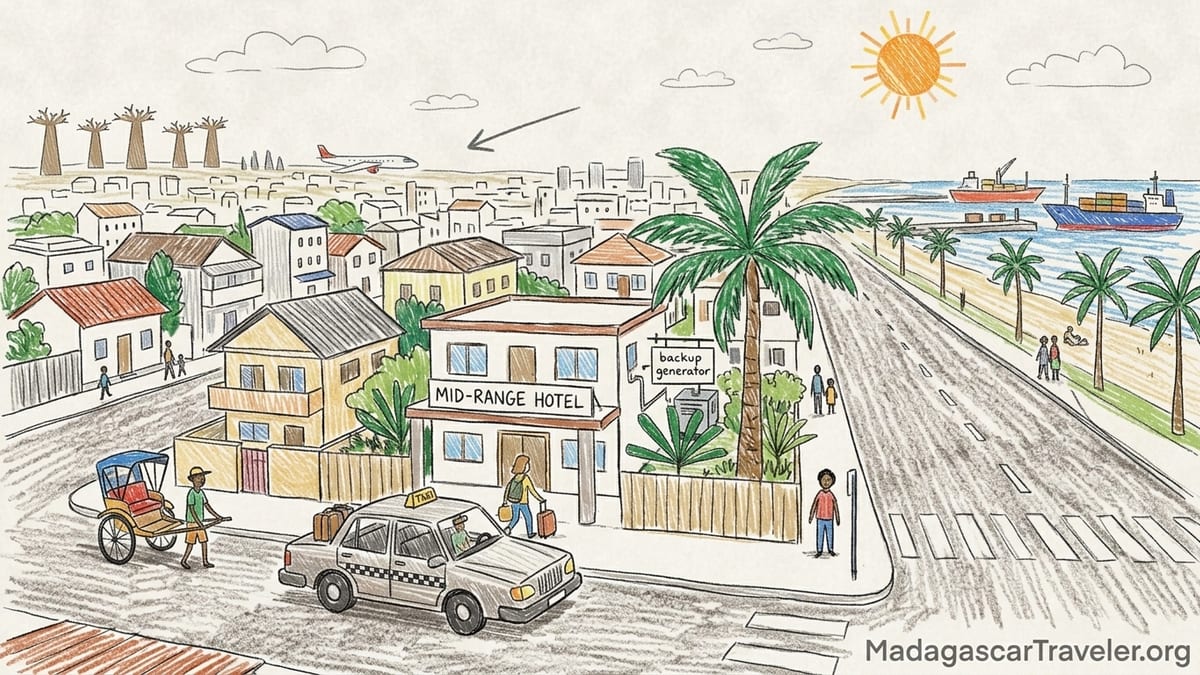
Where I Stayed in Toamasina and How It Worked Out
For this trip I chose a mid range business style hotel a few blocks inland from Boulevard Ratsimilaho, the main seafront artery in Toamasina that runs parallel to the beach and port area. The property was in a mixed residential and commercial neighborhood, close enough that I could walk to the promenade in about seven or eight minutes and to the bustling central market in around ten. That location felt like a good balance between being in the thick of things and not directly on a noisy main road.
I stayed for four nights, arriving on an afternoon flight into Toamasina Ambalamanasy Airport and leaving on an early morning departure. The hotel arranged an airport pickup in a private car for a fixed price that was similar to what local taxis were quoting at the terminal. The drive took about 15 to 20 minutes depending on traffic, which matches the airport’s position roughly 5 to 7 kilometers outside the center. The driver was used to dealing with luggage for travelers continuing to the coast, so getting bags in and out of the vehicle was quick and straightforward.
The decision to stay a few streets back from the water worked fairly well. At night I could still hear occasional motorbikes and a distant hum from the port, but it was noticeably quieter than the properties that face directly onto Boulevard Ratsimilaho or the main roundabouts. Power cuts happened several times during my stay, as they often do in Toamasina, but the hotel had a backup generator that kept the lights, air conditioning and Wi Fi running after a brief interruption. That made a big difference when trying to sleep in the humid coastal air and catching up on work in the evenings.
From a practical standpoint, being slightly inland meant I used pousse pousse rickshaws and taxis more often than someone staying right on the promenade, but not so much that it became a chore. I could walk to cafes, small restaurants and the market area in under ten minutes, and when the heat or rain made walking less attractive there were always pousse pousse operators waiting on the nearby corner. Distances inside the compact center felt manageable, which confirmed that choosing the neighborhood first and the property second was the right approach.
Understanding Toamasina’s Layout Before You Book
Toamasina is Madagascar’s main east coast port city, stretched along a sandy coastline with the commercial harbor, beachfront promenade and older grid like city center forming one continuous urban strip. The port and industrial facilities sit toward the northern and central parts of the waterfront, while the main commercial streets, market and many hotels cluster in the slightly more southern sections near Boulevard Ratsimilaho and the avenues that run perpendicular to it. Inland from the seafront, residential areas and quieter side streets extend west toward the main road leading to the airport.
The airport itself lies inland to the northwest, several kilometers from the coast. Even though the distance is not great, traffic, speed bumps and the general pace of life in Madagascar mean transfers are rarely fast, so a realistic expectation for most hotel to airport journeys in normal conditions is 15 to 25 minutes by car. This matters if you have early morning flights or need to coordinate with taxi brousse departures for the road north to places like Foulpointe or south toward the Pangalanes Canal access points.
Within the city, there is no formal public bus network. Instead, movement relies heavily on human powered or cycle based pousse pousse, tuk tuks, tricycle taxis and standard city taxis. Pousse pousse are a defining feature of Toamasina, with thousands registered, and they cover everything from short hops between the market and hotels to longer rides along the waterfront. That abundance of small scale transport means you do not have to stay directly on any particular street to get around, but your base will influence how often you need to negotiate rides and how much street noise you live with.
Most visitors end up choosing between five broad types of base. There are hotels on or very close to the seafront and Boulevard Ratsimilaho. There are central commercial area stays within walking distance of the market and administrative offices. There are slightly quieter zones a few blocks inland, where my own hotel was located. There are airport convenient accommodations on the road between town and Ambalamanasy. Finally, there are properties used mainly as gateways to east coast excursions, including stays arranged by tour companies that prioritize quick access to roads leading to places like the Pangalanes Canal or coastal resorts.
Staying Near the Seafront: Scenic or Practical
The seafront is the address most people imagine when they picture staying in Toamasina. Boulevard Ratsimilaho and nearby streets run along the coast, with a tree lined promenade, urban beach and glimpses of the harbor. Several of Toamasina’s better known hotels and apartments cluster along or near this strip, including mid to upper range properties that cater to both business travelers and visiting officials. From a guest’s perspective, these seafront locations offer easy access to the promenade for evening walks, quick access to nearby restaurants and bars, and a feeling of being in the livelier heart of the city.
On the ground, staying right on the waterfront is as much about atmosphere as it is about convenience. You might be within a two or three minute walk of casual seafood places, open air cafes and simple grills where locals gather, and you can reach the market area with a short pousse pousse ride or a 10 to 15 minute walk depending on your exact location. Watching the Atlantic rollers and port traffic from your balcony or the hotel terrace is undeniably appealing after a day on the road. For travelers who value that sense of place and do not mind a bit more noise, a seafront base can feel very rewarding.
There are trade offs. The main seafront roads carry steady traffic until late in the evening, including trucks heading to and from the port, motorbikes and tuk tuks. Nighttime noise from horns, music and the general life of the promenade can be noticeable, especially on weekends and holidays. Some properties have good soundproofing and modern air conditioning systems, but others rely more on older construction and ceiling fans. If your room faces the street, light sleepers might find earplugs as important as a good pillow. In addition, being closest to the water does not automatically mean being closest to practical services like larger supermarkets, which may sit a few blocks inland.
For my own trip I chose not to stay directly on the promenade but visited it daily. After walking the strip at different times of day, my view is that waterfront stays are best seen as a lifestyle choice rather than a strict practical necessity. You gain the pleasure of early morning or sunset walks along the coast without needing any transport, and you can step outside to find a pousse pousse almost instantly. However, for early airport departures or road transfers, you still need a car either way, and walking times to administrative offices or inland markets are only marginally longer from a few streets back. In other words, staying on the waterfront is genuinely pleasant but mainly scenic rather than fundamentally more efficient.
Central Commercial Areas: Walking Access and Urban Energy
The commercial core of Toamasina fans out behind the waterfront, with gridded streets filled with shops, small offices, banks, phone kiosks and the city’s principal markets. Some hotels sit directly in this central zone, within a five to ten minute walk of the main market and close to key intersections where pousse pousse gather. These central area accommodations tend to appeal to business travelers, NGO staff and visitors who prioritize walking access to everyday amenities over sea views.
From my slightly inland base I often walked through this central belt to reach cash machines, small grocery stores and phone shops. The experience confirmed why some travelers deliberately book into the commercial zone. During the day there is constant activity, but it feels more like an average Malagasy city than a tourist hotspot. You can buy fruit, bottled water, snacks and basic travel supplies without going far, and there are plenty of low key eateries serving rice dishes, grilled meat and fish. Walking times to the market were under ten minutes from my hotel, and it rarely took more than five minutes to find a pousse pousse when I wanted one.
At night, some central streets quieten down more than the waterfront, although major junctions remain lively. Traffic noise is still present, but the absence of port truck convoys and dense bar clusters can make sleep a little easier in certain blocks. The trade off is that you might be a 15 minute walk or a short pousse pousse ride from the seafront if you want an evening stroll by the water. For travelers visiting Toamasina mainly to organize logistics, meet local contacts or spend time in the markets, a central commercial base can be a practical choice, especially if you confirm that your chosen property has reliable backup power for air conditioning and Wi Fi.
Security wise, I felt reasonably comfortable walking the busier commercial streets in the late afternoon and early evening, carrying only essentials and keeping my phone and camera discreet. Locals I spoke to, including pousse pousse drivers and hotel staff, recommended using taxis or pousse pousse after dark for longer distances and avoiding deserted side streets. These are the same common sense precautions that apply in many African port cities. Staying central neither eliminates nor multiplies risk, but it does mean there are usually more people around and more options for quick transport.
Quieter Inland Areas: Residential Streets and Better Sleep
A few blocks inland from the seafront and main commercial streets, Toamasina’s character shifts. Here, side streets mix small houses, local eateries, schools and modest guesthouses or business hotels catering largely to domestic travelers. This is where I stayed, and it is the kind of area that often appeals to visitors who want a more low key environment without feeling isolated from the city. Streets are narrower, traffic is lighter and the background noise drops from a constant roar to a softer urban hum.
From my hotel, I could reach several simple restaurants in under five minutes on foot, and there was a small convenience style store nearby that sold bottled water, snacks and phone credit. Walking to the promenade took just under ten minutes at an easy pace. The main limitation of being slightly inland was that, during heavy rain, the drainage on some secondary streets was poor, so walking required watching where I stepped. On those evenings I was glad that pousse pousse and tuk tuks were willing to cover even short distances for a modest fare, especially when I had camera equipment or groceries with me.
In terms of comfort, the quieter location made a real difference at night. With the windows closed and air conditioning on, I heard only occasional vehicles and distant sounds from the port. Power cuts, which occurred for an hour or two on some evenings, briefly shut off the air conditioning and Wi Fi, but the hotel’s generator started quickly. Checking in advance whether a property has a backup system or not is important anywhere in coastal Madagascar, and it is especially valuable in Toamasina’s humid climate, where sleeping without a fan or air conditioning can be difficult for visitors not used to the heat.
This type of inland base suits travelers who plan to spend several nights in Toamasina, either before continuing to the coast or while handling work or logistics. Couples and solo travelers who want somewhere calm to return to at the end of the day, but who still appreciate being able to walk into town, often find these areas ideal. Families might also appreciate the quieter streets, though they should be prepared to rely on pousse pousse or taxis when moving children and luggage, since sidewalks are not always continuous and traffic can be unpredictable even on smaller roads.
Airport Convenient Stays and Transit Nights
Because Toamasina is the main hub for flights along Madagascar’s east coast and a gateway for road journeys to Foulpointe, Mahavelona and access points for the Pangalanes Canal, many visitors spend only one night in the city on either side of a domestic flight or taxi brousse journey. For these transit nights, being close to the airport access road or simplifying your transfer can matter more than being near the sea or markets.
There are a few hotels and guesthouses on the main road between the airport and town or in neighborhoods that offer relatively fast access to Ambalamanasy. Drivers and hotel staff describe realistic transfer times of around 15 to 20 minutes outside of peak periods, so you do not necessarily need to stay next to the runway to catch a morning flight. However, if you know you are arriving late in the evening or leaving before dawn, choosing a property that frequently handles airport transfers is wise. In my case, the hotel arranged a 5 a.m. pick up without any difficulty, and the driver assisted with loading heavy bags from the lobby to the car in very little time.
Comfort in airport convenient properties can vary widely, from basic guesthouses with fans and intermittent hot water to more modern business style hotels with strong air conditioning and reliable Wi Fi. If you expect to work in your room or stay connected, it is worth specifically asking in advance about power backup, Wi Fi coverage in rooms rather than only in reception, and early breakfast options. On my departure day, the hotel could not provide a full breakfast before 6 a.m., but they arranged coffee and simple pastries, which made the early start more manageable.
Airport focused stays are best for travelers treating Toamasina primarily as a connection point. Business travelers with tight schedules, people combining a domestic flight with a same day taxi brousse, and families with children who want to minimize transfers at odd hours will all benefit. For those who plan to spend at least a full day exploring the city, however, it often makes more sense to stay closer to the seafront or central commercial areas and just allow a little extra time for the airport run.
Using Toamasina as a Gateway to the East Coast and Pangalanes
Many itineraries treat Toamasina not as the final destination but as a jumping off point for the beaches and lagoons of Madagascar’s east coast. Taxi brousse routes and private transfers fan out from the city toward coastal resorts like Foulpointe and Mahavelona, and southward to boat landings that access sections of the Pangalanes Canal, where multi day pirogue trips and lodge stays are arranged. In this context, choosing your Toamasina base is partly about who will pick you up and where their vehicles can easily reach.
Tour operators and lodge owners along the Pangalanes often specify preferred pickup points in Toamasina’s urban area, sometimes near certain hotels that are familiar with early starts and luggage storage. When I discussed options with staff at my own hotel, they were comfortable coordinating with local drivers and tour contacts, offering to hold one of my smaller bags for a night if I chose to travel light for a canal excursion. This flexibility and familiarity with onward routes can matter more than the view from your window.
Travelers planning early morning road departures to the north coast or south to canal boarding points may prefer accommodations that sit close to major exit roads rather than deep inside the narrowest part of the grid. This does not mean staying on a highway, but rather looking for properties that offer secure parking or easy curbside pickup so that vehicles do not have to navigate crowded markets or the tightest one way streets. In my case, the driver picking me up for a day trip could park directly outside the hotel entrance for several minutes without blocking traffic, which reduced stress when loading camera gear and daypacks.
For those continuing to coastal villages or canal lodges, Toamasina is also the last place to reliably stock up on certain items. Staying near the commercial center rather than a purely scenic seafront often simplifies buying sunscreen, insect repellent, extra water, snacks and phone data before heading to quieter areas. On my final full day in the city, I spent an hour walking between a local supermarket, a pharmacy and a bakery, all within a small radius of my hotel, which allowed me to leave early the next morning without any additional shopping stops.
Who Each Area Suits: Matching Your Base to Your Trip
After several days of walking, riding pousse pousse and talking with drivers and hotel staff, some patterns emerged in who each type of base in Toamasina suits best. Visitors on very short stays, especially those arriving by air one evening and leaving the next morning, often do best with airport convenient or straightforward central hotels that can guarantee reliable transfers and early breakfasts. The priority is simple logistics and a solid night’s sleep rather than sea views.
Business travelers and NGO staff who need daytime access to offices, banks and administrative buildings usually find central commercial area accommodations most useful. Being able to walk to meetings in ten minutes, duck into a bank branch or print shop, and return to the hotel during midday heat makes the workday smoother. For them, the seafront is a pleasant place for an evening drink or dinner, reached by a short pousse pousse ride rather than an all day focus.
Couples, including those treating Toamasina as a brief city break before or after more remote adventures, often gravitate toward the seafront or quietly stylish hotels slightly inland. The waterfront’s evening atmosphere, with families strolling and young people gathering along the promenade, adds romance to the stay, and the ability to walk out to restaurants and bars without negotiating every ride can be appealing. If sleep quality is a concern, choosing a room that faces inward or sits on an upper floor, even in a seafront property, can help reduce noise.
Families with children and travelers continuing to the coast or Pangalanes may appreciate quieter inland or well run central hotels, particularly those with reliable power, air conditioning and staff experienced at handling luggage and special requests. Proximity to supermarkets and pharmacies can matter more than a direct beach view. From such a base, arranging early morning pickups, storing extra bags and coordinating with tour operators is usually straightforward, and walking distances to parks, markets and the seafront remain manageable.
The Takeaway
Looking back on my four nights in Toamasina, what stands out most is that the city rewards travelers who think about area first, hotel second. The decision to stay a few streets inland from the seafront, with a ten minute walk to both the promenade and the main market, gave me quieter nights, easy access to daily essentials and smooth logistics for both airport transfers and day trips. I never felt cut off from the life of the waterfront, yet I could step back from its noise whenever I returned to my room.
Seafront stays along Boulevard Ratsimilaho are genuinely atmospheric, putting the ocean, promenade and many restaurants right on your doorstep. They are best for travelers who value views and energy over maximum quiet. Central commercial area hotels trade sea breezes for short walks to markets, banks and shops, making them highly practical for business and logistics focused trips. Quieter inland properties, like the one I chose, offer a middle ground, with calmer nights and continued walking access. Airport convenient and gateway oriented stays will appeal to travelers who use Toamasina chiefly as a transport hub for flights, taxi brousse journeys and Pangalanes or beach excursions.
If I were planning a second visit, especially one that combined work days in the city with onward travel to the east coast, I would again choose a hotel in a quieter inland street within a ten minute walk of both Boulevard Ratsimilaho and the central market. I would look for a property with proven backup power, effective air conditioning, in room Wi Fi and staff accustomed to arranging airport transfers and early departures. That combination offers the most balanced base for experiencing Toamasina as both a living port city and a practical springboard to Madagascar’s remarkable east coast.
FAQ
Q1. Is it better to stay on the Toamasina seafront or a few streets inland
The seafront offers immediate access to the promenade and sea views but more noise, while inland streets are quieter yet still within a ten minute walk of the waterfront.
Q2. How long does it take to get from most hotels to Toamasina Ambalamanasy Airport
From central or seafront areas, typical car transfers to the airport take around 15 to 25 minutes depending on traffic, time of day and weather.
Q3. Are pousse pousse and taxis easy to find near the main hotel areas
Yes, pousse pousse and taxis are widely available along Boulevard Ratsimilaho, near the markets and at major junctions, and many hotels can call a driver when needed.
Q4. Which area is best if I have an early morning flight from Toamasina
A central or slightly inland hotel that regularly arranges airport transfers works well, as they can organize a reliable car and early checkout without sacrificing daytime access to the city.
Q5. Is staying on the waterfront essential for enjoying Toamasina’s atmosphere
No, you can easily reach the promenade by a short walk or pousse pousse from central or inland hotels, so waterfront stays are more about scenic enjoyment than necessity.
Q6. What should I ask hotels about power and Wi Fi before booking
Ask whether they have a backup generator, if air conditioning and room Wi Fi stay available during outages, and whether the signal is strong in guest rooms, not only at reception.
Q7. Which Toamasina base works best for families
Families often prefer quieter inland or central hotels with reliable air conditioning, easy access to supermarkets and pharmacies, and staff used to handling luggage and special requests.
Q8. Where should I stay if I plan to continue to the Pangalanes Canal
Choose a hotel that sits close to main exit roads and is familiar with arranging pickups for canal tours, so drivers can park easily and morning departures run smoothly.
Q9. Is it safe to walk around Toamasina from my hotel
During daylight and early evening, main streets, markets and the promenade feel reasonably comfortable with normal precautions, but using taxis or pousse pousse is advisable after dark.
Q10. If you returned to Toamasina, which part of the city would you stay in
I would again choose a quieter inland street within a ten minute walk of both the seafront and the central market, in a hotel with good backup power and airport transfer experience.