


Morondava is usually sold as a single image: a dirt road at sunset, framed by baobabs. My time there was much broader than that. I used Morondava as a base for a week, looping through baobab country, dry forests, coastal villages and river deltas. Some experiences I would repeat in a heartbeat, others I would tweak, and a few big-name moments felt surprisingly crowded compared with quieter, less advertised corners. What follows is not a checklist of attractions, but the specific experiences I actually had, what they cost me, how I arranged them, and whether I would do them again.
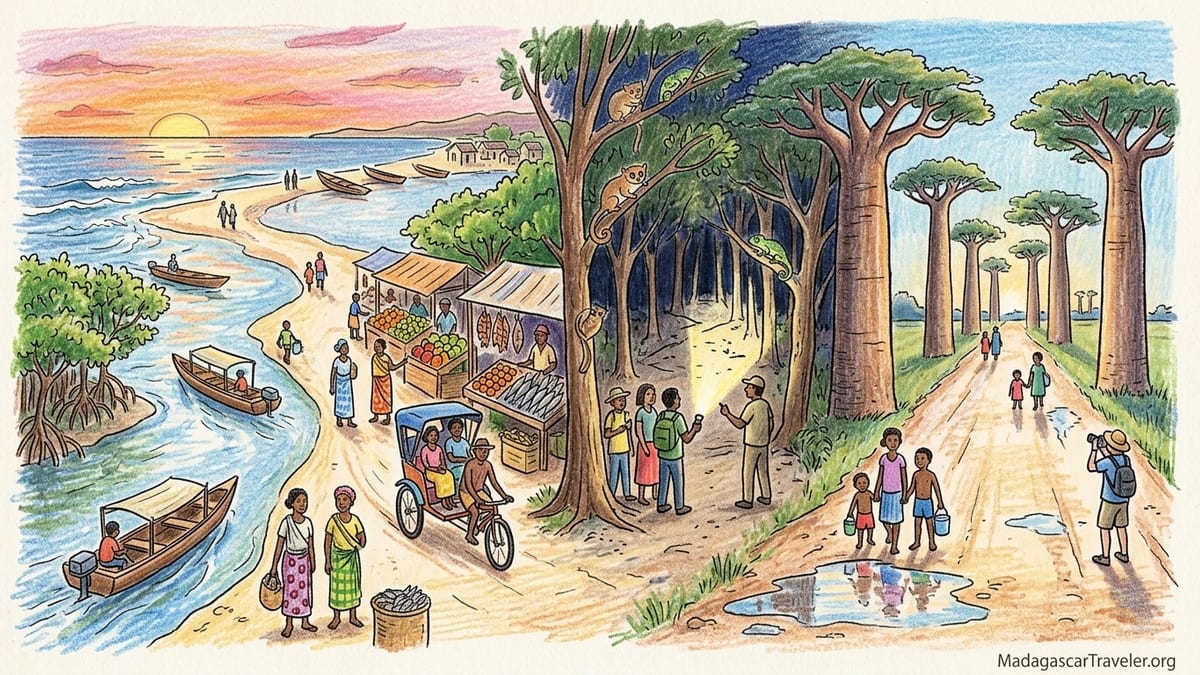
Chasing Light Among the Baobabs: Sunrise, Sunset and Everything Between
I ended up visiting the baobabs on three separate occasions from Morondava, each one arranged slightly differently through the same local driver I hired in town. He quoted me 150,000 ariary in cash for a pre-dawn round-trip to the Avenue of the Baobabs for up to three people, including waiting time. The drive from my guesthouse near the seafront took about 45 minutes along the RN8, on a mostly paved road that turns to packed dirt for the final stretch. The track itself was rutted but dry in September, with a few sandy patches that a normal car managed fine, and no hiking required beyond walking along the avenue.
The first time I went, for classic sunset, the place felt far from the remote scene I had imagined. By 4:30 p.m., minibuses and 4x4s had arrived from Morondava and farther north, and by the time the sky finally flared orange, there were perhaps a hundred people spread along the dirt road, with a dense knot of tripods at the western end. It was still beautiful, with the silhouettes of Adansonia grandidieri baobabs rising from bare red earth, but the jostling for the “perfect” angle and the occasional drone overhead made it feel more like a photo workshop than a meditative moment. I would repeat sunset here, but I would come earlier and walk farther down the road, away from the viewing area where most vehicles park.
The second visit, at sunrise the next morning, was the experience I would actively recommend. My driver picked me up at 4:30 a.m. and we reached the avenue in the blue pre-dawn light, with only two other small groups already there. The air was cooler and still, around 20–22 degrees Celsius, and without the haze of afternoon dust the trees stood out in sharp relief. I wandered almost alone along the dirt road, sidestepping puddles from a recent drizzle and photographing reflections of the baobabs in shallow water. Children from the nearby village walked to fetch water and hardly paid me any attention. The park keepers opened the small ticket booth closer to 6 a.m.; I paid an entrance fee of 10,000 ariary and an additional 2,000 ariary for community-managed parking. This was the only baobab visit that felt both photogenic and calm enough to linger, and it is the one I most want to repeat.
On my third outing, I combined the avenue with the “baobab amoureux,” a pair of intertwined trees about a 30 minute detour from the main road, and a hollow baobab that local guides use to explain traditional uses of the tree. This half-day trip was arranged through a Morondava hotel desk, with a 4x4 and driver for 250,000 ariary shared between two of us. The track beyond the main avenue became sandy and corrugated, and we were glad for the higher clearance. Village children gathered at each stop selling small carved baobabs and asking for photos; it felt more staged and less spontaneous than the simple sunrise walk. I would repeat the combined route only if I were with friends who had never seen baobabs before. For a second visit as a photographer, I would skip the detours and return only to the main avenue in the very early morning.
Into the Dry Forests: Day and Night Wildlife Walks Near Kirindy
Morondava’s most rewarding wildlife experiences for me were not in town but in the dry deciduous forest to the north, around Kirindy. I booked a full-day excursion at a small local agency in Morondava that specialized in Menabe trips. They offered a package at 420,000 ariary per person for two people that included a 4x4 with driver, fuel, park entrance, a local guide in Kirindy, and stops at the baobabs on the way back. We left town at 7:30 a.m. in a high-clearance vehicle and drove about 1 hour 45 minutes to the forest entrance, where the tarmac gave way to a wide laterite track with significant potholes and dust.
The daytime walk in Kirindy lasted around three hours, following mostly flat, sandy trails under a canopy of leafless trees, with heat building steadily toward midday. By 10:30 a.m. it was already over 30 degrees Celsius, and the light became harsh for photography. Despite the heat, the forest rewarded us with several lemur species, including red-fronted brown lemurs crossing the path and Verreaux’s sifakas perched in the trees, as well as giant jumping rats and endemic birds. Our local guide, assigned at the park office, spoke solid French and enough English to explain behavior and conservation issues. He carried no field guide but had an impressive eye for movement and sounds. I would gladly repeat the morning walk, but I would insist on starting closer to 7:30 a.m. inside the forest itself, even if that meant leaving Morondava in the dark.
The night walk was a separate highlight. After a simple early dinner at the basic restaurant near the park entrance, I joined a small group for a 90 minute circuit that started just after sunset. The air remained hot but less oppressive, and the darkness transformed the forest into a tunnel of torchlight and rustling leaves. We saw mouse lemurs, chameleons and sleeping birds almost immediately, with the guide using a narrow-beam flashlight to avoid blinding the animals. The sandy paths were easy underfoot, though I was glad to have closed shoes; branches and roots can be hard to see. The night walk cost an additional 40,000 ariary per person in guiding fees, payable in cash at the entrance, plus a small community fee of 5,000 ariary. This is an experience I would absolutely repeat, even if I had to endure the long, dusty drive again.
What I might change is how I structured the day. Doing both a long daytime walk and a night walk after the same return drive made for a ten hour field day bracketed by two bumpy 2 hour journeys. If I returned, I would consider staying at one of the simple lodges near Kirindy for a night, so that I could rest at midday, walk again in the late afternoon and then do the night outing with less fatigue. From Morondava as a base, however, a combined day and night visit is still possible and worthwhile, especially for travelers short on time.
Exploring Morondava Itself: Streets, Markets and a Quieter Riverfront
Because many travelers fly in and head straight out again, Morondava the town is often an afterthought. I spent three full days there between excursions and found that walking its streets gave me some of my most memorable, if understated, experiences. I stayed in a midrange guesthouse a few blocks back from the seafront, and most of my explorations were on foot or by bicycle rickshaw, known locally as cyclo-pousse. A short ride across town typically cost me 3,000 to 5,000 ariary after gentle bargaining, paid in small notes.
One morning I walked from my guesthouse down to the central market, about 20 minutes along sandy side streets lined with wooden houses and small shops. The heat was already climbing by 9 a.m., easily 28 degrees, but the narrow lanes provided some shade. At the market, stalls of rice, dried fish, tomatoes and piles of lychees pressed against each other in a jumble of smells and noise. I bought seasonal fruit and a fabric lamba as a souvenir, paying around 10,000 ariary after bartering, and spent another hour simply watching the choreography of porters, vendors and schoolchildren. Unlike the baobabs, no one here was posing for cameras, and the only other foreigners I saw were a pair of backpackers shopping for snacks. This was exactly the kind of city experience I would repeat: low cost, no guide required, and a chance to understand Morondava as a living place rather than a photo stop.
Later that same day, in the late afternoon, I walked toward the Morondava River mouth rather than the open ocean. Here, wooden pirogues and small motor boats lined the muddy banks, and fishermen patched nets under the shade of mangroves. The ground was uneven and occasionally slippery, with puddles and trash underfoot, so sturdy sandals were helpful. I did not arrange a formal tour; I simply wandered, greeting people in French and basic Malagasy phrases, and bought a small grilled fish from a street vendor for a few thousand ariary. It felt relaxed and friendly, and with the golden light on the water and the silhouettes of boats at anchor, it became one of my favorite photographic spots in town. I would repeat this riverfront walk any time, though always before dark and with minimal valuables given the lack of street lighting.
Local Markets and Everyday Food: Eating Well in the Heat
Morondava’s markets became my anchor between longer excursions. Beyond the central produce market, there are smaller neighborhood stalls where I bought breakfast snacks and drinks before early departures. On the mornings I went to the baobabs or Kirindy, I stopped at a bakery near the taxi-brousse station for fresh baguettes and mofo gasy, spending about 4,000 ariary for enough to feed two people. The station area itself was busy and chaotic, with vans loading for Belo-Tsiribihina and other towns, but it felt more practical than picturesque. I would repeat those quick, utilitarian stops because they made early travel easy, but I would not consider the taxi-brousse yard an attraction in its own right.
Lunchtime in Morondava is when the heat truly asserts itself. On the days I remained in town, I sought out small Malagasy restaurants close to the seafront, where a plate of rice with zebu stew or fish and laoka side dishes cost between 15,000 and 25,000 ariary. Many of these places were open-air, which meant shade but no air conditioning; by early afternoon, with temperatures hovering in the low 30s and little breeze, I was glad to retreat to my guesthouse for a siesta. Walking around at this hour felt draining, and I quickly learned to structure errands and photography for early morning or late afternoon. I would repeat the pattern of slow, shaded lunches and midday rest every time, rather than forcing sightseeing in the harshest heat.
At night, a different side of Morondava emerged. Street food stalls appeared near the main crossroads and by the seafront, selling sambos, skewers and fried bananas. I had several dinners here, eating on plastic stools under dim bulbs for less than 10,000 ariary. While the food was enjoyable and cheap, I was always conscious of footing; sidewalks were broken or non-existent, street lighting was patchy, and motorbikes moved quickly. I would repeat these evening forays, but only with a small headlamp and an awareness of where my guesthouse was in relation to the busiest junctions.
Coastal Time: From Oceanfront Sunsets to Quiet Sandspits
Morondava’s oceanfront is not a pristine, resort-style beach, but I still found that spending time along the coast balanced the dusty inland excursions. My guesthouse was a 10 minute walk from the main strip of seaside restaurants, and I often ended my days sitting at a plastic table with my feet in the sand, watching the sun sink into the Mozambique Channel. These seafront meals cost more than inland eateries, with mains priced around 30,000 to 45,000 ariary, but they came with a breeze and wide horizons. Crowds here were mostly local families and a handful of tourists; it never felt packed. I would happily repeat these sunset dinners as a way to decompress, even if the food itself was not dramatically better than in town.
One of my favorite coastal experiences started as an idle stroll. Mid-morning, I walked north along the beach toward the sandspit that separates the sea from the Morondava River. The sand here was firm near the waterline but became soft and tiring higher up the dunes. It took around 45 minutes at a relaxed pace to reach the narrower tip, passing football games, groups of women collecting shellfish and a scatter of beached pirogues. There were no formal facilities along this stretch; I carried my own water and wore a hat to cope with the unbroken sun. At the end of the spit, with water on both sides and a constant breeze, the heat felt more manageable and the sense of isolation was strong, even though I was still within sight of town. This was a completely unstructured outing, free except for the cost of a bottle of water, and it is a walk I would repeat on every visit.
I did not swim much directly in front of Morondava, as local advice varied about currents and water quality near the river mouth, but I did paddle and sit in the shallows during lower tide. Sand underfoot was generally clean, though occasional patches of litter collected near boat landings. If I returned, I would again treat Morondava’s coast primarily as a place for walks and sunsets rather than a classic beach destination, and I would save long swims for other parts of Madagascar.
Pirogue Journeys and River Life: Short Trips Rather Than Epic Expeditions
Western Madagascar is known for multi-day river journeys by pirogue, especially on the Tsiribihina and Manambolo rivers, but on this trip I opted for shorter outings close to Morondava instead of a full expedition north to Tsingy. Through a contact recommended by my guesthouse, I arranged a half-day pirogue trip in the Morondava estuary and adjacent mangroves. The price, after some negotiation, was 180,000 ariary for two people, including a simple lunch of grilled fish on a sandbank. We left around 8:30 a.m. to catch calmer water and returned by early afternoon before the heat peaked.
The pirogue itself was a narrow wooden canoe with an outboard motor and a canvas shade. Boarding required stepping from a muddy bank onto a slightly wobbling boat, so sandals with a good grip were helpful. Once on the water, the conditions were gentle; small waves and a light breeze made the heat bearable. We passed clusters of fishermen in similar boats, children playing in the shallows and women washing clothes at the water’s edge. The guide, who spoke French and a bit of English, pointed out birdlife and explained how tides affected access between villages. This trip felt both relaxed and revealing, offering a sense of how central the river is to everyday life. I would repeat it exactly as I did, including the early start, but I would bring a dry bag next time to protect my camera from occasional spray.
I also tested a much shorter, informal river crossing to Betania, a Vezo fishing village across the water from Morondava. At the riverbank near town, a cluster of pirogues offered ad hoc rides. I negotiated a price of 10,000 ariary for a return trip, sharing with local passengers. The crossing took around 15 minutes each way, skimming past moored boats and patches of mangrove. There were no seats as such, just planks along the sides, and the sun was fierce even in the late afternoon. On the Betania side, I walked through sandy streets lined with wooden houses and boat-building sheds, accompanied by an unofficial “guide” who appeared as soon as I stepped ashore and expected a small tip for showing me the church and school. I gave him 15,000 ariary at the end, which he accepted with a smile. I would repeat the crossing, as it offered a close-up view of coastal life, but next time I would agree a clear time limit with any would-be guide from the outset.
Menabe Cultural Moments: Village Visits and Shipyards Near Belo-sur-Mer
South of Morondava, I made a long day trip by 4x4 to Belo-sur-Mer, a coastal village known for traditional boat-building and salt pans. I arranged the trip through a Morondava-based driver who frequently worked with tour groups but agreed to take two independent travelers. The agreed cost was 450,000 ariary for the vehicle and driver for a very long day, payable in cash, with fuel included but meals and tips excluded. We left at 6:30 a.m. and returned around 7 p.m., spending a total of about six hours driving and four to five hours in and around Belo-sur-Mer.
The road south quickly turned into a sandy track with multiple branches, seasonally affected by tides and the state of small bridges. In the dry season the route was passable but slow, with stretches of deep sand where the 4x4 labored. Anyone prone to motion sickness would find this challenging. We stopped once at a small village along the way, where children gathered to watch and a woman sold us coconuts for 3,000 ariary each. These informal interactions were part of the appeal, and our driver translated when necessary. I would repeat this journey, but only outside the peak rainy months, and only with a driver who knows the current route well.
In Belo-sur-Mer itself, we walked through the village, visited the salt pans on the outskirts and spent time at the informal shipyards where large wooden sailing dhows were under construction. Our local contact, arranged by the driver, guided us between work sites and introduced us to carpenters who explained their methods. The guide fee was 60,000 ariary for the group, agreed in advance, and he earned it by keeping conversations flowing and making clear which areas we could photograph. Walking conditions were hot and exposed; the ground around the salt pans was crusted and uneven, and the beach near the yard mixed sand with sharp debris. I wore closed shoes and was glad of them. Culturally, this was one of the richest days of my time in Menabe, anchored not to a single spectacular view but to people at work. I would repeat this excursion, though if I had more time I would consider staying one night in Belo-sur-Mer to break the long drive.
On the return journey, instead of taking a full sea excursion, we opted for a short pirogue outing inside the lagoon, arranged spontaneously with a local boat owner for 80,000 ariary for an hour’s circuit. The afternoon wind had picked up, throwing up short, choppy waves, and at times the spray was heavy enough that I had to shield my camera with my body. It was an enjoyable way to see Belo-sur-Mer from the water, but if I repeated the trip I would time any lagoon outing for earlier in the day when conditions are calmer.
Day Trips into the Countryside: Red Earth, Rice Fields and Roadside Baobabs
Not every rewarding experience around Morondava came with an official ticket or named attraction. One morning, with no fixed plan, I asked a tuk-tuk driver to take me along the piste inland behind town, toward clusters of baobabs and small farming hamlets. We agreed on a flat rate of 60,000 ariary for roughly four hours, including waiting time and several short walks. The three-wheeled vehicle could not tackle deep sand or serious ruts, but the driver knew which side tracks remained firm enough after the last rain. We passed rice fields, cassava plots and scattered baobabs, the trees rising like sentinels above low crops.
Every 20 minutes or so we stopped and walked along footpaths between fields. The ground was dry and lightly cracked, but easy to cross in sandals. In several villages, women carrying water balanced metal basins on their heads, and young men worked with zebu cattle. These were not “official” cultural visits, so there were no set fees, but I made a point of buying small items, like fruit or snacks, from local stalls and avoiding intrusive photography. The only cost beyond the agreed tuk-tuk fare was a few thousand ariary in these informal purchases. Looking back, this wandering half-day felt truer to Menabe than some of the more orchestrated stops, precisely because nothing had been especially prepared for visitors. I would happily repeat spontaneous countryside drives like this on any return trip.
On another day, returning from an early baobab sunrise, my driver suggested a detour to a lesser-known cluster of baobabs a few kilometers off the main road that are not part of the formal “avenue.” There were no signs, and access was via a narrow sand track used by zebu carts. The area felt entirely empty when we arrived, with just birdsong and the distant sound of cattle. We spent an hour walking between trees, experimenting with angles without any other people in sight. Here, heat built quickly despite the early hour, and by 9 a.m. it was uncomfortable to stand in full sun for more than a few minutes at a time. Even so, this quiet interlude ended up being one of my favorite photography sessions. If I returned, I would ask specifically for these lesser-known groves, not to replace the main avenue but to complement it.
The Takeaway
Morondava is more than a two-hour detour for one postcard sunset. Used as a base, it opens up dry forests buzzing with nocturnal life, working shipyards on remote beaches, everyday market scenes and slow river journeys by pirogue. Some of my most anticipated moments, like the first crowded sunset at the Avenue of the Baobabs, were not the ones that stayed with me the longest. Instead, it was the almost empty sunrise among the same trees, the creak of a wooden canoe in the estuary, the sight of a dhow taking shape in Belo-sur-Mer and the simple rhythm of Morondava’s market mornings that I find myself wanting to repeat.
If you come, give yourself more than a night. Arrange a mix of structured excursions and unguided walks, and budget for a reliable driver when roads turn from asphalt to red dust. Expect heat, dust and simple infrastructure, but also genuine hospitality and a sense of being close to the landscapes that define western Madagascar. Morondava will reward you not just with a single photograph, but with a sequence of experiences that reveal the breadth of Menabe.
FAQ
Q1. How many days should I base myself in Morondava to enjoy these experiences?
For a similar mix of forest, baobabs, coast and village visits, five to seven nights in Morondava works well, allowing rest days between long, bumpy excursions.
Q2. Do I really need a 4x4, or can I get by with taxis and tuk-tuks?
Within Morondava town and for short countryside outings, tuk-tuks and taxis are fine, but for Kirindy, Belo-sur-Mer and many baobab side tracks, a 4x4 with driver is strongly recommended.
Q3. How expensive is it to hire a driver around Morondava?
On my visit, half-day 4x4 hires started around 150,000 ariary, while long day trips to Kirindy or Belo-sur-Mer ran from roughly 400,000 to 450,000 ariary, usually payable in cash.
Q4. Is it safe to walk around Morondava on my own?
By day I felt comfortable walking alone in central areas and markets with normal precautions; after dark I kept trips short, stayed on busier streets and used tuk-tuks for longer distances.
Q5. When is the best time of day to visit the Avenue of the Baobabs?
Sunset is dramatic but crowded; for fewer people, cooler temperatures and cleaner light, I found sunrise visits far more rewarding and would prioritize those.
Q6. Can I arrange pirogue trips only after I arrive, or should I book ahead?
Short pirogue outings in the Morondava estuary and to Betania can usually be arranged locally a day in advance through your guesthouse or directly at the riverbank.
Q7. Is swimming recommended on Morondava’s beaches?
I treated Morondava more as a place for coastal walks and sunsets; if you decide to swim, seek local advice on currents, tides and safer stretches away from river mouths.
Q8. What kind of footwear and clothing worked best for these activities?
Lightweight long sleeves, a hat and breathable trousers combined with sturdy sandals or trail shoes were ideal for hot market walks, forest trails and sandy tracks.
Q9. Are guided cultural visits to villages around Morondava respectful to residents?
They can be, provided they are arranged through local operators, group sizes stay small, photography is discreet and money from guiding clearly reaches community members.
Q10. Would you prioritize Kirindy, Belo-sur-Mer or more time at the baobabs if you were short on days?
If time were tight, I would combine at least one sunrise at the baobabs with a day and night walk in Kirindy, then add Belo-sur-Mer only if I had an extra full day available.