


On my most recent trip to western Madagascar, I discovered that where you stay in Morondava quietly dictates everything that follows: the quality of your Avenue of the Baobabs sunrise, how shattered you feel on the long road to Kirindy or Tsingy, and even whether you make it back from a sunset photo session in time for a cold drink and hot shower. I based myself in two different parts of town over several days and quickly learned that in Morondava, location strategy matters more than the hotel name on the sign.
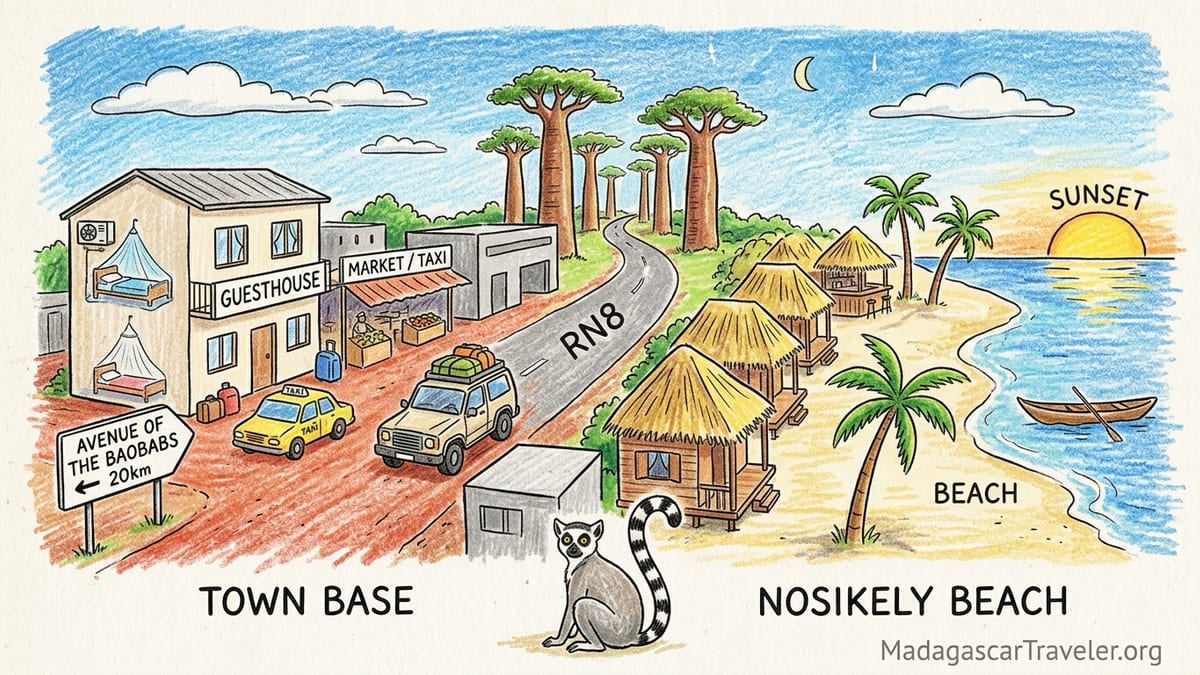
Where I Actually Stayed and How It Worked Once the Excursions Began
I split my time in Morondava between a small, central guesthouse near the market and taxi stand, and a beachside hotel on the Nosikely peninsula. Both were mid-range choices with private bathrooms, mosquito nets and either air conditioning or strong fans, a fairly typical setup for Morondava’s better small hotels and lodges. The contrast between the two locations ended up shaping my days far more than the room decor ever could.
In the centre of town, I stayed a short walk from the main taxi-brousse area and the paved road that leads directly out toward the Avenue of the Baobabs along Route Nationale 8, the 198 kilometre road that runs north from Morondava to Bekopaka and passes the famous baobab corridor about 20 kilometres from town.([en.wikipedia.org](https://en.wikipedia.org/wiki/Route_nationale_8_%28Madagascar%29?utm_source=openai)) From this base, my driver could collect me at the door and be on the RN8 in minutes. For my first sunset at the baobabs, we left the guesthouse and reached the avenue in roughly 35 minutes in a private car, which lines up with the commonly quoted 30 to 40 minute driving time from Morondava.([avenueofthebaobabs.com](https://avenueofthebaobabs.com/directions/?utm_source=openai))
Later in the trip I moved to a beachfront hotel at Nosikely, the low sand spit that curves along the Mozambique Channel. This area holds several of Morondava’s better-known seaside hotels and restaurants, including long-running beachfront properties that combine bungalows with on-site dining and sunset bars.([tripadvisor.com](https://www.tripadvisor.com/Hotels-g298273-Morondava_Toliara_Province-Hotels.html?utm_source=openai)) My room here was larger, with more reliable air conditioning than the town guesthouse, and the sea breeze helped keep mosquitoes down in the evening, especially with a properly tucked net over the bed. Yet once I began stacking early departures and late returns for baobab and wildlife excursions, the extra driving time in and out of Nosikely, over potholed side streets and through traffic, started to feel like an unnecessary complication.
In practice, both bases worked, but for different days. When my focus was walking into town for cash, snacks and local restaurants, the central guesthouse was ideal. When my priority shifted to recovery between long, hot days on the RN8 and nights of lemur-spotting at Kirindy, the quieter beach setting and stronger air conditioning on Nosikely became priceless. If you only remember one lesson from my experience, let it be this: decide whether you are in Morondava mostly to be out on the road, or mostly to rest by the sea, and choose your base accordingly.
Understanding Morondava’s Layout and Transfer Times
Morondava is compact but surprisingly segmented. The airport sits a short drive inland from the coast and about 15 to 20 minutes from central Morondava by car in light traffic, according to recent routing estimates that place the transfer from Morondava Airport to town at around 22 minutes for the fastest route.([avenueofthebaobabs.com](https://avenueofthebaobabs.com/and-lemurs-tours/?utm_source=openai)) Nosikely stretches as a beach strip slightly southwest of the town centre, reached by crossing a small bridge and following sandy streets lined with hotels and simple homes. To head inland to the Avenue of the Baobabs or Kirindy, vehicles must loop back through town and out on RN8, so every extra kilometre away from that axis adds to your excursion time.
From my central guesthouse near the market, a taxi or private car could reach the airport in roughly 20 minutes. My early morning flight home required a pre-dawn pickup, and even with a quick stop to refuel, we were at the terminal well within half an hour. Travelers I spoke with who stayed on Nosikely reported transfer times of about 25 to 30 minutes to the airport, depending on road conditions and how busy the narrow access road was with tuk-tuks and pedestrians.
The distances to everyday essentials also felt noticeably different between the two bases. From the central guesthouse, I could walk to several basic restaurants, small supermarkets and the local market in five to ten minutes. In the evening, I strolled to a popular restaurant and bar area used by locals and visitors alike, without needing transport. On Nosikely, I had an on-site restaurant and one or two alternatives within walking distance along the beach, but for any errands in town I had to budget at least 10 to 15 minutes by tuk-tuk each way.
The most important transfer time for most visitors is, of course, the trip to the Avenue of the Baobabs. The avenue sits on the RN8 about 20 kilometres northeast of Morondava, with travel time usually quoted at 30 to 45 minutes each way by car, depending on the condition of the dirt road section.([avenueofthebaobabs.com](https://avenueofthebaobabs.com/?utm_source=openai)) Leaving from central Morondava kept us close to the main road, and my late-afternoon departure for a sunset shoot took around 35 minutes. My sunrise visit required leaving town about 90 minutes before sunrise to allow for rough patches and to claim a good photography spot, which tallies with guidance that suggests arriving well before the best light.([avenueofthebaobabs.com](https://avenueofthebaobabs.com/fr/directions/?utm_source=openai)) If I had started from Nosikely instead of town for those trips, I would have added at least 15 to 20 extra minutes each way to fight my way through local traffic and out to the RN8.
Central Morondava: Functional Base for Fast Inland Departures
For travellers whose main goal is to wring the most from a short time in western Madagascar, central Morondava is hard to beat. From a simple guesthouse or small hotel in town, you are best placed for quick departures to the baobabs, Kirindy Forest and beyond. Many 4x4-based itineraries use Morondava as the starting point for a four to five day loop that takes in the Avenue of the Baobabs at sunset, a night at Kirindy for fossa and nocturnal lemurs, and then the long push to Tsingy de Bemaraha before returning via the baobabs again at sunrise.([madagascartraveler.org](https://www.madagascartraveler.org/western-madagascar-morondava-tsingy-first-timer-guide/?utm_source=openai)) Being close to the RN8 makes these logistics noticeably easier.
The trade-off in town is comfort and atmosphere. My central guesthouse was representative of several similar places in Morondava: private rooms with basic air conditioning or a ceiling fan, hot water in the mornings and evenings, and mosquito nets provided as standard, as is common in this part of Madagascar.([morondava-autrement.com](https://www.morondava-autrement.com/pages/tourisme/hotel/hotel-trecigogne-morondava.html?utm_source=openai)) Night-time temperatures can stay high and humidity can be intense, so a functioning fan is the minimum I would recommend. Air conditioning is far from universal but is increasingly common in mid-range hotels, and travelers in recent trip reports often note the difference it makes to post-road-trip recovery.
Breakfast from a central base can also be better aligned with early starts. Several hotels that cater to visitors heading to Kirindy or the baobabs will offer breakfast as early as 5:00 or 5:30, or prepare a packed breakfast if you are leaving before dawn. In my case, the guesthouse staff were used to drivers collecting guests around 4:30 to 5:00 for sunrise at the avenue, and they offered bread, fruit and coffee either quickly on site or to take away. Power reliability in town is reasonable by local standards, but outages do happen. Having your devices fully charged the evening before an early departure remains important, even when a hotel advertises Wi-Fi and electricity all day.
Crucially, most central hotels can arrange drivers and excursions, either directly or through partner agencies. It is common practice across Madagascar for small hotels and lodges to connect their guests with drivers and park guides, and both my central guesthouse and contacts in other town hotels confirmed they could organise a private vehicle to the Avenue of the Baobabs or a 4x4 for a multi-day loop north.([madagascartours.travel](https://www.madagascartours.travel/madagascar/avenue-of-the-baobabs/?utm_source=openai)) If you arrive in Morondava without anything pre-booked, a central location gives you faster access to local agencies and drivers, as well as cash machines for paying deposits.
Nosikely Beachfront: Sunset Views and Sea Breeze vs Extra Driving
Staying on Nosikely feels like being in a small resort town beside the sea, even though you are only a few kilometres from central Morondava. Here, hotels cluster along a sandy beach looking west toward the Mozambique Channel, and many travellers base themselves in bungalows within steps of the sand. One well-reviewed beachfront property is described as having private bungalows, two pools, spacious air-conditioned rooms and an on-site restaurant, while another long-running hotel-restaurant on Nosikely publishes detailed information and tariffs for its beachside rooms and tours.([tripadvisor.com](https://www.tripadvisor.com/Hotels-g298273-Morondava_Toliara_Province-Hotels.html?utm_source=openai))
My own beach hotel followed a similar pattern: individual rooms or bungalows with mosquito nets, solid air conditioning, tiled bathrooms with hot showers and an open-air restaurant facing the water. Wi-Fi worked best near reception and the bar, and electricity occasionally flickered during evening storms but always came back within an hour or two. The ocean breeze and distance from the main road meant noticeably less road noise than in town, and the sound of the surf made for far better sleep between hot, dusty day trips.
For coastal days, Nosikely is an excellent choice. I spent an afternoon wandering the sand, watching wooden pirogues come and go, and then settled at a beach bar for a front-row view of the sun setting over the channel. If your itinerary includes a full rest day between long drives, few places in western Madagascar feel as relaxing. However, each inland excursion required first navigating the sandy streets back to the main road, then crossing the bridge and threading through town before even starting the journey on the RN8.
Concrete example: my driver estimated about 15 minutes from a typical Nosikely hotel to the central taxi area under normal traffic, and closer to 20 or 25 minutes at busy times. Add this to the 30 to 40 minutes from town to the Avenue of the Baobabs, and a beach-based sunrise trip can easily mean 60 minutes or more on the road before dawn. For a single sunset outing, this may not matter. If you plan multiple early starts for wildlife viewing or photography, those extra transfers begin to erode the advantages of the seaside setting.
Quieter Outskirts and “Departure-First” Bases
Between central Morondava and the airport, and along the first stretches of the RN8, you will find a scattering of simpler hotels and lodges on the outskirts of town. These are often chosen less for charm and more for practicality: secure parking for 4x4 vehicles, a quick getaway for long road days and slightly lower room rates than the beachfront properties. Some overland itineraries that focus strongly on Tsingy de Bemaraha and long stretches of RN8 opt to stay in these areas for one or two nights, especially on the outbound leg toward Bekopaka.
The key advantage of an outskirts base is reduced morning traffic. If your priority is to leave Morondava before sunrise without weaving through the narrowest backstreets, being already positioned near the RN8 can save 15 to 30 minutes of stop-and-start driving. Tour dossiers created for western Madagascar group trips emphasise the value of efficient departures on long days, and many visiting groups accept simpler accommodation in exchange for smoother logistics and secure parking.([static1.squarespace.com](https://static1.squarespace.com/static/652bda933eaeb328efbf9c7d/t/65928d9cb55b4a219ed1af16/1704103326625/Madagascar%2B-%2BSecrets%2Bof%2BMadagascar%2B-%2BTour%2BDossier.pdf?utm_source=openai))
Facilities in these roadside hotels are variable but generally basic: rooms with private bathrooms, fans or occasionally air conditioning, mosquito nets and on-site restaurants geared toward travellers and drivers. Some publish breakfast hours from around 6:30, a little later than ideal for those aiming for the very first light at the baobabs, but are usually willing to organise early coffee and bread on request. A lodge near Morondava’s outskirts, for example, offers continental breakfast from 6:30 and can arrange airport transfers and shuttles for an additional fee, which reflects the broader pattern in the area.([hotels.com](https://www.hotels.com/ho1080922080/kimony-resort-morondava-madagascar/?utm_source=openai))
On my trip, I did not overnight in one of these outskirts properties, but my driver regularly stopped at similar roadside hotels for meals and breaks. Speaking with travellers who had stayed there, the verdict was consistent: perfectly fine for a one-night stop focused on the road ahead, but lacking the character of Nosikely’s beaches or the convenience of being able to stroll through central Morondava on foot.
Practical Comforts: Heat, Mosquitoes, Power and Breakfast Logistics
Regardless of which part of Morondava you choose, a few practical details will significantly affect your stay. First is heat management. Western Madagascar can be extremely hot and sticky, particularly between October and March. My central guesthouse had a ceiling fan and a small air-conditioning unit that struggled during the hottest afternoons, a comment echoed by another traveller who described an urban hotel in Morondava as nice but with air conditioning that was not very efficient.([mammalwatching.com](https://www.mammalwatching.com/wp-content/uploads/2025/02/mad.pdf?utm_source=openai)) My beach hotel on Nosikely, by contrast, had stronger air conditioning plus the benefit of natural sea breezes, which made a real difference to post-excursion recovery.
Mosquito protection is another area where you should check details before booking. In Morondava’s better hotels, mosquito nets are usually installed as standard over beds, and some properties list them explicitly among room amenities.([morondava-autrement.com](https://www.morondava-autrement.com/pages/tourisme/hotel/hotel-trecigogne-morondava.html?utm_source=openai)) My central guesthouse provided a net that fully covered the mattress, plus coils on the terrace in the evenings. On Nosikely, the beach breeze reduced mosquito activity slightly, but standing water after rain can still bring them in. Pack repellent and ensure your chosen property mentions nets or other measures; a clean room is not enough if you spend half the night chasing mosquitoes.
Power and Wi-Fi are functional but imperfect across Morondava. Both of my bases advertised Wi-Fi, and in both it worked best in common areas and more slowly, or not at all, inside rooms. Power cuts occurred two or three times during my stay, including once during a late dinner, but generators or backup systems usually kicked in for essential lighting. Based on recent trip dossiers for Madagascar tours, even organised groups are advised to expect occasional outages and to charge cameras and phones whenever power is available.([static1.squarespace.com](https://static1.squarespace.com/static/652bda933eaeb328efbf9c7d/t/65928d9cb55b4a219ed1af16/1704103326625/Madagascar%2B-%2BSecrets%2Bof%2BMadagascar%2B-%2BTour%2BDossier.pdf?utm_source=openai)) If you are downloading backup maps or uploading photos, plan to do so during the afternoon, not minutes before a 4:30 departure.
Breakfast timing is the final practical piece that links directly to your choice of base. For standard flights out of Morondava or late-morning activities, anywhere in town or on Nosikely will work. If you intend to photograph the Avenue of the Baobabs at both sunrise and sunset, or to reach Kirindy early for wildlife, you need a hotel prepared to offer food before dawn. Some publish breakfast times from 6:30, but in practice many are flexible if notified the night before, especially those used regularly by visiting birders, photographers and tour groups. I found that central hotels, accustomed to frequent early departures, tended to be slightly more flexible than purely beach-focused lodges that see more casual holidaymakers.
The Best Base by Traveller Type
After staying in both central Morondava and Nosikely, and seeing how outskirts properties fit into road-based itineraries, I came away convinced that the “best” base is not one single place but a match between location and travel style.
For a short stay of one or two nights aimed at ticking off the Avenue of the Baobabs and perhaps a quick visit to Kirindy, a central Morondava base suits most travellers. You are close to ATMs, shops, simple eateries and the main road, and your driver can collect you without navigating narrow beach lanes. Transfer time to the airport stays reasonable, and you are well positioned to organise last-minute excursions or share costs with other visitors heading to the same sites.
For dedicated photographers, especially those who want both sunset and sunrise at the baobabs on different days, a central or outskirts base focused on early road access makes the most sense. Extra 20 or 30 minutes of sleep before a 4:30 departure matters more than a view of the Mozambique Channel you will hardly see in daylight. Booking a small hotel known for working closely with 4x4 drivers and guides, including arranging pre-dawn breakfasts and secure equipment storage, will do more for your images than a beachfront cocktail bar ever can.
Wildlife travellers planning a loop that includes Kirindy Forest and Tsingy de Bemaraha should consider mixing bases: start with one night in central Morondava for logistics and supplies, then pivot to a quieter outskirts hotel or back to Nosikely for a decompression day at the end. Group itineraries from experienced operators commonly use Morondava as the hub for four to five day loops that link the avenue, Kirindy and Tsingy, returning to town for flights back to Antananarivo.([madagascartours.travel](https://www.madagascartours.travel/madagascar/avenue-of-the-baobabs/?utm_source=openai)) Taking a similar approach on a smaller scale can work well for independent travellers too.
Families and couples leaning toward a more relaxed coastal break will probably enjoy Nosikely most. The beach, pool options and safer-feeling walking environment are attractive when travelling with children, and a room with strong air conditioning and a sea view earns its keep on hot afternoons. Just be realistic about the early starts and extra driving time required if you also want to chase first light at the baobabs. Those setting out on a longer western Madagascar journey, perhaps combining Morondava and Tsingy with the RN7 or southern coast, may find that starting in town for admin and driver arrangements, then shifting to Nosikely for a final night by the ocean, strikes a good balance.
The Takeaway
Choosing where to stay in Morondava is less about picking a famous hotel name and more about deciding what you want your days to look like. Central Morondava gives you fast access to the RN8, easier coordination with drivers and agencies, and a straightforward run to the Avenue of the Baobabs, Kirindy and beyond. Nosikely offers sea breezes, sunsets and a softer landing between road days, but adds transfer time every time you head inland. Outskirts hotels, often chosen by overland tours, prioritise secure parking and quick departures over atmosphere.
Next time I visit Morondava, I would choose a hybrid strategy: arrive to a central guesthouse for two nights, use it as my base for both sunset and sunrise sessions at the Avenue of the Baobabs and for arranging any multi-day 4x4 loop, then finish with a final night on Nosikely’s beachfront to wash off the red dust in the ocean and enjoy one last sunset over the Mozambique Channel. For a first-time visitor with limited days and a focus on baobabs and wildlife, I would lean firmly toward a central base. For a returning traveller who has already “done the road” and simply wants to feel the western Madagascar coast, a quiet bungalow on Nosikely would be hard to beat.
FAQ
Q1. How long does it take to get from Morondava to the Avenue of the Baobabs?
By private car or taxi, expect around 30 to 40 minutes each way from central Morondava to the Avenue of the Baobabs, which lies about 20 kilometres northeast along the RN8. Conditions on the unpaved stretch can extend this to 45 minutes after heavy rain, so allow extra time if you are aiming for sunrise or sunset.
Q2. Is it better to stay in central Morondava or on the Nosikely beachfront?
Central Morondava is better if your priority is fast departures for sunrise at the baobabs, day trips to Kirindy or longer 4x4 loops. Nosikely is ideal if you value beach access, sunsets over the Mozambique Channel and a quieter atmosphere, and you are willing to add 15 to 20 minutes of transfer time each time you head inland.
Q3. Can Morondava hotels arrange drivers and excursions to the baobabs and Kirindy?
Yes. Most mid-range hotels and guesthouses in Morondava work regularly with local drivers and tour agencies and can arrange private taxis to the Avenue of the Baobabs, 4x4 vehicles for Kirindy Forest or multi-day loops to Tsingy de Bemaraha, as well as guides and park entrance logistics when required.
Q4. Do I need air conditioning in Morondava, or is a fan enough?
Temperatures in western Madagascar can be very hot and humid, so air conditioning is highly desirable, especially after long, dusty days on the RN8. A strong fan can be acceptable in budget places, but travellers consistently report that even basic air conditioning significantly improves comfort and sleep quality.
Q5. How bad are mosquitoes in Morondava, and do hotels provide nets?
Mosquitoes are present, especially after rain and around standing water, but most established hotels and guesthouses in Morondava provide mosquito nets over the beds. It is wise to confirm this when booking and to bring repellent for evenings, whether you stay in town, on Nosikely or on the outskirts.
Q6. What time do hotels in Morondava start serving breakfast for early excursions?
Published breakfast times often start around 6:30, but many hotels used by wildlife and photography travellers will offer earlier options or packed breakfasts if you request them the day before. For a sunrise visit to the Avenue of the Baobabs, you may need food prepared before 5:00.
Q7. How long is the transfer from Morondava Airport to town or Nosikely?
From Morondava Airport to central town hotels, the transfer usually takes around 15 to 20 minutes by car in light traffic. Reaching Nosikely beachfront hotels often takes 25 to 30 minutes, as vehicles must cross town and navigate narrower, sandy streets along the peninsula.
Q8. Is beachfront accommodation in Morondava worth it if I am mainly visiting the baobabs?
If your schedule is packed with pre-dawn and late-night inland excursions, a central base is more efficient. Beachfront accommodation on Nosikely adds extra driving but rewards you with sea breezes, sunset views and a more relaxing atmosphere, which may be worth it if you have at least one rest day.
Q9. Are there options in Morondava with secure parking for self-drivers or hired 4x4s?
Yes. Several hotels on the outskirts of Morondava and near the start of the RN8 offer courtyards or guarded parking specifically suitable for self-drivers and hired 4x4s. Many group tour itineraries use these properties to simplify early departures and overnight vehicle security.
Q10. What type of Morondava base is best for a longer western Madagascar trip?
For a longer trip that combines Morondava with Kirindy, Tsingy de Bemaraha and perhaps the RN7 or southern coast, many travellers benefit from a mixed strategy: start in central Morondava for logistics, supplies and initial excursions, then shift to Nosikely for a final night or two by the beach before flying back to Antananarivo.