


I had seen the postcard images of Avenue of the Baobabs long before I reached Morondava: baobabs as silhouettes against an orange sky, a dirt road glowing like embers. In reality, visiting from Morondava turned out to be less like arriving at a remote monument and more like stepping into a rural crossroads that happens to have one of the most photogenic tree lines on earth. What follows is exactly how I arranged transport, what the road was like, and what sunrise and sunset actually looked and felt like on the ground.
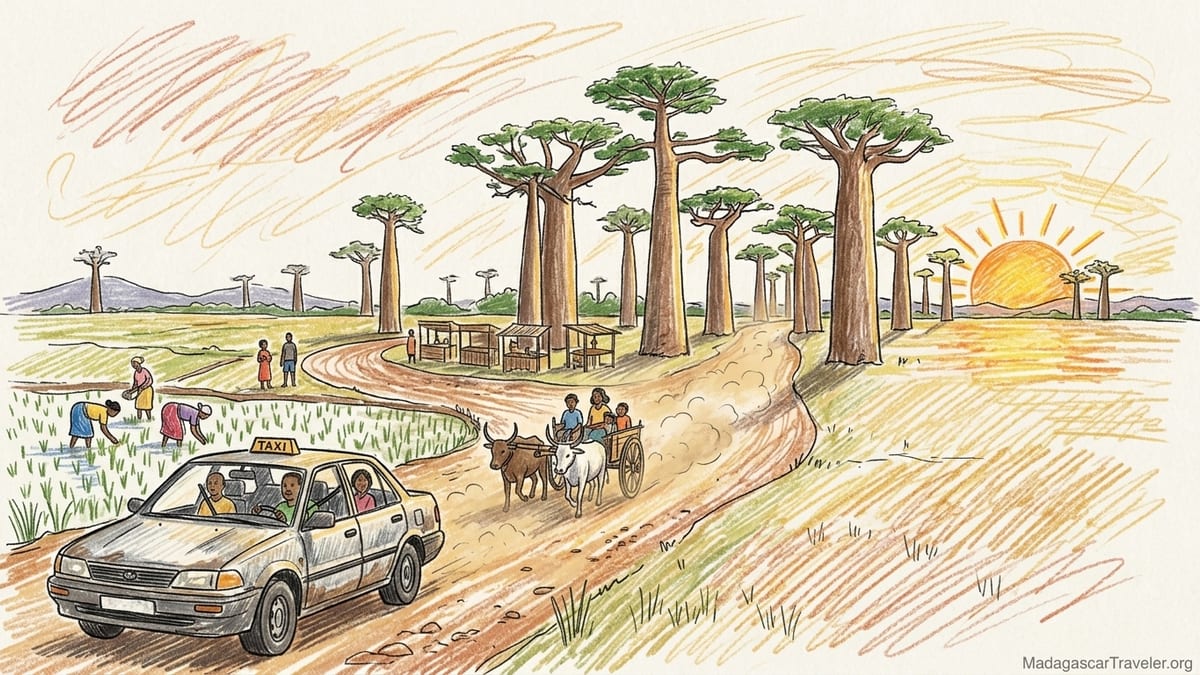
Getting From Morondava To The Avenue
I based myself in central Morondava, a few minutes’ walk from the waterfront, and arranged transport the old-fashioned way: by asking at my small hotel reception. They called a local driver who routinely runs trips to the Avenue along Route Nationale 8, the dirt road that heads north toward Kirindy and the Tsingy. We agreed a flat fee of 80,000 Ariary for a private return trip in a battered Toyota sedan, with the driver waiting during both sunset and, the next morning, sunrise. Around town I also saw 4x4 tours advertising combined Kirindy and Avenue visits for roughly 200,000 to 350,000 Ariary per person, but for a simple Morondava to baobabs run, a negotiated taxi remains the most straightforward option.
The Avenue sits roughly 15 to 20 kilometers north of Morondava, depending on where you start counting in town. Guides and drivers like to quote “about 20 minutes,” but that only holds when the road is dry and reasonably smooth. On my visits in the late dry season, with ruts and dust but no standing water, the drive took just over 35 minutes each way at a cautious pace. In conversation, other travelers in Morondava who came in early rainy season reported closer to 45 minutes, with sections of soft mud that forced them to slow to a crawl.
We agreed precise departure times based on the sun rather than on brochure promises. For sunset, which was a little after 5:30 p.m., we left my hotel at 4:30 p.m. and arrived with about half an hour to spare. For sunrise the following morning, we left in the dark at 4:30 a.m., reached the Avenue around 5:05 a.m., and watched the first color appear in the sky by 5:20 a.m. This timing gave enough margin in case a zebu cart blocked the way or a particularly bad patch of the RN8 demanded a slower crawl.
Parking is informal but organized enough. Drivers pull off onto a wider, packed section of dirt on the east side of the road, where a few wooden stalls and ticket tables sit. A small parking and access fee paid in cash, just a couple of thousand Ariary, covered both the vehicle and my time on foot. Local kids offered to “guard” the car for a few coins. There is no formal gate at the main line of baobabs, which begins a few dozen meters further north, so once you pay you are essentially free to wander along the road and into the fields on either side.
Road Conditions And The Reality Of The RN8
Anyone expecting a smooth highway from Morondava will be surprised before they even reach the first baobab. The RN8 here is a dirt road, not tarmac, and it feels every bit like the main artery for farmers, villagers, and supply trucks heading inland. Leaving Morondava, the first few kilometers pass low houses and roadside stalls, then quickly shift into patchwork fields broken by scattered baobabs. The surface alternates between hard-packed earth, corrugated ridges that set the car rattling, and deep sandy patches where the wheels dig in and the driver instinctively drops a gear.
In the height of the dry season, the problem is dust rather than mud. Each time a 4x4 roared past, a billowing cloud poured into the open windows, turning the sunset light a hazy orange well before we reached the Avenue. My driver advised closing the windows when we saw a vehicle coming and only opening them once the dust had settled. It meant the last five kilometers were a series of short, hot intervals with windows up and the fan battling the heat while the outside world turned sepia through the windshield.
During shoulder and early rainy seasons, local drivers warn of the opposite problem: water pooled in the same ruts and low points that raise dust in the dry months. Several travelers I met in Morondava who had just come back from the Avenue in November talked about fishtailing slightly in muddy sections and arriving with the wheel wells caked in red-brown clay. For that reason, many hotels suggest hiring a higher-clearance vehicle for trips that extend beyond the Avenue toward Kirindy, even if a regular taxi is still adequate for a simple sunset visit when the rains are light.
Despite the rough surface, the RN8 is not a dangerous road in good weather, but it is busy with life. We slowed frequently for children walking home from school, women carrying water buckets, and zebu carts loaded with firewood. The closer we came to the Avenue, the more baobabs appeared in ones and twos along the horizon, so that by the time the most famous cluster came into view it felt less like a surprise and more like a concentration of what we had been driving through for the past half hour.
First Impressions Of The Avenue Itself
Arriving the first afternoon, I was struck not by the number of baobabs but by how short the famous stretch actually is. On maps and in photos, Avenue of the Baobabs looks like a long, continuous colonnade. In person, the densest line of trees covers just a few hundred meters of the RN8, a dirt corridor bracketed by perhaps a couple of dozen large baobabs, with other trees scattered in adjacent rice fields and fallow plots. Step ten or fifteen meters off the road into the fields and the illusion of a tunnel of trees disappears, replaced by a more open savanna punctuated by stoic trunks.
What surprised me most, though, was how agricultural the setting felt. On one side of the Avenue, women were bent over in small rice paddies, their reflections merging with the trunks in the flooded plots. On the other, kids kicked a worn-out football in the dirt between the trees. There are simple snack shacks and tables selling wooden baobab carvings, cold drinks, and phone credit. The iconic view exists inside a very real working landscape, not a fenced-off national park, and that means local life is never more than a few steps outside the camera frame.
Crowding ebbed and flowed. For sunset, minivans and 4x4s began to arrive about an hour before the sun dropped, spilling couples with tripods, families with smartphones, and a steady stream of local visitors. At the height of the dry-season tourism window, you can easily find fifty or more people lining the road, all angling for almost the same composition of baobabs flanking a glowing western sky. That can feel jarring if you imagined standing alone in a silent, otherworldly landscape.
Moving a little away from the densest cluster of trunks makes a huge difference. By walking five minutes north, I found a curve where the road subtly bends and only a handful of people had drifted out. The trees were less tightly packed but the sense of atmosphere was stronger, with long shadows stretching across the rutted surface and a single zebu cart trundling through the dust. The surprise was that the most famous photograph of the Avenue is not necessarily where the most rewarding personal view lies.
Sunset: Light, Dust, And Sharing The Scene
The evening light at the Avenue feels almost engineered for photographs, but it changes much more quickly than those perfect Instagram shots suggest. When we arrived around 4:50 p.m., the sun was still high enough that the trunks were harshly lit on one side and the sky a pale, washed-out blue. For the first half hour, the best scenes were actually in the opposite direction from the sun, looking east, where the warm light brushed the bark and made the baobabs glow against a deepening sky.
As the sun dropped closer to the horizon, everything flipped. The western sky began to burn orange and red, and the baobabs closest to the setting sun turned into sharp silhouettes. That is when the dust became part of the show. Every passing vehicle threw up a low cloud that caught the light, creating bright halos around pedestrians and zebu. From a photography standpoint, this meant constantly choosing between clarity and mood. Shooting just after a truck passed filled the frame with glowing particles and streaks of light through the branches, but it also softened detail and coated lenses with fine grit that needed frequent wiping.
Sunset was also, undeniably, crowded. Vehicles parked haphazardly along the side, and at the classic midpoint of the Avenue photographers stood almost shoulder to shoulder. If you want an unobstructed foreground, you need to work for it. I found it effective to step off the road into the fields, with the permission of a local farmer who was watching the scene. From there, shooting back toward the track let me keep the people and cars small in the frame while still capturing the lit dust hanging over the road like mist.
I carried a lightweight travel tripod but used it less than expected in the evening. The dust and constant pedestrian traffic made low, long-exposure shots along the road itself impractical. Instead, I treated sunset as a time for handheld images, using a mid-range zoom in the 24 to 70 millimeter equivalent range. That allowed me to frame tight silhouettes of single trees and wider scenes of the entire corridor without changing lenses in the dust. The most effective compositions often included people, whether a local child crossing in front of the trunks or a zebu cart emerging from a glowing cloud, which made the scene feel more honest than attempts to airbrush humanity out of the picture.
Sunrise: Quieter, Cooler, And Surprisingly Subtle
If sunset felt like a small festival, sunrise was more like catching the baobabs before they had fully woken up. We left Morondava in the dark, the town still half asleep, and for most of the drive saw only the odd headlight from an approaching truck. The Avenue itself greeted us almost empty. When we parked at around 5:05 a.m., there were only two other vehicles in sight, both belonging to photography-focused tours whose participants were already walking the road in near silence.
The first light is not dramatic. For a good twenty minutes, the sky shifts through dark blue and slate gray while the baobabs stand as black cut-outs. Standing on the road facing east, the sun eventually rises behind a thin fringe of trees and low buildings on the horizon, not directly between the main trunks. That means the classic sunrise effect is more about the side light it casts across the scene than a perfect disk sliding between two baobabs. The surprise at dawn was how nuanced the light looked compared with the theatrical fire of sunset.
Once the sun clears the horizon, it begins to paint the western-facing trunks with soft gold. Turning your back on the rising sun and looking west, the trees gradually pick up definition and volume as shadows lift. For photography, this is where a tripod finally came into its own. With shutter speeds still relatively low and a desire to keep ISO down for cleaner files, I set up mid-road, checking constantly for the sound of an approaching vehicle, and shot a series of frames at around f/8 while the trunks transitioned from silhouettes to three-dimensional forms.
Sunrise was also when the Avenue felt most like part of a living village rather than a tourist icon. As the light strengthened, local residents began to appear. A woman cycled past with a sack of rice on her handlebars. Children walked to school in uniforms, sometimes pausing to watch the handful of photographers, sometimes ignoring us entirely. Because the tourist numbers were far lower than at sunset, it was easier to build compositions in which the only human elements were local people making their usual journeys. The whole atmosphere was calmer and cooler, without the press of selfie sticks and parked 4x4s, and for that reason alone I would prioritize sunrise if forced to choose only one time of day.
Photographing The Avenue In Real Conditions
From a purely photographic perspective, the Avenue is less about finding a single iconic angle and more about understanding where the sun is and how dust, people, and vehicles transform the scene. At sunset, you are shooting toward the west if you want silhouettes, which means the sun is directly behind the trees and any stray tourists walking along the road. That positioning almost guarantees someone will appear in your frame. Rather than fighting it, I began to treat human figures as scale markers, waiting until a lone walker or cyclist was centered between two trunks before pressing the shutter.
In the morning, with the sun rising in the east behind a more cluttered horizon, the best images often involved turning ninety or even one hundred and eighty degrees away from the brightest part of the sky. Shooting north or south along the line of trees revealed subtle side lighting, with textures in the bark standing out and long, cool shadows stretching across the track. A mid-range zoom again proved ideal. Wider angles around 24 millimeters emphasized the scale of the trunks and the sky, while slightly longer focal lengths compressed the spacing between trees so that they appeared more densely packed than they really are.
Dust shaped almost every photographic decision. I kept a microfiber cloth in a pocket and wiped the front element of my lens every few minutes after vehicles passed. Changing lenses on-site felt too risky, given the airborne grit, so I stuck with one body and one lens throughout both sessions. For anyone serious about night photography at the Avenue, a sturdier tripod and a fast wide lens would be valuable for capturing the Milky Way, but during regular sunrise and sunset visits, a compact tripod is mainly useful at dawn when the light is low and the crowds thin.
Perhaps the biggest technical surprise was how quickly the light evolves. The classic orange band on the horizon lasted no more than ten to fifteen minutes on both days. Before and after that window, you are working with either very high contrast or relatively flat light. Planning compositions in advance, even just mentally noting where you want to stand once the sky fires up, helps avoid wasting those crucial minutes shuffling for a better angle. In practice, that meant walking the road for ten minutes upon arrival each time, then returning to two or three preselected spots as the color peaked.
How Long To Stay And What A Return Visit Adds
For my first evening, I stayed at the Avenue for about one hour and fifteen minutes, from just before 5 p.m. until after the sun had slipped below the horizon and the sky’s color had faded. That felt sufficient to watch the transition from harsh afternoon brightness through golden hour and into full sunset. As most tour vehicles began to leave immediately after the sun disappeared, I lingered another twenty minutes and enjoyed a surprisingly peaceful blue hour, with only a handful of silhouettes moving through an indigo sky.
The return visit for sunrise changed my understanding of the place more than any extra photography could have done. Spending a total of nearly three hours across the two sessions revealed that the Avenue is not a static postcard backdrop but a busy piece of road that simply happens to look extraordinary when the light cooperates. Returning at dawn allowed me to see the same baobabs under entirely different conditions: damp, cool air instead of baked dust, and the sound of birdsong and distant roosters replacing the evening chatter of tour groups.
If your schedule in Morondava only allows one trip, I would still encourage planning at least ninety minutes on-site rather than a quick dash for the ten most colorful minutes of sky. This provides time to walk the surrounding fields, talk with local vendors, and watch how daily life weaves through the famous corridor of trees. Travelers I spoke to who had only done a rushed sunset stop en route from Bekopaka to Morondava often described the Avenue as overhyped, whereas those who saw both ends of the day tended to speak of the place with more nuance and affection.
There is also a practical argument for investing time: the weather and atmosphere are not guaranteed. Haze, distant bushfire smoke, or coastal clouds can mute sunset colors, while early morning mist can either enhance or obscure the baobabs. Building in a chance to return the next day from Morondava, even if you ultimately decide not to, makes it easier to relax and appreciate whatever conditions you actually get.
The Takeaway
Visiting Avenue of the Baobabs from Morondava is less about conquering a distant objective and more about slipping temporarily into the rhythm of a rural road that happens to host some of Madagascar’s most photogenic trees. The logistics are straightforward: a negotiated taxi or prearranged 4x4, roughly thirty to forty minutes of rattling along a dusty stretch of the RN8, a small parking and access fee, and then as much time as you care to spend walking between the trunks. What transforms that simple outline into a memorable experience is being realistic about the light, the crowds, and the very human activity that frames the famous view.
Sunset delivers drama: intense color, glowing dust, silhouettes, and the buzz of dozens of visitors jostling for their perfect shot. Sunrise offers subtlety: cooler tones, gentler side light, and a calmer atmosphere where the main movement comes from local residents heading to fields and school. Both are beautiful in different ways, and both reveal that the Avenue is shorter, busier, and more intertwined with surrounding farmland than most photographs admit.
For travelers coming from Morondava with a camera, the most rewarding approach is to embrace these realities rather than fight them. Use people and vehicles as part of your compositions instead of waiting in vain for a completely empty frame. Accept that your shoes will collect red dust, your lens will need constant wiping, and your best images may come during the quieter minutes before or after the peak color. With those expectations in place, the Avenue of the Baobabs becomes less of a single shot on a bucket list and more of a place you remember for its sounds, its smells, and the way its enormous trees mark the passing of an ordinary day.
FAQ
Q1. How far is Avenue of the Baobabs from central Morondava?
The Avenue sits roughly 15 to 20 kilometers north of central Morondava along the RN8 dirt road, which typically takes about 30 to 40 minutes to drive each way in dry conditions.
Q2. What is the best way to arrange transport from Morondava?
Most visitors either ask their hotel to call a local taxi driver or book a 4x4 tour that combines the Avenue with Kirindy. Negotiated private taxis from town are common for simple sunrise or sunset visits, while tour operators tend to focus on full-day or multi-day packages.
Q3. How much should I expect to pay for a return taxi trip?
On the ground in Morondava, recent travelers commonly report paying in the region of 60,000 to 100,000 Ariary for a private round trip with waiting time, depending on vehicle type, fuel prices, and negotiation, with higher costs for larger 4x4s.
Q4. Is the road suitable for a regular car or do I need a 4x4?
In the late dry season, a regular sedan can handle the RN8 to the Avenue, although the ride is bumpy and dusty. During the early rainy season, deeper ruts and muddy sections make high-clearance vehicles more comfortable and sometimes advisable, especially if continuing beyond the Avenue toward Kirindy.
Q5. Which is better, sunrise or sunset at the Avenue?
Sunset offers more dramatic colors and silhouettes but is usually busier, with many tour groups. Sunrise is quieter and cooler, with softer side light and more local activity, making it easier to compose photographs without large crowds.
Q6. How long should I plan to stay at the Avenue?
Allow at least 60 to 90 minutes on-site for either sunrise or sunset. This gives time to walk the length of the baobab-lined stretch, explore nearby fields for alternate angles, and watch how the light evolves before, during, and after the peak color.
Q7. Do I need a tripod for photography there?
A tripod is most useful at sunrise, when light levels are low and the scene is less crowded. At sunset, the dust, constant movement, and abundance of handheld opportunities often make a compact, easily repositioned setup more practical than a heavy, fully extended tripod on the road.
Q8. Is the Avenue of the Baobabs fenced or inside a national park?
No. The Avenue is part of a public dirt road running through farmland and small settlements. There are basic ticket tables and stalls near the main parking area, but the baobabs stand in and around working rice fields rather than in a formally fenced park.
Q9. Are there facilities like toilets and shops on-site?
Facilities are basic. You can usually find small wooden stalls selling drinks and snacks near the parking area, and some simple pit toilets may be available, but it is wise to use bathrooms in Morondava before departure and carry water and tissues with you.
Q10. Is it safe to stay after dark or arrive before dawn?
Most visitors who come for sunrise or stay into blue hour travel with a local driver who waits with the vehicle. The area is a lived-in rural community rather than a remote wilderness, and while it felt calm on my visits, normal precautions apply: keep valuables discreet, follow your driver’s advice, and avoid walking long distances along the road in complete darkness.