


I spent four nights based around Morondava on Madagascar’s west coast, trying to do what many first-time visitors attempt: sunset and sunrise at the Avenue of the Baobabs, a full Kirindy Forest wildlife day, a look at Morondava’s beaches and markets, and a tentative push south toward Belo-sur-Mer. On paper it looked relaxed. On the ground, long dusty transfers and early wildlife starts quickly ate into the days, and I underestimated how much time the RN8 dirt road would consume. What follows is how I would plan it next time, and how I would realistically use 2, 3 or 5 days after arriving in Morondava, without immediately launching into a full Tsingy or Tsiribihina expedition.
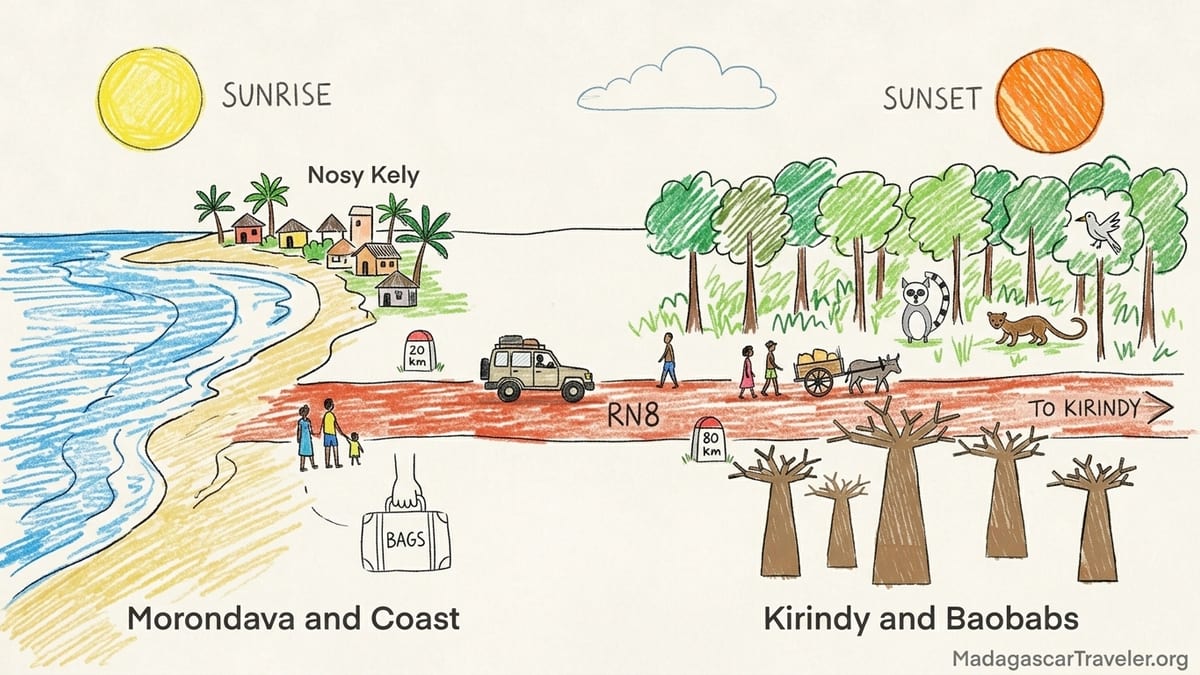
My Actual Stay: What Worked, What Felt Rushed
On my own visit I effectively had four nights to play with around Morondava. I arrived on an afternoon flight from Antananarivo, went straight to a beachside hotel near Nosy Kely peninsula, and thought I had plenty of time for both city and countryside. The rough plan was a first sunset at the Avenue of the Baobabs, a full day up in Kirindy Forest, then another baobab visit for sunrise followed by time around town and along the beach, with the option to add a side trip toward Belo-sur-Mer if everything felt smooth.
The first lesson arrived with the RN8. The Avenue of the Baobabs lies only about 20 to 25 kilometres from town, yet the ride took close to 40 minutes each way in the dry season, even in a 4x4, because the track is sandy and rutted and you slow for zebu carts and pedestrians. Guides in Morondava routinely describe it as a 30 to 45 minute transfer in good conditions, and that matched my experience. A basic sunset run with one or two stops near “baobab amoureux” easily became a three-hour round trip from hotel to hotel when you add waiting, photos and traffic.
The second miscalculation was Kirindy. Some group itineraries list Morondava to Kirindy as a three-hour drive each way, but my independent transfer in the dry season came in closer to two and a half on the way up and just under three returning, with long dusty stretches on the RN8 beyond the Avenue. This meant my “simple” Kirindy day absorbed well over six hours in the vehicle. Starting at 6:30 in the morning to catch the best wildlife activity, I still returned to Morondava around mid-afternoon coated in fine orange dust, more interested in a shower than in exploring town.
When I tried to layer in both sunrise and sunset at the baobabs around that Kirindy day, the schedule started to feel forced. Sunrise at the Avenue meant leaving a Morondava hotel around 4:45 to 5:00 in the morning in the dry season, because the sun is over the horizon by about 5:30 to 6:00 for much of winter and spring. The combination of pre-dawn wake-ups, midday heat and long jolting transfers created real road fatigue. I left feeling I had sampled everything, but I had not really rested anywhere, and a half-hearted attempt to arrange a Belo-sur-Mer day trip was sensibly abandoned once I understood that the southern track is a separate three-hour journey in its own right.
Understanding Distances, Sunrise and Road Fatigue
Morondava looks compact on a map, yet once you factor in road surfaces and light, the practical geography is much larger. The Avenue of the Baobabs is roughly 20 to 25 kilometres north of town along the RN8 dirt road, with most recent guides putting the transfer at about 30 minutes by private car in dry conditions, and up to 45 minutes by shared taxi-brousse. A round-trip taxi with waiting time is often quoted in the region of 50,000 Malagasy ariary or a bit more, which can rise sharply if you negotiate at the very last minute.
Kirindy Forest sits significantly further along the same route, and many operators still schedule three hours each way to account for rutted patches, cattle and occasional delays. A number of western Madagascar itineraries used by international tour companies explicitly mark Morondava to Kirindy as “approximate driving time: 3 hours each way,” and that aligns with more cautious planning. This is crucial if you are trying to combine Kirindy’s early wildlife peak, when lemurs and birds are active just after sunrise, with a sunset stop at the Avenue on the way back. The math quickly becomes unforgiving when you realise that an ideal wildlife start around 7:00 demands leaving Morondava before 4:30 in the morning if you have not slept closer to the forest.
Sunrise and sunset themselves also shape any realistic itinerary. Near the equator the day length does not swing as dramatically as in Europe or North America, but around Morondava sunrise hovers around 5:30 to 6:00 and sunset around 17:45 to 18:15 for much of the main dry season. Regional prayer timetables and astronomical listings show first light creeping in just after 5:00 in many months, which means that if you want the soft pastel colours before the sun clears the horizon at the Avenue, you must already be set up with your tripod by that time. That usually means leaving town in complete darkness and accepting that your first coffee will be drunk out of a thermos at the edge of a dusty track.
All of this adds up to road fatigue. The RN8 is beautiful in its own way, with red laterite dust, tall baobabs scattered into the distance and small Sakalava villages, but after several runs in 4x4s and taxi-brousses your back and patience begin to wear. Several long-distance itinerary reports from western Madagascar mention leaving Morondava for Bekopaka at dawn and arriving 10 to 12 hours later after ferries and stops, a reminder that this part of the country measures journeys in hours, not kilometres. Even with only Kirindy and the Avenue on your agenda, you are mimicking the first segment of that same route and will feel the same cumulative jolt.
What Two Days Realistically Allow: Morondava and Baobabs
If you have only two days after arriving in Morondava and your priority is the town plus the baobab landscapes, it is essential to accept that Kirindy is probably a stretch. A meaningful visit to the dry forest with a dawn walk and a night walk is hard to compress into a single day without feeling like a shuttle service, and you risk turning your short stay into a sequence of pre-dawn alarms. Instead, a two-day window is perfect for pairing Morondava’s coast and markets with a carefully timed visit or two to the Avenue of the Baobabs.
On the first afternoon or evening, it makes sense to focus on a sunset visit. Many local drivers suggest leaving Morondava around 15:30 to 16:00 in the dry months so you can stop at a couple of isolated baobabs and at the so-called “baobab amoureux” before reaching the main avenue for golden hour. With a private car you pay not just for the transfer but also for the driver to wait through sunset. The total on-the-ground time at the avenue might be 90 minutes, but door-to-door the experience edges toward three or more hours. Afterward you can still return for a fresh grilled fish dinner along Nosy Kely, listening to waves and zebu carts rolling along the sand.
That leaves the second day to understand Morondava itself. You can walk from many mid-range hotels on the peninsula into town to wander the market streets, where dried fish hangs in the sun and women sell seasonal fruit under bright umbrellas. A gentle morning swim in the Mozambique Channel is realistic, especially at lower tides when children play soccer on the hard-packed sand. If you are particularly motivated, you can mirror the previous day and book an early morning baobab run for sunrise instead of sunset. Just remember that this entails leaving town before 5:00 and that you will likely pay a little more for the uncomfortably early start.
What two days do not realistically allow is a meaningful sample of Kirindy’s wildlife. It is technically possible to race up to the forest, walk for a couple of hours looking for sifakas and birds, grab a quick lunch and rush back to catch a sunset at the Avenue, but every element of that plan is held together by optimistic timing and perfect road conditions. With only two post-arrival days, you are better served by slowing down, accepting that Morondava is your western beach stop, and investing in repeated visits to the Avenue for different light rather than chasing too many locations.
Adding Kirindy: How Three Days Change the Picture
Give yourself three days after landing in Morondava and the equation changes. Now you can realistically allocate one full day and at least one night to Kirindy Forest, and still find time for both a sunrise and a sunset at the Avenue of the Baobabs. The key question becomes whether to sleep in Morondava throughout or to spend a night closer to the forest to reduce early starts.
Several established western Madagascar circuits drive travellers from Morondava to Kirindy in the morning, check into a basic lodge near the forest entrance, then spend the late afternoon and evening on guided walks looking for giant jumping rats, mouse lemurs, chameleons and owls. By staying overnight, you eliminate one of the long pre-dawn transfers and can start your main morning wildlife walk at a humane hour between 6:30 and 7:00, when the diurnal lemurs become active. Operators who follow this model often note that Morondava to Kirindy is about a three-hour drive, information worth taking seriously if you are planning independently.
If you choose to keep Morondava as your single base, a three-day stay still allows for Kirindy, but you must embrace the early starts. One workable pattern is to dedicate day one to a relaxed sunset at the Avenue and a night in town, day two to a very early departure for Kirindy with sunset at the Avenue on the return leg, and day three to Morondava’s coast and markets. In practice that second day will probably begin around 4:00 or 4:30, so you can reach Kirindy for a morning walk, rest or nap at the forest lodging around midday when wildlife is quiet, then walk again in the late afternoon before leaving for the Avenue and returning to town after dark.
In my case, because I did not change hotels, I ended up packing “virtual” bags each day anyway, gathering camera gear, day packs and snacks in semi-darkness before dawn. Looking back, shifting one night to a simple bungalow near Kirindy would have saved almost three hours of driving and made the wildlife time feel more relaxed. The trade-off is the extra packing and unpacking, which many travellers dislike. For a three-day stay, one strategic overnight close to the forest usually repays the effort if wildlife is a core reason for your visit, but it is less compelling if your main goal is the baobab scenery rather than lemurs.
When Five Days Make Sense: Morondava, Forest and Coast
With five full days to play with after you arrive, Morondava and the surrounding Menabe region become a much more flexible canvas. You can slow down your pace to avoid back-to-back predawn alarms, add a meaningful coastal segment south or north of town, and still stop short of launching into a full Tsingy de Bemaraha or Tsiribihina River expedition. In effect, five days let you turn Morondava from a mere gateway into a region you actually inhabit for a short window.
One configuration is to spend two nights in Morondava itself, two nights closer to Kirindy, and one night in or en route to a smaller coastal village such as Belo-sur-Mer if seasonal conditions and logistics allow. The sandy 4x4 track to Belo-sur-Mer is often described as a three-hour crossing in the dry months, weaving among mangroves, small villages and occasionally flooded pans. Some lodges publish estimates of “about 3 hours by 4x4 from Morondava” and a similar duration by motorised boat in good sea conditions. Building a full night there into the plan, even if it turns into only a simple beach walk and view of traditional boatyards, transforms Belo-sur-Mer from a rushed excursion into a distinct coastal chapter.
Alternatively, you might remain based in Morondava for all five nights and use the extra time to spread out your activities rather than add new destinations. In a world of delayed flights and weather-sensitive internal connections, there is merit in this approach. You could schedule your first Avenue sunset flexibly on day one or two, add a full-day Kirindy run on day three, leave day four deliberately open for rest, beach time or a second baobab visit, and then keep day five as a buffer before onward travel. Travellers sometimes underestimate the value of having at least one full day with nothing booked in the middle of a west coast itinerary, simply to absorb dust, let laundry dry and regain enthusiasm for early starts.
The question is whether five days based entirely in Morondava still make sense once you have allocated time for a major onward expedition. Many national and regional tourism materials present Morondava primarily as a departure platform for western circuits, listing it in the same breath as Bekopaka for Tsingy de Bemaraha, the Tsiribihina River, and Belo-sur-Mer. If your broader Madagascar itinerary already includes several days for Tsingy or a multi-day river trip, then padding Morondava itself to five nights may not be the best use of limited time. At that point, balancing three nights in town with more nights upcountry along your chosen expedition route can create a more varied experience.
Hotel Changes, Dust and the Value of an Overnight Near Kirindy
The decision to change hotels during a short stay often divides travellers more than any question about specific sights. Around Morondava, the main pivot point is whether to move closer to Kirindy Forest for one or two nights or to endure longer daily drives but keep a single comfortable base on the coast. Both options carry real-world trade-offs that become obvious only once you have driven the RN8 a few times.
From a time and wildlife perspective, an overnight near Kirindy almost always wins. The forest itself is most alive in the cool of early morning and in the first hours after dark. Group itineraries that sleep nearby usually schedule a night walk along the access road soon after dinner, then an early morning walk after breakfast, making full use of both peaks. The nominal distance from Morondava might not seem large, but that three-hour drive each way shrinks your window for wildlife viewing and increases the chance that you will be tramping through the forest in the harshest midday heat instead of at the soft edges of the day.
On the other hand, moving inland even for a single night means packing your main bag again, leaving some belongings in storage in Morondava or loading them into the 4x4, and accepting more basic accommodation. While beach hotels around Nosy Kely and the town shoreline often have air conditioning, ocean views and an easy stroll to seafood restaurants, the lodges near Kirindy tend to be simpler, with fans, mosquito nets and intermittent hot water. After several dusty hours in a vehicle, trading a cool seafront room for a hot inland bungalow can feel like a step down in comfort, even if it gains you precious forest time.
In my own case, I remained loyal to the seaside hotel and then found myself effectively “packing” a small overnight kit for each very early departure anyway, filling daypacks with snacks, water, sunscreen and long sleeves. Looking back, that effort felt almost as disruptive as a single genuine hotel move would have been. For future trips, especially on a three or five day schedule where wildlife is a priority, I would accept one hotel change and sleep near Kirindy at least once. The time gain and the calmer start to the day justify the inconvenience. For a tight two-day visit, however, most travellers are likely better off staying put in Morondava and investing their limited energy in well-timed baobab outings instead of shuffling luggage.
When to Leave Morondava for a Wider Menabe Circuit
For many travellers, the hardest part of itinerary planning is knowing when to stop adding nights in a pleasant coastal town and when to move on to the next region. Morondava is no exception. It has a laid-back beach atmosphere, colourful sunsets over the Mozambique Channel and enough cafes and simple bars to fill gentle evenings. Yet the wider Menabe and Melaky regions hold many of the experiences that draw visitors west in the first place: the limestone pinnacles of Tsingy de Bemaraha, the Tsiribihina River, small coastal villages and more remote dry forests.
A practical threshold is this: if you are planning a dedicated Tsingy segment of three nights or more in Bekopaka, or a two to three day Tsiribihina descent, then Morondava’s role should shrink back to what the national tourist board often implies, namely as a gateway and staging post. In that context, two or three nights in town before or after the expedition are usually enough. Those nights can absorb delays on the road, provide time to visit the Avenue of the Baobabs in calm conditions and give you at least a taste of the coast. Pushing Morondava itself to five nights while also allocating substantial time to Tsingy or Tsiribihina tends to compress the rest of the country.
If, however, you do not plan to continue north to Bekopaka or embark on a river trip, then using Morondava as a base for a broader but still local Menabe loop makes more sense. This is where five days can be justified: two nights focused on the Avenue and town, one or two around Kirindy, and one in Belo-sur-Mer or another coastal community. You remain within roughly half a day’s reach of Morondava throughout, but you give each environment its own breathing space instead of trying to see everything from a single hotel. In this pattern, your onward movement from Morondava is not toward a separate expedition but part of the same Menabe-focused stay.
Ultimately the choice comes back to how much of western Madagascar you want to cover. Morondava is the launch pad for multiple classic circuits, and almost every local agency will frame it that way when you walk in the door. That does not mean you must follow a full expedition. It does mean that once your time there starts stretching beyond three to five nights, you should consciously decide whether you are deepening your experience of the immediate area or simply delaying a move to landscapes that might speak to you even more strongly.
The Takeaway
Looking back at my own four-night stay, the clearest lesson is that time in and around Morondava is consumed less by distance and more by texture: the texture of corrugated dirt roads, of slow sunrise light over baobabs, of afternoon heat in a dry forest and of fine dust settling on every surface. A schedule that looks loose on paper can feel packed on the ground once you realise that each main experience sits at the end of an unhurried, sometimes unpredictable journey.
With two days after arriving, focus on Morondava itself and the Avenue of the Baobabs. Prioritise one or two carefully planned visits at sunrise or sunset, enjoy the beach and markets, and resist the temptation to cram in Kirindy. With three days, decide whether wildlife is central enough to justify an overnight near the forest, knowing that this will save you precious hours and reduce dawn departures. And with five days, either slow down across Morondava, Kirindy and a nearby coastal village without committing to a full expedition, or accept that Morondava’s role is to stage you into something larger such as Tsingy de Bemaraha or the Tsiribihina River.
If you keep those trade-offs in mind, it becomes easier to design a stay that matches your energy level and interests rather than an idealised checklist. Morondava rewards travellers who respect its distances, its light and its dust, and who treat it not only as a gateway but also as a place worth inhabiting in its own right, even if only for a few unhurried days between the grander adventures of Madagascar.
FAQ
Q1. Is two days in Morondava enough to see the Avenue of the Baobabs properly?
Two days after arriving is usually enough for at least one good sunset or sunrise at the Avenue of the Baobabs and some time to explore Morondava’s beach and markets, as long as you do not also try to fit in a full Kirindy Forest visit.
Q2. How long is the drive from Morondava to the Avenue of the Baobabs?
The avenue sits roughly 20 to 25 kilometres from town along a dirt road, and most travellers report a transfer of 30 to 45 minutes each way in the dry season, depending on the vehicle and road conditions.
Q3. Do I really need an overnight near Kirindy Forest, or can I visit from Morondava in one day?
You can technically visit Kirindy as a long day trip from Morondava, but the return journey often totals six hours or more on a dusty road. An overnight near the forest saves early starts and lets you enjoy both a night walk and an early morning walk when wildlife is most active.
Q4. What are typical sunrise and sunset times around Morondava?
Around the main dry months, sunrise is usually between 5:30 and 6:00 and sunset between about 17:45 and 18:15. Exact times vary slightly by month, so you should confirm close to your travel dates, especially if you are planning a sunrise photography session at the Avenue.
Q5. How many days should I plan in Morondava if I also want to visit Tsingy de Bemaraha?
If you are committing to a separate three or four night Tsingy segment based out of Bekopaka, then two or three nights in Morondava before or after that trip are usually enough, mainly to see the Avenue of the Baobabs and rest from road travel.
Q6. Is five days based only in Morondava too long?
Five days based entirely in Morondava can work if you prefer a slow coastal rhythm and a few relaxed excursions. However, once you are planning that many nights and also considering Tsingy or a Tsiribihina trip, it often makes more sense to shift some time upcountry instead of keeping it all in town.
Q7. How dusty and tiring are the roads around Morondava?
The RN8 toward the Avenue and Kirindy is unpaved and can be very dusty in the dry season, with corrugations and soft sand in places. Even relatively short distances can feel tiring, so building in rest time between long drives is important.
Q8. Can I combine a Tsiribihina River trip with a short Morondava stay?
Yes, many western itineraries end a Tsiribihina River descent near Belo-sur-Tsiribihina and then continue to Morondava for one or two nights. In that case, Morondava acts primarily as a decompression stop and a chance to see the Avenue of the Baobabs rather than as a long beach holiday.
Q9. Is Belo-sur-Mer realistic as a day trip from Morondava?
In the dry season the 4x4 track to Belo-sur-Mer is often quoted at about three hours each way, so a day trip is technically possible but rushed. Staying at least one night in Belo-sur-Mer gives you more time to enjoy the beach and boatyards without spending most of the day in a vehicle.
Q10. What is the best way to split time between Morondava and Kirindy in three days?
A balanced three day plan is to spend one night in Morondava for a first baobab sunset, one night near Kirindy for evening and morning wildlife walks, and a final night back in Morondava to rest and enjoy the coast before you move on.