


Antananarivo is not a city you rush. The Malagasy capital spills over a chain of steep hills, with royal palaces on the ridges, crowded markets in the valleys and lakes and ring roads in between. Trying to “do it all” in one day quickly becomes a battle with traffic and gradients. A smarter approach is to build your visit around one compact hillside: the Rova of Antananarivo and the surrounding Haute Ville, then drop down to Analakely and Lake Anosy for markets, viewpoints and Malagasy food. Ambohimanga and Lemurs’ Park are worthwhile, but they work best as separate half‑day excursions rather than squeezing them into the same busy day.
Understanding Antananarivo’s Layout Before You Plan
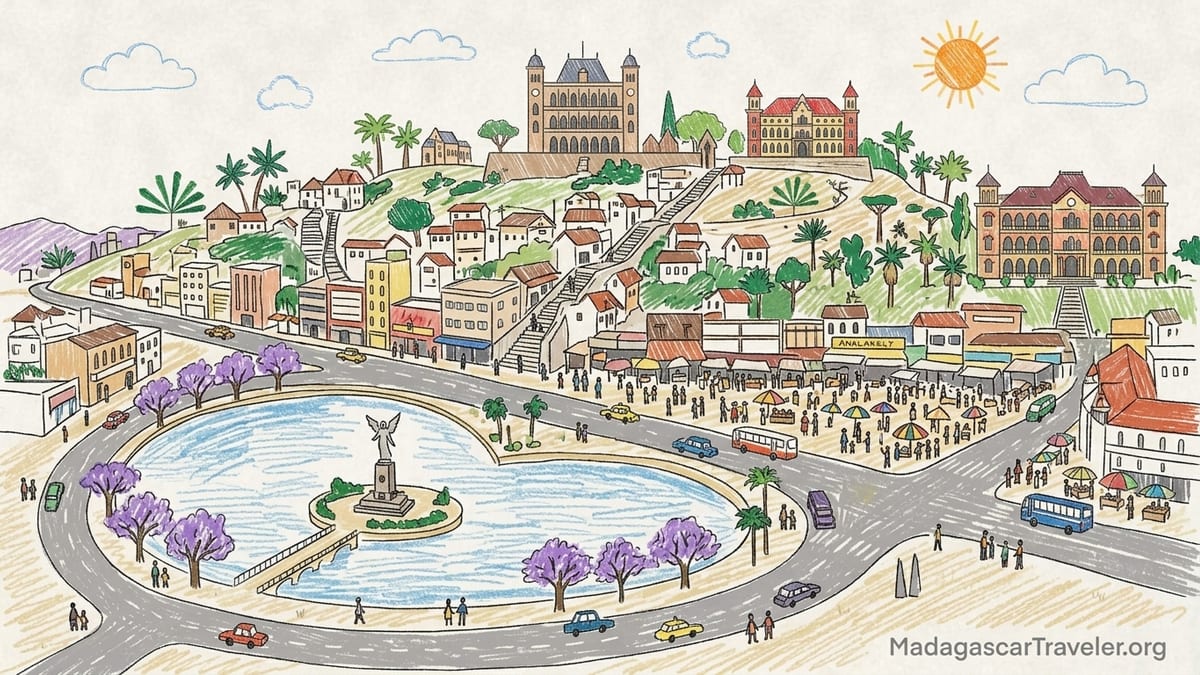
Antananarivo is built along a central ridge with a classic split between Upper Town and Lower Town. The Rova of Antananarivo and the surrounding Haute Ville sit high on the Analamanga hill, while Analakely, the main commercial district and market area, lies in the basin below. Lake Anosy curves around the southern side of the center, ringed by busy roads and government buildings. Distances on the map may look short, but altitude changes and heavy traffic mean that a “quick hop” often is not quick at all.
The key for a one‑day visit is to cluster sights that are naturally linked. The Rova, Andafiavaratra Palace, churches and narrow streets of Haute Ville combine easily on foot if you are comfortable with hills. Analakely’s market, the Independence Avenue area and the stairways climbing toward Haute Ville connect well as a separate walking segment. Lake Anosy, with its island war memorial and sweeping city views from the surrounding banks, is best reached by taxi from either district, then explored on foot.
Visitors are often surprised by how steep Antananarivo feels. Walking from Analakely up to the Rova involves a sustained climb of several hundred vertical meters on cobbled streets and old staircases. Fit walkers may enjoy the challenge; others will find a taxi to the Upper Town, then a mostly downhill wander later in the day, far more enjoyable. Knowing this in advance lets you structure your sightseeing so that gravity works in your favor rather than against you.
Traffic is another factor. Journeys of three to four kilometers can easily stretch to 30 or 40 minutes in peak periods. For that reason, it is sensible to avoid repeatedly crossing the city. Plan your day in two main blocks, one centered on the Haute Ville and Rova area, the other in and around Analakely and Lake Anosy, with taxis used to bridge the gaps rather than to hop between every single stop.
A Morning in Haute Ville: Rova and Andafiavaratra Palace
Start your day on the rooftop of the city. The Rova of Antananarivo, the former royal compound of the Merina monarchy, dominates the skyline and offers sweeping views of red‑tiled roofs, rice paddies and rolling hills. Access and restoration status have evolved over the years following a devastating fire, so it is worth asking your hotel for the latest update or arranging a licensed guide who knows what is currently open. Even when interior sections are restricted, the hill, ramparts and nearby viewpoints alone justify the trip.
From most central hotels, it is practical to take a taxi directly up to the Rova entrance first thing in the morning. The climb by foot from the lower city is long and exposed, and traffic tends to worsen as the morning progresses. Expect a taxi from around the central districts to cost the rough equivalent of a few euros; agree the fare in advance and keep small bills handy. Many drivers will wait or give you their number so you can call later, but it is just as easy to find another taxi after your visit.
Just below the Rova sits the red‑roofed Andafiavaratra Palace, once the residence of Prime Minister Rainilaiarivony and now a small museum. Even if the museum exhibits are only partly open at the time of your visit, the building is worth seeing for its architecture and the panoramic terrace overlooking the lower city. The palace lies only a short walk from the Rova gate on gently sloping streets, so you can comfortably link both on foot.
The surrounding Haute Ville district is one of the most atmospheric parts of Antananarivo. Narrow lanes thread between pastel‑colored townhouses with wooden balconies, old stone staircases and small corner shops. You can easily spend an hour or more meandering from the Rova area toward churches such as Cathédrale Andohalo and then drifting along residential streets. While the Upper Town feels calmer than the markets below, keep valuables discreet and avoid wandering down secluded alleys alone. Hiring a local guide for half a day gives context to what you are seeing and adds a level of reassurance, particularly if you want to explore side streets you might otherwise skip.
Walking the Upper Town: Steep Streets, Churches and Viewpoints
Haute Ville rewards slow exploration on foot. From the Rova and Andafiavaratra area, you can follow streets that contour along the ridge, dipping gently and then rising again, with frequent glimpses down to the lower city. Gradients vary: some stretches are gentle enough that you barely notice the climb, while side streets often turn into steep staircases connecting levels of the hill. For a typical visitor in average shape, the upper‑level streets are manageable, but those with knee issues or limited mobility should be selective about which stairways they tackle.
One practical way to structure your walk is to start at the Rova, stroll past Andafiavaratra Palace and then drift toward the main churches and viewpoints before gradually descending. The path toward Andohalo, for instance, passes traditional houses and small family kiosks selling snacks like mofo gasy rice cakes. Look for informal viewpoints where the city opens beneath you, often marked by benches or stone walls where locals gather. These are ideal places to pause, catch your breath and take photographs of the patchwork of roofs and rice fields in the valleys.
Because Haute Ville is a lived‑in neighborhood rather than a packaged historic center, you will encounter everyday scenes: children walking to school, laundry drying on balconies, carpenters working in half‑open workshops. Dress modestly, greet people with a simple “Salama” and be cautious about taking close‑up photos of individuals without permission. Petty theft can occur, so keep your camera strap secure and consider leaving passports and excess cash in your hotel safe.
For many visitors, a guide is especially helpful in this part of town. Street names, old royal residences and significant houses are not always signposted, and a knowledgeable guide can point out which church was favored by which royal figure or explain how the city expanded from the original hilltop fortress to the sprawling metropolis you see today. Guides can also suggest the best stairway descent toward Analakely if you decide to walk down, balancing views with safety and gradient.
Analakely and the Markets: Dropping into the Lower Town
From Haute Ville, you can either walk down to the lower city or take a taxi to Analakely, the central commercial district. The walk, using stairways that cut through the hillside, offers rewarding views but can be hard on knees and ankles, especially in wet weather. If you prefer a gentler option, ask your driver to drop you near the lower end of Independence Avenue, then explore on foot from there.
Analakely’s market area is one of the busiest and most emblematic corners of Antananarivo. Stalls spill out along side streets, selling everything from fresh fruit and vegetables to cheap clothing, household goods and phone accessories. Rather than treating this as a place to buy souvenirs, think of it as a window into daily life. Watch shoppers bargaining for rice, school uniforms being tried on in improvised fitting rooms, and hawkers weaving their way through traffic with trays of bananas or peanuts balanced on their heads.
Safety is mostly about common sense. Analakely can be crowded and chaotic, and pickpocketing is a known risk, especially near bus stops and in the tightest alleys. Leave your passport in your hotel, carry only the cash you expect to need for the day, and keep your phone zipped away when you are not actively using it. Many travelers find it easier to use a small cross‑body bag worn in front. Avoid wandering in this area after dark; if you have dinner nearby, take a taxi door to door rather than walking back.
Prices in the market are negotiable. For everyday items like a bag of seasonal fruit, locals pay the equivalent of a few coins, while foreigners can expect to be quoted more. Bargain with a smile and be prepared to walk away if you feel uncomfortable. If you want better quality handicrafts with clearer pricing, ask your hotel or guide to direct you to a dedicated craft market or boutique elsewhere in the city, then treat Analakely mainly as a sensory and photographic experience.
Lake Anosy and Classic City Views
A short taxi ride from Analakely or Haute Ville brings you to Lake Anosy, one of Antananarivo’s signature landmarks. The oval‑shaped lake, encircled by a busy road, contains an island with a prominent war memorial and angel statue. While access to the island itself is usually restricted, the lake’s outer banks and the slight rise in the surrounding streets provide excellent vantage points over the water and up toward the hills of the Upper Town.
Lake Anosy is especially photogenic in the late afternoon, when the light softens and the reflections of the hills shimmer on the surface. In certain seasons, rows of jacaranda trees around the lake burst into purple bloom, adding another layer of color. You will share the pavements with office workers, students and couples taking a stroll, and you may find informal snack vendors selling roasted peanuts or local sweets. Keep an eye on traffic when crossing the ring road; pedestrian crossings are not always respected.
This is also a logical area to pause for a coffee or early dinner in one of the nearby restaurants or cafes. Look for places slightly back from the main road, where you can sit on an upstairs terrace and watch the traffic slide around the lake below. Prices in mid‑range establishments are generally modest by international standards but higher than in basic Malagasy eateries; a main dish of grilled zebu steak with rice or a plate of ravitoto with pork might cost roughly what you would pay for a simple cafe meal in a smaller European city, with street snacks and basic rice dishes significantly cheaper.
Because the city center can feel less secure after dark, it is wise to plan your return to your hotel in advance. Ask the restaurant to call a trusted taxi or use a driver recommended by your accommodation. Nighttime photos of the illuminated war memorial and reflected lights on the lake are tempting, but it is best not to linger on the roadside with your camera on display; take a few quick shots and move on.
Tasting Malagasy Food: From Street Snacks to Sit‑Down Meals
Malagasy cuisine is built around rice, known locally as vary, served at almost every meal. The simplest and most authentic way to experience it is in a hotely, a small local eatery often found near markets or on busy corners. At lunchtime in central Antananarivo, you might find office workers lining up for a plate of rice topped with laoka, the generic term for side dishes such as stewed beef, beans in tomato sauce or leafy greens in coconut milk. Prices in basic hotelys are low by international standards, making them a good option for travelers who want to eat where locals do, as long as they are comfortable with shared tables and limited English.
If you prefer a more polished setting, mid‑range restaurants in the city center and Haute Ville serve Malagasy classics with a few international touches. Look out for romazava, a hearty beef and greens broth, or ravitoto, finely chopped cassava leaves slowly cooked with pork. Zebu steak is another staple, usually grilled or served with a pepper sauce, accompanied by rice or potatoes. For dessert, try koba, a dense peanut and rice cake wrapped in banana leaves, or simple seasonal fruits like lychees and mangoes when in season.
Street snacks make good fuel during a day of sightseeing. Around Analakely and in side streets of Haute Ville, vendors sell mofo gasy, small rice‑flour cakes cooked in cast‑iron molds, often eaten for breakfast or as a mid‑morning treat. You may also see skewers of grilled meat, fresh fruit cups or samosa‑style pastries stuffed with vegetables or meat. Choose stalls with a steady flow of local customers, where food turns over quickly, and avoid items that have been sitting exposed for long periods, especially under strong sun.
Tap water in Antananarivo is not recommended for visitors. Stick to bottled or filtered water, which is widely available in shops and kiosks. In restaurants, it is reasonable to ask whether ice is made from filtered water and to request your drink without ice if you are uncertain. Alcohol is available in many places, with local beers commonly on offer, but note that public drunkenness is frowned upon and walking home intoxicated after dark increases your risk of petty crime.
A Realistic One‑Day Itinerary Linking the Main Sights
Because of the city’s hills and traffic, the most effective Antananarivo day focuses on a few core areas rather than a long checklist. A practical structure starts in the Upper Town, drops into the Lower Town for markets and finishes near Lake Anosy, using taxis for bigger transitions and walking where the scenery justifies the effort.
In the morning, arrange a taxi directly to the Rova entrance, aiming to arrive soon after opening to avoid crowds and the brightest sun. Spend around an hour taking in the hilltop views and whatever sections of the complex are accessible, then wander downhill on foot to Andafiavaratra Palace. Visit the museum if it is open or simply admire the building and its outlook. Continue along Haute Ville’s ridge streets toward churches and viewpoints, pausing for a mid‑morning coffee or snack in a small local cafe.
Late morning or around lunchtime, begin your descent toward Analakely. If your knees are up to it and conditions are dry, your guide can lead you down one of the stairway routes threading through the hillside, which brings you directly into the bustle of the lower city. Alternatively, you can hail a taxi from a convenient Upper Town square and ask to be dropped near the Independence Avenue area. Have lunch either in a simple hotely if you are feeling adventurous or in a mid‑range restaurant near the center if you prefer something more familiar.
Dedicate your early afternoon to exploring Analakely and its markets. Keep valuables secure, wander the main thoroughfares and side streets at an unhurried pace, and treat any purchases as a bonus rather than the primary goal. As the day cools, take a taxi to Lake Anosy, walk a circuit of the accessible pavements and enjoy the changing light on the water and hills. Finish with an early dinner in a nearby restaurant or return by taxi to a dining spot close to your hotel, avoiding unnecessary walking after dark.
Ambohimanga and Lemurs’ Park: Worthwhile but Separate Excursions
Two of the region’s best‑known attractions, Ambohimanga and Lemurs’ Park, lie outside central Antananarivo and are better treated as separate half‑day trips than as rushed add‑ons to a city sightseeing day. Trying to fit either into the same schedule as the Rova, Haute Ville, Analakely and Lake Anosy usually means spending more time in traffic than actually on site.
Ambohimanga, a historic royal hill and UNESCO World Heritage site to the northeast of the city, offers a quieter, more rural counterpart to the Rova. Visitors typically reach it by car with a driver or guide, then explore the royal compound, its defensive gates and tombs on foot. The site’s cultural importance and the views over the surrounding countryside reward an unhurried visit of several hours. Combining Ambohimanga with a light walk in Haute Ville on a different day creates a balanced pair of experiences focused on Madagascar’s royal history.
Lemurs’ Park, located roughly 20 to 25 kilometers southwest of central Antananarivo along Route Nationale 1, is a small private reserve and botanical park where several species of lemurs live in semi‑free conditions among native trees and plants. Reaching the park typically takes around an hour or more each way, depending on traffic, even though the distance is not large. Visitor itineraries commonly dedicate a morning or afternoon to the park alone, joining a guided circuit to observe the animals, learn about conservation efforts and enjoy a short walk through the grounds before returning to the city.
If you only have one full day in Antananarivo, prioritize the core city sights instead of forcing either of these excursions. If you have two or three days, consider one city‑focused day built around the Rova, Haute Ville, Analakely, Lake Anosy and Malagasy food, plus a second half‑day visit either to Ambohimanga for history and views or to Lemurs’ Park for an accessible introduction to lemurs close to the capital. This structure keeps your time ratios sensible: more minutes spent actually exploring, fewer stuck in traffic or in transit.
FAQ
Q1. Is it realistic to visit the Rova, Haute Ville, Analakely and Lake Anosy all in one day?
Yes, if you cluster sights and use taxis for longer hops. Start at the Rova and Haute Ville in the morning, move to Analakely for lunch and market time, then finish the afternoon at Lake Anosy before returning to your hotel.
Q2. How steep is the climb between Analakely and the Rova?
The climb is sustained and can feel demanding, especially in warm weather. Expect several hundred vertical meters on cobbled streets and stairways. Many visitors prefer to take a taxi up to the Rova and only walk downhill later.
Q3. Do I need a guide to explore Haute Ville and the Rova area?
A guide is not strictly required but is very helpful. They can explain the history of the Rova and Andafiavaratra, point out significant houses and churches, choose safer walking routes and help with language and taxis.
Q4. Is Analakely Market safe for foreign visitors?
Analakely is busy and generally fine during the day if you use common sense. Keep valuables out of sight, watch for pickpockets in crowded alleys, avoid flashing phones or cameras and do not walk there after dark.
Q5. Can I walk between Haute Ville and Analakely, or should I always use a taxi?
You can walk, especially downhill from Haute Ville toward Analakely via stairways and sloping streets. Going uphill is tiring, so many travelers choose a taxi for the ascent and then enjoy a gradual descent on foot later.
Q6. How much time should I allow for Lemurs’ Park or Ambohimanga from Antananarivo?
Plan at least half a day for each. Reaching Ambohimanga or Lemurs’ Park usually takes around an hour or more each way with city traffic, and you will want a couple of hours on site to make the trip worthwhile.
Q7. What are typical costs for taxis and meals in central Antananarivo?
Short taxi rides within central areas are usually inexpensive by international standards, but always agree the fare in advance. Local hotely meals of rice and side dishes are very cheap, while mid‑range restaurant mains cost roughly what you might pay in a small European city cafe.
Q8. Are there good vegetarian options in Antananarivo?
Yes. While many dishes include meat, you can often find vegetable stews, beans, rice dishes and salads, especially in larger restaurants. It is helpful to explain your preferences clearly and ask which laoka are meat‑free.
Q9. When is the best time of day to visit Lake Anosy?
Late afternoon is ideal. The light softens, traffic flows a little easier than at midday, and reflections on the water are more photogenic. Plan your return by taxi before it is fully dark.
Q10. Should I prioritize Ambohimanga or Lemurs’ Park if I only have one extra half day?
If you are most interested in history and royal culture, choose Ambohimanga. If seeing lemurs is your priority and you do not have time for a national park, Lemurs’ Park offers an accessible close‑to‑city option.