


Antananarivo, usually shortened to Tana, can feel confusing on a first visit: traffic is slow, neighborhoods are hilly and spread out, and Ivato International Airport sits roughly 16 kilometers from the historic center. With nearly two hundred hotels and guesthouses listed on major booking platforms, choosing the right base is less about chasing a single “best” hotel and more about matching your budget and travel style to the right area. This guide focuses on real-world options in the most useful neighborhoods, comparing things that matter on the ground such as airport transfers, Wi-Fi reliability, pools, restaurants, air-conditioning and how easy it is to reach key sights.
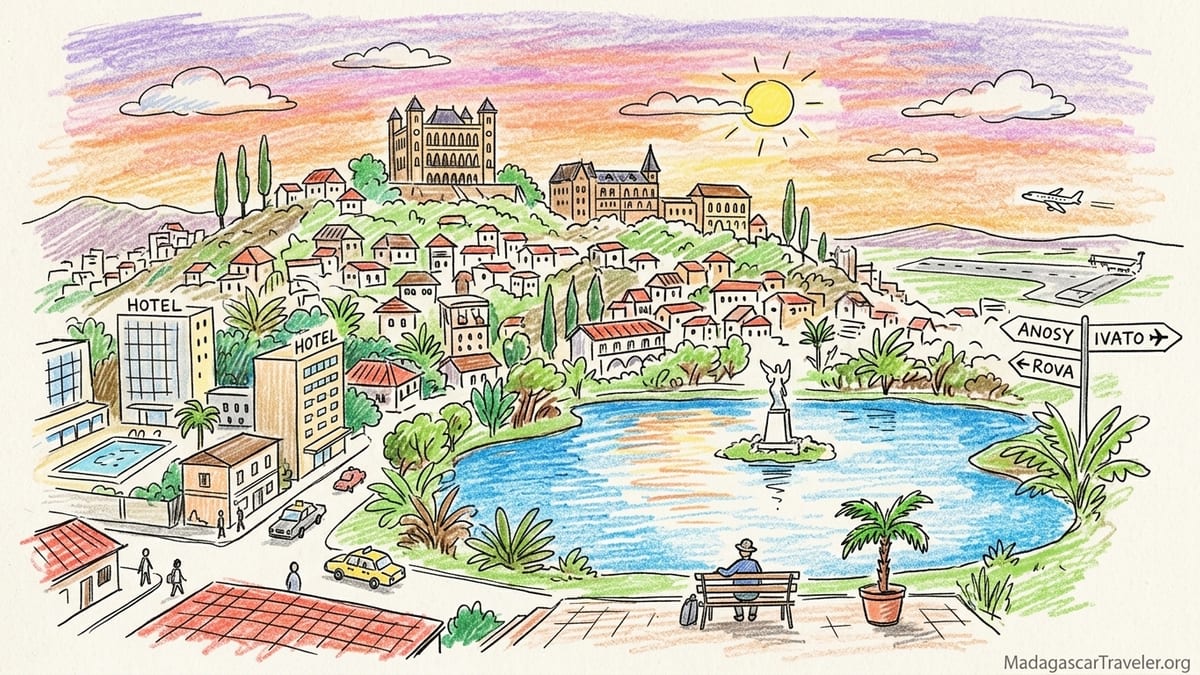
How Antananarivo’s Neighborhoods Shape Your Stay
Antananarivo stretches across steep hills and lakes, so where you sleep will shape almost everything about your visit. The main areas visitors use are the compact Upper Town around the royal palaces, the central business districts near Avenue de l’Indépendance and Anosy lake, the nightlife and dining hub of Isoraka and Antaninarenina, the modern commercial zone of Ankorondrano and the airport cluster around Ivato. Traffic between these areas can be heavy, so a hotel that looks close on a map may still be 45 minutes away in rush hour.
For most leisure travelers who want to sightsee, stay central in or near Isoraka, Antaninarenina, Anosy or around Lake Anosy and the Avenue. From these areas you can walk or take short taxi rides to the Rova (Queen’s Palace), Andafiavaratra Palace, the city’s main markets and several strong restaurants. For business trips that involve embassies, NGOs or corporate offices, Ankorondrano and the nearby Waterfront district put you closer to modern offices and shopping centers, but you will be farther from the old town atmosphere.
Transit stays around Ivato International Airport are worth considering if you have late-night or early-morning flights, or if you are simply overnighting between domestic connections. Hotels out by Ivato and the adjacent suburbs of Talatamaty and Ambohibao typically offer free 24-hour shuttle transfers, secure parking and quieter nights than downtown. They are less convenient for sightseeing, so many travelers pair one or two airport nights with a couple of nights in the center to experience the city.
Safety is another factor in choosing your area. The central hotel districts and Ivato’s better-known properties are accustomed to international guests and usually provide guarded entrances and on-site security. Petty theft can occur anywhere, particularly after dark, but well-reviewed hotels in Isoraka, the Waterfront, and around Ivato tend to have better lighting, controlled access and staff who can arrange trusted taxis rather than relying on random street cabs.
Luxury Hotels and Business Classics: Waterfront, Ankorondrano and Anosy
If you are looking for international-level comfort in Tana, the densest cluster of upscale hotels lies around the modern Waterfront development and Ankorondrano. Properties such as Radisson Blu Hotel Antananarivo Waterfront and its serviced-apartment sister hotel overlook a man-made lake, with indoor pools, full-service restaurants, fitness rooms, secure parking and solid high-speed Wi-Fi geared toward business travelers. Rooms here typically start from the low to mid three-figure range in US dollars, similar to a four- or five-star city hotel in southern Europe, but are often available with promotional weeknight rates outside peak season.
These hotels are particularly practical if you are in Tana for meetings or conferences, because many embassies, corporate headquarters and NGOs are in or near Ankorondrano. Their meeting rooms, business centers and reliable backup power make video calls and hybrid meetings feasible in a city where power cuts are not unusual. Air-conditioning is standard, and soundproofing is generally better than in older central properties, which helps with sleep if you are jet-lagged or catching up after long fieldwork trips elsewhere in Madagascar.
Closer to the historic center, long-running business hotels like the Carlton by Lake Anosy and the Louvre Hotel & Spa near the Avenue de l’Indépendance mix business and leisure. The Carlton, a tower block visible from many parts of the city, offers large rooms, multiple restaurants, a sizeable outdoor pool, tennis courts and guarded parking. The Louvre places you right in the city-center grid, with an indoor pool, spa and quick access on foot to banks, travel agencies and shops. If you plan to use taxis for sightseeing, staying near Anosy or the Avenue can shave ten to twenty minutes off each ride compared with Ankorondrano.
Airport access from these luxury and business hotels is straightforward but not always fast. In light traffic, the drive to Ivato can be 30 to 40 minutes, but at rush hour or during evening arrivals it can stretch toward an hour or more. Some high-end properties can arrange private transfers with English- or French-speaking drivers, usually at an extra fee that is still reasonable by European standards. If you have a 6 a.m. departure, consider spending your final night near Ivato even if you base yourself in the Waterfront or Anosy most of your trip.
Boutique Charm in Isoraka and the Upper Town
For travelers who value character over corporate gloss, Isoraka and the Upper Town offer some of Antananarivo’s most atmospheric boutique hotels. These areas are built on steep cobbled streets, with colonial-era townhouses and mansions that have been converted into intimate properties. You trade big pools and large gyms for antique furniture, carved wooden verandas and terraces with panoramic views of the red-tiled city below.
Lokanga Boutique Hotel, perched on the royal hill above the city, is a textbook example. Set in a 1930s residence, it offers individually decorated rooms filled with vintage pieces, polished wood floors and city views that glow at sunset. With only a handful of rooms, service feels personal; staff can arrange private drivers, restaurant bookings and early breakfasts for day trips. The location is particularly appealing if you want quick access to the Rova and Andafiavaratra Palace while still being a taxi ride away from the busier nightlife streets.
Down in Isoraka and nearby Antaninarenina, small boutique addresses such as La Varangue and The Citizen appeal to travelers seeking a sense of place. La Varangue is tucked down a lane near the presidential palace and is known for its bric-a-brac decor, leafy courtyard and strong in-house restaurant, popular with residents and visitors alike. The Citizen sits by Lake Anosy and combines a small number of stylish rooms with a terrace restaurant that locals use for sundowner cocktails, offering city and lake views without having to venture far after dark.
These boutique hotels typically include breakfast and have reliable Wi-Fi and air-conditioning, but their infrastructure can be idiosyncratic compared with newer high-rises. Not all have elevators, so be prepared to climb stairs with your luggage, and some may rely on smaller generators during power cuts. Airport transfers are usually by pre-booked taxi rather than a free shuttle; budget around 25 to 40 minutes in normal traffic and consider arranging pick-up through the hotel to avoid haggling at the terminal after an overnight flight.
Mid-Range City-Center Hotels: Comfort Without Frills
In between boutique charm and full luxury are Tana’s mid-range workhorses, concentrated around the downtown core, Soarano station and the lower streets leading up toward Isoraka. These hotels tend to be practical rather than beautiful, but they offer clean rooms, hot showers, air-conditioning in at least the higher room categories and on-site restaurants serving Malagasy and international dishes. For many independent travelers, this band of hotels strikes the best balance between price and comfort.
Properties like Tsanga Tsanga Hotel near Soarano station and several business-style hotels along and behind Avenue de l’Indépendance are good examples. You can expect en-suite rooms, daily housekeeping, secure reception areas and often a small bar or rooftop terrace. Prices typically fall in the budget-friendly range for international visitors, often under what you might pay for a basic chain hotel in Western Europe, especially outside peak domestic holiday periods. Breakfast is frequently included, with fresh fruit, pastries and eggs made to order, though buffet spreads tend to be modest compared with large resorts.
Wi-Fi in this tier is usually decent enough for email and messaging, though speeds can fluctuate during evening peaks or storms. If you need to upload large files or hold video calls, ask the front desk which floors or lounges have the strongest signal. Many mid-range hotels will let you sit in the restaurant or lobby outside meal hours if you need to work, and some can provide backup 4G routers for a small fee or deposit. Air-conditioning is common but not universal in the very cheapest rooms, so check that carefully if you are sensitive to heat during the warm rainy season.
Most mid-range city-center hotels offer airport transfers on request rather than as a bundled free service. You might pay a fixed fee that is still modest by international standards for a private car with seatbelts and a driver who waits if your flight is delayed. This can be more dependable than negotiating directly with airport taxis late at night, especially if you arrive with children or lots of luggage. Parking for self-drive rental cars is sometimes tight downtown, so if you plan to rent a vehicle, consider a property that explicitly advertises secure on-site parking rather than street-side options.
Family-Friendly Bases in the City and Near Nature
Families traveling in Madagascar often use Antananarivo as a staging point between national parks and the islands, which means they arrive with tired children, sandy luggage and sometimes within hours of onward flights. Choosing a family-friendly base with a pool, flexible meal times and space to spread out can make a big difference. You will find options both in the central city and closer to Ivato, depending on whether you want to sightsee or simply rest.
Central hotels with pools, such as larger business properties and certain boutique hotels with courtyards, are popular with families who plan to spend at least one full day exploring Tana. A pool gives children a way to burn off energy after long car journeys, and many hotel restaurants will adapt dishes to simpler tastes if you ask. Look for connecting rooms or junior suites that can hold extra beds, and confirm in writing if you need baby cots, as stock can be limited. Breakfast buffets with cereal, yogurt and fruit also help when juggling different appetites and early departures.
Near Ivato, hotels like Relais des Plateaux and similar lodge-style properties are particularly convenient for families. Set in gardens or wooded grounds, they often feature outdoor pools, small playgrounds or lawns where children can run around safely inside a gated compound. Because they primarily serve transit passengers, these hotels are used to very late check-ins and early check-outs, which suits families arriving after midnight or leaving at dawn. Free 24-hour shuttles reduce the stress of arranging taxis with half-asleep kids and multiple bags.
Wherever you stay, ask about practical details that matter to families: mosquito nets over beds, fans or air-conditioning in all bedrooms, blackout curtains for naptime and the availability of boiled or filtered water for mixing formula. In some hotels, Wi-Fi coverage is stronger in public areas than in far-flung family rooms; if your children rely on streaming or online schooling, request a room closer to the router or lobby. Many properties are flexible if you explain your needs in advance, and emailing the hotel a week before arrival often gets better results than last-minute requests at check-in.
Transit and Airport Hotels around Ivato
Given Ivato International Airport’s distance from the city center and the number of late-night and early-morning flights, the strip of airport and transit hotels around Ivato has grown into its own mini hotel market. Properties here are designed for practicality: nearly all offer free or affordable 24-hour airport shuttles, early breakfasts or snack options, day rooms for long layovers and reliable wake-up calls. You trade easy access to central sights for peace of mind that you are only a few minutes from the departure hall.
Relais des Plateaux, for instance, sits a short drive from the terminal and combines hotel-level comfort with a resort-like feel, including a pool and spa. Smaller boutique addresses such as San Cristobal Boutique Hotel and Nosy Manga near the airport appeal to travelers who prefer more intimacy than a big complex, often offering stylish rooms and surprisingly good restaurants for a transit area. Budget-friendly guesthouses and motels line the roads between Ivato and the suburbs of Talatamaty and Ambohibao, many advertising free H24 shuttles and simple but clean en-suite rooms that work well for a quick overnight stop.
These hotels are particularly useful for itineraries that involve domestic flights to the coasts or national parks, which often depart early in the morning. Staying near Ivato the night before can remove the anxiety of crossing town in pre-dawn traffic or worrying about roadblocks and delays. Some airport hotels will also store luggage for a few days at low cost if you are heading to remote areas where you do not want to carry everything, then returning through Tana before flying home.
Even if you base yourself downtown for most of your trip, consider finishing with a final night near the airport if your international flight departs before 9 a.m. It allows for a more relaxed last day in the city and a shorter trip to the terminal the following morning. When comparing airport hotels, pay attention to shuttle frequency, whether transfers are private or shared, and whether the service operates all night without extra fees. For very late arrivals, confirm that reception is staffed 24 hours so you are not left waiting outside a locked gate.
Practical Tips: Wi-Fi, Air-Conditioning, Parking and Getting Around
Across Antananarivo’s accommodation spectrum, most hotels now advertise free Wi-Fi, but quality varies. Upscale properties and newer business hotels usually provide the most stable connections and often have backup systems for power cuts. In boutique and mid-range stays, Wi-Fi may be strongest in lounges and restaurants, weaker in far rooms or upper floors. If you rely on connectivity, consider traveling with an unlocked phone and purchasing a local SIM at the airport, using the hotel network as a complement rather than your only option.
Air-conditioning is standard in luxury and business hotels and in many boutique properties, but in some older mid-range hotels and guesthouses the coolest rooms may still rely on fans and good cross-ventilation. During Tana’s cooler, drier months, this is not necessarily a problem, but in the warm rainy season it can affect comfort and sleep quality. When booking online, read recent guest comments to see whether rooms get stuffy at night and whether the air-conditioning works during local power outages.
Parking and transport logistics deserve more attention here than in many cities. Central streets are narrow and crowded, so if you plan to hire a car with a driver, choose a hotel with a clear entrance where vehicles can pull in safely off the road. Larger hotels and many airport properties offer secure, gated parking, which is useful if you arrive with a 4x4 full of luggage and field gear. Taxis are plentiful, but it is safer and often more comfortable to let your hotel call a trusted driver they know, particularly after dark or if you are carrying camera equipment and laptops.
Finally, think through your personal rhythm: if you know you will arrive late at night and leave again after only a few hours, an Ivato-area hotel may make more sense than trekking downtown. If you have two or three days to explore, a central base near Isoraka, Antaninarenina or Anosy will allow you to walk to restaurants and some sights, then add a final airport night if your outbound flight is very early. Using Antananarivo’s hotels strategically in this way turns what might otherwise feel like a chaotic transit point into a smoother, more enjoyable part of your Madagascar journey.
The Takeaway
Antananarivo’s hotel scene is broader and more nuanced than many visitors expect. Instead of hunting for a single top-rated property, start by deciding whether your priority is easy sightseeing, airport convenience, conference access or simply a quiet place to recover between long drives. The Waterfront and Ankorondrano concentrate polished business and luxury hotels with strong Wi-Fi and modern comforts. The Upper Town and Isoraka deliver boutique charm and proximity to historic sites and lively restaurants. Downtown mid-range properties keep budgets in check without sacrificing essentials like hot water and breakfast.
Families and weary transit passengers often find the greenery and shuttles of Ivato’s airport hotels the easiest option, especially on nights bracketed by flights. Across all categories, pay attention to recent guest feedback on Wi-Fi reliability, functioning air-conditioning and the responsiveness of airport transfer services. With a little advance planning and realistic expectations about traffic and hills, you can match your hotel not only to your budget but to the rhythm of your trip, turning Tana into a comfortable hub rather than a stressful layover.
FAQ
Q1. Which neighborhood is best for a first-time visitor to Antananarivo?
For most first-time visitors, staying near Isoraka, Antaninarenina or around Lake Anosy works best, as these areas balance walkable access to restaurants and sights with good hotel choices and reasonable taxi times to the airport.
Q2. How long does it usually take to get from the city center to Ivato International Airport?
In light traffic the drive from central neighborhoods like Isoraka or Anosy to Ivato can take about 30 to 40 minutes, but during rush hour or evening arrivals it can stretch toward an hour or a bit more.
Q3. Are airport hotels around Ivato worth it for early-morning flights?
Yes, if your international or domestic flight leaves early in the morning, staying near Ivato the night before reduces the stress of crossing town before dawn and lets you use free or low-cost hotel shuttles.
Q4. Do most Antananarivo hotels offer free airport transfers?
Many airport-area hotels include free 24-hour shuttles, while central city hotels more often arrange private transfers for a fee, which is still modest compared with many other capitals.
Q5. How reliable is hotel Wi-Fi in Antananarivo?
Upscale and newer business hotels usually provide the most stable Wi-Fi, while boutique and mid-range properties may have strong coverage in public areas but variable signal strength in some rooms.
Q6. Is air-conditioning standard in Antananarivo hotels?
Air-conditioning is standard in luxury and business hotels and common in many boutique properties, but some older mid-range hotels and guesthouses still rely mainly on fans and natural ventilation.
Q7. Are family rooms or connecting rooms easy to find?
Family and connecting rooms exist in larger hotels and some airport lodges, but availability can be limited, so it is wise to request specific configurations and extra beds well in advance.
Q8. Is it safe to walk around the hotel areas at night?
In main hotel districts such as Isoraka, the Waterfront and parts of Anosy, walking short distances is common, but it is still sensible to take licensed taxis after dark and avoid carrying visible valuables.
Q9. Should I rent a car or rely on taxis and drivers?
Most visitors rely on hotel-arranged taxis or private drivers because central streets are crowded and parking can be tight; self-drive is mainly useful for experienced drivers heading out of the city.
Q10. How far in advance should I book hotels in Antananarivo?
For popular boutique and airport hotels, booking several weeks ahead is sensible, especially in peak season or if you need family rooms; for standard mid-range city hotels, availability is usually good with shorter notice.