


Antananarivo, or simply "Tana" to locals, is far more than a necessary stop between international flights and Madagascar’s famous national parks. Perched on a chain of ridges at around 1,200 meters above sea level, the capital is where the island’s Merina monarchy rose to power, where independence was debated and declared, and where contemporary Malagasy culture is most densely layered. For first-time visitors, understanding Antananarivo’s royal hill, crowded markets and challenging traffic is the key to making the city a highlight, not just a layover.
Understanding Antananarivo’s Merina Royal Heart
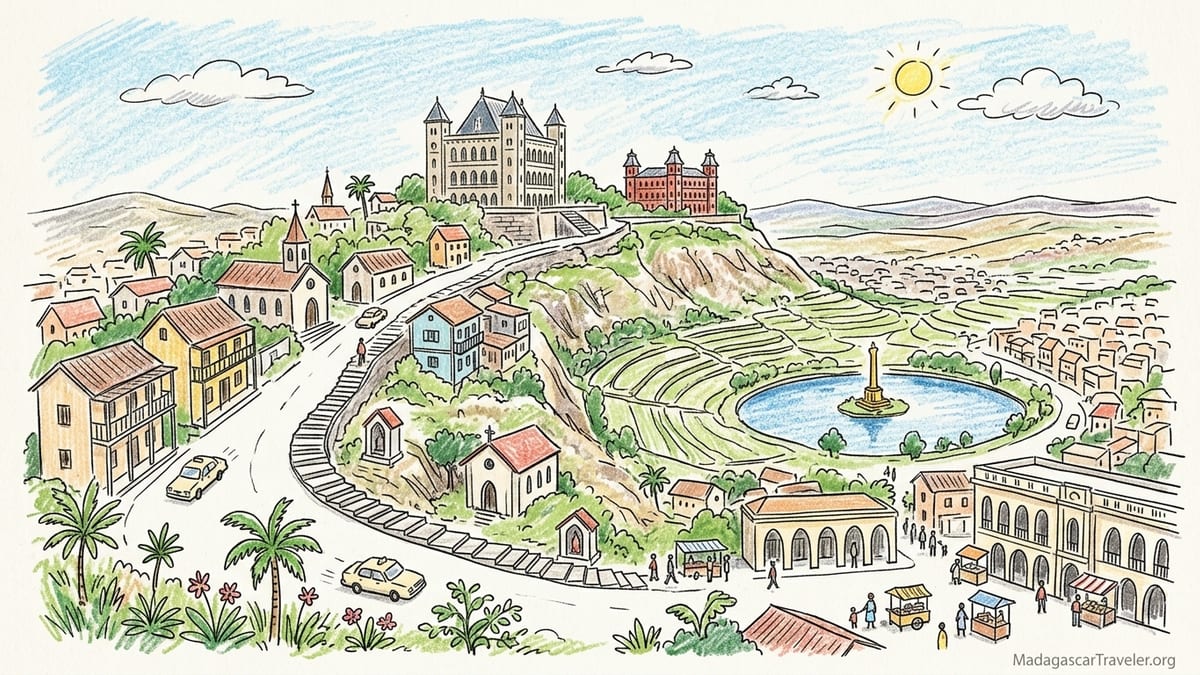
To orient yourself in Antananarivo, start by seeing it as the capital of a former highland kingdom rather than just another African city. The Merina people consolidated power here from the 17th century, ruling from walled hilltop fortresses known as rova. Their political and spiritual center was the Rova de Manjakamiadana, a complex of palaces and royal tombs crowning the city’s Haute Ville. Madagascar’s tourism authorities describe it as the country’s most important historic architectural ensemble, and for good reason: this was the seat of queens and kings who unified much of the island and later negotiated with European powers.
Much of the Rova burned in a devastating fire in 1995, but careful restoration has gradually brought back its silhouette of pale stone walls and steep roofs that dominate the skyline. When you stand in its courtyards, looking over the rice fields and suburbs below, it becomes easier to imagine how this ridge once controlled trade routes and symbolized Merina rule. Guides on site, often local history enthusiasts, can explain how traditional burial practices, royal marriages and alliances with coastal peoples shaped the kingdom. Their stories typically weave in Queen Ranavalona I, whose 19th‑century reign is remembered for both resistance to European influence and severe internal repression.
For a deeper sense of continuity, pay attention to how modern political life still clusters around the same hills. Government buildings, embassies and elite schools dot the ridges not far from the Rova, while religious and ancestral ceremonies continue to take place on nearby slopes. A walk from the Rova down into the lower town, through staircases lined with small shrines and family tombs, shows how notions of rank, lineage and elevation still subtly structure the city’s geography.
Haute Ville, the Rova and Andafiavaratra: Walking the Upper Town
Most visitors begin their exploration of Haute Ville at the Rova de Manjakamiadana, then work their way along the ridge toward the red‑walled Andafiavaratra Palace. This former prime minister’s residence, once home to the powerful Rainilaiarivony, now serves as a museum and repository for artifacts rescued from the Rova fire. Inside, you may see royal regalia, portraits of monarchs, carved wooden furniture and religious objects that survived flames and looting. Exhibits are modest by European standards, but they are some of the most significant historical objects on the island, and labels are gradually improving, sometimes with English translations.
From the Rova’s terraces, a typical first‑time visitor route follows narrow streets past stone churches, colonial‑era schools and balconied houses with wooden galleries. These buildings are often faded and patched, but their details tell stories: carved door lintels referencing traditional highland motifs, old French tiles brought up from the port of Toamasina, and small domestic altars tucked into corners. A guided walk, booked through a reputable local agency or your hotel, can help you safely navigate the steep staircases and residential lanes while hearing about the neighborhood’s social history.
Andafiavaratra itself sits on another high point and is easily recognizable by its reddish exterior and corner turrets. From the square in front, you get panoramic views of Antananarivo’s lower quarters, Lake Anosy and the Betsimitatatra plains beyond. It is a good place to pause with a coffee from a nearby kiosk or a street vendor selling mofo gasy, the slightly sweet rice‑flour cakes cooked over charcoal that are a Tana breakfast staple. Late afternoon is particularly atmospheric, with golden light catching the hills and church towers and cool highland air settling in.
Because pavements are uneven and some stairways are poorly lit, these walks are best done in daylight and with good shoes. Many travelers hire a car and driver to drop them at the Rova, then meet them later near Andafiavaratra or in the lower town, avoiding the need to navigate isolated slopes after dark.
Analakely, Avenue de l’Indépendance and Lake Anosy
Descending from Haute Ville toward Analakely, you leave the royal hill and enter the commercial and political core of modern Antananarivo. Analakely is the central district spreading out from Avenue de l’Indépendance, a long boulevard lined with arcaded buildings from the French colonial period. The avenue once hosted the legendary Friday Zoma market, said to have been among the largest weekly markets in the world before it was moved and regulated. Today the boulevard is framed by banks, offices, cafes and mid‑range hotels, and in the evenings you may see families strolling and teenagers gathering around snack stands.
At ground level, Analakely Market remains one of the city’s most intense experiences. Under metal roofs and along crowded alleys, hundreds of small stands sell everything from piles of lychees and cloves to second‑hand clothes, mobile phone accessories and aluminum cooking pots. Recent visitor reports describe it as sprawling, chaotic and rich in local color, but also a place where petty theft is common. It is wise to carry minimal cash, leave passports at your hotel, and, if possible, go with a trusted guide or driver who knows the layout and can help with bargaining.
A short distance uphill from Analakely is the Place de l’Indépendance, a symbolic square marking Madagascar’s break from French rule in 1960. A granite stele commemorating independence stands roughly where a First World War monument to French dead once stood. This shift in memorial focus reflects the broader move from colonial commemoration to national pride. Spending a few minutes here, perhaps from the terrace of a nearby café, helps connect the royal story of Haute Ville with the anti‑colonial politics of the 20th century.
South of the commercial center, Lake Anosy adds an unexpectedly tranquil note. This artificial lake curves like a ring around a central island topped by a golden winged monument to fallen soldiers. Around June 26, Madagascar’s Independence Day, fireworks and public celebrations focus on this area. On ordinary days, you may see young couples leaning on the railings, office workers cutting through on their commute and vendors selling peanuts or grilled snacks beside the water. The traffic circling the lake can be heavy, but early morning or late afternoon walks along its edges are pleasant breaks from the density of Analakely.
Markets and the Emerging Food Scene
While Analakely is the city’s best‑known market, it is only one piece of Tana’s wider trading ecosystem. Smaller neighborhood markets, known as tsena, appear at almost every major intersection, selling seasonal produce from the highlands: bags of rice, cabbages, tomatoes, potatoes, leafy greens and herbs. In the cold season, you might find piles of strawberries, while in the hot rainy season, mangoes and lychees flood the stalls. For a gentler introduction than Analakely, visitors can ask drivers to stop at a smaller tsena where the atmosphere is calmer and vendors have more time to chat.
Tana’s food scene is still modest compared with larger African capitals, but it is evolving. Traditional hotely, small informal eateries, serve plates of rice with laoka, side dishes such as romazava (a beef and greens broth), chicken with ginger or pork with leafy cassava. Prices in these neighborhood spots remain low by international standards, which makes them attractive for budget travelers willing to accept simple surroundings and shared tables. For those seeking more comfort, a growing number of bistros and hotel restaurants in areas like Isoraka, Anosy, Ivandry and Ambatobe offer Malagasy‑French fusion cuisine, grilled zebu steaks and seafood brought from coastal cities.
Street food is another accessible way to taste the city. Vendors push carts selling mofo gasy in the mornings, samosas and grilled brochettes in the afternoon, and skewers of meat or sausages near bus stops in the evening. A typical real‑world scenario might be grabbing a cone of hot peanuts and a bottle of local soda while waiting out a traffic jam, or buying a freshly fried banana fritter as you walk between sights. As always, choose busy stalls where ingredients are moving quickly, and carry small notes so you do not need to reveal a wallet full of larger bills.
Coffee culture is also slowly taking root. In the center you will find bakeries and cafés offering espresso, croissants and local pastries, frequented by office workers and students. These venues, often with Wi‑Fi and reliable electricity, double as practical meeting points for tours or drivers. They give first‑time visitors a chance to observe daily life, from suited civil servants to market porters grabbing a quick snack.
Arriving at Ivato Airport and Navigating Tana’s Traffic
Antananarivo’s main gateway is Ivato International Airport, often listed by its code TNR. Located roughly 16 kilometers northwest of the city center, it feels deceptively close on a map, but the journey into town can take anywhere from 45 minutes in light traffic to well over 90 minutes during peak hours or rain. Arrivals and departures are often concentrated around key international flights, which can make the terminal feel busy despite its relatively small size.
After clearing immigration and customs, most passengers emerge into a hall where hotel representatives, tour operators and taxi drivers wait. The official airport taxi stand usually operates with fixed or semi‑fixed prices to central districts, commonly quoted in ariary. Recent travel reports suggest a rough range that, when converted, can run to the equivalent of around 15 to 25 US dollars for a private airport taxi into central Antananarivo, depending on the exact neighborhood, time of day and bargaining. It is common to pay a little more for late‑night arrivals or for larger vehicles that can handle bulky luggage.
Some ride‑hailing and local car‑with‑driver services are beginning to operate in Antananarivo, but coverage from the airport can vary, especially late at night or during network outages. For most first‑time visitors, arranging a transfer in advance through their hotel or a tour operator is the least stressful option. Hotels accustomed to international guests in areas such as Ivandry, Isoraka, Ambatobe and Anosy routinely offer this service, adding the cost to your bill. This can also help avoid the awkwardness of negotiating when tired or jet‑lagged.
Once in the city, traffic becomes a defining feature of daily life. Narrow roads, a growing population of cars and minibuses known as taxi‑be, and frequent road works combine to make even short distances unpredictable. It is not unusual for a three‑kilometer cross‑town trip to take 45 minutes in the late afternoon. Visitors often adapt by planning one or two main activities per day, scheduling cross‑city moves either before 8 am or after 7 pm when possible, and using a dedicated driver who can wait while they visit sites. Walking can be pleasant for short distances in daylight, especially on the ridges, but sidewalks are inconsistent and some areas feel uncomfortable after dark.
Taxis, Getting Around and Where to Stay
Antananarivo’s cream‑colored taxis are among the most visible elements of the streetscape. Many are aging French models, but they are ubiquitous and relatively affordable. Meters are almost never used, so every journey requires agreement on a price before you get in. For a short daytime trip within a central neighborhood, visitors might realistically agree a fare that equates to just a few US dollars. Longer cross‑town rides, or routes up the steep hills of Haute Ville, cost more. It is common to negotiate a slightly higher fare in the evening, both because of lower demand and safety concerns.
Taxi‑be minibuses, which follow fixed routes and are extremely cheap, can be tempting, but they are usually overcrowded and confusing for newcomers. Local authorities, international organizations and many embassies generally advise visitors not to rely on them, particularly at night, due to safety and pickpocketing risks. Instead, many travelers and resident expatriates hire a trusted driver by the day. Hotels and guesthouses can usually recommend someone, and the all‑day rate remains moderate by international standards, particularly if shared between a couple or small group.
Where to stay in such a hilly, spread‑out city is a crucial decision. For visitors focused on history and city walks, districts around Haute Ville, Isoraka and the upper parts of Anosy offer character, older architecture and closer proximity to the Rova and Andafiavaratra. These areas feature mid‑range hotels and guesthouses in converted townhouses, often with good views and on‑site restaurants. However, streets can be steep, and you will still want a car at night.
For those prioritizing security, comfort and easier access to embassies and NGOs, neighborhoods like Ivandry and Ambatobe are common choices. These zones, especially popular with expatriates, host international schools, gated compounds, modern apartment complexes and restaurants serving everything from Malagasy staples to pizza and Asian cuisine. Accommodation here ranges from serviced apartments to upper‑mid‑range hotels, usually at prices somewhat lower than comparable properties in large European capitals. The trade‑off is that you are farther from historic sites, so most sightseeing requires crossing busy traffic corridors.
How Antananarivo Fits into a Wider Madagascar Trip
Many travelers arrive in Madagascar with wildlife and beaches foremost in mind: the lemurs of Andasibe‑Mantadia and Ranomafana, the baobabs of the west and the shores of Nosy Be or Île Sainte‑Marie. It is tempting to treat Antananarivo as a mere logistical hub, but giving the capital at least two or three full days adds depth to any itinerary. Spending time at the Rova, Andafiavaratra and the independence landmarks provides historical and cultural context for the regions you will later visit.
In practice, a classic first‑time itinerary might look like this: two nights in Tana on arrival to recover from flights and explore Haute Ville and Analakely; three to four nights in Andasibe for rainforest and lemurs; then a flight or long drive to a coastal zone such as Nosy Be in the northwest or Ifaty in the southwest for beaches and marine life. Another common combination is to finish a southern or western road trip back in Tana, allowing at least one buffer night in the city before your international departure to absorb any delays or road issues.
Because domestic flights in Madagascar can be subject to last‑minute schedule changes, experienced operators often build in time in Antananarivo at both the beginning and end of a trip. This not only protects against missed connections but also opens up chances to explore museums, crafts shops and contemporary culture. For example, you might use a spare morning to visit an artisan workshop in the outskirts where wood carvers or silk weavers produce the souvenirs sold in the center, or to attend a small jazz or salegy music performance, especially during festivals such as the long‑running Madajazzcar.
Antananarivo also serves as a staging post for excursions into the highlands beyond the city limits. Day or overnight trips to former royal sites like Ambohimanga, a UNESCO‑listed hilltop rova northeast of Tana, extend the story of Merina power and spiritual life. Visits to lakeside villages and rice terraces in the surrounding countryside show how highland agricultural systems still sustain much of the population, linking today’s market trade back to centuries of terracing and irrigation.
The Takeaway
Antananarivo rewards travelers who approach it not just as a transit point but as the political and spiritual capital of a highland kingdom that later became a nation. From the Rova de Manjakamiadana and Andafiavaratra Palace in Haute Ville to the commercial bustle of Analakely and the reflective curves of Lake Anosy, the city’s topography itself tells a story of power, trade and memory. Its Merina royal heritage, independence landmarks and evolving food and market culture offer a counterpoint to Madagascar’s better‑known lemur forests and beaches.
First‑time visitors who prepare for crowded traffic, negotiate taxis with confidence and choose accommodation that matches their priorities can turn what might have been a stressful stopover into an engaging cultural chapter. Building a few unhurried days in Tana into a wider itinerary allows the city’s steep streets, hillside views, smoky food stalls and royal relics to come into focus. When you finally board a flight or set off on a national road, you leave not just with photos of lemurs and shores, but with a sense of the highland capital whose decisions have long shaped the island beyond.
FAQ
Q1. How many days should a first-time visitor spend in Antananarivo? Most travelers are well served by spending two to three full days in Antananarivo, split between exploring the royal hill and markets at the start of a trip, and allowing at least one night at the end as a buffer before international flights.
Q2. Is the Rova de Manjakamiadana open to visitors, and do I need a guide? The Rova complex has progressively reopened with restoration work, and visitors are generally allowed into designated areas; hiring a local guide at the entrance is recommended to understand the history, rituals and surviving architecture in context.
Q3. How safe is Analakely Market for tourists? Analakely is a bustling central market where pickpocketing and bag snatching do occur, so visitors should carry minimal valuables, keep bags zipped and in front, and ideally go with a guide or trusted driver, especially if unfamiliar with crowded markets.
Q4. What is a typical taxi fare from Ivato Airport to the city center? Fares vary with traffic, time of day and neighborhood, but a private airport taxi into central Antananarivo often costs the rough equivalent of about 15 to 25 US dollars, with a slightly higher rate at night or for larger vehicles.
Q5. Which neighborhoods are best to stay in for first-time visitors? For easy access to historical sights, areas around Haute Ville, Isoraka and Anosy are convenient, while travelers seeking more modern comforts and a residential feel often choose expat‑oriented neighborhoods such as Ivandry and Ambatobe.
Q6. Is it easy to get around Antananarivo without speaking French or Malagasy? Basic tourism transactions are possible in English in hotels, larger restaurants and with some guides, but French is widely used; having key phrases or a translation app, and arranging drivers through your accommodation, makes getting around noticeably easier.
Q7. Are taxi-be minibuses a good option for visitors? Taxi‑be minibuses are very cheap and widely used by locals, but they are usually crowded, confusing for newcomers and not recommended for visitors, particularly at night, due to safety, comfort and pickpocketing concerns.
Q8. What local foods should I try in Antananarivo? Visitors should look for mofo gasy rice cakes at breakfast, plates of rice with laoka such as romazava or ginger chicken in hotely eateries, and street snacks like samosas, brochettes and fried bananas from busy stalls where food is cooked fresh.
Q9. How does Antananarivo fit into a wider Madagascar itinerary focused on wildlife and beaches? Antananarivo works best as both cultural centerpiece and logistical base, with two or three days at the start for royal and urban history, and at least one night at the end to cushion against domestic flight or road delays before international departures.
Q10. When is the best time of year to visit Antananarivo? The dry, cooler months in the southern winter, roughly from May to October, usually offer clearer skies, more comfortable temperatures and slightly easier travel conditions than the wetter, hotter season, although conditions vary from year to year.