


For almost every international traveler to Madagascar, Antananarivo – or Tana – is the unavoidable gateway. The question in 2026 is not whether you will pass through the capital, but whether it deserves one precious extra day in an itinerary built around baobabs, beaches and rainforest. With new restoration work at the Rova, ongoing access to the sacred royal hill of Ambohimanga and easy wildlife at Lemurs’ Park, the case for stopping has become stronger. Yet traffic, limited vacation time and the pull of the coasts mean it is still a real trade off. This guide weighs what you gain from one or two days in Tana against what you give up elsewhere in Madagascar.
Understanding Tana’s Role in a Madagascar Trip
Antananarivo is where almost all international flights land, and in practice most visitors are forced to spend at least one night here because domestic flights rarely line up cleanly with long haul arrivals. Late evening landings followed by morning departures are common, which naturally raises the question: do you schedule only a bed near Ivato Airport or add a full day in the city between flights. In 2026, with restoration on the royal palace complex progressing and tours to surrounding sights running more smoothly, this has become a one versus two day decision for many travelers.
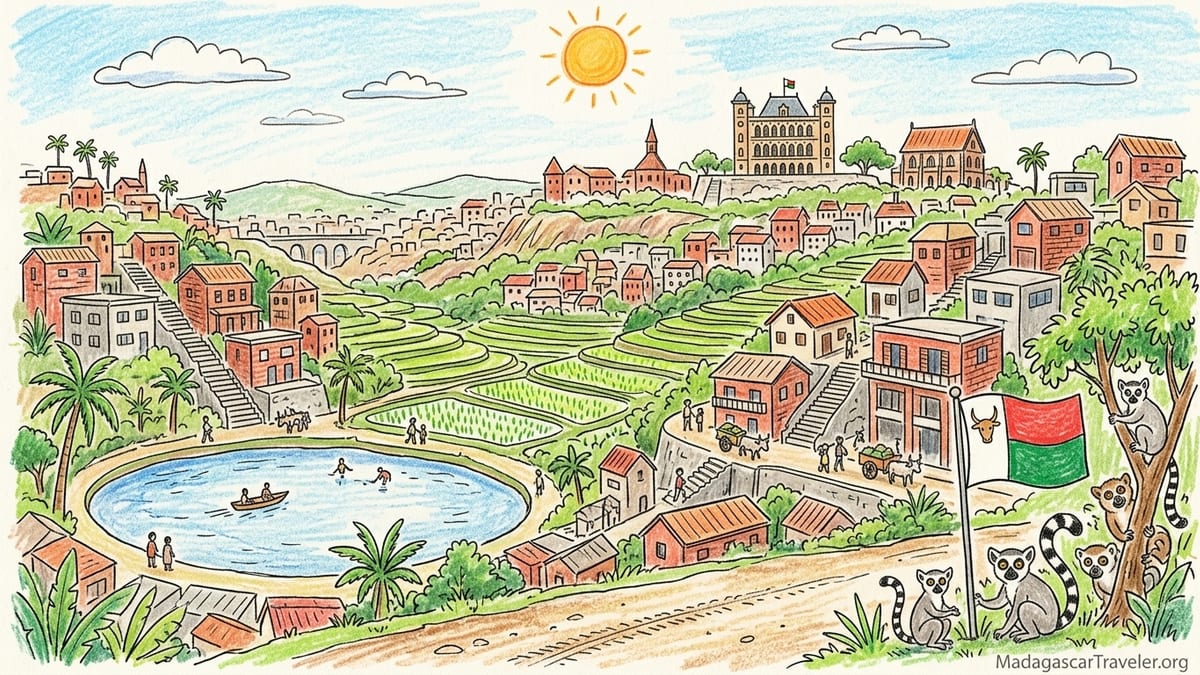
Tana itself is a highland city of steep hills, terraced rice paddies and a mix of red brick houses and concrete sprawl. It is not a beach destination and it cannot compete with national parks such as Andasibe or Ranomafana for wildlife, nor with the Avenue of the Baobabs or Nosy Be for headline scenery. What it does offer is context: the Merina royal history that shaped modern Madagascar, a first encounter with Malagasy language and food, and a lived-in, sometimes hectic urban experience that many visitors find clarifies the rest of their trip.
This context matters because Madagascar is big and internal journeys are slow. A typical first time visitor might have 10 to 14 days and want to see rainforest around Andasibe, a west coast baobab landscape, and at least a couple of days by the sea. Every extra night in Tana is a night you are not on the RN7 to Isalo or flying to the islands. That trade off is real, but depending on your interests, one extra day in the capital can make the rest of the trip more meaningful and sometimes logistically easier.
Recent years have also brought bouts of political tension, including protests in late 2025 that affected some central districts. While tourism businesses continued operating, it is important to check up to date travel advice from your own government and to stay flexible. For most visitors this will influence route planning and where you stay more than it will dictate whether you add a day in the capital at all.
What One Full Day in Antananarivo Really Buys You
Think of one extra day in Tana as buying you a layered introduction to Madagascar rather than a checklist of “top sights.” Realistically, you are choosing between using that day for a straight transfer out to somewhere like Andasibe or Morondava, or pausing for an urban immersion built around the Upper Town, the Rova and a couple of markets. Done well, this can be both affordable and manageable even when you are jet lagged.
A common one day circuit begins on the ridge of the Upper Town, where pastel houses, staircases and churches contrast with the low rice fields and lakes below. A driver and car arranged through a midrange hotel typically costs in the region of what you might spend on an airport transfer plus a short tour in a European city, and it lets you link sites efficiently instead of negotiating taxis several times in heavy traffic. With a vehicle, you can start at the Andafiavaratra Palace museum, continue to the Rova for its sweeping views, then descend toward the Anosy lake area and finish in a central neighborhood for dinner at a Malagasy restaurant.
Along the way, you get first exposure to Malagasy dishes like romazava, a beef and greens stew, or ravitoto, slow cooked pork with cassava leaves, in restaurants geared to travelers but still used by locals. Places in central neighborhoods often offer main courses at prices similar to a standard meal in a Western European city bistro, with cheaper options at local eateries if you are comfortable with a more basic setup. You might also sample street snacks such as mofo gasy, a sweet rice flour cake cooked in cast iron molds, which you will then recognize in small towns later on.
Crucially, carving out a full day allows time to rest and adapt. Many travelers coming from Europe or North America discover that jumping straight from a long overnight flight into a multi hour road transfer is simply exhausting. Spending that first day in Tana lets you sleep, organize currency, local SIM cards and domestic flight confirmations, and meet the driver or guide who will accompany you later. What could feel like “lost time” on paper often proves to be a practical investment in making the rest of the trip smoother.
Merina Royal History, the Rova and the Upper Town
The strongest cultural argument for giving Antananarivo more than a perfunctory stopover is the chance to explore Merina royal history on its home turf. The Merina kingdom unified much of Madagascar’s highlands in the 18th and 19th centuries, and its rulers shaped the political and cultural landscape that visitors encounter today. Their story is literally built into the ridges above Tana’s old quarters, with the Rova of Antananarivo and surrounding palaces forming a visible landmark from much of the city.
The Rova complex suffered a devastating fire in the 1990s and has been undergoing a long process of stabilization and restoration. Recent updates from Malagasy and French language sources indicate that significant restoration work reached completion toward the end of 2025, with sections of the complex now reopened to visitors as part of guided circuits that explain the history of the monarchy and the reconstruction. Although some areas remain under conservation, the combination of reconstructed palace buildings, foundations and the panoramic view across the city makes it a compelling stop for travelers interested in history.
Pairing the Rova with the nearby Andafiavaratra Palace, a striking red building that houses exhibits including royal regalia and portraits, creates a half day thematic visit. Guides based at these sites or hired through agencies can weave together stories of queens like Ranavalona I, the arrival of Protestant missionaries and the later French colonial period. For culture focused travelers, this narrative is one of the main reasons to stay in Tana instead of heading straight to the countryside.
The surrounding Upper Town streets also reward slow exploration. You can walk past colonial era facades, small workshops and family run shops selling everything from religious icons to second hand clothes, peeking into courtyards and churches along the way. While this is not a manicured old town in the European sense, it feels lived in and gives a first sense of daily life in the highlands. Spending even two or three hours here can ground the rest of your journey through smaller Merina towns on the RN7 or the rice growing areas around Antsirabe.
Markets, Malagasy Food and Everyday City Life
Beyond palaces and viewpoints, Antananarivo is where you can safely and efficiently encounter Malagasy markets and food culture for the first time. Central markets sell everything from piles of lychees in season to woven raffia hats and carved zebu horn trinkets. Some of the largest markets can feel overwhelming and are best visited with a local guide, not only for navigation but also for practical advice on where photography is welcomed and how to handle petty theft risks. Smaller neighborhood markets can be more relaxed and are often easier introductions for jet lagged visitors.
For many travelers, a highlight of a one or two day stop is a meal in a restaurant that blends Malagasy ingredients with French or broader African influences. In districts popular with visitors, you will find menus that list romazava and ravitoto alongside grilled zebu steaks, local fish when available, and desserts built around seasonal fruit. Budget wise, a sit down dinner in a comfortable, traveler friendly restaurant with a glass of Malagasy wine or a local Three Horses Beer typically costs significantly less than an equivalent meal in major Western capitals, though imported items quickly raise the bill.
Street level experiences, from buying small bags of roasted peanuts to watching children play football between parked taxis, are harder to quantify but often shape whether travelers feel Madagascar is “worth the journey.” Tana offers these in concentrated form. You may watch commuters balancing produce on their heads, groups of school children in uniform negotiating the hills, and tailors working on hand crank sewing machines in doorways. That immersion can be intense, and the city’s poverty is visible, but if approached respectfully it adds depth that purely nature based itineraries sometimes lack.
Of course, there are trade offs. Traffic congestion is serious and getting across town can take far longer than maps suggest. During peak hours, a drive of only a few kilometers can stretch to 45 minutes or more, which is why many itinerary planners recommend focusing on one or two adjacent neighborhoods each day instead of trying to “do it all.” With only one day, that usually means choosing between a focus on the Upper Town and central markets, or heading out of the city for an excursion such as Ambohimanga or Lemurs’ Park.
Ambohimanga and Lemurs’ Park: What an Extra Day Outside the City Adds
If you decide to allocate two full days around Antananarivo rather than one, the main candidates for that extra time are the Royal Hill of Ambohimanga and Lemurs’ Park. Both are within easy reach of the city by car, and many 2026 itineraries explicitly frame the decision as whether to spend one day in Tana proper or two days including one of these excursions.
Ambohimanga, about 20 to 25 kilometers northeast of central Antananarivo depending on your starting point, is a UNESCO listed royal hill that served as a fortified Merina capital and later as a sacred burial site. UNESCO and recent travel guides describe it as a combination of royal compound, tombs and sacred forest set above rice terraces, still visited today for pilgrimage and blessing ceremonies. A typical visit from Tana takes roughly 45 to 60 minutes of driving each way in light traffic and can stretch longer when roads are busy, which makes it a natural half day or more. Once at the site, most travelers spend two to three hours with a local guide exploring wooden palaces, stone gates and viewpoints over the surrounding countryside.
Practical tours to Ambohimanga in 2026 often come as packages including hotel pickup, transport, entry fees and guiding, with sample prices in recent agency listings starting around the equivalent of a modest half day cultural tour in other African capitals. Independent travelers can negotiate a taxi or hire car and pay entrance and guide fees on arrival, which according to up to date reports generally amount to the cost of a casual meal in a midrange Tana restaurant. The experience is as much about atmosphere and living spiritual practice as it is about architecture, and many visitors come away describing it as the clearest window into highland identity they encountered.
Lemurs’ Park, meanwhile, lies roughly 22 to 25 kilometers southwest of central Antananarivo on the RN1. It is a small private reserve and botanical garden where several species of lemur move semi freely in a river bordered area. Current official information states that the park is open daily, with standard opening hours around mid morning to late afternoon, and that visits are guided, usually lasting about an hour and a half. Admission fees, which include a guide, remain moderate by international standards. For travelers who might not have the time or budget to reach more distant parks, or for those anxious about trekking in humid forest immediately after a long flight, Lemurs’ Park offers a gentle, low effort lemur encounter.
Both Ambohimanga and Lemurs’ Park require time that could otherwise be spent reaching the island’s headline natural areas. The trade off is particularly sharp for travelers with only a week on the ground, who must weigh a half day at Lemurs’ Park against, for example, an additional afternoon hike in Andasibe where lemurs are seen in a wilder setting. For many, the compromise is to use a long transit stop or arrival day for the city itself and then dedicate a second day either to Ambohimanga for history or to Lemurs’ Park for guaranteed wildlife, depending on personal priorities.
Traffic, Safety and the Limits of a Short Stay
Any honest decision about whether Antananarivo is “worth visiting” has to acknowledge the less romantic side of the experience. The first is traffic. The city’s road network struggles with the number of vehicles, and there is no metro or tourist oriented public transport. Roadworks, narrow streets and hills mean that distances look short on a map yet feel long on the ground. Travelers who try to cram both Ambohimanga and Lemurs’ Park plus a full circuit of central sights into a single day often end up spending more of their time in a car than at the places they came to see.
The second issue is safety and comfort. Petty crime, including pickpocketing and opportunistic theft, is a risk in busy market areas and on crowded streets, especially after dark. Recent government travel advisories also highlight episodes of protest and occasional unrest in central districts. For most visitors who follow common sense precautions, stay in well located accommodation and use trusted drivers, experiences are uneventful beyond the usual big city hassles. Still, solo travelers arriving late at night or families with young children may decide that minimizing time in the capital feels calmer.
Urban intensity is another factor. Tana can be loud, dusty and visually overwhelming, with obvious poverty alongside embassies, malls and upscale hotels. Some travelers, particularly those hoping for an easy tropical escape, find that the reality of life in the capital clashes with their expectations. Others appreciate the honesty of it and feel that understanding Madagascar means spending at least a day confronting these contradictions. Your tolerance for this kind of environment should influence whether you add that second day.
Finally, there is the opportunity cost. Every night in Antananarivo is a night you are not hearing indri calls in the Andasibe forest, watching the sunset behind baobabs near Morondava or snorkeling off the islands. For visitors with ten days or more, the trade off is easier to absorb. For those with only a week, especially if domestic flights eat up full days, the capital can quickly feel like a logistical necessity rather than a highlight, unless you plan carefully to make each hour count.
Who Should Stay in Tana and Who Should Move On Quickly
By this point, the outlines of the decision are clear. Whether Antananarivo is “worth it” depends on who you are as a traveler, how much time you have and what you want from Madagascar. Rather than a simple yes or no, it is more useful to think in terms of traveler profiles and how an extra day plays out for each one.
Transit travelers with long layovers or flight enforced overnights can get a meaningful taste of the city in a single day or even a structured half day, provided they stay fairly close to the airport or in a well connected central district. Booking a hotel that can arrange door to door transfers and a short guided outing to the Upper Town or Lemurs’ Park may make that layover feel like a mini trip rather than pure waiting. On the other hand, if your onward flight leaves early the next morning or political conditions are tense, staying at an airport hotel and resting can be the wiser choice.
First time visitors with ten to fourteen days in Madagascar generally benefit from one full day and night in Antananarivo at the start or end of the trip. That day gives space to understand Merina history at the Rova, adjust to the highland climate, handle practicalities and sample Malagasy food in a relatively accessible setting. With this length of stay, adding a second Tana day that includes Ambohimanga or Lemurs’ Park is attractive if you lean toward culture and do not mind trimming a beach stop by a day.
Culture focused travelers and those particularly interested in history, religion and everyday life should lean toward two full days in and around Tana. One can be dedicated to the Rova, Andafiavaratra, markets and neighborhood walks; the other to Ambohimanga with perhaps a quieter wander in a lakeside or residential area on return. For these visitors, the capital becomes a core part of the story rather than a gateway, and the slight reduction in time at the coast or in the rainforest is an acceptable price.
Travelers with only a week on the island, especially those intent on seeing rainforest and at least one coastal area, may be better off limiting themselves to the minimum one night enforced by flight schedules. In practice, that often means arriving late, sleeping at a hotel that is either near the airport or on the road to the next destination, then departing early by road or air. If there is a spare half day, using it for a compact Upper Town visit or an efficient Lemurs’ Park stop can work, but trying to fit in both city and royal hill excursions with such a tight schedule risks diluting the nature experiences that probably motivated the trip in the first place.
The Takeaway
Antananarivo is not the reason most people come to Madagascar, and if you imagine a glossy, easygoing capital it may challenge you. Yet it is precisely its steep streets, lived in neighborhoods and deep layers of Merina history that can turn a necessary stopover into one of the most memorable days of a trip. With the Rova reopening more fully and access to Ambohimanga and Lemurs’ Park straightforward in 2026, the capital now offers a clearer return on that extra day than it did a decade ago.
If you have at least ten days in the country and an interest in culture, one to two days in and around Tana are well worth it. You will come away with a better grasp of how Madagascar fits together, from royal politics on the hills to rice cultivation in the valleys and contemporary life in crowded markets. If, on the other hand, you have only a week and your dreams center firmly on rainforest, baobabs and beaches, then treating Tana primarily as a logistical hub and keeping your time there to a single necessary night is a defensible choice.
In the end, the capital rewards curiosity more than casual wandering. Arrive with realistic expectations, plan your routes to minimize traffic, use local guides where they add insight and safety, and choose either one focused city day or two including a carefully selected excursion. Framed that way, the question stops being “Is Antananarivo worth visiting at all” and becomes “How can I make my unavoidable time here count.”
FAQ
Q1. Is Antananarivo worth visiting if I only have one spare day
Yes, one extra day can be worthwhile if you focus on the Upper Town, the Rova and a market, using a driver or guide to avoid losing time in traffic. It gives you a valuable introduction to Merina history and Malagasy food before you continue to the parks and coasts.
Q2. Should I choose Ambohimanga or Lemurs’ Park for my second day around Tana
Pick Ambohimanga if you are more interested in history, spiritual sites and hilltop landscapes. Choose Lemurs’ Park if you want a guaranteed, low effort lemur encounter, especially with children or if you are nervous about trekking in forest immediately after a long flight.
Q3. Is Antananarivo safe for tourists in 2026
Most visits are trouble free, but petty crime is a concern in busy areas and there have been occasional protests in recent years. Stay in reputable accommodation, use trusted drivers, avoid walking alone at night, keep valuables out of sight and follow current advice from your government and local hosts.
Q4. How bad is the traffic in Antananarivo really
Traffic can be heavy, especially at rush hours and on routes between the airport and central districts. Short distances may take 30 to 45 minutes or more. Plan your sightseeing in compact zones, start early when possible and avoid scheduling more than two or three major stops in a single day.
Q5. Where should I stay for a one night stopover in Tana
If you have an early morning flight, an airport area hotel minimizes stress. If your onward travel starts by road the next day, consider a guesthouse in a district that sits on your outbound route, arranged with transfers so you do not have to navigate taxis on arrival.
Q6. Can I see lemurs near Antananarivo without going to a national park
Yes. Lemurs’ Park, about 20 to 25 kilometers from central Tana, offers guided visits where several lemur species live in a semi natural setting. It is not a substitute for a wild forest experience, but it is an accessible option for those with tight schedules or limited mobility.
Q7. Is the Rova of Antananarivo fully open again
Significant restoration work has been completed and guided visits now include restored sections along with panoramic views over the city. Some areas remain under conservation, so expect a mix of reconstructed buildings, historic foundations and interpretive explanations rather than a perfectly finished palace complex.
Q8. How many days should first time visitors spend in Tana
For most first time visitors with around two weeks in Madagascar, one full day and night in Antananarivo is a good baseline, with a second day added if you are particularly interested in culture or want to visit Ambohimanga or Lemurs’ Park without feeling rushed.
Q9. Is it better to explore Antananarivo at the start or end of my trip
Both work, but many travelers prefer to spend a day in Tana at the start to adjust, handle logistics and learn some context, then keep the final night simple near the airport before an international departure. Others end in the city for last minute shopping and a closing dinner.
Q10. What should I realistically skip in Tana if I only have a few hours
If time is very short, skip distant excursions and large, chaotic markets. Focus instead on a brief Upper Town visit for views and a quick walk, or on a single, well reviewed restaurant where you can try Malagasy dishes before continuing your journey.