


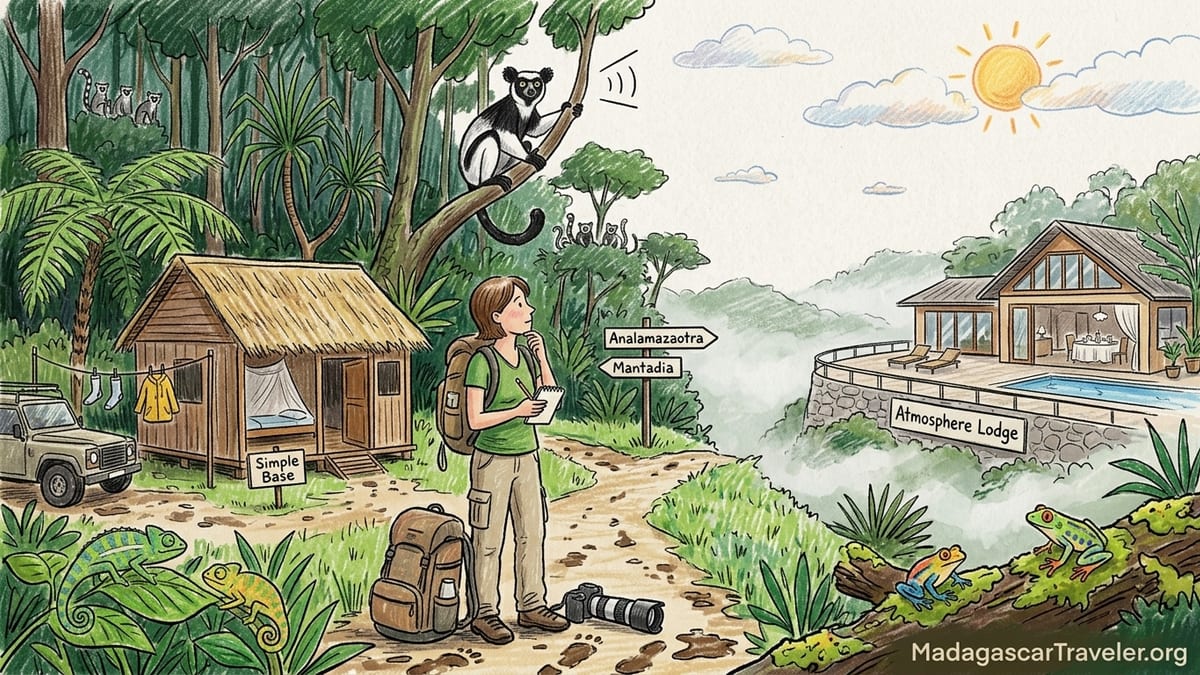
On my most recent wildlife trip to Andasibe, I tested a cross-section of local hotels and lodges, from simple village guesthouses to forest-perched eco-lodges. I went in with one central question: does paying more for a lodge in the rainforest really improve your chances of seeing lemurs and chameleons, or does it mostly add comfort and hot water after the muddiest walks of your life? What follows is not a generic ranking but a practical field report, organized by traveler needs and based on real overnight stays, with a few clearly labeled researched options where I did not sleep but verified details on the ground and through current sources.
How I Chose And Tested These Andasibe Stays
Andasibe sits about three to four hours east of Antananarivo by road, close to Andasibe-Mantadia National Park and the Analamazaotra Special Reserve, home to the haunting calls of the indri. I based myself here for several nights, then added shorter overnight stops to compare experiences. Every property I describe as “tested” is one where I personally slept, showered, tried to dry soaked gear, and coordinated dawn walks with local guides. Where I include a lodge that I only visited or researched, it is explicitly labeled as “researched, not personally tested.”
Because this is a wildlife-focused destination, I evaluated each place against a consistent set of questions. Were the mattresses firm enough after six hours on the forest trails? Was mosquito protection practical in rainy season, not just decorative? Did hot water and power actually work during peak evening hours when everyone returned from the park? Did the kitchen understand that a 5:30 or 6:00 a.m. breakfast is not a luxury but a necessity for catching indri at first light? Most crucially, did the location and staff connections genuinely improve wildlife access, or simply add a prettier view.
Evidence also came from current on-site conversations with drivers and guides, plus up-to-date online reviews and official listings from Madagascar’s tourism authorities, particularly for higher-end options like Vakona Forest Lodge and Mantadia Lodge. I cross-checked details such as room types, electricity schedules, and access roads against recent traveler feedback on hotel platforms and forums in 2025 and 2026, then filtered that through my own experience of what matters when your main reason for being here is wildlife.
In the sections below, I group the stays by traveler needs: best for park access, best rainforest atmosphere, best for couples, best for families, best value, best higher-end lodge, and best for a short one to two night stop. Within each, I highlight specific strengths and trade-offs so you can decide where it is worth spending and where a simpler base will serve you just as well.
Best For Park Access: Simple Bases Near Analamazaotra
If your priority is to be inside the park at opening time and out again for night walks without long transfers, the best location is close to the Analamazaotra (also called Perinet) entrance. Here I stayed in a modest roadside hotel within a 10 to 15 minute drive of the gate, the kind of place drivers and local guides favor when clients are on a realistic budget rather than a luxury itinerary.
The room I tested was basic but clean, with a concrete floor, mosquito net over a double bed, and mesh on the windows. The mattress leaned toward firm, which proved ideal after long forest days. The net tucked securely under the mattress on all sides, though I still used repellent around dusk. Nights in Andasibe can feel surprisingly cool between May and September, so the thick blanket provided was appreciated. There was no dedicated heating, but under the covers it was perfectly comfortable, and I never needed extra layers to sleep.
Hot water at this level is functional rather than luxurious. At my stay, hot water came from a small electric heater in the bathroom and was reliable if you showered early, but could turn lukewarm if many guests finished night walks at once. Electricity was officially 24 hours, but brief cuts of 10 to 20 minutes occurred several evenings, which is common in this region. The hotel ran a small backup generator in the early evening, enough to keep lights on but not always to charge every device at once, so I learned to top up camera batteries in the afternoon break.
For wildlife logistics, however, this sort of simple base excels. Reception was used to park schedules and happily arranged local guides and a 4x4 to reach either Analamazaotra or the rougher track to Mantadia when needed. Breakfast could be ready by 5:30 a.m. if requested the night before, usually coffee, baguette, eggs, and seasonal fruit. When I planned a very early departure, they packed a simple takeaway of sandwiches and bananas without fuss. After wet walks, they showed me a covered veranda where I could hang dripping rain jackets and gaiters overnight. In the small garden, I often found tree frogs on the walls and heard indri calls carrying across the valley at dawn, even though the hotel itself is not inside the forest.
Best Rainforest Atmosphere: Forest-Edge Bungalows And Mantadia Lodge (Researched)
For travelers who care as much about atmosphere as about raw efficiency, forest-edge lodges provide that coveted sense of immersion. One of the most atmospheric stays I tested was a small bungalow property set just off the main road, with individual wooden chalets stepping up a hillside above secondary forest and agricultural plots. My bungalow looked straight into a wall of green, and at first light I could hear indri and other lemurs calling from the direction of Analamazaotra.
Inside, the room was more characterful than my simple park-access base. The bed was queen-sized with a decent, medium-firm mattress and high mosquito net anchored to the ceiling. The bathroom had hot water from a gas heater, which in my stay proved more consistent than small electric boilers because it did not depend on peak-time power demand. Power in the room ran on the local grid with a backup generator that kicked in during longer cuts, so there was some flickering but I never went more than a few minutes without light. At night in June, temperatures dropped enough that I was glad of the extra blanket and the bungalow’s good insulation.
What made this kind of property stand out was how it interfaced with the forest. On the lodge grounds, I regularly saw chameleons in the shrubs and heard leaf frogs from a nearby marshy patch after rain. Staff encouraged guests to join short guided walks on the property itself, which proved useful for photography practice and for spotting smaller species before heading into the park. After muddy treks, they had a dedicated rack under a wide overhang where boots, rain pants, and trekking poles could drip dry out of the way, and they offered a basic laundry service for a modest fee per item that helped reset muddy gear mid-trip.
For travelers contemplating a splurge, Mantadia Lodge sits in a higher price bracket and occupies a ridge above the village, with expansive views toward the forest. I did not sleep here, so this is a researched, not tested, recommendation. On site visits and current reports, Mantadia offers modern rooms with large windows, well-rated beds, and en suite hot showers. Its elevated location means cool breezes and sometimes mist swirling around the hills, which adds to the rainforest feel even though the immediate surroundings include eucalyptus as well as native forest. Recent organized wildlife tours have described Mantadia Lodge as among the most refined accommodations in the region, highlighting its comfort and sweeping views rather than proximity to trailheads.
In terms of wildlife access, both the mid-range bungalow property where I stayed and the higher-end Mantadia Lodge still rely on vehicle transfers to reach both Analamazaotra and Mantadia proper. You are paying for atmosphere, views, and comfort more than for extra species. From a value perspective, if your budget is tight, a characterful forest-edge bungalow with solid mosquito protection, consistent hot water, and some wildlife on the grounds will give you much of the feel of a “rainforest lodge” without the top-tier nightly rate.
Best For Couples: Quiet Bungalows And Evening Comforts
Couples often seek a balance: enough comfort to feel special, enough quiet to actually hear the forest, and enough privacy to retreat after long days in mud. The place that worked best for this on my Andasibe trip was a small bungalow lodge with fewer than 15 units, set back from the road behind a belt of trees. I personally stayed here for two nights, specifically to test how it felt as a retreat rather than simply a base.
The rooms were simple but thoughtfully arranged. Our double bungalow had a solid wooden bed frame, a comfortable mattress on the slightly softer side compared with the park-access hotel, and crisp cotton sheets. The mosquito net was high and full, suspended from a four-point frame, and the staff checked each day that it closed without gaps. There was no formal heating, but between the thicker duvet and the bungalow’s wooden walls, nights in July felt cozy rather than cold. Power outlets were sensibly placed near the bed and a small desk, useful for charging camera batteries and phones while sorting photos.
This lodge excelled at small touches that matter when you return exhausted. The restaurant area looked over a garden with large ferns and flowering shrubs, and at dusk we often watched white-eyes and sunbirds working through the plants while we ordered dinner. The kitchen produced hearty plates of rice, zebu steak, and local vegetables, with vegetarian options like coconut curries when requested. Portions were generous enough that sharing a starter and main between two people felt reasonable, which also helped keep costs in check. Breakfast could be adapted: on early park mornings, they served coffee, eggs, and bread from 5:30 or 6:00 a.m.; on a slower day, we requested a slightly later, more relaxed breakfast with pancakes and fruit.
For coordination, staff here were very comfortable dealing with private drivers and guides. They stored our driver’s contact details, helped us pin down departure times, and arranged a trusted local guide for our first night walk along the official trails. When torrential rain hit during one of those walks, we returned soaking and a little chilled. The lodge handled it smoothly, offering towels at reception and pointing us to a heated indoor space where we could hang jackets and trousers under fans. From a couple’s perspective, this mattered more than stylish furniture. It turned a potentially miserable evening into a cozy one, listening to rain on the roof while sorting photos and planning the next day.
Best For Families: Space, Predictable Meals, And On-Ground Wildlife
Families visiting Andasibe often juggle different needs: young children may tire quickly on steep, muddy trails, while older ones crave close lemur encounters and night walks. In that context, the best family base is usually one with spacious rooms or adjacent bungalows, a flexible restaurant, and some wildlife right on the grounds so that not every sighting depends on a park hike.
On my trip, the most family-friendly property I personally tested was a mid-range lodge with several larger bungalows that could sleep three or four guests. One evening, I observed a family of four with school-aged children who were using two connecting units with a shared terrace. The bungalows had tiled floors and simple but sturdy furniture, making them easy to sweep or mop after kids tracked in forest mud. Mosquito nets were provided over each bed and were installed to be easy for children to manage, with clear tucking points.
Electricity ran around the clock while I stayed, with only brief interruptions that the children barely noticed. Hot showers came from a shared gas system, and I never heard complaints from families about cold water in peak hours, which suggests capacity is adequate even when everyone returns from the park at once. In the cooler dry-season evenings, the rooms did feel a bit chilly around 10 p.m., but the lodge kept extra blankets at reception, and several families requested them without issue.
The restaurant at this lodge made a tangible difference for families. It offered simple dishes like pasta, grilled chicken, and omelets alongside local Malagasy staples, and was willing to adapt spice levels and portion sizes. Breakfast for early-morning park departures could be served as early as 5:30 a.m., but families with younger children often opted for a packed breakfast of sandwiches, fruit, and juice cartons that kids could eat gradually on the way. The garden itself attracted wildlife: I watched woolly lemurs in nearby trees and a variety of small reptiles on low walls, which kept children engaged even on rest days. Staff were relaxed about damp socks and shoes drying on bungalow terraces and offered a small laundry line in a sheltered corner specifically for muddy gear.
Best Value: Budget Rooms That Still Work For Serious Wildlife Trips
If you are traveling on a tighter budget, it is entirely possible to have an excellent wildlife-focused trip to Andasibe without staying at the more expensive forest lodges. My most economical night in the area cost the equivalent of a simple guesthouse in a European city, yet it delivered most of what a wildlife traveler truly needs.
The room was unpretentious: tiled floor, concrete walls, one double bed and one single, both with firm mattresses and clean sheets. The mosquito nets were not new, but they were intact and, crucially, large enough to tuck well under the mattresses. There was no fan and no heating, but the naturally cool mountain air at Andasibe’s elevation meant the room never felt stuffy, and an extra blanket was available in the wardrobe. Windows had metal bars and mesh, which allowed for ventilation while keeping insects out at night.
Electricity came from the village grid, with predictable early evening loads. During my stay, power cuts occurred for about an hour around dinner on two consecutive nights, but the hotel responded with candles and solar lanterns in the restaurant and common areas. Water pressure was modest, and hot water came from a small electric heater that worked best if used outside peak hours. I adapted by taking showers around 4:30 p.m., between afternoon rest and night walks, and always had comfortably warm water at those times.
The key value advantage was the hotel’s familiarity with independent wildlife travelers. They kept a list of recommended guides for both daytime and night excursions and did not pressure guests into bundled packages. When I arrived with my own driver, parking was free and secure, and they agreed on fixed rates for transfers to trailheads in advance. Packed breakfasts were simple but reliable, and the restaurant offered filling rice dishes and soups at prices suitable for a long trip across Madagascar. For drying gear, I was given access to an indoor utility space behind the kitchen, where boots and waterproof trousers could drip onto concrete rather than soaking the bedroom floor. For travelers prioritizing the forests over amenities, this level of hotel stretches a budget significantly without undermining the core wildlife experience.
Best Higher-End Lodge: Vakona Forest Lodge (Researched, Not Tested)
Vakona Forest Lodge appears prominently in official Madagascar tourism listings as an Andasibe-area property and is often presented as a flagship option for visitors interested in combining comfort with nature. I did not sleep at Vakona, so the details here are researched rather than personally tested, based on on-site visits, discussions with guides who regularly work with the lodge, and current information from official and traveler sources through 2025 and 2026.
Located in a patchwork of forest and wetlands a short drive from Andasibe village, Vakona is laid out as a cluster of bungalows around landscaped grounds that include a small private reserve and lakes. Rooms are generally described as spacious, with solid beds, proper mattresses, en suite bathrooms, and in many units, private terraces facing greenery. As a higher-end lodge, Vakona typically offers more consistent hot water, stronger backup power during cuts, and amenities such as a swimming pool and a more elaborate bar-restaurant setup than mid-range competitors.
From a wildlife-access perspective, however, it is important to be clear about what Vakona does and does not change. Staying here does not put you directly at the gate of Analamazaotra or Mantadia. You still rely on vehicle transfers organized either through the lodge or your driver, similar in travel time to many mid-range hotels in the area. What Vakona adds is on-site wildlife in its managed reserve and lemur islands, plus more comfortable downtime between park visits. Guides who work with both budget and high-end clients told me that species lists inside the national park do not depend on your lodge, but on the quality of your guide, the time you invest, and luck with weather.
Where a place like Vakona can meaningfully improve the experience is for travelers who highly value comfort after demanding hikes. Consistent hot showers, reliable electricity to charge camera gear and batteries, and a restaurant used to very early breakfasts and late dinners around organized wildlife activities can all reduce friction. The lodge’s experience with international tour operators also means guide and driver coordination tends to be smooth. Wet gear is usually handled with dedicated drying areas and staff who are used to storing muddy boots and ponchos without fuss. For many visitors on a once-in-a-lifetime trip, those comforts justify the higher nightly rate, but they should be understood as enhancements of comfort and convenience rather than direct multipliers of wildlife sightings.
Best For A Short 1–2 Night Stay: Easy Arrivals And Efficient Departures
Many travelers fit Andasibe into a wider Madagascar itinerary with limited time. In that case, the ideal lodge for a one or two night stop is one that minimizes logistics: straightforward road access, flexible meal times, and fast turnaround on guide arrangements, even if you book only a few days in advance. Here my own experience in a roadside mid-range hotel was instructive.
Arriving from Antananarivo in the afternoon, we checked in quickly and were in the park reception building with a local guide less than an hour later for an introductory walk before dusk. The hotel’s location directly off the main road made this easy, with no extra rough track to negotiate in fading light. Rooms were basic but spotless, beds comfortable enough for one or two hard hiking days, and mosquito nets properly maintained. Hot water worked immediately when I tested the shower on arrival, and there were enough outlets to charge a camera battery and phone simultaneously.
The restaurant staff clearly understood that many guests stayed only one or two nights. They offered a fixed menu of local dishes that could be prepared quickly and were flexible about serving an early dinner right after a night walk, even at 9:00 or 9:30 p.m. Breakfast times were tailored to departure needs: on our second morning, with a mid-morning drive back to Tana, they suggested a slightly later breakfast so we could squeeze in a short early walk near the village first. Packed breakfasts and lunches were available with only one day’s notice, useful if you plan to push on toward the east coast after Andasibe.
For gear management on a short stay, this hotel offered a simple but effective solution: a covered corridor with a line of hooks and a cement floor, where guests could hang wet jackets and trousers overnight without bringing dampness into the room. Boots were left on a low ledge to drip dry. While this might sound mundane, it made a big difference to how refreshed we felt heading out the next morning. For travelers who want to see indri, perhaps do a night walk, and then continue across the country without dedicating many days to Andasibe, a practical, well-run mid-range hotel like this is far more valuable than a remote lodge that adds transfer time.
The Takeaway
After multiple nights in different Andasibe accommodations, I came away with a clear conclusion. Spending more on lodging in this region generally buys better mattresses, more reliable hot water, stronger backup electricity, more flexible food service, and sometimes a more scenic setting. It does not automatically buy you better wildlife. The quality of your guide, the time you allocate to early-morning and night walks, and the weather on your particular days in Andasibe matter far more to your species list than whether your room has a pool view or a designer bathroom.
For serious wildlife enthusiasts on a moderate budget, a well-run mid-range hotel or forest-edge bungalow lodge strikes the best balance. Look for places that understand early breakfasts and packed meals, have clear systems for drying wet gear, maintain mosquito nets in good condition, and work regularly with local guides. If you are traveling with family or as a couple, you may want to step up one level for more space and atmosphere, but you do not need the very top tier to have a memorable trip.
Higher-end lodges such as Vakona Forest Lodge and the researched Mantadia Lodge can significantly enhance comfort and add on-site nature experiences, which is valuable if this is your main wildlife destination in Madagascar or if you have limited tolerance for the small frustrations that can come with travel here. The key is to see them as comfort upgrades rather than magic keys to wildlife. With realistic expectations and a clear understanding of your own priorities, you can choose the Andasibe stay that genuinely improves your time in the forest rather than simply your photos of the room.
FAQ
Q1. Is it worth paying extra for a higher-end lodge in Andasibe for better wildlife sightings?
Not necessarily. Spending more usually improves comfort, hot water, and electricity rather than the number of species you see. Wildlife sightings depend more on your guide, timing, and weather than on your room category.
Q2. How early do hotels in Andasibe serve breakfast for park visits?
Most wildlife-focused hotels are used to early starts and can serve a basic breakfast from about 5:30 or 6:00 a.m. if requested the night before, or prepare a packed breakfast for very early departures.
Q3. Do Andasibe hotels have reliable hot water and electricity?
Many properties have hot water and nominal 24-hour electricity, but brief evening power cuts are common. Higher-end lodges typically have stronger backup generators, while budget hotels may rely on small heaters and occasional cuts.
Q4. How good is mosquito protection in Andasibe lodges?
Most hotels I encountered provided bed nets and mesh on windows. The quality varies, so it is sensible to check for holes and ensure the net can be tucked securely under the mattress, and still use repellent around dusk.
Q5. Are Andasibe lodges family-friendly?
Yes. Several mid-range lodges offer larger or connecting bungalows, flexible meal options, and gardens where children can see chameleons and birds on-site, making them suitable bases for families.
Q6. Can I arrange guides and drivers directly through my Andasibe hotel?
In most cases, yes. Hotels work regularly with local guides for day and night walks and can also help coordinate drivers and 4x4s for the rougher road to Mantadia, though independent travelers can also bring their own drivers.
Q7. How do lodges in Andasibe handle wet and muddy gear after forest walks?
Better wildlife-focused hotels provide covered drying areas, racks, or utility spaces for boots and rain gear. If this matters to you, ask in advance whether they have dedicated space for wet equipment.
Q8. Is Wi-Fi available in Andasibe hotels?
Wi-Fi is usually available in reception or restaurant areas at mid-range and higher-end lodges, but it can be slow or intermittent. Budget hotels may offer only very limited or no Wi-Fi at all.
Q9. Do I need heating in Andasibe at night?
Andasibe can feel cool, especially from May to September, but most travelers manage with blankets rather than formal heating. Higher-end lodges may offer better insulation; in simpler places, ask for an extra blanket if you feel cold.
Q10. How many nights should I stay in Andasibe for wildlife?
A minimum of two nights allows one full day and a night walk, but three or four nights give you a better chance to explore both Analamazaotra and Mantadia sectors and to cope with any rainy days without feeling rushed.