


I arrived in Andasibe the way many travelers do in Madagascar: rumpled from a long drive, rain jacket already damp, and wondering if the promise of rainforest magic could possibly live up to the marketing. I had come by private car with a Malagasy driver from Antananarivo, spending four nights based near Analamazaotra and later closer to Mantadia, determined to understand what it actually involves to use Andasibe as a wildlife base rather than just ticking off a quick day tour. I expected three easy hours from the capital, a couple of leisurely forest walks, indri lemurs calling on cue and evenings with a cold beer by the lodge fireplace. What I found was far muddier, much more humid, and also far more rewarding than the glossy brochures suggest.
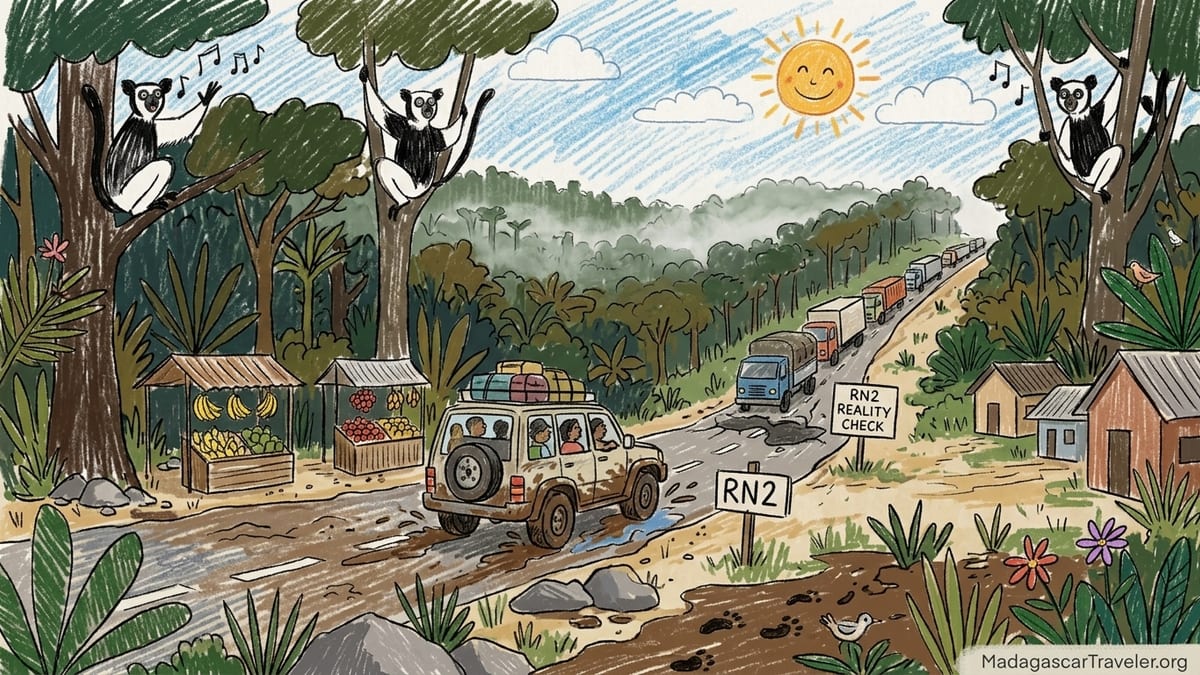
Getting to Andasibe: The RN2 Reality Check
My trip started in Antananarivo, where the classic advice is that Andasibe sits roughly three hours to the east along the RN2. Official tourism material repeats this confidently, but once we pulled out of Tana’s suburbs it became clear that the word "roughly" does a lot of work. Between the city’s dense traffic, trucks grinding uphill and sections of worn asphalt, my journey took just over four and a half hours door to door, which matches the three to five hour window many recent visitors now report for the 140 to 160 kilometer run. I was very glad I had booked a car with a driver rather than attempting it myself in fading afternoon light.
The road itself is fully paved, which in Madagascar is not a given, but this is not a Western-style highway. The RN2 threads through small towns, past roadside stalls selling bananas and lychees in season, and around slow lorries that create long queues on hills. At one point we idled almost half an hour behind a convoy as roadworkers patched a damaged section. It was a reminder that trying to squeeze Andasibe into a rushed day trip from Tana is possible in theory, but in practice leaves little margin if a truck breaks down or a stretch of road washes out after heavy rain.
For my first two nights I based myself at a midrange lodge a few minutes’ drive from the Analamazaotra entrance, which meant once we reached Andasibe village I was off the main road quickly. Even that last stretch felt different from the rest of Madagascar I had seen so far; mist hung over the forested hills, and the air felt soft and almost sweet compared with sunburnt highland towns. It already felt like an entrance gate to something wilder, even before I set foot on a trail.
Looking back, the first lesson Andasibe taught me was simple: build in time. A four or five hour journey each way is normal now, and arriving in the dark after an international flight would have been exhausting. Giving myself four nights meant the long drive became a one-off effort, not a tight logistical puzzle.
First Impressions: Humidity, Mist and a Village on the Forest Edge
On my first full morning I woke before my alarm, not because of jungle noise but because the room felt oddly heavy. When I slid open the lodge’s wooden shutters, a white curtain of mist drifted past the balcony. The air was cool, but within minutes my clothes felt slightly damp. Andasibe is a montane rainforest, and even in what passes for a dry season the humidity is real. Coming from the relatively crisp air of Antananarivo at over 1,200 meters, the change was immediate.
Once I walked down toward the village, I realized how closely Andasibe town and forest interlock. The main strip along the RN2 has a few basic restaurants, small grocery shops and stalls selling fruit and phone credit, yet the tree line never feels far away. At one crossroads, I could see a row of concrete houses on one side and thick, dark forest on the other. It felt less like a resort hub and more like a workaday Malagasy village that happens to sit beside one of the country’s most accessible rainforests.
There is no wide choice of gourmet dining here. My lodge offered set-menu dinners of rice, zebu stews and simple fish dishes, while in the village I found a couple of straightforward places serving brochettes, rice and cold soft drinks. A handful of better-known lodges closer to Analamazaotra and along the access road toward Mantadia offer more polished restaurants with pasta, grilled meat and wine, but overall evenings felt low-key. I quickly learned to order dinner soon after finishing my afternoon walk; kitchens work at their own pace, and by Madagascar standards that is part of the charm.
This close-knit, lived-in feel is easy to miss if you rush straight from a tour vehicle into the forest. Yet understanding Andasibe as a real village on the edge of a protected area, with local guides and community-run reserves, set the tone for the rest of my stay. The rainforest might be the headline act, but it is framed by everyday Malagasy life.
Waking to the Indri: Mornings in the Rainforest
The moment that justified all the potholes on the RN2 came on my second morning, just after sunrise. I was lying in bed, listening to distant roosters, when a single rising whoop cut through the mist. Then another, and another, braiding together into a sound that felt too eerie to be quite animal. The lodge staff smiled when I walked into breakfast with goosebumps: the indri had started calling.
Analamazaotra, the section of protected forest closest to the village, is famous for these indri, the largest living lemurs. Official descriptions talk about whale-like songs that can carry for up to two kilometers, and hearing them from my breakfast table rather than on a recording gave those phrases new weight. The calls began around 6:30 in the morning and echoed for perhaps fifteen minutes, fading as the sun climbed. They framed every early start for the rest of my stay.
Early starts are not optional here if you care about wildlife. Park staff open the Analamazaotra entrance in the morning, typically around 7 or 7:30, and visiting is only allowed with a registered local guide. I met mine at the gate for a three to four hour circuit that began on well-defined paths and soon ducked into narrower, muddier side trails. Inside the forest, the humidity wrapped around us like a blanket. Even on cooler days, sweat and fine mist meant my shirt stuck to my back within half an hour.
On that first walk I did see indri, but not instantly and certainly not at arm’s length. We followed their calls, stopping often as the forest echoed in different directions. When we eventually found a family group high in the canopy, they were black-and-white silhouettes filtered through a lattice of leaves. Distant diademed sifakas leapt between trees like slow-motion acrobats. It was magical, but it also taught me that Andasibe is not a zoo. Some mornings indri can be seen from near the main path, on others guides spend an hour reading tracks and listening, and some unlucky visitors with only a single rushed visit may catch only brief, distant glimpses.
Mud, Rain and Why My Footwear Was a Mistake
However romantic the misty forest appears from a lodge terrace, the practical reality underfoot is less forgiving. Andasibe is one of the wettest regions that many short-term visitors experience in Madagascar. Even outside the peak rainy months, showers can roll through several times a day, and the clay-rich soils hold water like a sponge. On my first walk in Analamazaotra I made the mistake of relying on lightweight trail shoes with shallow tread. Within ten minutes on a secondary path my soles had accumulated thick bands of reddish mud that turned each step into a cartoonish slide.
The guides seemed prepared for this. Many wore old rubber boots bought in Tana markets, and a few lodges rent gumboots for a modest daily fee. I watched several visitors pick their way gingerly along the trail edges, trying to keep their expensive hiking shoes clean, and realized I had joined their ranks. By the time a mid-morning shower arrived, the forest floor had turned into something between a streambed and a skating rink.
Rain itself is part of the experience. On one afternoon in the community-run VOIMMA reserve, just outside the national park boundary but within walking distance from parts of Andasibe village, a steady drizzle began within half an hour of setting off. The forest smell intensified, a rich mix of wet earth, decaying leaves and something almost floral from unseen flowers high in the canopy. Tiny frogs called from hidden perches, and every touch of bamboo or sapling released a spray of cold droplets. My rain jacket kept my torso mostly dry, but my trousers were soon soaked to the knee.
I had underestimated how thoroughly Andasibe would test my gear. Quick-dry clothing and a second pair of shoes for the lodge became essential, not just nice-to-have. Those who arrived in only canvas sneakers or sandals struggled on the slippery paths and spent evenings blow-drying soaked footwear by the fireplace. If Andasibe taught me a second lesson, it was respect for rainforest mud.
Analamazaotra vs Mantadia: Choosing Where to Base Yourself
In guidebooks Andasibe-Mantadia is often presented as a single destination, but on the ground the choice of where you sleep shapes your days. Staying near Analamazaotra, as I did for my first two nights, meant a short ten-minute transfer each morning to the main entrance on the south side of the forest. Most of the area’s accommodation clusters along or close to the RN2 between Andasibe village and the park, which keeps access simple. From these lodges, it is realistic to visit the national park in the morning and a community reserve like VOIMMA or the Mitsinjo-managed forest in the afternoon without feeling rushed.
For my third and fourth nights I moved to a lodge located further along the rough road that leads toward Mantadia National Park, the wilder northern section of the protected area. The distance from the RN2 to the Mantadia entrance is only around 15 to 20 kilometers, but recent traveler reports and local operators both describe it as an hour or more of slow driving on a degraded track, especially after rain. My driver’s 4x4 rocked and bumped through puddles and ruts that would have stopped a low-clearance vehicle long before the park boundary.
Being based partway along that access road made the early start for Mantadia easier. We still left the lodge around 6:30 in a drizzle, but at least we were not adding extra time from the main road. Once inside, the difference from Analamazaotra was immediate. Trails felt more remote, with fewer other groups on the paths and a greater sense of old-growth forest towering overhead. Birdlife seemed richer, and we caught sight of another family of indri, along with black-and-white ruffed lemurs much deeper in the trees.
The trade-off was that returning to Andasibe village for dinner was impractical. Lodges closer to Mantadia tend to be more self-contained, often higher-end properties with on-site restaurants and activities like canoeing or private forest walks. If you stay there, you commit to a quieter, more secluded experience, which can be wonderful but less convenient for spontaneous night walks in VOIMMA or quick runs to village shops. My conclusion was that first-time visitors primarily focused on Analamazaotra and community reserves are usually better off near the RN2, while wildlife obsessives with time for multiple days in Mantadia will appreciate lodging further inside the forest corridor.
Long Wildlife Days: How A Typical Andasibe Schedule Really Feels
Before arriving, I imagined Andasibe days unfolding at a gentle pace, with a morning walk, a long lunch and perhaps a short optional activity in the afternoon. In reality, wildlife-focused days here are long and layered. My guide suggested we start by 7 in the morning for Analamazaotra, because many lemurs, including indri, are most active in the cooler early hours. A standard circuit there can take three to four hours once you factor in time spent tracking calls, stopping for chameleons and frogs, and waiting quietly for good views.
By the time we exited around late morning, I was hungry, mildly damp and ready for a break. Most lodges near the park arrange lunches either back at the restaurant or as simple picnic boxes. I tried both. Eating hot rice and vegetables back at a lodge while my clothes dried in the thin sun felt luxurious compared to balancing a sandwich on a log under dripping trees. Yet if you want to fit both a day walk and a night walk into the same twenty-four hours, lingering too long is a mistake.
On my second day I made exactly that error. After a long morning in the national park, I returned to my bungalow and allowed myself an extended nap. By the time I woke properly, clouds were rolling in and my planned late afternoon visit to Mitsinjo’s forest had to be cut short. I still managed a night walk with a VOIMMA guide, spotting mouse lemurs darting through the undergrowth, sleeping chameleons and the pinprick eyeshine of frogs. But I walked back to the lodge knowing I had squeezed three separate outings into a single day. It was exhilarating and also tiring in a way that crept up on me.
By contrast, when I devoted an entire day to Mantadia the rhythm felt more sustainable. We left early, spent most of the day on longer, less crowded trails, ate our packed lunch beside a forest stream where blue couas flitted between branches, and returned in the mid-afternoon with just enough energy left for a relaxed dinner. I skipped the night walk that day, and my legs thanked me. The pattern that emerged is one I would recommend: pair a big daytime excursion with a quieter evening, or a modest morning with a night walk, but resist stacking Analamazaotra, Mantadia and a nocturnal outing all into one overstuffed schedule.
Lodge Life: Evenings, Meals and The Quiet Between Rain Showers
Evenings in Andasibe are less about nightlife and more about listening to rain on rooftops. After sunset, fog often settles over the valley, muffling sound and turning lodge gardens into shadowy silhouettes. At my first lodge, guests congregated in a central dining room with a small bar. A wood-burning fireplace did its best to dry layers of wet clothing draped on chair backs, and the staff circulated offering local Three Horses Beer and simple rum punches infused with vanilla or citrus. Conversations tended to revolve around the day’s sightings: who had glimpsed a leaf-tailed gecko, how close someone had managed to approach an indri, whether the road to Mantadia had been worse than expected.
Meals were hearty rather than fancy. One night brought a starter of vegetable soup, followed by zebu steak in pepper sauce with rice and a side of greens, and a basic fruit salad for dessert. Another evening the main course was chicken cooked "a la crème" with pasta, plus a vegetarian variation made with local vegetables. Prices for such set menus, based on my bill and current reports from other travelers, run in a moderate range by international standards, neither backpacker-cheap nor luxury-expensive. In Andasibe village itself, roadside eateries and small restaurants serve rice plates and grilled meat or fish at significantly lower prices, though with more limited ambience and slower service.
At the lodge closer to Mantadia, evenings felt more remote. Generator power ran only for part of the night, and when it cut out the darkness was profound. I spent one post-dinner hour on the terrace listening to distant frog choruses and something crashing occasionally in the undergrowth. Without village lights nearby, the sense of being wrapped in forest was total. It is an atmosphere that rewards travelers who enjoy quiet, book-filled evenings more than those seeking bars or live music.
This contrast between village-adjacent lodging and deeper forest retreats underlined the practical trade-offs in where you base yourself. Both delivered comfortable beds and decent food. Yet access to shops, alternative restaurants and community reserves was easier from the RN2 side, while the Mantadia-side lodge offered unmatched immersion and a stronger feeling of being away from the main tourist trail, even though in reality I was only a rough track and an hour’s drive from the same protected area.
Expectations vs Reality: Mistakes I Made in Andasibe
Despite reading extensively before my trip, Andasibe still managed to surprise me in ways that translated directly into mistakes. The first was simple over-ambition. Looking at the map, I assumed I could easily visit Analamazaotra, a community-run reserve and Mantadia in a tight two-day window. On the ground, the combination of long drives, early starts, required guiding and weather meant that would have turned my visit into a forced march. By spreading those activities over four nights, I gave myself the flexibility to shift Mantadia to a day with better weather and to repeat a morning in Analamazaotra when indri calls sounded particularly close.
My second misstep was footwear. My trail shoes had served me well in drier parks, but Andasibe’s sticky mud exposed their limits. Watching guides breeze along in knee-high rubber boots while I slid sideways down slopes taught me more about local conditions than any packing list. If I returned, I would either bring simple Wellington-style boots or budget to rent them locally, and I would pack gaiters or long socks I did not mind coating in clay.
A third expectation I had to adjust was the idea of constant, close-up lemur encounters. Marketing images often show indri framed perfectly at eye level, or sifakas posing in clearings. In reality, many sightings took place high in the canopy, against backlit sky, and some species remained stubbornly distant. One morning in Mantadia we heard black-and-white ruffed lemurs several times but only glimpsed them far off through binoculars. The forest is dense, and animals have many places to move out of sight. Accepting that Andasibe is a genuine rainforest, not a curated viewing platform, turned each good encounter into a gift rather than an entitlement.
The final and perhaps most important mistake I nearly made was considering just one night in Andasibe at the planning stage. On paper, a quick overnight detour from Tana looks efficient: drive three or four hours, walk in Analamazaotra the next morning, then head back. After experiencing the place at a slower rhythm, that now feels like short-changing both the destination and yourself. Weather alone can wipe out a planned walk, and travel delays on the RN2 are not rare. A minimum of two nights, and ideally three or more, transforms Andasibe from a rushed box-tick into a rounded wildlife base where you can respond flexibly to rain, fatigue and serendipitous opportunities.
Practical Realities: Access, Guides and Park Rules
On the logistical side, several practical details define how a visit to Andasibe works. First, access. The drive from Antananarivo to the Andasibe area is now commonly experienced as four to five hours rather than the older three-hour estimate, especially when you factor in crossing the capital’s traffic and occasional roadworks on the RN2. That is still relatively easy by Madagascar standards, which is why official tourism bodies highlight Andasibe-Mantadia as the country’s most accessible rainforest. But visitors should plan with current timing, not optimistic brochure numbers, in mind.
Second, guiding requirements. Entry into both Analamazaotra and Mantadia sections of the protected area is controlled, with tickets purchased at park offices and visits only allowed in the company of licensed local guides. The same applies to most community-run reserves around Andasibe, including VOIMMA and the Mitsinjo-managed forest, especially for night walks. Park and guide fees are set locally and adjusted periodically; when I visited, I paid a park entry fee per person and a separate guide fee per group based on the length of the chosen circuit. Payment was in local currency at the entrance, in cash. Given occasional changes, it is wise to ask your lodge for up-to-date prices on arrival rather than relying on pre-trip figures.
Third, opening hours and daily rhythm. Daytime access to Analamazaotra and Mantadia is generally restricted to standard daylight hours, roughly from early morning to mid to late afternoon. Night walks do not take place inside the core national park itself but instead in adjacent community reserves along the road near Andasibe village. Guides there typically begin night walks soon after full dark, around 6:30 or 7 in the evening, and outings last one to two hours. It is quite possible to do a morning walk in the national park and a night walk nearby on the same day, provided you manage your rest and meal times.
Finally, vehicles. While any roadworthy car can manage the RN2 in dry conditions, the track to Mantadia is a different proposition. Both local tour operators and recent independent travelers consistently describe it as suitable only for high-clearance vehicles, ideally 4x4, especially during or after rain. Hiring a driver with the right vehicle from Antananarivo or arranging excursions to Mantadia through your Andasibe lodge are the simplest options. Attempting the road in a small rental car would not only risk getting stuck but could also void insurance coverage.
The Takeaway
After four nights and a mix of early mornings, muddy trails and quiet lodge evenings, Andasibe revealed itself as far more than a quick add-on to an Antananarivo itinerary. It is a living, breathing rainforest gateway where village life, community conservation and formal national park management meet along a single stretch of road. Visiting as a wildlife traveler involves accepting long travel days on the RN2, committing to early starts, being humble about how much you can fit into one day and being willing to get genuinely wet and muddy.
If there is one image that stays with me, it is standing on a damp ridge trail in Analamazaotra, legs streaked with red clay, camera useless in the mist, listening to an indri family calling from somewhere just out of sight. In that moment, the lack of perfect photos or guaranteed sightings mattered less than the feeling of being momentarily woven into the fabric of a Malagasy rainforest morning. Andasibe rewards those who give it time, pack realistically and allow space for both discomfort and wonder.
FAQ
Q1. How long does it really take to drive from Antananarivo to Andasibe?
The drive usually takes between four and five hours each way, depending on Antananarivo traffic, roadworks and weather along the RN2.
Q2. Is a 4x4 vehicle necessary to visit Andasibe and Mantadia?
You can reach Andasibe village and Analamazaotra on the paved RN2 without a 4x4, but a high-clearance 4x4 is strongly recommended for the rough access road to Mantadia.
Q3. How many nights should I spend in Andasibe for wildlife viewing?
Two nights is an absolute minimum, but three or four nights allow time for Analamazaotra, a community reserve night walk and at least one full day in Mantadia without rushing.
Q4. Do I need a guide to enter the parks and reserves around Andasibe?
Yes. Licensed local guides are mandatory in Analamazaotra and Mantadia and are also used for night walks and trails in nearby community reserves such as VOIMMA and Mitsinjo.
Q5. What is the difference between staying near Analamazaotra and closer to Mantadia?
Lodges near Analamazaotra and the RN2 offer easier access to the village, national park entrance and community reserves, while lodges toward Mantadia feel more remote and immersive but require longer drives for most activities.
Q6. How wet and muddy should I expect the trails to be?
Trails are often muddy and slippery throughout much of the year, with frequent showers. Expect wet clothing, slick clay underfoot and waterlogged sections, especially on smaller side paths.
Q7. What footwear and clothing work best in Andasibe?
Sturdy boots or rubber gumboots with good grip, quick-dry trousers, a proper rain jacket and at least one spare set of clothes for evenings are far more practical than casual sneakers.
Q8. Are lemur sightings guaranteed in Andasibe?
No sightings can ever be guaranteed, but indri and several other lemur species are regularly encountered with the help of experienced guides. Views vary from close and clear to distant silhouettes high in the canopy.
Q9. Can I visit Andasibe as a day trip from Antananarivo?
A day trip is technically possible but involves six to ten hours of driving in one day, leaving limited time for walks and little buffer for delays. An overnight stay is strongly recommended.
Q10. What are evenings like in Andasibe for travelers?
Evenings are quiet and lodge-centered, with simple hearty meals, drinks by the fireplace or terrace, and the option of guided night walks rather than bars or organized nightlife.