


The first thing you notice after pulling into Andasibe from Antananarivo is not a lemur call but how tired you are. The RN2 drive looks short on a map, yet in reality it often takes around three and a half to four and a half hours, depending on traffic leaving the capital and lorry congestion on the hills. By the time you check into your lodge, you are stiff from the curves, slightly dazed from the constant overtaking, and not always in the best shape for a long rainforest hike. Planning a realistic 2, 3 or 4 day stay in Andasibe starts with acknowledging that fatigue and building in the right mix of early starts, rain buffers and proper downtime.
My Own Andasibe Stay: What I Tried, And How It Really Felt
On my last visit I spent three nights in the Andasibe area after a few days of travel elsewhere in Madagascar. I drove from Antananarivo along the RN2, leaving just after 8 a.m. and reaching the Andasibe turnoff a little over four hours later, slowed by trucks on the hill sections and a long bottleneck on the eastern exit from the city. That timing is consistent with current reports that put the journey at roughly 3 hours 45 minutes in light traffic, stretching to well over four hours when the road is busy. By the time I rolled past the familiar roadside stalls at Moramanga and into the cooler air around Andasibe village, I was in no state for a demanding hike.
I had originally drawn up an ambitious arrival program. The idea was to check in, grab a quick late lunch, then attempt a short afternoon circuit in the Analamazaotra section of the park before rolling straight into a guided night walk in one of the community reserves such as Mitsinjo or VOI MMA. On paper this looked efficient: maximize an already paid-for travel day and “not waste” time at the lodge. In practice, once I arrived, the combination of travel fatigue, rising afternoon humidity and the paperwork required at park headquarters made the double program unrealistic.
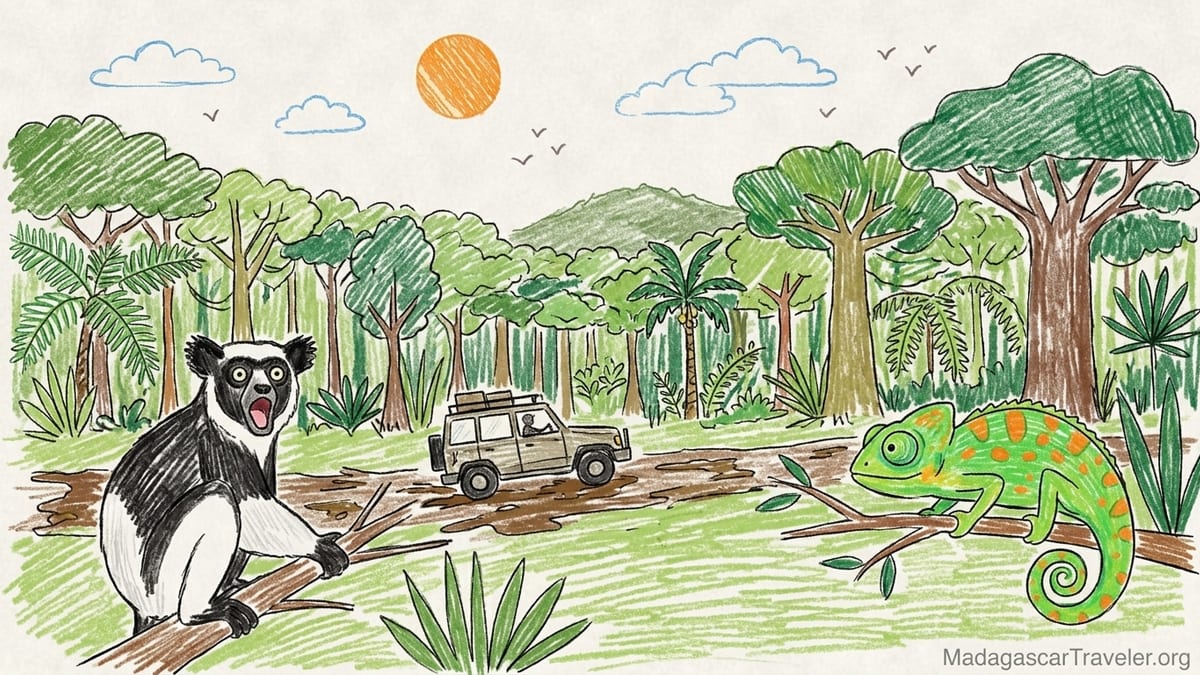
Instead, I compromised. After a coffee and a shower, I opted only for a night walk that first evening. My guide met me just after dusk at the entrance track to the community reserve, where several local associations offer structured nocturnal walks along forest edges and narrow paths. A typical night outing lasts one and a half to two hours and starts between 6 p.m. and 6.30 p.m., which left just enough time to rest, unpack, and eat a light snack rather than a full meal. The walk delivered what I had secretly hoped for: mouse lemurs in the torch beam, a chameleon coiled on a branch and the first eerie cries of indri drifting from the dark hills beyond.
The experience confirmed two things that matter for itinerary planning. First, after the RN2, combining a substantial park walk and a night walk on the same arrival day is possible only if you reach Andasibe by late morning and you know you function well when tired and jet-lagged. Second, even if you can manage both, you might not want to. I was grateful that I had left the longer Analamazaotra or Mantadia circuits for the following days, when I could be at the park gates at opening time and actually enjoy the rainforest rather than fight to stay alert.
Understanding The Andasibe Area: Parks, Reserves And Driving Realities
Planning how to spend two, three or four days in Andasibe is easier if you picture the area as a cluster of different forest zones that share similar wildlife but offer different levels of access, trail difficulty and crowding. The core official protected area is Andasibe Mantadia National Park, which in practice is split into the more accessible Analamazaotra Special Reserve near the main road and the wilder Mantadia sector further north along a rough track. Analamazaotra is where most visitors get their first encounter with the indri, the largest living lemur, along marked, relatively short trails close to Andasibe village.
Beyond the national park lie several community and private reserves that fill the gaps in timing and experience. To the west of the village, the Association Mitsinjo manages a forest area with established circuits of one to five hours and offers both day and night walks with local guides. Current information indicates that these circuits are sold at graded prices that have historically fallen in the tens of thousands of ariary per person, with separate community guide fees but still distinctly less than a full day in Mantadia. Another community initiative, VOI MMA, protects a belt of forest a short walk or drive from Analamazaotra and offers quieter trails with opportunities for early morning indri viewing, day walks and night walks in a less crowded setting.
Then there is Mantadia proper. Reaching its trailhead requires an additional drive of roughly one hour from Andasibe along a deteriorated track that usually demands a 4x4. Recent traveler reports emphasize that this approach, not the walking itself, is what makes Mantadia a time‑consuming day. Once there, the official trail menu is built around easy two hour circuits and more demanding three hour routes that climb higher into primary forest. On a dry day those times are realistic. After heavy rain, ankle deep mud and slippery roots can stretch a “two hour” trail closer to three, especially if you stop often for birds, orchids or frogs.
This geography matters because it determines how much you can sensibly fit into each day. Analamazaotra and the nearby community reserves can be combined with relatively short transfers, leaving time in the middle of the day to rest. Mantadia, by contrast, consumes an entire day once you add the approach drive, a morning hike, a break for a packed or basic lodge lunch, and perhaps a shorter afternoon loop. Any itinerary that pretends otherwise risks turning what should be a memorable rainforest immersion into a rushed box‑ticking exercise.
What Two Days After The RN2 Really Allow
Many travelers consider giving Andasibe only two days and one or two nights, especially if they are squeezing the rainforest between beach time on Nosy Be and a southern route toward Isalo. With careful choices, two days can deliver excellent sightings and a satisfying sense of the forest, but only if you keep ambitions in check. The first limitation is simply recovery. On arrival day, particularly if you have also flown in from abroad within the previous 24 hours, most people underestimate how draining the RN2 can feel when layered on top of airport formalities and an early wake‑up.
With just two days, I would structure my stay around one flagship morning in Analamazaotra and one dedicated nocturnal outing, with optional light activity in between. If I reached Andasibe mid‑afternoon on day one, I would skip any serious hike and schedule only a night walk, ideally in Mitsinjo or VOI MMA where nocturnal circuits venture into actual forest rather than hugging the public road. This gives you your first mouse lemurs, tree frogs and chameleons with minimal physical demand. The next morning I would be at the Analamazaotra reception as close to opening time as possible, usually around 7 a.m., when indri calls echo most strongly and diurnal lemurs are active near the trails.
A standard guided circuit inside Analamazaotra lasts two and a half to four hours depending on how often you stop for photography and how quickly your group moves. Finishing by late morning lets you return to your lodge in time for lunch, change out of muddy clothing and decide whether you have the energy for anything more strenuous. In the rainy season, the pattern of clear early mornings and heavy afternoon showers reinforces this logic. A long lunch and a sheltered veranda become more attractive when the sky darkens and the first drops drum on the roof.
What two days do not realistically allow, in my view, is a full Mantadia visit unless you are prepared for a very long and potentially stressful day. Squeezing the one hour 4x4 approach, a three hour trail and a return drive into a “spare” day after your Analamazaotra morning means either cutting your rainforest time short, hiking during the soggiest midday period, or spending several hours on a rutted track in fading light. For travelers short on time, I would rather see them invest those hours in a second early morning or an additional night walk in the closer reserves, deepening their feel for the forest without overextending themselves.
Why Three Days Transform The Andasibe Experience
Adding a third day and night in Andasibe changes the character of the trip entirely. With three nights, you can balance Analamazaotra, a Mantadia excursion and at least one nocturnal or community reserve experience without turning any single day into an endurance test. It also gives you breathing space for rain delays, which are a simple fact of life in one of Madagascar’s wettest accessible forests. Early morning is still prime time, but when you know you have multiple dawns to play with, a stormy first sunrise does not feel like a disaster.
On a three day framework, my own stay unfolded roughly as follows. The arrival afternoon was reserved for a gentle walk around the village and lodge grounds, followed by the night walk described earlier. The second day began with an early breakfast and a focused Analamazaotra circuit, returning to my lodge around late morning for lunch and a rest. A second, shorter stroll in one of the community reserves in mid‑afternoon gave me a different perspective on the forest canopy and excellent views of diademed sifakas, which can be harder to spot near the main park entrance when groups cluster around an indri family.
The third day I devoted to Mantadia, leaving Andasibe soon after dawn in a hired 4x4. The drive took just under an hour each way along a track that alternated between firm gravel and deep ruts, and I was glad I was not attempting it in a regular saloon car. Once at the park station, my guide and I chose one of the intermediate circuits, officially described as lasting around three hours, and adjusted our pace for birding and photography. Cloud cover kept the temperature manageable but the previous night’s rain had left sections of the trail slick, and by the time we returned my boots were spattered with mud up to the ankle.
Crucially, this three day pattern never felt rushed. Lunches fell at reasonable hours, usually around 12.30 or 1 p.m., rather than devolving into energy bars eaten on a rock at 3 p.m. because I had misjudged the walking time. I had time to rinse and dry my trousers between outings and to sit quietly on the lodge terrace, listening to the afternoon chorus of frogs and distant indri calls. The guides I worked with also appreciated having clear, single‑focus assignments for each day. Booking them for a full Mantadia day well in advance, then arranging Analamazaotra and community visits a day or two ahead, helped avoid last‑minute scrambles when the best guides were already engaged by tour groups.
What A Fourth Day Adds For Wildlife And Birding Travelers
For casual visitors, three days in Andasibe often feel sufficient. For serious wildlife watchers, photographers or birders, however, a fourth day can be extraordinarily valuable. The rainforest does not run on a schedule, and many of the more elusive species in the Andasibe area, from leaf‑tailed geckos to ground rollers, reveal themselves only with patient repetition of the same trails at different hours and in different weather conditions. A fourth day creates room for that patience, as well as for a strategic rest period so you can stay sharp for early morning and night sessions.
With four days, I would keep my core structure intact but free up a whole block for either a second Mantadia visit or an exploratory outing to one of the less visited reserves, such as Maromizaha south of the RN2. Some specialist birding groups already structure their Andasibe segment in this way, focusing their limited time on a mix of Analamazaotra, Mitsinjo, VOI MMA and at least one additional primary forest site to maximise their chances of key target species. If you are traveling independently, you can borrow this logic at a smaller scale. Repeat the Analamazaotra circuits on different mornings to catch indri families in varying positions. Devote a dawn to a community reserve where indri and sifakas vocalise without the background murmur of coach parties.
A fourth day also makes logistical sense once you factor in rain buffers and your own energy. During my stay, one afternoon was effectively a write‑off, with heavy rain setting in soon after lunch and continuing until nightfall. I could have forced a wet and muddy walk, but the prospect of tripping over roots in a downpour while my lens fogged did not appeal. Because I was not rushing to “cover” Mantadia or every reserve in a fixed 48 hour window, I could simply shift my plan, read on the veranda and let my clothing dry properly before the next early start.
For birders, the extra dawn and dusk windows are perhaps the strongest argument. Many of the region’s sought‑after species, such as the pitta‑like ground roller or certain vangas, are easiest at very specific times on known sections of trail. If your only Mantadia day is marred by wind or the presence of a large, noisy group ahead of you, your odds of quality sightings drop. A fourth day lets you return under better conditions or divert your effort to another promising site, guided by up to date local knowledge rather than a rigid itinerary.
Early Mornings, Rain Buffers And The Reality Of Muddy Trails
Regardless of whether you have two, three or four days in Andasibe, the daily rhythm of the rainforest remains the same. Early mornings are the engine of your trip. The indri’s calls carry at dawn, often between roughly 6 a.m. and 9 a.m., and diurnal lemurs generally feed and move most actively in the first cool hours of the day. Guides tend to prefer starting their main circuit soon after the park opens, both to catch this activity and to avoid the buildup of groups along the narrower sections of trail.
Rain is not an occasional inconvenience in Andasibe. It is an integral part of the ecosystem. Showers can blow through quickly, but extended downpours are common enough that they should be built into your plan. When you draw up a two day schedule that leaves no margin for a washed out morning, you implicitly accept the risk that some experiences might be curtailed. With three or four days, you can adopt a more flexible approach: hold the most important activities, such as Mantadia or your first Analamazaotra morning, for the earliest clear window, then slot shorter community reserve walks and night outings around the inevitable spells of wet weather.
Mud and trail conditions are more than cosmetic issues. On my Mantadia day, what had been described as an “easy” two hour loop the week before my visit was, in practice, tiring and slow because overnight rain had turned certain sections into a series of slick, angled roots and mud steps. Parts of Analamazaotra and the community reserves can behave the same way in the wet season. This not only increases your physical effort but also affects timing. A circuit that a fit group can cover in under two hours on dry ground might take an older or less steady traveler closer to three when conditions are slippery.
Clothing management, surprisingly, becomes one of the key rhythms of an Andasibe stay. Having at least two sets of long trousers suitable for hiking means you can wear one while the other dries. Many lodges offer basic laundry but cannot always turn muddy gear around within hours, especially in persistent rain. In my case, having an unscheduled mid‑afternoon at the lodge to rinse and hang my clothes before the next day’s early start was not idle time but an essential part of keeping the rest of the itinerary enjoyable.
Guide Availability, Lunch Timing And Necessary Downtime
Another practical constraint in Andasibe is guiding. Park regulations require visitors to enter Analamazaotra and Mantadia with a licensed local guide, and most community reserves also work through their own guide associations. In the highest seasons, especially around European summer holidays and during Malagasy public holidays, the best guides are often booked by tour groups days in advance. If you arrive with only two days to spare and no prior arrangements, you might find that the only remaining options are very early or very late slots, or guides whose language skills do not match your needs.
For this reason, it helps to think of your Andasibe days in terms of one major guided activity per day, secured ahead of time, with the rest left deliberately flexible. A dedicated morning in Analamazaotra or Mantadia, a night walk in Mitsinjo or VOI MMA, or a focused birding session in a specific reserve like Maromizaha counts as a major block. Lunches can then be arranged around these anchors, usually back at your lodge or at one of the small roadside eateries near the park entrance. Many day visitors to Mantadia opt to carry a simple packed lunch that can be eaten at the picnic area or along the trail to avoid losing time driving back to the village.
Downtime is the hidden ingredient that makes these building blocks work. After a four hour morning hike, especially in humid conditions, most travelers need at least an hour or two to cool down, drink properly and simply sit still. Skipping that rest to cram in another circuit almost always catches up with you the next day. During my three night stay, the early afternoons became a cherished pause: a hot shower, a plate of rice and local fish, and half an hour listening for distant indri calls while my socks dried on the rail.
This downtime is also your chance to fix small logistical problems before they cascade. It is when you check that tomorrow’s guide is confirmed, that your driver knows what time you expect to leave for Mantadia, that your torch batteries are charged for the night walk, and that your rain jacket has finally dried out. In a two day dash, these tasks are often squeezed into late evenings when you are already tired. With three or four days, they slot more naturally into the middle of the day and reduce the stress around your key wildlife experiences.
What To Prioritize, What To Drop, And Why One Night Is Not Enough
If I had to strip my Andasibe experience down for someone with very limited time, my priority list would be clear. First, secure at least one early morning circuit in Analamazaotra or an equivalent nearby forest where indri are reliably present. Hearing and seeing these lemurs at close range is, for most visitors, the emotional heart of an Andasibe trip. Second, schedule a proper night walk inside forested land, not just along the public road, to encounter the region’s nocturnal life. Depending on availability and your interests, this could be with Mitsinjo, VOI MMA or another community reserve that permits guided night access under the canopy.
If time and energy remain, I would next add either a second day walk in a community reserve that offers a slightly different habitat, or a Mantadia day for those particularly drawn to primary forest and birding. What I would drop first, if forced by time constraints or fatigue, would be any attempt to combine a half hearted Mantadia visit with a full slate of Analamazaotra walks on the same short stay. I would also let go of the idea of cramming multiple short circuits into each day. A single, well guided three or four hour walk, approached when you are rested and alert, will always be more rewarding than two or three rushed loops where you are staring at your watch.
This is why one night in Andasibe almost always produces a fundamentally different, and usually poorer, trip than three nights. With a single night, you are unlikely to manage more than a late arrival, a hurried dinner and perhaps a short night walk, followed by one morning circuit and an early afternoon departure back along the RN2. You might hear the indri once, see a couple of lemur species and glimpse a few geckos in the torch beam, but there is little sense of settling into the rhythms of the forest. A delayed flight, a traffic jam leaving Antananarivo or a storm at dawn can also wipe out half of what you came for.
With three nights, by contrast, you build layers of experience. The first morning’s indri calls become a reference point for the second. You start to recognise specific trees on the trail to the Mitsinjo platforms or the bend in the VOI MMA path where diademed sifakas like to rest. You have time to notice the smaller details, from the different species of tree ferns to the delicate orchids clinging to branches over the streams. Above all, you allow for the unpredictability of wildlife, weather and your own body, and give Andasibe the space to unfold.
The Takeaway
Andasibe rewards time and realistic planning more than frantic scheduling. The RN2 journey that gets you there is longer and more tiring than the distance suggests, and the rainforest itself is an environment where early mornings, rain and mud set the tempo. Trying to wrestle that tempo into a rigid sequence of back to back activities usually leads to frustration.
For many travelers, two full days and at least two nights can deliver a satisfying first taste of Andasibe, provided they focus on one Analamazaotra morning and one solid night walk, with the rest left flexible. Three days and nights open up a balanced mix that includes Mantadia or additional community reserves without turning any day into a race. A fourth day is where serious wildlife watchers, photographers and birders find their extra margin, using the additional dawns and dusks to chase elusive species and to ride out the inevitable rainy spells.
Most importantly, do not underestimate how much rest, dry clothing, and unstructured time on a lodge terrace add to the quality of your wildlife encounters. The forest around Andasibe is one of Madagascar’s great natural stages, but the performance is not scripted. If you give it room, and plan your 2, 3 or 4 days with gentle buffers instead of strict timetables, you are far more likely to leave with the memories you came for: the indri’s morning call echoing across the mist, a tiny chameleon curled on a branch at night, and the quiet satisfaction of having moved at the forest’s own pace.
FAQ
Q1. Is it realistic to visit Andasibe as a day trip from Antananarivo?
It is technically possible but not advisable for most travelers. The drive typically takes around three and a half to four and a half hours each way, which can leave you with only a few hours of usable time in the forest and a tiring return in the dark. An overnight stay gives you access to early morning wildlife activity and a proper night walk.
Q2. How many nights should I plan in Andasibe if I am interested in both lemurs and birds?
If you care about both lemurs and birds, three nights is a very good minimum. This allows at least two early mornings and enough time to include both Analamazaotra and either Mantadia or a quieter community reserve, without rushing through key birding windows.
Q3. Can I combine a Mantadia visit with a night walk on the same day?
It is possible for fit travelers who handle long days well, but it will be tiring. A Mantadia outing often means leaving around dawn and returning mid‑afternoon. Adding a night walk that starts around 6 p.m. leaves little time for rest, a shower and an unhurried meal.
Q4. Do I need a 4x4 vehicle to reach Mantadia National Park?
In practice, yes. The access track beyond Andasibe is rough, with ruts and muddy patches that become challenging after rain. Recent visitor reports consistently recommend a 4x4, and many lodges or local agencies can arrange one with a driver for the day.
Q5. Is it worth visiting the community reserves if I am already going into Analamazaotra?
Yes, the community reserves such as Mitsinjo and VOI MMA complement Analamazaotra. They can be quieter, allow flexible night walks inside forested areas, and sometimes offer different viewpoints on species like diademed sifakas, tree frogs and chameleons.
Q6. How should I plan around rain during a short Andasibe stay?
Prioritise your most important activities, such as Analamazaotra or Mantadia, for the earliest clear morning you have. Keep afternoons and additional days flexible so you can swap a long hike for a shorter community walk or lodge downtime when heavy rain sets in.
Q7. What clothing and gear are most important for the trails?
Closed shoes with good grip, two pairs of lightweight long trousers, a quick‑dry shirt, a rain jacket, a small backpack and a headlamp for night walks are key. Having spare socks and a plastic bag for muddy clothes makes life easier back at the lodge.
Q8. How far in advance should I book guides in Andasibe?
During high season it is wise to arrange at least your main Analamazaotra and Mantadia guides several weeks ahead through your lodge or a local operator. Night walks and community reserve visits can sometimes be organised a day or two in advance, but the most experienced guides are often booked first.
Q9. Is a night walk safe, and what can I expect to see?
Guided night walks in the established reserves are generally safe and follow marked paths. You may see mouse lemurs, chameleons, sleeping birds, frogs and a variety of insects. Guides control the use of torches to minimise disturbance to wildlife.
Q10. If I only have two days, should I prioritise Mantadia or stay closer to Andasibe village?
With only two days, most travelers are better off focusing on Analamazaotra and nearby community reserves, where transfers are short and early mornings and nights can be fully used. Mantadia is more rewarding when you have at least three days and can dedicate one full, unhurried day to it.