


Just a few hundred meters off the southern tip of Sainte-Marie, tiny Île aux Nattes feels like a different world. There are no cars or tuk tuks, just sand paths, coconut palms and the sound of waves. You reach it by traditional pirogue from Sainte-Marie’s “Pointe sud,” and once you step ashore the pace drops several gears. The key question for many travelers is simple: is Île aux Nattes better as a dreamy day trip, or should you actually sleep there and make it your base instead of Sainte-Marie?
Understanding Île aux Nattes and the Crossing from Sainte-Marie
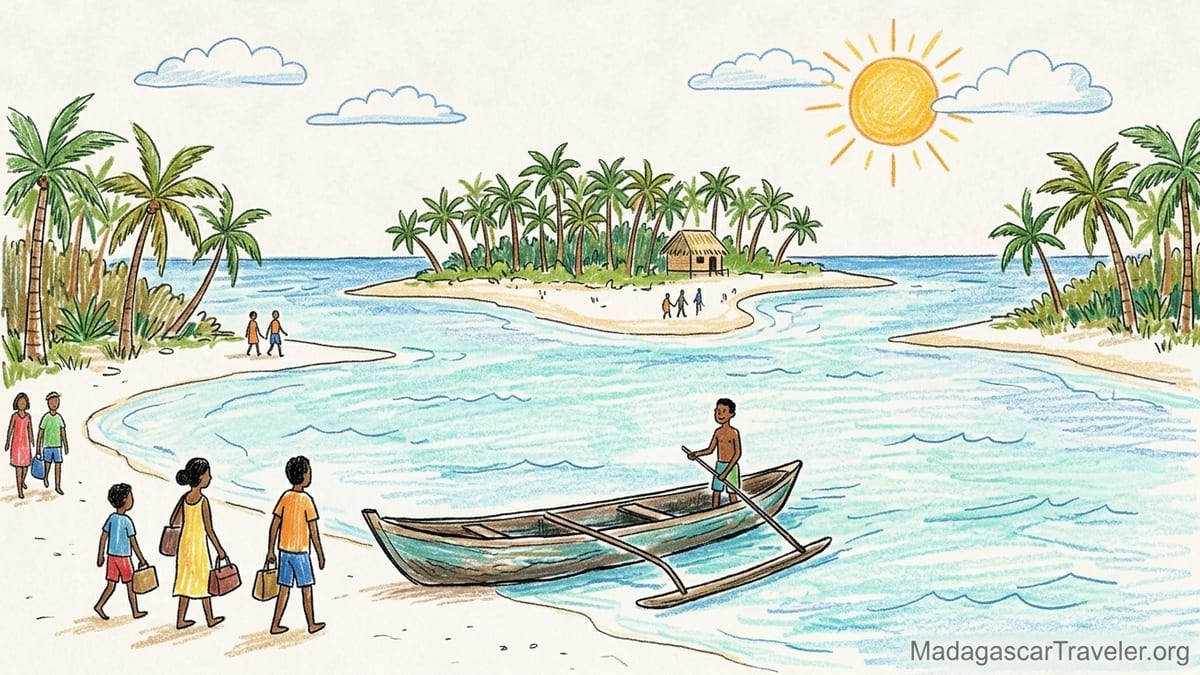
Île aux Nattes, also known as Nosy Nato, is a small island separated from the southern tip of Sainte-Marie by a narrow lagoon channel only a few hundred meters wide. The crossing itself usually takes just five to ten minutes in a wooden pirogue, but the experience is very different from climbing into a taxi boat at a busy resort marina. You walk down a sandy track at La Pointe, step into a narrow dugout canoe and glide across shallow, turquoise water with Sainte-Marie behind you and the palm fringed curve of Île aux Nattes ahead.
Most visitors reach La Pointe by tuk tuk from the main town of Ambodifotatra or from their hotel elsewhere on Sainte-Marie. Current local rates are often around 30,000 ariary for up to three people from town to the southern point, depending on bargaining and time of day. From there, pirogue owners typically charge just a few thousand ariary per person for the return crossing, with published examples around 3,000 ariary for a simple there and back seat in a shared canoe. In practice, many travelers organize the transfer directly with their guesthouse on Île aux Nattes, which sends a motorized pirogue or coordinates a trusted boatman who knows exactly where to drop you.
The crossing itself is usually calm, inside the shelter of the reef, but this is still a simple wooden boat with no jetty on the Île aux Nattes side. Expect to step into shallow water or onto wet sand as you land, and dress accordingly. During the main season from June to October, transfers generally operate throughout daylight hours, but it is sensible to arrive at La Pointe before late afternoon if you are not booked with an accommodation that guarantees pickup. After dark, crossings become more limited, and arranging them through your hotel rather than showing up at the jetty is strongly recommended.
Luggage, Porters and Practical Arrival Logistics
Because Île aux Nattes has no roads and no vehicles, how you handle luggage becomes an important part of deciding whether to sleep there. If you are traveling light with a small backpack, the pirogue ride and walk to your lodge are straightforward. You step out onto the beach, sling your bag over your shoulder and follow a sandy path under the palms for ten or fifteen minutes. Many travelers who stay on the island comment that this is one of the pleasures of arrival: there is no engine noise, only waves and birds as you walk to your bungalow.
If you are carrying heavy suitcases or camera gear, you will probably want help. Around the landing points on Île aux Nattes you will usually find local porters offering to carry bags on foot or by simple wheelbarrow. Prices are not fixed, but visitors report paying the equivalent of a few euros for help with standard luggage. Many guesthouses, such as small ecolodges and boutique bungalows on the east and south coasts, can pre arrange a porter to meet you directly at the beach where the pirogue lands. When you book, it is worth specifying the approximate time of your arrival boat and how many bags you have, particularly if any of them are not easily carried on a shoulder.
Choosing between a day trip and an overnight stay partly comes down to how much moving around you want to do with your gear. If you plan to spend several nights elsewhere on Sainte-Marie and only want a taste of Île aux Nattes, keeping your main luggage at your hotel on the main island and visiting for the day with a single small bag can be convenient. If, however, you are aiming for three to five slow days with nothing more than swimwear, a book and a camera, then committing to move everything across to Île aux Nattes and settling in often makes more sense.
Beaches, Lagoon and Walking the Island
The great appeal of actually sleeping on Île aux Nattes is that the island becomes your garden. The whole circumference can be walked in roughly half a day at a relaxed pace, with a mix of sandy shoreline, village stretches and more secluded coves. Tour operators and local guides commonly include a full island walk as an excursion, but many independent travelers simply follow the sand, pausing to swim when they find a piece of empty lagoon.
Beaches vary slightly by side of the island. The eastern and southern coasts tend to feel wilder and more exposed to the ocean, with sweeping views of the reef and more breeze. Several small ecolodges and houses, such as those around Ravenala Lodge on the far south, lean into this feeling of open horizon and unspoiled coastline. The western side looks back toward Sainte-Marie and is better sheltered, with calm shallows that suit families or less confident swimmers. If you come only on a day trip from the main island, you will typically be dropped on one of the easy access western beaches near the pirogue landing or a beach restaurant, which can feel busier in high season as excursion groups arrive for lunch.
Staying overnight changes your rhythm completely. You can swim early in the morning before the first day trippers appear, or walk along the sand at sunset when the last boats have already returned to Sainte-Marie. Travelers who have spent several days here often describe at least one almost empty beach moment, especially outside peak holiday weeks, where they shared the shoreline only with a local fisherman walking past with a net. If walking the island is a priority, base yourself here. If you simply want a quick look and a single swim, then a day excursion from a Sainte-Marie hotel can be enough.
Restaurants, Supplies and Everyday Convenience
On a practical level, Sainte-Marie offers more choice of shops, markets and restaurants. The main town of Ambodifotatra has small supermarkets, fresh produce stalls and street food, and the north and central coasts are lined with hotels and independent restaurants where you can eat Malagasy dishes, simple French plates or seafood. It is entirely possible to spend a week on Sainte-Marie, do a day trip to Île aux Nattes, and enjoy a different dinner setting every night back on the main island.
Île aux Nattes, in contrast, is still a small community. You will find a handful of beachside restaurants and bars, many attached to guesthouses, where menus focus on grilled fish, coconut rice, zebu brochettes and seasonal fruit. Portions are generally generous and prices are often slightly lower than in big resort hubs elsewhere in Madagascar, but you will not have endless variety. Vegetarians and vegans can eat well with rice, vegetables and local curries, but should mention their needs when booking accommodation so that hosts can plan ingredients accordingly.
Because there are no large supermarkets on Île aux Nattes, it is wise to bring any specific items you cannot easily do without. Common examples include sunscreen brands you trust, reef safe lotion, insect repellent, preferred snacks for children or special diet products. Several travelers report stocking up in Ambodifotatra or at a grocery near the Sainte-Marie airport before heading south to the pirogue. This is especially important if you are planning a longer, more secluded stay on the quieter southern or eastern shores of Île aux Nattes, where the nearest small shop might be a twenty minute walk away.
Electricity, Wi-Fi and Working From the Island
For many visitors, a core decision point between staying on Sainte-Marie or on Île aux Nattes is connectivity. On the main island, electricity tends to be more consistent around Ambodifotatra and at established hotels, though power cuts remain common and many properties rely partly on generators or solar. Mobile data coverage from Malagasy operators is generally stronger on Sainte-Marie, and some higher end hotels offer relatively stable Wi-Fi suitable for light remote work and video calls.
On car free Île aux Nattes, expectations need to be lower and more specific. Some lodges, such as Ravenala Lodge in the far south, now advertise 24 hour electricity via solar panels with battery storage and offer a basic Wi-Fi connection on site. Others run generators in the evening, meaning you can charge devices and have lights and a fan for a few hours but may not have power during the middle of the day. A number of simple bungalow operations have no in room electrical sockets at all, instead asking guests to charge phones and cameras in the restaurant area.
If you need to work reliably online, a Sainte-Marie base with a single overnight on Île aux Nattes might be more realistic than committing to a full week on the smaller island. An alternative strategy is to choose one of the better equipped houses or villas on Île aux Nattes, confirm in writing that they have 24 hour power and testable Wi-Fi, and still bring a local SIM card with data as a backup. For travelers who are happy to disconnect, limited electricity quickly becomes part of the island’s charm. Many repeat visitors describe how the absence of bright streetlights, televisions and constant notifications intensifies the feeling of being far from everyday life.
Choosing the Right Hotel or Guesthouse
Both Sainte-Marie and Île aux Nattes offer a mix of small hotels, ecolodges and simple beach bungalows, but the atmosphere on the two islands is noticeably different. On Sainte-Marie you can stay in everything from larger resort style properties with swimming pools, such as beachfront complexes along the east coast, to intimate guesthouses near Ambodifotatra aimed at domestic travelers. These are a good choice if you want whale watching excursions in season, easy access to natural rock pools in the north, and the possibility of different excursions without changing your base.
On Île aux Nattes, accommodation is more limited in number but often more immersive. Options range from rustic thatched bungalows directly on the sand, where open windows catch the breeze and mosquito nets sway above simple beds, to a few better equipped houses aimed at longer stays, sometimes with their own kitchen and private deck. Properties like small ecolodges on the southern shore emphasize privacy, unspoiled nature and an off grid feeling, even when they provide modern comforts such as solar power, hot water and Wi-Fi in shared areas.
When deciding whether to overnight, ask yourself whether you value variety or depth. If you prefer having several bars, restaurants and activity providers within a short tuk tuk ride, consider staying on Sainte-Marie and planning one or two full days on Île aux Nattes. If what you want most is to wake to the sound of waves, walk barefoot from your bungalow into the sea and rarely see a vehicle, then choosing a base on Île aux Nattes and visiting Sainte-Marie’s sights as day trips can be the more satisfying option.
How Much Isolation Do You Really Want?
Perhaps the most important factor in this decision is your personal threshold for remoteness. Day trippers from Sainte-Marie typically experience Île aux Nattes as a gentle escape that still feels linked to the rest of their trip. They cross over mid morning, swim and eat at a beach restaurant that can organize kayaks or boat trips to the lighthouse, then return to their hotel on Sainte-Marie in time for dinner in town or a sunset drink at a larger bar. For sociable travelers, families with younger children, or those nervous about being far from medical care or an ATM, this is an appealing compromise.
Overnight guests, on the other hand, lean into the island’s quiet. After the last excursion boats have left, the beaches empty, and most of the activity contracts to a few small restaurants and fireside bars. You walk along dark sand paths with a headlamp, and the background soundtrack is wind in the palms and the surf on the reef. Travelers who have spent a week here often describe it as the highlight of their Madagascar itinerary precisely because there was “nothing to do” beyond swimming, strolling, reading and talking with local hosts.
If you are unsure where you sit on this spectrum, a hybrid plan works well. Start with two or three nights on Sainte-Marie to explore whale watching in season, the pirate cemetery, natural pools and forests, plus a first day trip to Île aux Nattes. If you find yourself reluctant to board the pirogue back at the end of the day and already imagining staying, shift your base for your remaining nights. It is easy enough to move hotels once on site, especially outside the busiest school holiday periods, as long as you are flexible on exact location and level of comfort.
The Takeaway
Île aux Nattes is not just another beach annex of Sainte-Marie. The absence of cars, the short but atmospheric pirogue crossing and the limited infrastructure make it a genuinely different kind of stay. Choosing whether to visit only for the day or to sleep there depends on how much you value quiet, how lightly you are willing to travel and how dependent you are on urban conveniences such as varied dining and reliable internet.
As a rule of thumb, if you are content with simple comforts, happy to walk on sand paths and excited by the idea of being largely offline, then at least two or three nights on Île aux Nattes will likely be the most memorable part of your time in the region. If you are traveling with a tight schedule, expect to work online or prefer more nightlife and restaurant options, consider basing yourself on Sainte-Marie and treating Île aux Nattes as a leisurely day trip.
Whichever you choose, planning transfers in advance with your accommodation, setting realistic expectations for electricity and Wi-Fi, and preparing to carry your bags on and off the pirogue will help your visit run smoothly. Once these logistics are in place, the decision stops being about practicalities and becomes about mood. Do you want the secure feeling of looking at the little island from your hotel terrace in Sainte-Marie, or the deeper quiet of looking back at the lights of the main island from a beach where the only traffic is the tide?
FAQ
Q1. Is Île aux Nattes suitable as a first base in Madagascar, or should I stay on Sainte-Marie first?
For most travelers, it works well to spend the first night or two on Sainte-Marie to recover from flights, access ATMs and buy supplies, then transfer to Île aux Nattes once you are rested. However, if your accommodation on Île aux Nattes can arrange a direct airport pickup and pirogue transfer, it is entirely possible to go straight there and start your trip in full retreat mode.
Q2. How long should I stay on Île aux Nattes if I choose to overnight there?
Many visitors find that two or three nights is enough to walk the island, swim daily and unwind without feeling cut off. Travelers who enjoy slow travel and reading on the beach often extend their stay to five or even seven nights, using Île aux Nattes as a true retreat between more active sections of a Madagascar itinerary.
Q3. Are pirogue transfers between Sainte-Marie and Île aux Nattes safe?
The short lagoon crossing is usually calm, and pirogues make the trip many times a day in good weather. That said, boats are simple wooden craft, often without life jackets, and do not operate to big ferry standards. Choosing an operator recommended by your hotel, avoiding crossings in rough weather and planning to arrive and depart in daylight all increase safety and comfort.
Q4. Can I easily visit Sainte-Marie attractions if I stay on Île aux Nattes?
Yes. Many lodges on Île aux Nattes can arrange day trips to Sainte-Marie highlights such as the natural pools in the north, whale watching in season or visits to the pirate cemetery. You cross by pirogue in the morning, meet a driver on the Sainte-Marie side and return to your bungalow in the late afternoon or early evening.
Q5. What should I pack differently if I plan to sleep on Île aux Nattes?
In addition to normal beach clothing, it is useful to bring a headlamp or small torch for walking paths at night, extra insect repellent, any specific medications or snacks you rely on, and a waterproof bag or dry sack so that electronics stay safe during the pirogue crossing and any wading ashore.
Q6. Is there an ATM on Île aux Nattes, or should I bring cash?
There is no bank on Île aux Nattes, and payment by card is still rare, especially in small guesthouses and local restaurants. Plan to withdraw enough cash in Ambodifotatra or at an ATM near the Sainte-Marie airport before crossing, allowing for accommodation balances, meals, activities and a buffer for tips and unexpected costs.
Q7. Will I get mobile signal and data on Île aux Nattes?
Most travelers report at least basic mobile coverage from Malagasy operators on parts of the island, though speed and reliability can vary with weather and exact location. It is wise to buy a local SIM card with a data package on the mainland or in Antananarivo, then test reception at your lodge on arrival and use Wi-Fi when available as a backup rather than a primary connection.
Q8. Is Île aux Nattes a good choice for families with children?
The shallow lagoon, car free paths and friendly village atmosphere can be excellent for families, provided parents are comfortable with the simple infrastructure. Young children usually enjoy the pirogue ride and freedom to play on the sand, but parents need to supervise swimming carefully and be aware that medical facilities are on Sainte-Marie rather than on the small island itself.
Q9. How expensive is it to stay on Île aux Nattes compared with Sainte-Marie?
Prices vary with season and comfort level, but simple bungalows on Île aux Nattes often cost roughly the same or slightly less than midrange rooms on Sainte-Marie. Higher end villas or ecolodges on the small island can be comparable in price to quality resorts on the main island. Factor in transfers and the need to bring some supplies from Sainte-Marie when comparing overall costs.
Q10. If I have only one full day in the area, should I prioritize a day trip or an overnight on Île aux Nattes?
With a single full day, most travelers base themselves on Sainte-Marie for convenience and plan a long, relaxed day trip to Île aux Nattes that includes lunch and a walk along the beach. If you already have your logistics in place and are comfortable moving with luggage, arriving on one afternoon, sleeping on Île aux Nattes and leaving the following afternoon can still give you a meaningful taste of its slower rhythm.