


Sainte-Marie, also known as Nosy Boraha, is the Indian Ocean island many Madagascar visitors hope still exists: coconut palms leaning over calm lagoon water, quiet sand tracks instead of traffic, and humpback whales breaching just offshore in season. For a first-time visitor, it feels far removed from the busier, more resort-focused atmosphere of Nosy Be. This guide walks you through what to expect, where to base yourself, how to get around, and how to make sense of the island’s main areas from Ambodifotatra town to the southern beaches and Île aux Nattes.
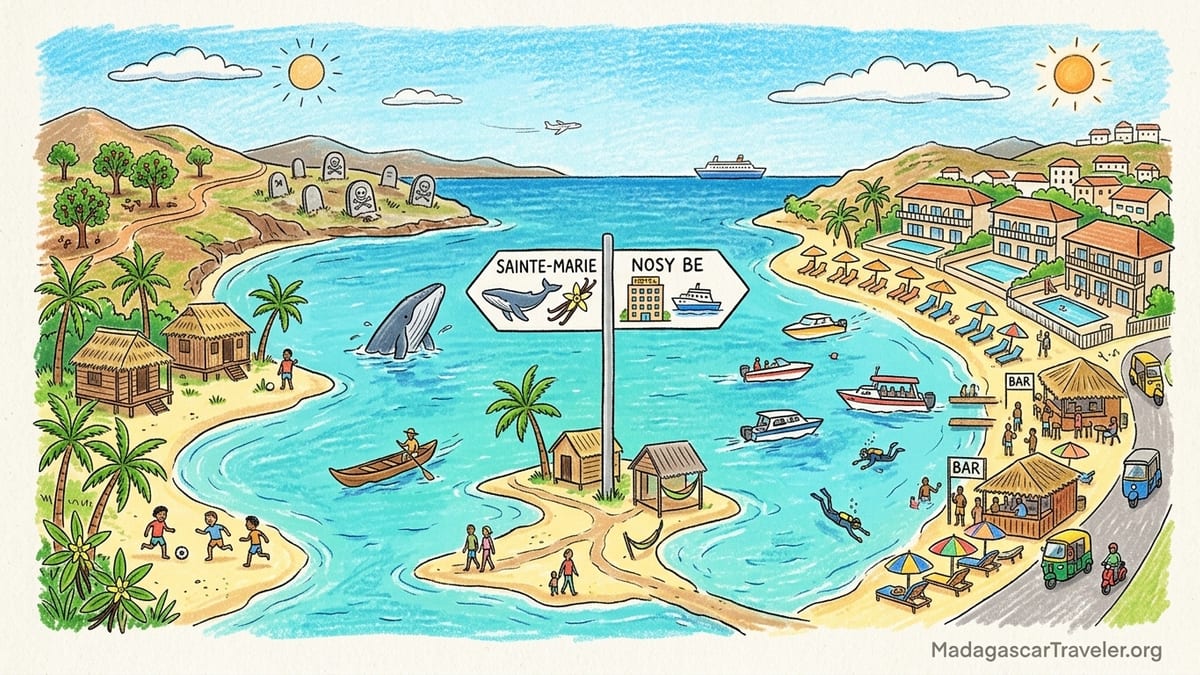
Why Sainte-Marie Is Different From Nosy Be
Travelers often compare Sainte-Marie with Nosy Be, Madagascar’s better-known beach hub, but the experience on the ground is quite different. Nosy Be has a developed hotel strip, busy nightlife and a concentration of dive centers and excursion boats. Sainte-Marie is quieter and more linear, a long narrow island with villages spread along a single main road and far fewer large resorts. You come here for simple guesthouses, small ecolodges, local rum and vanilla, and an atmosphere that feels more village than resort.
On a practical level this means you will not find big-brand hotels, shopping malls or rows of beach bars. Instead, you might stay in a handful of bungalows at a place like a family-run ecolodge in the south, where electricity can be limited at night and the restaurant chalks up the day’s seafood catch on a blackboard. In Ambodifotatra, the main town, the scene is a couple of small cafés, a covered market and a few grocery kiosks rather than a polished waterfront promenade. Prices tend to be moderate by Indian Ocean standards, and bargaining is still common for tuk-tuk rides and local excursions.
The trade-off for lower development is a stronger sense of place. During whale season, it is possible to sit on a simple wooden terrace on the west coast and watch humpbacks pass within a few hundred meters of shore while local kids play football on the beach. Inland, there are dirt paths through clove and cinnamon trees rather than paved hiking trails. If you want spa complexes and multiple restaurant choices within walking distance of your hotel, Nosy Be may suit you better; if you prefer barefoot sand, low-key evenings and a more Malagasy feel, Sainte-Marie is likely the better fit.
Ambodifotatra and the Island’s Pirate Past
Ambodifotatra, sometimes written Ambodifototra, is the compact main town and your reference point for services. It is essentially a single main street running parallel to the shoreline with wooden shopfronts, small hotels and a fuel station. This is where you will find the island market for fresh fruit, basic pharmacies, ATMs when they are working, and phone shops for local SIM cards. Many visitors stop here on arrival to buy snacks, withdraw cash and organize onward transport before heading to their beach accommodation.
The town also anchors Sainte-Marie’s pirate history. In the 17th and early 18th centuries the island’s sheltered bay was a base for several famous pirates, including figures such as William Kidd and Olivier Levasseur, who favored the channel between the island and mainland Madagascar as a strategic hideout. Today you can visit Île aux Forbans, a small islet in Ambodifotatra Bay, and the so-called Pirate Cemetery, where a cluster of weathered tombstones with skull-and-crossbones carvings looks out over the sea. Local guides in town can arrange a short pirogue crossing to the island and tell stories about shipwrecks and hidden treasure, which makes a half-day historical outing from most parts of the island.
Just south of town stands the red-roofed Catholic church Notre Dame de l’Assomption, often cited as Madagascar’s oldest Catholic church. For first-time visitors, combining the church, the market and the pirate sites into one circuit gives a good introduction to Ambodifotatra in a single morning, leaving afternoons free for the beach. Accommodation in and around town ranges from simple Malagasy-run guesthouses used by domestic travelers to a few midrange options that appeal to budget-conscious international visitors who want walking access to shops and transport rather than an isolated beach.
Southern Beaches, Natural Pools and Ampanihy
Most beach-focused travelers base themselves on the west or south coasts of Sainte-Marie, where the lagoon is calm and sunsets light up the channel. South of Ambodifotatra, the tarmac road soon gives way to quieter sections, with small clusters of bungalows tucked among coconut trees. Around villages like Vohilava and Ankarena you will find some of the island’s better-known lodges with direct access to sandy beaches. A typical day here is slow: a morning swim or snorkel in the lagoon, fresh fish and rice for lunch at your lodge restaurant, and a late-afternoon walk along the tide line as fishermen bring in their dugout canoes.
One of the area’s natural highlights is the Piscines Naturelles, or natural pools, on the east coast of the southern part of the island. Here the ocean waves have carved out large rock basins that fill with clear turquoise water at certain tide levels, creating a sheltered place to swim or simply float. Reaching the pools generally involves hiring a tuk-tuk or 4x4 from your lodge and then walking a short distance along sandy paths. Conditions can vary depending on swell and tides, so it is wise to go with a local guide or driver who knows when swimming is safe and when the waves are too strong.
Further north on the island, the bay of Ampanihy is known for its mangroves, calm water and birdlife. Outfitters and lodges offer guided walks that cross the island from the central ridge down to the Ampanihy mangroves, often as a full-day hike with a picnic lunch. You might start the day in the slightly cooler forested interior, hearing the calls of endemic birds, before emerging at the bay’s edge to explore the mangrove channels by pirogue. For first-time visitors this kind of excursion balances beach time with a sense of Sainte-Marie’s ecosystems beyond the hotel strip.
Île aux Nattes and the Surrounding Lagoon
At the very southern tip of Sainte-Marie a narrow channel separates the main island from tiny Île aux Nattes, also called Nosy Nato. There are no cars on Île aux Nattes, and most visitors get around by walking on sandy footpaths or taking short canoe rides in traditional pirogues. The circumference of the island can be walked in a few hours, passing small villages, palm-fringed coves and viewpoints where you can see right across the reef to the open ocean. For many travelers, this feels like the purest escape in the Sainte-Marie archipelago.
Reaching Île aux Nattes is straightforward. From Ambodifotatra, tuk-tuks follow the main road south to the village at the tip of Sainte-Marie, a ride of roughly 20 minutes under normal conditions. From there local boatmen ferry passengers across the channel in a few minutes, typically for a modest fee that you agree on in advance. Once on Île aux Nattes you step into a low-key world of small guesthouses, beach bars with wooden decks and hammocks, and simple restaurants serving grilled fish, coconut curries and local vanilla-flavored desserts.
The lagoon around Île aux Nattes is one of the area’s best spots for swimming and snorkeling. In calm weather you can wade out over white sand shallows that gradually deepen to coral patches where parrotfish and butterflyfish feed. Some lodges offer kayak or stand-up paddleboard rental so you can explore sandbanks and small islets in the surrounding lagoon. During whale season, it is not unusual to watch humpbacks breaching beyond the reef while you are sitting on the beach, which underlines how close the migration route passes to the southern end of Sainte-Marie.
Whale Watching, Diving and Snorkeling
From roughly June to September each year, humpback whales migrate from Antarctic waters to the warm, sheltered channel between Sainte-Marie and mainland Madagascar to breed and calve. This makes the island one of the Indian Ocean’s most reliable places to see humpbacks. In peak season, it is common to spot blows and tail slaps from shore along the west coast, particularly north of Ambodifotatra and near viewpoints overlooking the Sainte-Marie Channel. Several lodges and local operators run boat-based whale watching trips, typically lasting two to three hours in the morning when the sea is calmer.
Responsible operators follow international guidelines for whale watching, keeping a respectful distance and limiting the number of boats around the animals. Guesthouses often partner with specific skippers or guides, and you can sign up at your reception for departures the next day. Pricing varies, but a half-day excursion marketed to individual travelers might cost in the region of what you would pay for a similar boat trip elsewhere in Madagascar, often including hotel pick-up and sometimes basic refreshments onboard. When comparing offers, ask how many passengers they usually take, whether there is a trained guide onboard and what their approach is when multiple boats converge on the same whales.
Diving around Sainte-Marie focuses on healthy coral gardens, macro life and, in season, the acoustic presence of whales rather than dense fish schools or big pelagic species. Several small dive centers operate along the west and south coasts and on Île aux Nattes, offering fun dives and introductory courses. Compared with Nosy Be, dive infrastructure is more limited and boats are smaller, but sites are often uncrowded. It is not unusual for certified divers to find themselves alone with a divemaster on a morning double-tank outing, especially outside peak holiday periods. Snorkeling is accessible directly from shore in many parts of the lagoon, though visibility depends on tides and weather, so local staff can advise on the best time each day.
Getting Around: Tuk-Tuks, Bicycles and Scooters
Sainte-Marie’s small size and relaxed pace make getting around relatively straightforward, though not always fast. The main road runs roughly north to south along the length of the island, with sandy side tracks leading to beachfront lodges and villages. In and around Ambodifotatra, three-wheeled tuk-tuks are the standard form of public transport. You can flag them down in the street or find them near the market, and fares are usually negotiated per trip rather than by meter. For example, a short hop within town might cost only a small amount, while the longer ride from Ambodifotatra to the southern tip near Île aux Nattes will cost more, especially with luggage.
Many guesthouses and small hotels rent out bicycles, often simple mountain bikes, for exploring at your own pace. Cycling along the coastal road to small bays like Baie de Lokintsy in the north or down toward Vohilava in the south is popular, especially in the cooler early morning and late afternoon. Expect patchy road conditions, some sandy stretches and occasional potholes. Scooters or small motorbikes are another option offered by a few lodges or independent rental outfits. These give you greater freedom to reach trailheads for walks, the natural pools on the east coast or remote coves, but you should be comfortable riding on gravel and sand and factor in that helmets and insurance coverage may not match European or North American standards.
On Île aux Nattes, transport is primarily on foot or by pirogue. You can walk from your guesthouse to most beaches and viewpoints in under an hour, and barefoot walks around the island at low tide are a highlight for many visitors. For specific outings, such as visiting a tiny offshore sand islet or crossing to a restaurant on the opposite side of the lagoon, local boatmen offer short transfers. The absence of cars and motorbikes contributes significantly to the island’s quiet feel, especially at night when the loudest sound is often just the surf and the occasional generator.
Arriving and Leaving: Flights and Ferries
Access to Sainte-Marie tends to be more weather-dependent and less predictable than to Nosy Be, which is part of its off-the-beaten-path character. The island’s small airport, located in the south near Ankarena, serves domestic flights from Antananarivo and sometimes from Toamasina or other regional hubs, usually operated by Madagascar Airlines or its domestic brand. Schedules can change from season to season, and flights are not always daily, so it is important to check current timetables and book in advance, especially if your international connection depends on a specific day. Delays and last-minute adjustments are not uncommon, so building in a buffer day in Antananarivo before your outbound international flight is prudent.
For travelers with more time or tighter budgets, ferries and fast boats link Sainte-Marie with the east coast of mainland Madagascar. Services typically run from ports such as Soanierana Ivongo or, in some seasons, Mahambo, with crossing times that vary depending on vessel and sea conditions. Boats are usually early-morning departures to take advantage of calmer seas. Sea conditions in this part of the Indian Ocean can be rough, so cancellations due to weather are possible, especially in cyclone season. Tour agencies in Toamasina and Antananarivo, as well as many guesthouses on Sainte-Marie, can help arrange tickets and transfers to the ports, often combining road transport and boat into a single package to simplify logistics.
Whichever way you arrive, expect a pleasant sense of scale once you are on the island. The drive from the airport in the south to Ambodifotatra takes well under an hour under normal conditions, and from Ambodifotatra to the northern tip is only a modest distance further. This compact size means you can base yourself in one or two locations and still explore much of the island without constantly packing and unpacking.
Where to Stay and How Long to Spend
Accommodation on Sainte-Marie and Île aux Nattes spans a spectrum from simple beach bungalows with cold-water showers to more polished boutique ecolodges with pools, landscaped gardens and curated excursions. The common denominator is scale: properties tend to be small, with a few rooms or bungalows spread among palms rather than multi-story buildings. Some of the longest-established lodges cluster on the west and southwest coasts, where calm lagoon water suits swimming and families, while budget-conscious travelers might choose simple guesthouses closer to Ambodifotatra to have easy access to markets, tuk-tuks and the ferry pier.
If your priority is waking up directly on the sand and having sunsets over the Sainte-Marie Channel, look at options along the west and south coasts and on Île aux Nattes. If you prefer easier logistics and a bit more local life, a night or two in town can be worthwhile at the start or end of your stay. Many visitors combine a few nights on the main island with a few nights on Île aux Nattes to experience both. For example, a traveler might spend three nights at a midrange beach lodge near Vohilava, using tuk-tuks or bicycles for day trips, and then move to a simple bungalow guesthouse on Île aux Nattes for three nights of car-free island walking and snorkeling.
In terms of trip length, anything under three nights on Sainte-Marie feels rushed once you factor in travel time and the island’s naturally slow pace. A realistic stay for a first-time visitor is at least five to seven nights, which allows time for one or two whale watching outings in season, a half-day in Ambodifotatra for the pirate sites and market, a day for the natural pools or an island-crossing hike to Ampanihy, and two or three unstructured beach days. Travelers combining multiple regions of Madagascar often allocate about a week to Sainte-Marie at the end of a longer itinerary, using it as a decompression stop after more intense wildlife or road-trip segments on the mainland.
The Takeaway
For a first-time visitor to Madagascar, Sainte-Marie offers a version of island life that feels both accessible and quietly removed from mainstream resort tourism. You still have domestic flights, guesthouses that can arrange airport pick-ups and whale watching operators that understand international expectations around safety and responsible wildlife viewing. Yet the tone is resolutely low-key: no big nightclubs, few packaged activities beyond small-group tours, and long stretches of coastline where locals outnumber visitors.
The island’s appeal comes from the sum of its parts. Ambodifotatra provides just enough infrastructure and history to give context. The west and south coasts offer calm beaches and the chance to watch humpbacks from shore. Île aux Nattes distills the car-free, palm-fringed lagoon fantasy into walkable scale. Inland walks to natural pools and Ampanihy show the relationship between forest, mangrove and sea. Taken together, these elements create an experience that is more about slowing down than ticking off sights. For travelers who value authenticity, sea breezes and the sound of whales exhaling offshore, Sainte-Marie is an island worth taking slowly.
FAQ
Q1. How many days should a first-time visitor spend on Sainte-Marie?
Most first-time visitors find that five to seven nights works well. This allows time for at least one whale watching trip in season, a half-day around Ambodifotatra and the pirate sites, a day or two on Île aux Nattes, and a couple of unscheduled beach days to adjust to the island’s slower rhythm.
Q2. When is the best time to see humpback whales around Sainte-Marie?
The main humpback whale season typically runs from around June to September, with peaks that can vary slightly year to year. During this period whales use the sheltered channel between the island and mainland Madagascar for breeding and calving, and sightings from shore and on boat trips are common when sea conditions allow.
Q3. How do you get from the airport to popular beach areas or Île aux Nattes?
The island’s small airport is in the south, and most lodges can arrange a car or 4x4 transfer that usually takes under an hour to reach Ambodifotatra or the main west and south coast beaches. To continue to Île aux Nattes, you travel by road to the southern tip of Sainte-Marie and then cross the narrow channel in a small boat, a short ride that local boatmen run frequently during daylight.
Q4. Is Sainte-Marie suitable for budget travelers?
Yes, Sainte-Marie can work for travelers on a moderate budget, especially those willing to stay in simple guesthouses instead of high-end ecolodges. Everyday costs like local meals, tuk-tuk rides and basic rooms can be relatively affordable compared with more developed Indian Ocean islands, although imported goods and domestic flights can add up, so it is wise to plan spending and book key services ahead.
Q5. How does Sainte-Marie compare to Nosy Be for diving and snorkeling?
Nosy Be has more dive centers, boats and a wider choice of sites, while Sainte-Marie offers a quieter experience with fewer divers and more intimate outings. Around Sainte-Marie and Île aux Nattes you can expect healthy coral gardens, macro life and, in whale season, the chance to hear humpbacks underwater, but overall infrastructure is simpler and conditions such as visibility and access can be more weather-dependent.
Q6. Do I need to book whale watching and excursions in advance?
In peak whale season it is sensible to reserve whale watching outings at least a day or two ahead, especially if you have limited time or are traveling in school holiday periods. Many lodges manage bookings directly with trusted skippers and guides, so you can usually organize trips on arrival, but travelers with specific dates or large groups may prefer to coordinate with an operator before reaching the island.
Q7. What should I expect from road and transport conditions on the island?
Roads on Sainte-Marie are a mix of tarmac and rougher sections with potholes and sand, so travel is slow even over short distances. Tuk-tuks are common around Ambodifotatra and along the main road, while bicycles and scooters are popular options for exploring at your own pace. On Île aux Nattes there are no cars and movement is mostly on foot or by pirogue, which contributes to the island’s calm but also means you should pack lightly.
Q8. Is Sainte-Marie a good choice for families with children?
Sainte-Marie can be a rewarding destination for families who value nature and simple pleasures like swimming, shell collecting and boat rides. The calm lagoon on the west and south coasts suits supervised swimming, and older children often enjoy spotting whales, visiting the pirate sites and taking short hikes. However, parents should be comfortable with a more rustic level of infrastructure, including occasional power cuts and limited medical facilities compared with major cities.
Q9. Are there ATMs and reliable card payment options on the island?
Ambodifotatra usually has at least one functioning ATM, but service can be intermittent and machines sometimes run out of cash or go offline. Many guesthouses and small businesses still prefer payment in cash, and card acceptance is not universal, particularly in remote areas and on Île aux Nattes. It is prudent to bring enough local currency for most daily expenses and to confirm payment options with your accommodation before arrival.
Q10. Is Sainte-Marie safe for independent travelers?
Sainte-Marie is generally perceived as relaxed and welcoming, and many independent travelers explore the island on foot, by bicycle or tuk-tuk without issues. As elsewhere, sensible precautions apply: keep valuables out of sight, use hotel safes where available, avoid walking alone on remote beaches after dark and follow local advice during rough seas or heavy rain. Political events on the mainland rarely affect day-to-day life on the island, but it is still wise to monitor current travel advisories before your trip.