


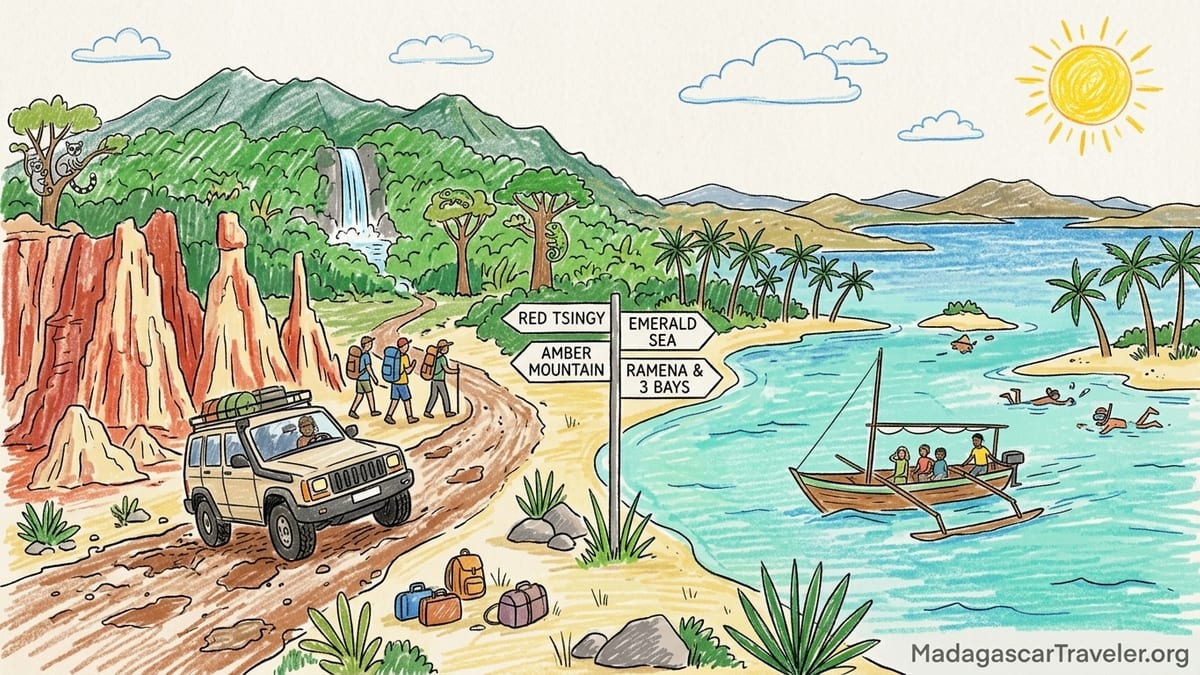
Base yourself in Antsiranana (still widely known as Diego Suarez) for a few days and you are suddenly spoiled for choice: rainforest hikes in Amber Mountain, limestone pinnacles in Ankarana, crimson canyons at the Red Tsingy, wild beaches along the Three Bays and lazy sailboats on the Emerald Sea. Most of these outings are sold as expensive, full‑day excursions by local agencies and hotels, and very few travelers have the time or budget to do them all. This guide breaks down each option with real‑world timings, comfort levels and costs so you can decide which trips genuinely deserve a place in your northern Madagascar itinerary.
How Day Trips Work Around Antsiranana
Antsiranana is the main hub for exploring the north of Madagascar, and almost all excursions start from town or from the nearby beach village of Ramena. Distances on the map look short, but the combination of potholed tarmac, gravel tracks and seasonal damage from cyclones means you should always allow more time than a simple kilometre count suggests. For example, the 105 to 110 kilometre drive from Antsiranana to the main entrance of Ankarana Special Reserve usually takes about 2 to 3 hours in a private 4x4 in good conditions, and longer after heavy rain when temporary detours and makeshift bridge crossings appear.
Organised day trips are commonly sold through hotels or agencies at prices that often start around the equivalent of 150 to 250 US dollars for two people for destinations like Amber Mountain or the Emerald Sea. That usually includes a vehicle with driver, fuel and sometimes lunch, but not always park entry or a local guide. If you walk the seafront in Antsiranana or Ramena you will also meet freelance boat skippers and drivers offering similar trips at negotiable rates. Their starting prices are often lower, but you need to check safety gear, vehicle condition and what is actually included.
Public transport is useful inside town but becomes impractical for most day trips. Local tuk‑tuks and taxis can take you to Ramena or the start of the Three Bays walk in under an hour, but Amber Mountain, the Red Tsingy and Ankarana are realistically 4x4 territory if you want to complete them as day outings without worrying about breakdowns or getting stranded after dark. For all of the trips described below, an early start between 7:00 and 8:00 in the morning is the norm.
Because most visitors combine Antsiranana with Nosy Be, the vanilla coast or Antananarivo, time is usually tight. The decision is rarely whether you go somewhere, but whether that place is worth giving up another experience. The following sections compare the main excursions by driving or boat time, scenery versus wildlife, how tough the walking is, and whether you should treat each one as a stand‑alone day or try to combine it with another stop.
Amber Mountain National Park: Cool Forests and Easy Wildlife
Amber Mountain National Park lies roughly 30 kilometres south of Antsiranana. In practice, that translates into about a 45‑minute to 1‑hour drive by paved road to the village of Joffreville and a further short climb to the park entrance. Several operators in town offer Amber Mountain as a classic full‑day excursion, often marketed with names like “Amber Mountain Day Trip” and built around 4 to 5 hours of walking on forest trails plus a picnic lunch. Shorter half‑day versions, popular with cruise passengers, reduce walking time to around 2 to 3 hours and usually skip the longer circuits.
Wildlife is the key reason to prioritise Amber Mountain. The cool montane rainforest shelters leaf‑tailed geckos, several species of chameleon and crowned lemurs, and birders come looking for species such as the Madagascar crested ibis. Local MNP‑certified guides typically know exactly where nocturnal chameleons sleep during the day and can point out well‑camouflaged geckos on tree trunks that independent visitors would almost certainly miss. Even non‑specialists tend to see multiple chameleon species, lemurs and colourful frogs on a normal daytime walk.
Hiking in Amber Mountain is moderate rather than extreme. Most of the popular circuits, such as a loop to one or two waterfalls and a volcanic crater lake, last between 2 and 5 hours on undulating forest paths. Trails can be muddy and slippery after rain, but there is no serious exposure or scrambling. Good sports shoes or light hiking boots are enough for most visitors, and because the park sits at higher elevation than Antsiranana, temperatures are noticeably cooler. Many travelers describe Amber Mountain as a literal and figurative breath of fresh air after a few hot days on the coast.
Although guides are not strictly mandatory for daytime visits, in practice almost everyone hires one at the park entrance or through their tour operator, especially as the main trails are not always well signed and the guide fee is modest compared with the cost of the vehicle. A 4x4 is useful but not absolutely essential in the dry season, as the road to Joffreville is mostly paved. Overall, Amber Mountain is a destination that comfortably fills a full day from Antsiranana and is rarely worth combining with anything more ambitious than a short stop in Joffreville or a sunset drink back in town.
Red Tsingy: Photogenic Stop Best Combined With Other Routes
The Red Tsingy, or Tsingy Rouge, is a striking cluster of eroded red sandstone and clay pinnacles located southeast of Antsiranana off the main Route Nationale 6. From town, most drivers follow the RN6 south for about 45 to 60 minutes before turning onto a rougher track that leads to the viewpoints. Travel agencies often quote a total drive time of around 1.5 to 2 hours each way, but seasonal factors matter a lot. After heavy rain, sections of the access track can become rutted or temporarily closed, which is why both local guides and national tour operators insist on a high‑clearance 4x4 for this excursion.
In contrast to Amber Mountain and Ankarana, the Red Tsingy is about scenery rather than wildlife. You come here to photograph the crimson and cream formations against a bright blue sky, not to look for lemurs. Visitors typically follow a short loop trail around the main canyon rims and down to a closer viewpoint, spending 1 to 2 hours on foot. The path is easy enough for most reasonably mobile travelers, with only occasional short, dusty descents and climbs. This makes the site accessible if you like big landscapes but are not keen on strenuous hiking.
Because the visit itself is relatively short, few experienced operators treat the Red Tsingy as a stand‑alone full‑day excursion unless clients specifically request it. It fits naturally as a stop on a longer driving day between Antsiranana and Ankarana, or between Ankarana and Antsiranana, adding one or two extra hours to the journey. Some agencies design itineraries where you leave Ankarana after breakfast, spend an extended late‑morning break at the Red Tsingy for photos and a picnic, then reach Antsiranana in the afternoon. That pattern makes the most sense if you want to see the formations without sacrificing a separate day.
If you are tempted by brochures from Antsiranana that advertise the Red Tsingy as a dedicated day tour, ask very specific questions. Clarify how much actual time you will spend at the site versus in the vehicle, whether lunch is included, and whether the same journey could be structured instead as part of your transfer to or from Ankarana. For many travelers on tight schedules or budgets, it is the classic example of an expensive but visually rewarding stop that is best folded into another excursion rather than given its own day.
Three Bays and Ramena: Coastal Scenery With Flexible Effort
The so‑called Three Bays, usually listed as Baie des Sakalava, Baie des Dunes and Baie des Pigeons, unfold on the windy peninsula east of Antsiranana. Most visitors either start from town by 4x4 or taxi, or base themselves in Ramena, a relaxed beach village about a 40‑minute drive from the centre. From the end of the rough coastal track, a scenic walking path follows cliffs, dunes and wild coves for several hours, often ending at Orangea Beach or back in Ramena. Local travel guides describe it as one of the most scenic walks in northern Madagascar, with long ocean views and frequent kite‑surfers in the first bay when the wind is up.
The main draw here is scenery rather than wildlife. Expect turquoise shallows, white sand, rust‑coloured headlands and views across one of the world’s largest natural harbours. The walking is generally easy to moderate: you follow sandy paths and sometimes scramble over low rocks, but there are no big climbs. Fit hikers might cover the full Three Bays route in 4 to 5 hours including photo stops, while others prefer to shorten the walk by having their driver meet them at a midway point or simply relax longer at one favourite bay. Unlike the parks inland, there are no official trail permits, and a formal guide is optional rather than required, though local fixers in Antsiranana or Ramena can show you the best viewpoints.
Because access is simple and the walk can be shortened or lengthened, the Three Bays are one of the easier excursions to arrange independently. Many visitors negotiate a return taxi or 4x4 from Antsiranana for a fixed fare, asking the driver to wait in Ramena or at one of the bays. Budget travelers sometimes even use shared taxis to Ramena, then hire a local motorbike or walk part of the route. The main comfort concern is the sun: there is very little shade, so a hat, sunscreen and plenty of water are essential, especially in the dry season from May to October.
Whether the Three Bays deserve a full day depends on your pace and how much time you want on the beach. A common pattern is to start the walk mid‑morning, enjoy a long seafood lunch at a simple restaurant in Ramena, then swim or relax on the beach until late afternoon before returning to Antsiranana. That rhythm uses most of the day but stays relaxed. If you are short on time, it is one of the few excursions that still works well as a half‑day, perhaps by focusing on just one or two bays and spending less time at lunch.
Emerald Sea: Lagoon Escape That Eats a Whole Day
The Emerald Sea, often called Mer d’Emeraude, is the shallow, turquoise lagoon beyond the pass at the mouth of Antsiranana Bay. Trips usually start with a transfer by car from Antsiranana to Ramena in about 40 minutes, followed by an open‑boat crossing of roughly 45 minutes to an hour, depending on tides and wind. Local fishing boats and simple motorised pirogues anchor at sandy islets in the lagoon, where most excursions include a grilled fish lunch and hours of swimming or snorkelling in calm, sandy‑bottomed water.
There is no hiking on an Emerald Sea outing and very little wildlife beyond reef fish and the occasional turtle. The attraction is atmosphere: impossibly clear water, a rim of sandbars and views back toward the high hills around Antsiranana. On a typical group excursion sold through a hotel, you leave town around 8:00 in the morning and do not return until mid to late afternoon, which means the entire day is spoken for. This makes the Emerald Sea an expensive choice in terms of both money and time compared with, say, an independent beach afternoon at Ramena.
Because weather and tides affect the crossing, going with a reputable operator is important. Before booking, ask about life jackets, maximum group size, shade on the boat and whether the picnic lunch can accommodate any dietary restrictions. Prices quoted to foreign visitors can vary widely, but it is common to see rates that rival or exceed those for a day in Amber Mountain, even though there are no park fees or local guides involved. Some cruise passengers arrange shorter versions timed to their ship’s schedule, but independent travelers generally commit to the full day, as there is no easy way to cut the outing short once you are out on the lagoon.
If you already plan to spend time on Nosy Be or other islands with strong beach and snorkelling options, think carefully about whether the Emerald Sea is essential. Travelers who have limited days in northern Madagascar and a tight budget sometimes opt instead for the Three Bays walk plus a relaxed afternoon on Ramena’s beach, which delivers a mix of sea views and swimming with less logistical complexity. On the other hand, if Antsiranana is your only northern base and you value a classic lagoon‑day experience, the Emerald Sea is a justifiable indulgence and pairs well with more active inland excursions on other days.
Ankarana: Longer Excursion That Merits More Than One Day
Ankarana Special Reserve, now often described as Ankarana National Park, protects one of Madagascar’s most dramatic karst landscapes. From Antsiranana, the southern entrance at Mahamasina lies about 105 to 110 kilometres away on the RN6. In practice, most visitors report a driving time of 2 to 3 hours in a private 4x4 in good conditions, though recent cyclone damage and temporary bridge issues can stretch that longer. Once you add time to settle formalities at the park office and hire a local guide, there is limited margin left in a single day for the best circuits.
Inside Ankarana, the focus is on rugged scenery and caves, with rewarding but sometimes demanding walking. Classic routes such as the circuit to the “big tsingy” viewpoints or to suspension bridges across razor‑sharp limestone often take several hours each. Paths can be hot and exposed, with sections over bare rock and uneven surfaces that require sturdy footwear and reasonable balance. A number of caves shelter bat colonies, and diurnal lemurs, such as crowned lemurs, are present but not guaranteed in the hotter middle of the day. Most visitors who stay overnight arrange one main circuit on the afternoon of arrival and another the following morning, giving plenty of time for both photographs and wildlife stops.
A park‑accredited guide is mandatory for hikes in Ankarana, and for good reason. The maze of limestone ridges and sinkholes is not a place to explore alone, and guides help tailor the choice of circuit to your fitness, footwear and heat tolerance. Several small lodges and bungalows cluster just outside the park entrance, which is why many itinerary planners recommend at least one night here rather than attempting Ankarana there‑and‑back from Antsiranana in a single day. Trying to do so would mean at least 4 to 6 hours on the road plus a compressed, midday‑only visit when temperatures and crowds are at their peak.
Ankarana is also where the Red Tsingy often fits naturally into a longer route. For example, some travelers drive from Antsiranana to Ankarana in the morning, stop for an early lunch and an afternoon walk in the reserve, then spend the night near the park. The following day, they travel back toward Antsiranana or onward toward Ambilobe, pausing at the Red Tsingy for 1 to 2 hours of photos. This kind of combined itinerary makes better use of both time and money than treating the Red Tsingy as an isolated day trip from Antsiranana, especially for those continuing toward Nosy Be via Ankify.
Decision Guide: Matching Excursions to Your Time, Budget and Style
When you compare these excursions side by side, three factors tend to determine which ones are genuinely worth fitting into a limited stay: how long you want to spend in the vehicle or boat, how much you value wildlife versus scenery, and whether you prefer easy strolling or more committed hiking. Amber Mountain, for example, involves roughly 2 hours of total driving for a full day of cool forest walking with frequent wildlife sightings. An Emerald Sea outing delivers far less walking and no forest fauna, but it offers hours of lagoon relaxation in exchange for a similar combination of road transfer plus boat time.
In terms of hiking difficulty, the Three Bays are the gentlest, with flexible routes along dunes and coastal paths that you can adapt to almost any fitness level. Amber Mountain sits in the middle, with forest trails that can be muddy but rarely steep or exposed. Ankarana is the most demanding, involving rocky paths and hot, open tsingy surfaces that challenge anyone uncomfortable with uneven footing. Travelers with mobility concerns often do better focusing on Amber Mountain, the Emerald Sea and perhaps a short Red Tsingy viewpoint visit from the vehicle rather than committing to longer Ankarana circuits.
Vehicle requirements are another key filter. For the Three Bays and Ramena, a regular city taxi or simple 4x4 transfer is usually fine, and some budget visitors even reach Ramena with shared taxis. Amber Mountain is best with a 4x4 but, in the dry season, can sometimes be reached in a standard vehicle arranged through a local driver. In contrast, the Red Tsingy access track and the RN6 sections around Ankarana almost always demand a proper 4x4 with good clearance, especially after the rainy season when washouts and temporary detours appear. If you do not want to pay for a dedicated vehicle day just to see the Red Tsingy, folding it into your Ankarana transfer becomes an obvious money‑saving strategy.
Finally, consider how much each excursion overlaps with other parts of your Madagascar itinerary. Visitors already heading to Nosy Be or another island‑heavy region may decide that the Emerald Sea, lovely as it is, duplicates experiences they will have elsewhere and instead put their funds into Amber Mountain and at least one full day and night in Ankarana. On the other hand, anyone whose trip is focused largely on Antsiranana and the northern mainland might prioritise a balanced mix: one forest day in Amber Mountain, one coastal day combining Three Bays and Ramena, and one more expensive inland loop taking in Ankarana with a Red Tsingy stop.
The Takeaway
Antsiranana offers more possible day trips than most visitors can realistically afford or schedule, so choosing deliberately matters. Amber Mountain stands out as the most rewarding single excursion for travelers who want a concentrated dose of Madagascar’s famed biodiversity with comfortable, moderate hiking and manageable driving times from town. If you have only one inland day, this is the park that justifies both the expense of a vehicle and the cost of a local guide.
The Red Tsingy delivers spectacular photographs but comparatively little time out of the vehicle, which is why it usually makes the most sense as a stop on your Ankarana transfer rather than as a dedicated tour from Antsiranana. The Three Bays and Ramena offer flexible, low‑stress coastal scenery that you can organise with a simple taxi or local driver, ideal if you want to keep costs down yet still experience the region’s famous beaches and cliffs. The Emerald Sea, by contrast, is a classic full‑day lagoon escape whose value depends heavily on how much other beach time you have elsewhere in Madagascar.
Ankarana itself rewards anyone willing to invest at least one night and two partial days. Trying to treat it as a rushed day trip from Antsiranana generally leads to long hours on the RN6, limited time on the trails and higher overall stress. If your schedule or budget cannot stretch to an overnight there, it is better to focus on closer highlights rather than trying to do everything. Thoughtful planning, clear questions about what is included in quoted prices and realistic expectations about road conditions will help you turn Antsiranana from a simple stopover into a memorable northern base.
FAQ
Q1. Can I visit Amber Mountain and the Red Tsingy in a single day from Antsiranana?
It is technically possible in the dry season with a private 4x4 and a very early start, but you would spend many hours in the vehicle and have limited time at each site. Most travelers find it more enjoyable to give Amber Mountain a full day on its own and see the Red Tsingy as part of a transfer day to or from Ankarana.
Q2. Do I really need a 4x4 for the Red Tsingy and Ankarana?
For both destinations a high‑clearance 4x4 is strongly recommended, and in some seasons it is effectively essential. The access track to the Red Tsingy can become deeply rutted, and sections of the RN6 around Ankarana are rough or temporarily diverted after heavy rain, conditions that ordinary cars struggle to handle safely.
Q3. Are guides mandatory in Amber Mountain and Ankarana?
In Amber Mountain guides are not strictly mandatory for day hikes, although most visitors hire one to spot wildlife and navigate the network of trails. In Ankarana, going with a park‑accredited guide is required for the main circuits and strongly advised for safety, as the limestone labyrinth and cave systems are not suited to independent exploration.
Q4. How long does a typical Emerald Sea excursion take door to door?
Most Emerald Sea outings last a full day. Expect about 40 minutes by car from Antsiranana to Ramena, 45 minutes to an hour by boat to the lagoon, several hours of swimming, snorkelling and lunch on a sandbank or small island, and then the same travel time back in the afternoon.
Q5. Which excursion is best if I only have one free day in Antsiranana?
If you have just one day, Amber Mountain is usually the strongest choice, offering cool forest walking, several waterfalls or crater lakes, and good chances of seeing chameleons and lemurs with a reasonable amount of driving. Travelers who prefer sea views over wildlife might instead choose the Three Bays and Ramena for an easier, more coastal day.
Q6. Is it realistic to visit Ankarana as a day trip from Antsiranana?
It is technically possible but not recommended. The return drive alone typically takes 4 to 6 hours, and you would arrive at the park in the heat of the day with limited time for the best circuits. Staying at least one night near the park entrance gives you cooler hiking hours and a much better overall experience.
Q7. Can I organise the Three Bays walk without going through a tour agency?
Yes. Many visitors simply hire a taxi or private driver from Antsiranana to the start of the trail or to Ramena, agree a pick‑up point and time, and explore the coastal path independently. A local guide is optional and can usually be arranged through your hotel if you want more commentary or help finding the route.
Q8. How should I prioritise if I am also visiting Nosy Be or other islands?
If your wider itinerary already includes strong beach and snorkelling options around Nosy Be, it often makes sense to concentrate your Antsiranana excursions on Amber Mountain and at least part of Ankarana rather than spending a full additional day on the Emerald Sea. A Three Bays and Ramena outing still adds distinctive coastal scenery without duplicating the island experience too closely.
Q9. What is the best season for these day trips from Antsiranana?
The drier, cooler months, roughly from May to October, offer the most comfortable hiking temperatures in Amber Mountain and Ankarana and the most reliable road and track conditions for reaching the Red Tsingy. The Emerald Sea and Three Bays are also pleasant in this period, though wind can be strong on some days. In the main rainy months, expect more mud on trails, higher rivers and a greater chance of transport delays.
Q10. How can I avoid overpaying for excursions in Antsiranana?
To keep prices reasonable, compare quotes from at least two or three sources, ideally your hotel and one or two established local agencies. Ask exactly what is included, from fuel and park entry to guide fees and lunch, and confirm the schedule and return time in writing or by message. If a proposed itinerary involves a lot of driving for a short visit, consider whether combining that stop with a transfer day or choosing a closer destination would give you better value.