


Antsiranana, still widely known by its colonial name Diego Suarez, is less a single destination than a base camp for exploring northern Madagascar’s extraordinary variety of landscapes. The city itself is relaxed and atmospheric, but the real draw is what lies around it: a vast natural bay, white sand beaches, a jade-green lagoon, volcanic rainforest, and the sharp limestone spires of the tsingy. This guide focuses on how first-time visitors can use Diego as an efficient and comfortable hub for the region’s highlights.
Why Base Yourself in Antsiranana
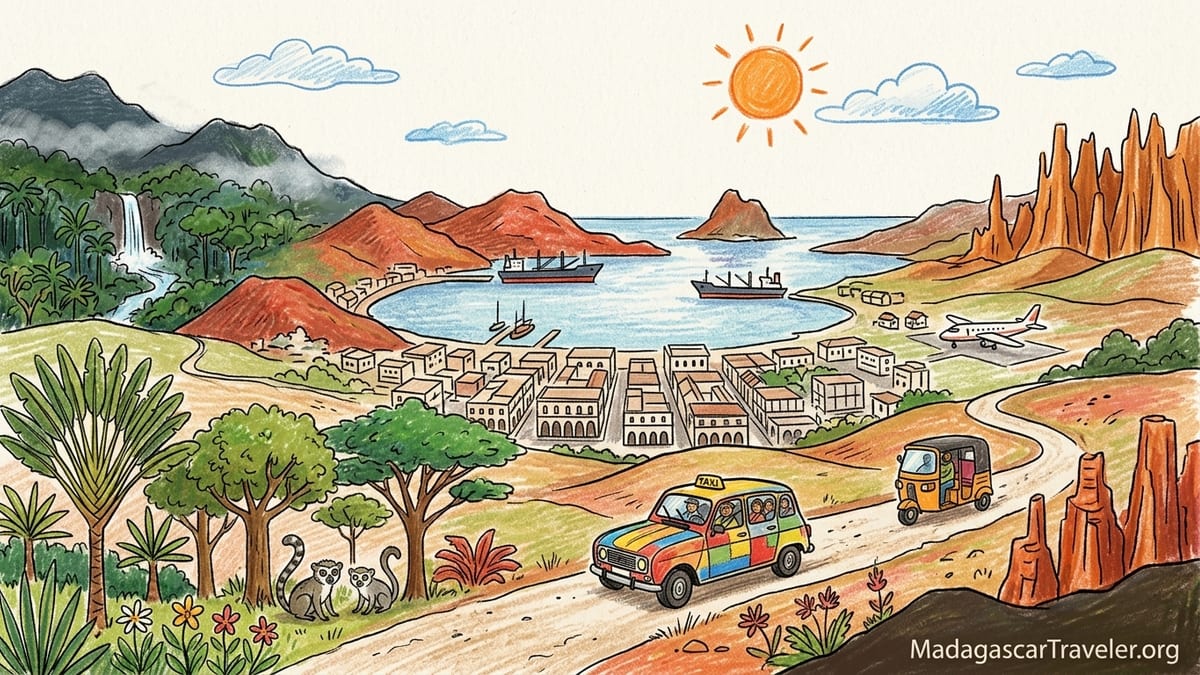
Antsiranana sits on one of the world’s largest natural harbours, a deep indentation on Madagascar’s northern tip. From the seafront boulevard you see rust-red hills, anchored freighters and the outline of the Sugar Loaf islet, Nosy Lonjo. The colonial grid of narrow streets, low-rise buildings and old arcades gives the centre a compact, walkable feel. You can spend a day browsing the market near Rue Colbert, visiting the war cemetery or people-watching at a cafe terrace, but most travelers find that the city itself is not the main reason to come.
The real appeal is how much northern Madagascar you can reach in short hops from Diego. Within a two-hour radius you have the rainforest and crater lakes of Amber Mountain National Park, the sculpted red clay spires of the Red Tsingy, the limestone canyons and caves of Ankarana, and the turquoise lagoon of the Emerald Sea. Few places in Madagascar pack such contrasts into such short distances. A visitor who stays three full days and never leaves the city will miss most of what makes the region special.
That is why many operators describe Diego as the gateway, not the destination. A typical first-time itinerary might use three or four nights in town as a base, plus one or two nights closer to Ankarana or the Red Tsingy. The rhythm becomes simple: sleep in Diego, head out early with a driver or guide, spend the day in a radically different landscape, and return at sunset to a seafront hotel and dinner at a local restaurant.
Compared with more famous Nosy Be, Antsiranana feels more local and less resort-like. There are fewer international-standard hotels, but also fewer crowds and more interaction with Malagasy daily life. For travelers who enjoy variety and are willing to accept basic road conditions in exchange for big rewards, it is among the most satisfying bases in the country.
Arriving via Arrachart Airport and Getting Into Town
Most first-time visitors arrive at Arrachart Airport, a small facility about 6 to 8 kilometres south of the city along the RN6 highway. It serves domestic flights from Antananarivo and, depending on the season and airline schedules, occasional regional services from places such as Réunion or Mayotte. Facilities are simple: expect a single-story terminal, manual baggage handling, and limited services. There is usually a small kiosk selling drinks and snacks, but no elaborate duty-free or lounges.
On arrival, immigration and baggage claim are generally straightforward, although flights can bunch together and create short queues. Many hotels and tour operators offer advance-arranged transfers. If you book with a local agency for a package that includes Amber Mountain or Ankarana, they will typically meet you at the exit with a sign, help with bags and drive you directly to your hotel in town. This is the most stress-free option, especially for late arrivals.
Independent travelers will find taxis and private drivers waiting outside the terminal. Vehicles are often older sedans or 4x4s. Prices fluctuate with fuel costs, but a one-way taxi from Arrachart into central Antsiranana is commonly negotiated in Ariary, usually the equivalent of around 5 to 10 euros for the 15 to 25 minute ride, depending on your bargaining and exact destination. Agree the fare before getting in and confirm whether the price is per car or per person. There is no meter system, so everything is by negotiation.
Public transport from the airport is limited. While the RN6 carries bush taxis and shared minibuses, they do not usually originate at the airport terminal. For a first-time visitor with luggage, it is far more practical to budget for a private taxi or pre-booked transfer. Because flight times can change at short notice, keep one night in Diego at the start of your trip rather than planning to connect directly onward to another region.
Where to Stay and Eat in Diego
Accommodation in Antsiranana ranges from simple guesthouses to a handful of mid-range hotels with bay views. On the seafront, properties like Allamanda Hotel, with its modern rooms and pool looking over the harbour, appeal to visitors who want comfort and a sense of occasion at sunset. In the centre, smaller hotels and family-run guesthouses on and around Rue Colbert offer more budget-friendly rooms and easy access to cafes, markets and taxi stands. Rooms with air conditioning are worth paying for, as heat and humidity can be intense, especially from November to March.
Many travelers divide their stay between town and the countryside. A common strategy is to spend the first and last nights in Diego itself, and use one or two nights at a lodge near Joffreville for Amber Mountain, or near Ankarana for the tsingy. These lodges are usually in a higher price bracket than basic city guesthouses but reduce driving times and allow for early-morning starts in the parks. When comparing prices, keep in mind that some rural lodges include breakfast and occasionally dinner, which can offset costs.
Eating out in Antsiranana is part of the experience. On and near Rue Colbert you will find small restaurants serving a mix of Malagasy dishes, simple French-inspired plates and seafood. Daily catches might include zebu brochettes, grilled fish with rice and laoka (side dishes), or octopus in coconut sauce. Prices for a main course in a modest local restaurant are often in the range of a few euros equivalent, while more polished venues on the seafront can charge slightly more, especially for imported drinks and wine.
Vegetarians can usually find rice with vegetable stews, omelettes, or pasta, though options may be limited compared with larger cities. Many visitors drink bottled water and avoid raw salads unless they trust the restaurant’s hygiene. Coffee is widely available in the mornings, and some cafes open early enough for a quick espresso before a day trip. Because nightlife is low-key, most people dine between 19:00 and 21:00 and are back at their hotels soon after, resting for the next excursion.
Getting Around: Taxis, Drivers and Tour Logistics
Within Antsiranana, the most visible transport icon is the fleet of ageing Renault 4 taxis, often painted in bright colours and patched with repairs. These taxis operate without meters, so you negotiate fares in advance. Short hops within the city centre commonly cost the local equivalent of one or two euros. For slightly longer runs, such as from the centre to the seafront hotels or to the Cotisse intercity transport station, fares rise modestly. Many visitors also use three-wheeled tuk-tuks, known locally as bajaj, which can be even cheaper for quick trips.
For excursions beyond the city, a private driver with a car or 4x4 is almost essential. Road conditions vary from paved but potholed highways like the RN6, to graded dirt tracks leading to the Red Tsingy or certain viewpoints. Tour operators based in Diego, as well as independent guides, typically offer day trips that bundle together vehicle, driver, local guide in the park and picnic lunch. For example, a full-day guided outing to Amber Mountain or the Emerald Sea sold by reputable agencies often falls in the broad range of around 80 to 150 euros per person, depending on group size, inclusions and season.
Self-driving is possible but not usually recommended for first-time visitors unfamiliar with Malagasy road etiquette and conditions. Distances may look short on the map, but progress can be slow because of potholes, livestock and occasional river crossings. A drive from Diego to the Red Tsingy can take around two hours and to Ankarana anywhere from two to four hours. Many travelers who tried to arrange everything independently eventually opt for a local operator because of the convenience of door-to-door logistics and their ability to adjust plans if there is unexpected rain or roadworks.
If you are on a tighter budget, you can still reach some sites by combining public transport and local hires. For example, you might take a bush taxi south on the RN6 to a junction, then hire a motorcycle taxi or 4x4 for the last stretch to a park entrance. However, this can become complicated and time-consuming. For a first visit focused on nature excursions, paying for at least a few organized day trips is usually a good value, both in time saved and in safety.
Ramena, Three Bays and the Emerald Sea
Just east of Antsiranana, the coastline opens out into a string of bays and beaches that feel worlds away from the bustle of town. Ramena, a fishing village roughly 18 to 20 kilometres from the centre, sits on a long curve of white sand backed by simple houses, palm trees and casual seafood eateries. Shared taxis and collective minibuses run this route along the N59b, and private taxis or drivers can cover the distance in about 20 to 30 minutes. Many visitors stay in an inexpensive guesthouse in Ramena for a night or two to enjoy quieter evenings by the water.
From Ramena you can walk or drive to the celebrated Three Bays: Baie des Sakalava, Baie des Pigeons and Baie des Dunes. The classic outing is a part-walk, part-vehicle loop that might begin at Sakalava Bay, popular with kitesurfers, then follow coastal paths past dunes and viewpoints, ending at Ramena where your driver collects you. The terrain is not technically difficult, but sun exposure is intense. Carry plenty of water, a hat and reef-safe sunscreen. Local guides are easy to hire in the village or through agencies in Diego, and often include a simple picnic on the sand.
Further offshore lies the Emerald Sea, or Mer d’Émeraude, a shallow lagoon separated from the open Indian Ocean by a line of reefs and islets. Its intense turquoise colour on a clear day is one of the north’s most photogenic sights. Reaching it involves a drive to Ramena or another coastal departure point, then a 45 to 75 minute ride by motorboat or traditional pirogue across the bay. Excursions typically last five to eight hours, including beach time on a sandbank, snorkelling in calm waters and a grilled seafood lunch served picnic-style under makeshift shade.
Prices for Emerald Sea trips vary by operator and group size but commonly start from a modest double-digit euro amount per person for a shared boat, including lunch and basic snorkel gear. Private sailboat or catamaran charters cost more but provide extra space and flexibility with timing. When comparing offers, ask specifically what is included, whether life jackets are provided, and how they handle changing weather or strong winds. Because the lagoon is shallow, departures may be affected by tides and swell, and your guide will often recommend the calmest days early in your stay.
Amber Mountain, Red Tsingy and Ankarana National Park
To the south of Antsiranana, the landscape shifts dramatically from dry coastal scrub to cool, misty forest. Amber Mountain National Park, reached by road in roughly one hour from Diego, rises to over 1,400 metres and catches moisture from passing clouds. The result is a green island of montane rainforest filled with waterfalls, crater lakes and a network of walking trails. Most visitors base themselves either in Diego or in the nearby village of Joffreville, where a cluster of lodges offers quicker access to the park gate.
Entry fees for parks in northern Madagascar are typically charged per person per day in Ariary, with guides paid per group. Exact amounts change regularly, but a visitor can expect to pay the equivalent of a few euros for entrance and a similar figure for a half-day or full-day guide, with transport additional. Guides are mandatory in Amber Mountain and worth their cost, not only to navigate the trail network but also to spot leaf-tailed geckos, chameleons and, with luck, crowned lemurs in the canopy. Standard hikes visit waterfalls like Cascade Sacrée and crater lakes wrapped in dense vegetation.
Continuing south from Amber Mountain on the RN6 brings you to the Red Tsingy, an area of fragile red laterite pinnacles carved by erosion. The turnoff is on a dirt road that can be rough in the rainy season and is best attempted with a 4x4. From Diego, the drive to the Red Tsingy viewpoint often takes around two hours. Visitors walk on marked paths and viewing platforms above the formations, which glow in shades of copper and orange in the afternoon light. It is a visually striking site, but also fragile; staying on the walkways and respecting park rules is essential to avoid damaging the soft clay.
Further along the same highway, usually another one to two hours from the Red Tsingy turnoff, lies Ankarana National Park. Here, limestone has been sculpted into a jagged forest of grey tsingy, pierced with canyons and caves. Trails range from short walks to hanging bridges over sinkholes and longer treks that reach panoramic viewpoints over the tsingy fields. Many itineraries include one night at a lodge near the park so travelers can explore in the cooler hours. For a first-time visitor based in Diego, combining the Red Tsingy and Ankarana in a one-night, two-day circuit is one of the most rewarding excursions in northern Madagascar.
How Many Days to Spend and Sample Itineraries
Because Diego functions as a hub for very different landscapes, trip length matters. For a first visit with a focus on nature and scenery, four full days in the region is a practical minimum. This allows you to spend one day on the Emerald Sea, one day in Amber Mountain, and one combined day for Ramena and the Three Bays, with a spare day that can be used for a city walk or a half-day excursion. Travelers with more time can add an overnight loop south to the Red Tsingy and Ankarana.
A common pattern for a six-night stay might look like this in practice. Day 1: arrive via Arrachart Airport, transfer to a seafront hotel in Diego and stroll the town in the late afternoon. Day 2: full-day tour to Amber Mountain with a guide, returning to Diego at dusk. Day 3: Emerald Sea excursion with boat, snorkelling and beach lunch. Day 4: Ramena and Three Bays walk, finishing with sunset drinks at a simple beach bar. Day 5 and 6: two-day circuit to the Red Tsingy and Ankarana with an overnight near the park, returning to Diego on the evening of day 6 and flying out the next morning.
Those with only three full days can still see a lot by prioritizing. You might choose Amber Mountain and the Red Tsingy on a long but manageable day trip, and dedicate the remaining full day to either the Emerald Sea or Ankarana, accepting that you will leave some highlights for a future visit. Because weather, especially wind on the lagoon, can affect sea excursions, it is wise to book the Emerald Sea early in your stay so you have room to reschedule.
Ultimately, the right length depends on your pace and interests. Wildlife enthusiasts often want more time in Amber Mountain and Ankarana to look for lemurs and endemic reptiles. Beach-focused visitors may spend extra nights in Ramena and limit inland trips. What unites most first-timers who leave satisfied is that they treat Diego as a multi-day hub, not a quick overnight transit point, and allocate at least two or three full days to excursions into the surrounding landscapes.
The Takeaway
Antsiranana is one of those places where the map does not tell the full story. On paper, it is a small city at the end of a road, far from Madagascar’s other hubs. On the ground, it is a rare crossroads of rainforest, tsingy, bays and lagoons within reach of a simple taxi ride or day tour. First-time visitors who come only for the colonial streets and harbour views are usually surprised by how quickly they start planning extra days to see what lies beyond.
If you approach Diego as a base rather than a stand-alone attraction, planning becomes easier. Secure a comfortable hotel in town, arrange a few key excursions with reputable local guides, and be flexible with your schedule for weather and road conditions. Expect modest infrastructure and the occasional delay, but also expect mornings in cool cloud forest, afternoons among red spires, and evenings on a terrace overlooking one of the Indian Ocean’s great natural bays.
Above all, remember that the greatest reason to stay in Antsiranana is its access to northern Madagascar’s unusually varied landscapes, not a checklist of city sights. The colonial heritage and harbour atmosphere are part of the appeal, but it is the combined experience of sea, forest and stone that makes this corner of the island linger in memory long after the journey home.
FAQ
Q1. How many days should a first-time visitor spend in Antsiranana?
Most first-time visitors should plan at least four full days in the region, which allows time for the Emerald Sea, Amber Mountain, Ramena and the Three Bays, plus either the Red Tsingy or Ankarana.
Q2. Do I need a 4x4 to visit Amber Mountain, Red Tsingy and Ankarana?
You do not need to drive yourself, but your tour operator or hired driver will usually use a 4x4, especially for the dirt access roads to the Red Tsingy and some sections around Ankarana.
Q3. Is Antsiranana safe for independent travelers?
The town is generally calm, and most visits pass without incident. Standard precautions apply: avoid walking in poorly lit areas at night, keep valuables out of sight and use registered taxis or known drivers.
Q4. Can I visit the Emerald Sea and Amber Mountain in a single day?
Technically it is possible but not recommended. Each site deserves a full day, and combining them would mean rushed visits, long hours in vehicles and little margin for weather or delays.
Q5. What is the best time of year to visit Diego Suarez and its surroundings?
Conditions are usually most comfortable during the drier, cooler months, roughly from May to October, when rain is less frequent and hiking trails are easier to manage.
Q6. Are guided tours necessary in the national parks?
Guides are mandatory in parks like Amber Mountain and Ankarana and are highly valuable. They know the trails, help with safety and greatly increase your chances of seeing wildlife.
Q7. How much should I budget for day tours from Diego?
Prices vary, but many full-day excursions that include transport, guide services and a simple lunch fall in a broad range from the equivalent of 80 to 150 euros per person, depending on group size and inclusions.
Q8. Is it better to stay in Diego or Ramena for the beach?
For beach time, Ramena offers a quieter setting directly on the sand. Many travelers split their stay, using Diego as a base for inland tours and Ramena for one or two relaxed nights by the sea.
Q9. Can I use public transport to reach the main sights?
Shared taxis and bush taxis run along main roads, but they rarely drop you directly at park entrances. For a first visit, combining public transport with locally arranged drivers or tours is usually the most practical compromise.
Q10. Is Antsiranana a good choice for families with children?
Families who enjoy nature and do not mind basic infrastructure often find the region rewarding. Calm lagoon waters, short forest walks and close wildlife encounters can be memorable, provided you plan rest days and sun protection.