


Northern Madagascar offers two magnetic bases for travelers short on time: Antsiranana, better known as Diego Suarez, on the mainland and Nosy Be, the country’s most developed island escape. Both sit in the same broad region, yet they deliver very different trips. One centers on national parks, rugged overland journeys and wild bays; the other focuses on boat trips, diving, snorkeling and easy-going resort life. If you cannot fit in both, choosing the right base can make or break your northern Madagascar itinerary.
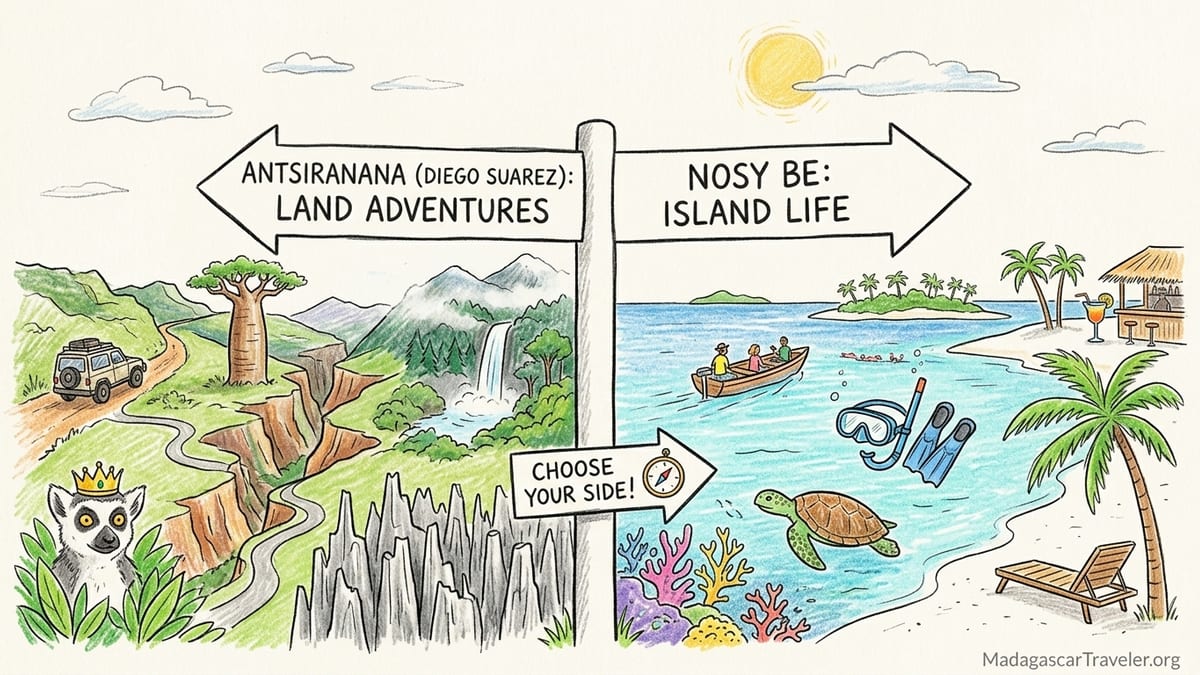
Big Picture: Land Adventures vs Island Life
Antsiranana and Nosy Be are only a short regional flight apart, but the experiences on offer feel worlds away. Diego Suarez is the logical hub for exploring mainland highlights such as Amber Mountain National Park, the Red Tsingy formations, Ankarana National Park and the Three Bays coastline. Expect long days in 4x4s on potholed roads, guided hikes through forest and limestone canyons, and windswept beaches popular with kitesurfers rather than sun‑loungers.
Nosy Be, by contrast, is all about the sea. The island is ringed by small offshore islets where you can snorkel reefs, dive steep walls, search for whale sharks in season and unwind at comfortable beach hotels. A typical day might be a boat trip to Nosy Tanikely marine reserve for snorkeling with turtles, lunch on Nosy Komba watching black lemurs in village trees, then sunset cocktails back at a resort in Madirokely or Ambondrona.
In practical terms, Diego suits travelers who prioritize land‑based wildlife and dramatic landscapes, are comfortable with imperfect infrastructure and want a more “Madagascar as it is” feel. Nosy Be suits those looking for a softer landing: better choice of midrange and upscale hotels, straightforward logistics, reliable boat excursions and a social scene that can include beach bars and low‑key nightlife. Many forum discussions where travelers compare the two end up circling this same distinction: Diego for parks and adventure, Nosy Be for sea and relaxation.
If your trip is short, trying to do both often means losing two valuable days to transfers. With internal flights limited and road journeys slow, most recent travelers who reported smooth trips chose one base and explored that region in depth rather than racing between the two.
National Parks & Landscapes: Amber Mountain, Red Tsingy and Ankarana vs Marine Reserves
Antsiranana’s biggest argument is its access to some of northern Madagascar’s most impressive land‑based protected areas. Amber Mountain National Park sits about an hour to ninety minutes’ drive inland, a cool, misty montane rainforest where guided day walks reveal waterfalls, crater lakes, leaf‑tailed geckos and several lemur species. Many visitors base themselves in Diego or nearby Joffreville and arrange full‑day excursions with local guides, paying a modest park fee plus guide cost and a 4x4 transfer.
South of Diego, Ankarana National Park offers a very different landscape: razor‑sharp limestone tsingy pinnacles, bat caves and hanging bridges. Reaching Ankarana typically involves a long 4x4 journey on Route Nationale 6, which is paved but slow, followed by half‑day or full‑day hikes inside the park. Travelers commonly report seeing crowned and Sanford’s brown lemurs along the trails, as well as impressive cave systems and viewpoints over the tsingy fields. Nearby, the Red Tsingy provides a striking detour, with eroded red sandstone spires that glow in late afternoon light, usually combined with an Ankarana loop.
Nosy Be’s protected areas are mostly marine. The small island of Nosy Tanikely is effectively a natural aquarium: boat trips from Nosy Be or Nosy Komba bring snorkelers to shallow reefs where green turtles graze on seagrass and schools of reef fish patrol the drop‑off. Some operators run combined day tours that include a visit to Nosy Komba’s village and lemur sanctuary plus Tanikely snorkeling, with prices often in the range that midrange travelers would consider reasonable for a full‑day guided excursion including lunch and basic gear.
On Nosy Be itself, Lokobe Reserve protects one of the island’s last pockets of primary forest. Accessed by pirogue through mangroves from the village of Ambatozavavy, Lokobe offers the chance to see nocturnal lemurs, chameleons and endemic tree species on guided walks. Compared with Amber Mountain and Ankarana, however, Lokobe is small and the island’s forest is more fragmented, so travelers who are primarily interested in Madagascar’s classic rainforest and canyon hiking often feel that Diego’s parks offer a deeper land‑based nature experience.
Beaches, Bays & Kitesurfing vs Classic Island Beaches
Diego Suarez does not have the instantly postcard‑perfect beaches some expect from the Indian Ocean, but it excels in atmosphere and seascapes. The famed Three Bays, typically visited on a day trip by 4x4 and on foot, include Sakalava, Pigeon and Dunes bays. These long arcs of pale sand and turquoise water are often nearly empty, save for a handful of kitesurfers and local fishermen. Sakalava Bay, in particular, has become a kitesurfing hotspot thanks to steady winds during the southern winter months, drawing riders to a few simple ecolodges and kite schools.
Another major draw from Diego is the so‑called Emerald Sea, a shallow lagoon north of the town. Day trips run in traditional pirogues or small motorboats, taking visitors across electric‑green water to sandbank islands where simple seafood lunches are served under thatch. These outings are less about luxury and more about the adventure of getting there, with basic facilities and a strong sense of being far from the mainstream resort circuit.
Nosy Be, on the other hand, offers exactly the sort of beaches many people picture when they imagine an Indian Ocean holiday. Madirokely and Ambatoloaka host the busiest strips, with a line of small hotels, beach bars and restaurants facing the bay. Farther north and west, areas such as Ambondrona, Andilana and the island’s more secluded coves offer calmer settings, with resorts backing directly onto fine sand and shallow swimming water. Nosy Sakatia, a short boat ride away, has low‑key lodges and a marine turtle reserve off its beaches, while Nosy Iranja’s twin sandspit is a popular goal for full‑day boat trips.
For pure beach idling, easy swimming and sunset drinks, Nosy Be clearly has the edge. Diego’s coastline feels wilder and windier, with fewer shaded loungers and more exposed, empty stretches suited to walking, kitesurfing or photography rather than long days of flat‑calm bathing.
Diving, Snorkeling & Whale Sharks vs Land Wildlife
If marine life is a priority, Nosy Be is the stronger choice. Dive centers in Ambatoloaka and around the island run daily trips to offshore sites such as the Nosy Be archipelago reefs and pinnacles. Conditions are generally best from about April to December, with whale shark season typically peaking from mid‑October to mid‑December when operators offer dedicated snorkeling outings to look for these gentle giants at the surface. Reputable operators emphasize a code of conduct that keeps a respectful distance and limits the number of swimmers in the water with each animal.
Snorkeling is accessible even to non‑divers. Many visitors report seeing turtles, colorful reef fish and healthy coral gardens on trips to Nosy Tanikely, Sakatia’s turtle reserve and shallower fringing reefs. Prices for shared boat excursions usually sit in the range of a typical full‑day activity elsewhere in the Indian Ocean region, including a simple Malagasy lunch and guiding. Nightlife often revolves around these same diving communities, with a social atmosphere in beach bars after the boats return.
Diego Suarez has some coastal snorkeling opportunities around the Emerald Sea and nearby islets, but it is not a major diving destination. Instead, the wildlife stars are on land. Amber Mountain’s cool forest supports crowned lemurs, Sanford’s brown lemurs, a wide range of chameleons and endemic birds. Ankarana hosts several lemur species, bats in cave chambers and a rugged tsingy ecosystem that feels far removed from the beach‑and‑cocktails scene. Travelers who come mainly for Madagascar’s mammals, reptiles and forest trails usually feel they get more value per day around Diego than on Nosy Be, especially when combining multiple parks.
For many itineraries, the trade‑off is clear: choose Nosy Be if swimming with whale sharks, frequent snorkeling or logging a dozen dives is central to your trip; choose Diego if your vision of Madagascar centers on walking through rainforest, exploring canyons and seeing lemurs in more natural, less curated settings.
Hotels, Nightlife & Atmosphere
The hotel landscape around Diego Suarez is more limited and simpler than Nosy Be’s, but it has improved in recent years. In town, small city hotels cater mainly to business travelers and short stays; most leisure visitors prefer to stay in Ramena village near the Three Bays or at small ecolodges near Sakalava Bay and other beaches. These range from very basic bungalows with intermittent hot water to midrange boutique properties with pools and landscaped gardens. Nightlife in Diego itself exists but is low‑key, with a handful of local bars and restaurants; Ramena is even quieter, with dinners often taken in‑house at lodge restaurants.
Nosy Be has a much broader spread of accommodation, from backpacker guesthouses in Ambatoloaka to polished boutique resorts on quieter stretches of coast and a handful of upmarket lodges on private or semi‑private islands such as Nosy Komba and Nosy Sakatia. Many properties have in‑house dive centers or partner closely with external operators, making it easy to book activities at reception. Some lodges include half‑board or full‑board in their nightly rates, which can help with budgeting when local restaurant options are limited.
In terms of nightlife, Nosy Be is the clear winner. Ambatoloaka in particular has a reputation for beach bars, live music nights and a social, sometimes rowdy atmosphere, especially during high season and weekends. Travelers looking for a quieter stay usually base themselves in Madirokely, Ambondrona or more remote bays, driving or taking a taxi in for the occasional evening out. By contrast, Diego is a functional provincial town with a port and garrison feel; some repeat visitors recommend using it simply as a logistical hub and spending most nights in nearby beach villages rather than expecting a polished seafront promenade.
For atmosphere, the choice comes down to taste. Diego and its surroundings feel more Malagasy, with fewer international chains, more French‑influenced colonial architecture in town and a stronger sense of day‑to‑day local life. Nosy Be, particularly its main tourist strip, can at times feel like an international bubble oriented to foreign visitors, though staying on Nosy Komba, Sakatia or in smaller coastal communities can soften that impression.
Transport, Trip Length & Ease of Travel
Both Diego Suarez and Nosy Be are reached primarily by air from Antananarivo and, for some routes, from regional hubs. Antsiranana’s Arrachart Airport usually has a handful of weekly domestic flights, and Nosy Be’s Fascene Airport is one of the country’s busier gateways, with domestic services and a small number of international links from regional cities. Between the two, there may be a limited direct flight each week, but schedules change often, so most travelers either connect through Antananarivo or travel overland via the RN6 highway and ferry crossings.
Overland, the roughly 300 to 350‑kilometre journey between Diego and the Nosy Be ferry at Ankify can easily take a full day in a private 4x4 due to road conditions and slow traffic. Many recent travelers report spending 8 to 10 hours on the road, sometimes more in the rainy season. Once at Ankify, small ferries and speedboats connect to Nosy Be. Because of these slow transfers and the risk of flight changes, most independent travelers recommend allocating at least two to three weeks if you truly want to combine Diego, its parks and Nosy Be in a single trip without feeling rushed.
If your total time in Madagascar is 10 to 14 days, the most realistic approach is to choose either Diego and the northern parks or Nosy Be and its archipelago. For Diego, a common pattern is 3 to 4 nights in or around the city for Emerald Sea and Three Bays trips, 2 to 3 nights near Amber Mountain and 2 to 3 nights around Ankarana, often in small lodges near the park gates. For Nosy Be, many visitors spend a week split between a main island base such as Ambondrona or Madirokely and a quieter stay on Nosy Komba or Sakatia, with one or two full‑day boat excursions.
Within each base, movement is easier. On Nosy Be, taxis, hotel transfers and pre‑booked boats handle most logistics, and roads on the island are short even if sometimes potholed. Around Diego, hiring a private 4x4 with driver‑guide is strongly recommended for Amber Mountain, Ankarana and Red Tsingy, with costs shared between passengers. Public transport exists in the form of bush taxis, but the combination of long travel times, irregular schedules and safety considerations makes private transport the more realistic option for most short‑term visitors.
Costs, Safety & Who Each Destination Suits
Daily budgets in both Diego and Nosy Be can be moderate by international standards, but costs add up differently. Around Diego, accommodation can be relatively affordable, especially in simple guesthouses, but you may spend more on private 4x4 transfers and guided park visits. In Nosy Be, midrange and upscale hotels command higher nightly rates, but shared boat excursions and the ability to walk or take short taxi rides between beaches can keep day‑to‑day transport costs down.
In terms of safety, northern Madagascar is generally perceived as calmer than some other regions, though basic precautions still apply. Recent visitors often describe Nosy Be as feeling safer and more relaxed for solo travelers, with a more established tourism infrastructure, while the Diego area rewards those who arrange logistics with reputable operators or driver‑guides and avoid driving at night. In both places, theft of unattended valuables can occur on beaches or in towns, so standard travel common sense is essential.
Diego Suarez is best suited to adventurous travelers, photographers, hikers and anyone who wants to see a cross‑section of Madagascar’s emblematic landscapes without attempting the long RN7 route in the south. Couples and small groups who are comfortable on bumpy roads and do not need polished nightlife will likely appreciate the variety of Amber Mountain, Ankarana, Red Tsingy, Emerald Sea and the Three Bays within a compact region.
Nosy Be works well for first‑time visitors seeking a straightforward beach and marine‑life holiday with a Malagasy twist. It is particularly appealing for divers, honeymooners who want comfort without extreme isolation, and families looking for calm swimming water and short boat trips. Those who dream of whale shark encounters, sunset catamaran cruises and lazy days on resort beaches will find more of what they want around Nosy Be than in Diego.
The Takeaway
If you have to choose just one northern base, your decision hinges on whether you are more excited by parks and overland adventure or by marine life and island hopping. Diego Suarez delivers Amber Mountain’s misty forest, Ankarana’s tsingy canyons, the sculpted Red Tsingy and wild bays that feel far from the classic resort circuit. It asks more from travelers in terms of comfort and patience on the road, but it rewards that effort with uniquely Malagasy landscapes and a stronger sense of being on the mainland.
Nosy Be offers a softer landing, with a wide range of hotels, established dive centers, easy access to snorkeling reefs and a busy little island nightlife. Its surrounding islets, from Nosy Komba to Nosy Sakatia and Nosy Iranja, make it easy to spend several days on the water without complicated logistics. For many visitors on a first or short trip, especially those who value relaxation and sea life over long 4x4 journeys, Nosy Be is the more practical choice.
For travelers with the time and budget, combining both makes for a superb three‑week itinerary: a week of hiking and tsingy in the Diego region followed by a week of diving and island hopping around Nosy Be, with buffer days for the inevitable travel delays. For everyone else, being honest about your priorities is key. If you picture boots on the trail and lemurs in the trees, head for Diego. If you dream of fins in the water and sunsets over calm bays, base yourself on Nosy Be.
FAQ
Q1. If I can only choose one, should I pick Antsiranana (Diego Suarez) or Nosy Be?
For land‑based national parks, hiking and tsingy landscapes, Diego is the stronger choice. For easy beaches, diving, snorkeling and whale shark trips, Nosy Be usually makes more sense.
Q2. How many days do I need in Diego Suarez to see Amber Mountain, Red Tsingy and Ankarana?
Plan at least 6 to 8 full days: 1 to 2 days for Amber Mountain, 2 to 3 for Ankarana, a half‑day to full day for Red Tsingy and a couple of days for the Emerald Sea and Three Bays.
Q3. How long should I stay on Nosy Be for diving and island trips?
A week is a comfortable minimum. That allows a mix of rest days, 3 to 4 dive or snorkel days and at least one full‑day excursion to islands such as Nosy Komba, Tanikely or Nosy Iranja.
Q4. Is it realistic to combine Diego Suarez and Nosy Be on a two‑week trip?
It is possible but tight. Overland transfers or flight changes can consume 2 to 3 days. Most travelers with 10 to 14 days find it more relaxing to choose one base and explore that region well.
Q5. Which destination is better for seeing lemurs in the wild?
Diego has the edge for wild lemur sightings in large national parks such as Amber Mountain and Ankarana. Nosy Be offers more curated encounters, especially on Nosy Komba and in Lokobe Reserve.
Q6. When is whale shark season in Nosy Be?
Whale sharks are typically seen off Nosy Be from around September to December, with a peak in mid‑October to mid‑December. Outside this period, sightings are much less reliable.
Q7. Is Nosy Be safer than the mainland for solo travelers?
Nosy Be generally feels more structured and manageable for solos, with concentrated tourist areas and established operators. Diego is still accessible but benefits more from pre‑arranged guides and drivers.
Q8. Do I need a 4x4 to visit the parks around Diego Suarez?
A 4x4 with driver is strongly recommended for Amber Mountain, Ankarana and Red Tsingy, both for comfort and safety. Public transport is slow and not ideal for short visits.
Q9. What type of traveler will enjoy Diego more than Nosy Be?
Hikers, photographers, wildlife enthusiasts and those who enjoy offbeat destinations and do not mind basic infrastructure tend to prefer Diego and its surrounding parks and bays.
Q10. What type of traveler will enjoy Nosy Be more than Diego?
Divers, snorkelers, honeymooners, beach lovers and travelers seeking a relatively easy, resort‑style base with organized day trips and some nightlife are usually happier on Nosy Be.