


Antsiranana, still widely known as Diego Suarez, is the natural gateway to Madagascar’s far north: the Emerald Sea, the Three Bays, Amber Mountain and remote northern beaches. Where you choose to sleep here shapes your entire trip. Stay in central Diego for restaurants and nightlife, Ramena for easy beach days and Emerald Sea excursions, Sakalava Bay for kitesurfing, or one of the quiet, isolated bays if you want to unplug completely. This guide compares the main areas, using real hotels and on-the-ground practicalities to help you pick the right base.
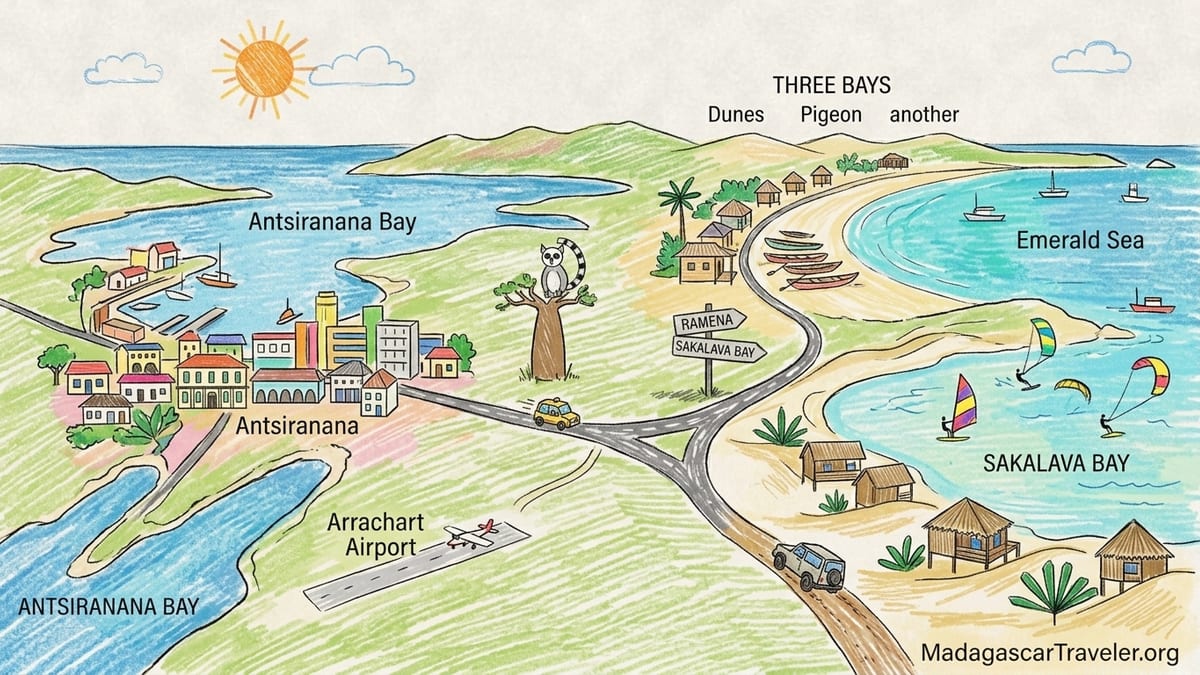
Understanding the Layout of Diego Suarez and Its Bays
Antsiranana city sits at the innermost point of a huge natural harbor on Madagascar’s northern tip, with a peninsula that stretches east toward Ramena and the Three Bays. Arrachart Airport is a short drive south of the city, so almost every journey begins or ends in central Diego. From the city, a sealed road heads east to Ramena village and continues on to the more remote bays, including Sakalava Bay, Dunes Bay and Pigeon Bay.
Ramena lies roughly 18 to 20 kilometers from Diego along the paved National Road 59b, usually about 40 to 45 minutes by taxi depending on traffic and roadworks. Sakalava Bay is a little further again along the same coast and accessed by a track off the main road. Many lodges estimate 45 to 60 minutes from Diego to Sakalava, depending on the condition of the last unpaved stretch. This means you can, in theory, day trip between the city, Ramena, and Sakalava, but travel time and road quality encourage choosing one area as your main base.
Emerald Sea and the Three Bays excursions generally depart either from Ramena beach or small embarkation points along the peninsula. Most city hotels and kite lodges can arrange transport to departure points. That said, your base will influence how early you need to start your day and whether you are first or last back on the boat. Beach quality, restaurant choices and nightlife also shift dramatically from downtown Diego to the sleepy kitesurf lodges scattered along Sakalava Bay, so thinking through your priorities before booking is essential.
Staying in Central Diego Suarez: Convenience and Urban Energy
Central Diego Suarez is the most practical choice if you want restaurants, bars and easy access to everyday services. Around streets like Rue Colbert and the seafront boulevard, you will find a cluster of midrange hotels and guesthouses, often in restored colonial buildings or mid-century blocks. Properties such as Hotel de la Poste or similar long-established addresses typically offer air-conditioned rooms, on-site restaurants, a bar and reliable mains electricity, which can be a relief after long journeys on the RN6.
From a logistics point of view, Diego is closest to Arrachart Airport. In normal conditions, the drive into town can take as little as 15 to 20 minutes by taxi. Many hotels can arrange airport pickups, and independent taxis wait outside arrivals for a set fare that visitors usually negotiate in advance, often in Malagasy ariary equivalent to roughly 10 to 20 US dollars. If you are arriving on a late flight or only have one or two nights before heading inland toward Amber Mountain or Ankarana, staying in the city minimizes transfers and makes early-morning departures much easier.
City stays are also best for restaurant access and nightlife. You can step out of your hotel and find local hotely eateries serving rice and zebu stews, pizzerias, simple seafood grills and a few more polished venues popular with NGO staff and tour groups. After dark, some bars and clubs open late by local standards, though nightlife is modest compared to big African cities. Taxis around town are plentiful and relatively cheap, so you rarely need a private driver if you are only moving between city hotels, restaurants and the waterfront.
The trade-off is that Diego itself is not a beach destination. The harbor is impressive but not ideal for swimming, and you will need to organize day trips to Ramena or the Three Bays to enjoy the sand and open water. Safety is generally better than in the capital Antananarivo, but normal city precautions apply: avoid walking long distances late at night, keep valuables discreet, and use trusted taxis arranged by your accommodation when in doubt.
Ramena Village: Classic Beach Vibe and Emerald Sea Access
Ramena is the classic seaside choice for travelers who want sand and sea at their doorstep without giving up access to tours and basic services. This fishing village sits on a long crescent of beach that functions as the de facto “city beach” for Diego. The bay here is more sheltered than Sakalava, so Ramena’s water is generally calmer and better for casual swimming, paddling with children or simply watching the fishing pirogues come and go.
Accommodation in Ramena runs from simple beach bungalows to modest hotels with sea views. You will see names like Hotel Lakana Ramena or similar local guesthouses listed in regional tourism brochures, typically offering straightforward rooms, mosquito nets, cold or sometimes hot showers and a beachside restaurant. Room prices can start from very affordable local guesthouse rates and rise toward midrange levels in better-equipped properties. Power cuts and patchy water pressure are possible, but many establishments now use solar panels or backup generators to smooth out the worst of the outages.
One major benefit of staying in Ramena is direct access to excursions. Most trips to the Emerald Sea depart from Ramena’s beach, where you will see skippers organizing small boats for shared or private outings. If you are already staying in the village, you can simply walk down to the meeting point; if you are based in Diego you might face a 40 to 45 minute early-morning taxi ride before you even board the boat. Similarly, day hikes and 4x4 tours to the Three Bays often begin near Ramena or along the nearby tracks, so many guides can pick you up directly from your hotel.
Evenings in Ramena are quiet but pleasant. A handful of restaurants and beach bars serve grilled fish, coconut curries and cold drinks, often with tables arranged directly on the sand. After around 10 or 11 pm the village generally winds down, and there is little in the way of organized nightlife compared with Diego. For most visitors, that is part of the appeal. You will still find local taxis and tuk-tuks, but after dark it is common to arrange return trips or next-day pickups through your guesthouse or a trusted driver rather than relying on random vehicles.
Sakalava Bay: Kitesurfing Hub and Dedicated Watersports Lodges
Sakalava Bay is widely regarded as one of Madagascar’s premier kitesurfing and wingfoil spots, thanks to consistent trade winds, a large shallow lagoon and protective reefs that keep the water relatively flat. The bay lies beyond Ramena on the same peninsula, reached via a track that turns off the main road. Travel time from Diego typically ranges from about 45 minutes to an hour depending on vehicle type and road conditions. From Ramena, it is closer, but you will still need a 4x4, taxi or arranged transfer rather than walking.
The accommodation scene here is very different from both Diego and Ramena. Several small eco-lodges and kite camps line the lagoon, purpose-built for riders. Examples include Sakalava Lodge, Madakitecamp, Karibo Kite, Ocean Lodge and KiteParadise Madagascar, all of which focus on beachfront bungalows, full-board meal plans and on-site kitesurf schools. Many of these lodges advertise all-inclusive or semi-inclusive packages that combine accommodation, three daily meals and kite or wingfoil instruction or equipment rental, with indicative weekly packages starting around mid three-figure to low four-figure euro amounts per person.
Because most lodges sit directly on the sand or just behind the first dune, guests can usually launch their kite right in front of their bungalow. On-site IKO-certified schools cater to beginners and intermediates, while experienced riders appreciate the ability to sail out at almost any time during the windy season from roughly late March to mid-December. Facilities have improved markedly in recent years, with many lodges installing Starlink or similar satellite internet in their restaurants and common areas, as well as solar-powered systems that offer a more stable electricity supply than in some villages.
The trade-off for this convenience on the water is relative isolation on land. Outside of lodge restaurants and bars there is virtually no independent nightlife, and non-kitesurfers can sometimes feel confined if they have not planned additional excursions. Lodges often organize day trips to the Emerald Sea, the Three Bays, Amber Mountain or local villages, but almost all of these require advance arrangements and a vehicle. For grocery stores, ATMs or a broad choice of restaurants, you would need to return to Diego, which is usually done by private driver or lodge-arranged taxi rather than casual street hailing.
Quiet Bays and Remote Resorts: Total Escape on the Peninsula
Beyond Sakalava Bay, the coast continues toward wilder, quieter spots such as Dunes Bay, Pigeon Bay and other small coves facing the Indian Ocean. A handful of isolated resorts and guesthouses are scattered in this broader area, sometimes marketed under their own bay names or simply as “northern peninsula” retreats. These stays appeal to travelers who prize peace, nature and seclusion over quick access to restaurants or nightlife.
Properties in these more remote bays tend to be small and low-impact, with a mix of rustic-chic bungalows and simple rooms. Many are run by long-term expat owners or Malagasy families who understand the logistics of life far from the city. Expect solar power, bucket showers if the pump fails and a focus on fresh local produce such as fish, rice, seasonal fruits and vegetables rather than expansive international menus. Some resorts are specifically geared to wind-based sports, while others emphasize snorkeling, stand-up paddleboarding, birdwatching or simply relaxing with a book under a casuarina tree.
From Arrachart Airport, reaching these bays usually means driving into Diego first, then continuing along the peninsula by 4x4. Transfer times can approach 1.5 to 2 hours, particularly if the final section of track is rocky or muddy after rain. These distances are manageable for a week-long stay but less convenient if you plan frequent day trips inland or into town. Excursions to the Emerald Sea or Amber Mountain can still be arranged, but you will need to rely on your resort’s contacts and be comfortable with early starts and longer drives than those staying in Diego or Ramena.
On the upside, the beaches in these bays are typically emptier than Ramena and noticeably quieter than the busy kite lagoon at Sakalava. Night skies are dark enough to show the Milky Way, and you may hear only wind and surf at night. For couples on a romantic break, birders, writers, or anyone seeking a digital detox, this can be the perfect environment. Just remember that shops and pharmacies are far away, so you should arrive with any essential medication, sunscreen, spare contact lenses and other personal items you cannot easily replace locally.
Airport Distance, Transport and Whether You Need a Driver
Most visitors to Antsiranana arrive via Arrachart Airport, a modest regional airport with flights connecting mainly to other Malagasy cities. Central Diego is the closest main accommodation area, with taxis often covering the journey in about 15 to 20 minutes. From the city, Ramena is about 18 to 20 kilometers along a paved road, while Sakalava Bay and the more isolated resorts require additional driving on smaller roads or tracks beyond Ramena. As a rough guide, budget around 45 minutes from Diego to Ramena and 45 minutes to an hour to Sakalava in good conditions, longer after heavy rain.
Independent taxis are common around Diego itself and can be used for short hops within the city, to and from the airport and sometimes out to Ramena. Fares are usually negotiated in advance and paid in cash. For longer distances, particularly to Sakalava Bay, Dunes Bay or Pigeon Bay, many travelers find it simpler and safer to arrange transfers through their hotel or to hire a car with a driver for a day or several days. Local tour operators and guides frequently offer driver services that bundle airport transfers, day trips to Amber Mountain or Ankarana, and beach runs to Ramena or the bays.
Whether you need a dedicated driver depends on your itinerary. If you stay in central Diego and only plan one full-day excursion to Ramena and the Emerald Sea, casual taxis and a single pre-arranged day trip are usually enough. If you base yourself in Ramena and plan to visit Amber Mountain, Sakalava Bay and the Emerald Sea on different days, a driver becomes more practical, since combining public taxis and ad-hoc rides can quickly eat into your time and energy. For guests staying in Sakalava Bay lodges, in-house transfers often cover arrivals, departures and excursions, reducing the need to negotiate with outside drivers.
Driving yourself is technically possible if you rent a 4x4 in Madagascar, but conditions around Diego include variable road surfaces, livestock on the road and limited roadside assistance. For most short-term visitors, especially those unfamiliar with Malagasy traffic customs, a local driver is worth the cost. This is particularly true if you are traveling with kitesurf gear, cameras or young children and want to minimize stress while moving between airport, town, beaches and national parks.
Comparing Beach Quality, Nightlife and Restaurant Access by Area
Beach quality shifts dramatically as you move along the peninsula from Diego to Ramena and beyond. Diego itself is a working harbor with impressive views but little in the way of swimmable sand near the city center, so beach time usually means a day trip. Ramena offers a broad sandy bay with gently shelving water suitable for casual swimming, sunbathing and beach football. Sakalava Bay, by contrast, is oriented toward wind sports: the lagoon is shallow and sandy-bottomed but choppy when the trade winds blow, making it perfect for kitesurfing and wingfoiling rather than tranquil floating.
Further out, quiet bays and remote resorts may sit on beaches that face either the lagoon or the open ocean. These can be spectacular but sometimes less sheltered, with stronger currents and waves. Lodges typically advise guests where it is safe to swim or snorkel directly from the beach and when to wait for calmer conditions. Regardless of where you stay, reef shoes are sensible for exploring rocky sections, and sunscreen and sun-protective clothing are essential, as UV levels in northern Madagascar can be intense even on cloudy days.
Nightlife is another major differentiator. Central Diego offers the liveliest scene, with a mix of Malagasy bars, hotel lounges and a few basic clubs or late-opening venues. You can dine at one restaurant and move on to another bar afterward without needing a car, which suits sociable travelers and solo visitors who like to meet others on the road. Ramena shifts the focus to sunset drinks and early nights, with a handful of beach bars closing not long after dinner service. Sakalava Bay and the remote resorts tend to rely on their own in-house bars, where socializing means chatting with fellow guests over a post-session drink rather than going “out” elsewhere.
Restaurant access follows a similar pattern. Diego provides the widest range, from local eateries serving hearty rice plates for well under 10 US dollars to midrange restaurants with seafood, French-influenced cuisine and simple vegetarian options. Ramena’s choice narrows to a strip of beachfront restaurants attached to guesthouses and small hotels, while Sakalava Bay and isolated bays mostly operate on full board or half board systems. That can be a relief for riders who want to think only about wind and waves, but less ideal if you enjoy picking a new restaurant each night. Vegetarians and vegans should especially communicate dietary needs in advance when booking more remote accommodation so the kitchen can plan accordingly.
Which Area is Best for You?
The ideal base around Antsiranana depends on your priorities, trip length and travel style. If you are visiting for just a few nights and want a straightforward base for city exploration, restaurant hopping and day trips to Amber Mountain or Ramena, central Diego is the smart option. You will be closest to the airport and most tour operators, and you can drop into a travel agency or guide office in person to arrange last-minute excursions. Travelers on a tighter budget also find more low-cost guesthouses and local eateries in the city than at the beach lodges.
If daily beach time and a relaxed coastal atmosphere matter more than nightlife, Ramena strikes a good balance. You can swim and walk along the sand whenever you like, have immediate access to Emerald Sea outings, and still be within a taxi ride of Diego for errands or a change of scene. Families who want their children to play safely on the beach but do not need organized kids’ clubs often find Ramena an easy fit, especially when they choose a guesthouse directly on the sand.
Sakalava Bay is the obvious choice if your trip revolves around kitesurfing, wingfoiling or windsurfing. Staying in a dedicated kite lodge removes most logistics: equipment is on-site, instructors are nearby, and the best riding hours are visible from your breakfast table. Non-rider partners should check that their lodge offers alternative activities, such as stand-up paddleboards, yoga platforms, massages or guided walks, so they do not feel stranded when the wind is strong. Finally, if your dream is to disconnect from crowds and screens, or to spend a full week focused on nature, birdlife and empty beaches, one of the smaller remote bays can be a standout choice.
In practice, some travelers split their time: two nights in Diego to handle logistics and explore the harbor and markets, then several nights in Ramena or Sakalava, and perhaps a final night back in the city before an early flight. This mixed approach can work particularly well if you are combining the north with other regions of Madagascar and want to minimize stress around internal flights while still experiencing both the urban and coastal sides of Diego Suarez.
The Takeaway
The Antsiranana region offers a rare combination of city convenience, classic beach life, world-class kitesurfing and near-total seclusion, all within roughly two hours of Arrachart Airport. Choosing where to stay is less about finding a single “best” area and more about matching the strengths of each location to the trip you actually want to have.
Pick central Diego Suarez if you value short airport transfers, a wide choice of restaurants and easy access to tour operators. Opt for Ramena if waking up to a swimmable, family-friendly beach and walking to your Emerald Sea boat appeals. Head to Sakalava Bay if you are a rider or aspiring rider who wants to maximize time on the water with kitesurf or wingfoil schools at your doorstep. Seek out one of the quieter bays if your priority is silence, starry skies and long, empty stretches of sand.
Whichever base you choose, arranging at least one or two day trips beyond your immediate area will show you why this corner of Madagascar has become a highlight of the country’s northern circuit. With some thought about transport, excursions and your own travel rhythm, the Diego Suarez region can offer both adventure and genuine rest in the same journey.
FAQ
Q1. How far is Diego Suarez city from Arrachart Airport?
In normal traffic it usually takes around 15 to 20 minutes by taxi between Arrachart Airport and central Diego Suarez, making the city the most convenient base for arrivals and departures.
Q2. How long does it take to reach Ramena from Diego?
Ramena is about 18 to 20 kilometers from Diego along a paved road, and most visitors report a journey time of roughly 40 to 45 minutes by taxi or private car in typical conditions.
Q3. Is Sakalava Bay suitable for non-kitesurfers?
Yes, non-kitesurfers can enjoy Sakalava Bay’s scenery, quiet beaches and lodge comforts, but should be aware there is little independent nightlife and most activities are organized through the lodges.
Q4. Do I need a 4x4 vehicle to reach Sakalava Bay?
You do not have to drive yourself, but the final stretch to Sakalava is on a track, so most people either use a 4x4 transfer arranged by their lodge or hire a car with driver rather than relying on small city taxis.
Q5. Which area is best if I want to visit the Emerald Sea?
Ramena is the most convenient base for Emerald Sea excursions, since many boats depart directly from its beach, but Diego hotels and Sakalava lodges can also arrange transfers to the departure point.
Q6. Are there ATMs and pharmacies in Ramena or Sakalava Bay?
ATMs and most pharmacies are located in Diego Suarez city, so staying in Ramena or Sakalava means planning ahead, bringing cash and carrying any essential medication with you.
Q7. Is it safe to walk around Diego Suarez at night?
Diego is generally calmer than Madagascar’s capital, but sensible precautions apply: stick to well-lit central streets, avoid showing valuables, and consider using hotel-arranged taxis after dark.
Q8. Can I stay in Diego and day trip to Sakalava Bay for kitesurfing?
It is possible, but travel time of about 45 minutes to an hour each way can become tiring, so dedicated riders usually prefer staying in a Sakalava kite lodge for at least part of their trip.
Q9. What is the windy season for kitesurfing in Sakalava Bay?
The main windy season is broadly from late March to around mid-December, when the trade winds blow most consistently, though exact conditions vary from year to year.
Q10. Is it realistic to combine Diego, Ramena and Sakalava in one trip?
Yes, many travelers spend a couple of nights in Diego for logistics, then move on to Ramena or Sakalava for beach time, returning to the city for a final night before an early flight.