


Antananarivo is not just Madagascar’s busy highland capital. It is also the ideal launchpad for day trips that reveal the island’s royal history, volcanic landscapes and rainforest wildlife. Within a two to four hour drive you can stand in the sacred courtyards of Ambohimanga, watch indri lemurs calling in the Andasibe forest, or breathe cool air beside Lake Mantasoa. Choosing where to go, especially if you only have one or two days free, calls for some careful trade-offs between culture and wildlife, travel time and comfort, and whether to push for a very long day or slow down and stay overnight.
Understanding Your Options out of Antananarivo
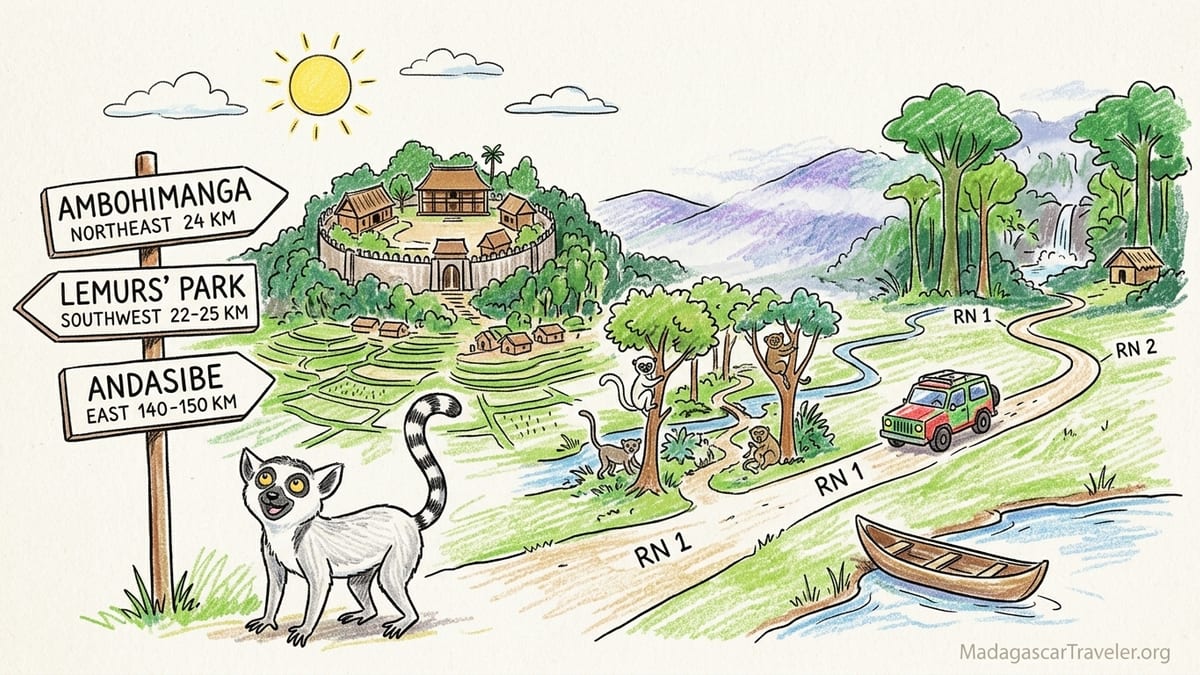
From central Antananarivo, the main day-trip contenders fall into two broad bands. Very close to the city, the Royal Hill of Ambohimanga lies about 24 kilometres to the northeast and Lemurs’ Park around 22 to 25 kilometres to the southwest along Route Nationale 1. Both are realistic half-day excursions, even if you only have a spare morning or afternoon. By contrast, Mantasoa and Ampefy generally require a full day, and Andasibe, roughly 140 to 150 kilometres east on Route Nationale 2, pushes the limits of what counts as a day trip from the capital.
Travel times in Madagascar are deceptive. On paper, two or three hours does not sound demanding, but congestion leaving Antananarivo and slow trucks on the national roads often stretch journeys. Recent visitor reports suggest about 45 to 60 minutes to reach Ambohimanga by car when leaving after morning rush hour, around 45 to 75 minutes for Lemurs’ Park, close to three hours for Mantasoa and Ampefy, and typically three and a half to four and a half hours for Andasibe, depending on traffic and stops along the way. Drivers and tour companies often build in generous buffers for unexpected delays.
Costs also vary. A private car and driver for a day from Antananarivo often starts around the equivalent of 60 to 100 US dollars for a basic sedan, with higher prices for 4x4 vehicles and fuel sometimes billed separately. Park and site entrance fees are much lower in comparison, normally a few dollars to under 20 dollars per person, though there are extra required payments for guides in some reserves. As you weigh your options, it helps to think of each destination in terms of a package: road time plus driver or tour cost, local entrance and guide fees, and your own energy levels.
For travellers with only one free day, the most sensible combinations are Ambohimanga plus a short Antananarivo city tour, Lemurs’ Park plus lunch in town, or a very early departure to either Ampefy or Mantasoa. Andasibe can be attempted as a marathon day out, but most experienced visitors and local agencies recommend staying at least one night to avoid spending more time in the car than in the rainforest.
Ambohimanga: Madagascar’s Royal and Sacred Hill
The Royal Hill of Ambohimanga is Madagascar’s most important cultural site and the only major UNESCO-listed royal complex currently accessible from Antananarivo. Perched on a forested hill about 24 kilometres from the capital, this fortified royal settlement served as a political and spiritual centre for the Merina kingdom from the 16th to the 19th centuries. Within its stone gateways and ditches you will find a royal city with timber palaces, royal tombs, ceremonial courtyards and sacred trees, all overlooking terraced rice fields and villages.
For travellers interested in history and culture, Ambohimanga deserves priority. A typical visit from Antananarivo might involve leaving your hotel around 9:00 in the morning, reaching the hill after 45 minutes to an hour by private car, spending two to three hours on site, and returning mid-afternoon. Entrance fees for foreign visitors are modest by international standards and are often paired with a local guide, either arranged on arrival or pre-booked through a tour company. Guides are not strictly compulsory, but hiring one is highly recommended as their stories bring the royal compound and rituals to life.
Physically, the visit is moderate rather than strenuous. Expect stone steps, some uneven paths and short uphill walks between gates and palace structures. Most reasonably fit travellers can manage the circuit in comfortable walking shoes, though those with mobility issues may appreciate taking more time or skipping some steeper sections. The altitude and shade from the surrounding forest keep temperatures relatively cool, especially in the dry season from May to October.
In terms of logistics, Ambohimanga is a classic half-day destination. There is no real advantage in staying overnight solely for the site unless you are combining it with rural homestays or in-depth cultural programmes. Many visitors pair Ambohimanga with an afternoon visit to Antananarivo’s markets or hilltop viewpoints, keeping total driving time under two hours. For travellers who want a meaningful experience without a long road journey, the Royal Hill is the strongest single choice out of the capital.
Lemurs’ Park: Easy Wildlife Fix Close to the Capital
Lemurs’ Park offers one of the most accessible wildlife encounters near Antananarivo. Located roughly 22 kilometres southwest of the city along Route Nationale 1, it functions as a small private reserve and botanical garden that focuses on semi-free-ranging lemurs in a reforested riverside setting. The park is close enough to be reached in 45 minutes to an hour by car in light traffic, although leaving during peak rush hours can stretch the drive.
Entrance fees for foreign adults are higher than at many public sites but still relatively affordable, and they include a compulsory guided tour that typically lasts around one to one and a half hours. Groups are small and guides walk you slowly through shaded paths, pointing out species such as ring-tailed lemurs, Coquerel’s sifakas and bamboo lemurs that have been reintroduced or rescued. Because the lemurs are accustomed to people and live in a contained area, sightings are virtually guaranteed, making this an attractive option for travellers on tight schedules who still want to see these emblematic animals.
Physically, Lemurs’ Park is easy. Paths are mostly flat, shaded and well maintained, so children, older travellers and people who are not keen hikers can enjoy the visit without strain. There is usually time after the tour to visit the small shop or have a drink; some visitors arrange lunch nearby or return to the city for a meal. A realistic plan from Antananarivo might be to leave mid-morning, visit the park around lunchtime, and be back in town by mid-afternoon, keeping total time outside the city to four to five hours.
An overnight stay near Lemurs’ Park is rarely necessary. The main value here is convenience and predictability compared with the wilder but more time-consuming rainforest parks. For travellers who are in Antananarivo on business and only have a free half-day, Lemurs’ Park is the most practical way to see live lemurs without facing a pre-dawn departure or a late-night return.
Mantasoa: Cool Air, Pine Forests and Gentle Activity
Mantasoa lies to the east of Antananarivo and has long served as a highland retreat for city residents. Centred on a large man-made lake ringed by pine forests and scattered holiday cottages, it offers cooler temperatures and a calmer atmosphere than the capital. The drive typically takes around two and a half to three hours each way by private car, partly on national roads and then on smaller routes, so it demands a full day even if you do not plan strenuous activities.
Once at Mantasoa, most visitors spend their time walking short forest trails, enjoying lakeside views or arranging simple activities through local lodges, such as canoeing or boat rides when water levels and weather permit. There are also historical connections to the 19th-century engineer Jean Laborde, whose industrial complex once stood in the area, though the remains are limited and less immediately impressive than the royal palaces at Ambohimanga.
Entrance fees at Mantasoa are modest or sometimes embedded in what nearby guesthouses and restaurants charge their day visitors. Local guides for walks can often be arranged on the spot through your driver or lodging, but they are not mandatory. Physically, the terrain is gentle, with some mild hills and forest paths suitable for travellers of average fitness. However, cool temperatures and occasional rain mean that a light jacket and sturdy closed shoes are advisable.
Mantasoa can be done as a day trip by travellers who leave Antananarivo early in the morning and accept that half the day will pass inside a vehicle. The experience is more about mood and scenery than headline sights, so many locals and repeat visitors choose to stay overnight at one of the lakeside lodges to make the journey worthwhile. If your time in Madagascar is limited, Mantasoa is best if you value a quiet, cool escape and do not mind sacrificing big-name attractions for relaxed walks and simple comforts.
Ampefy: Volcanic Landscapes, Waterfalls and Country Life
West of Antananarivo, Ampefy and the surrounding Lake Itasy region showcase volcanic highland scenery that contrasts sharply with the city’s crowded hills. Reached by Route Nationale 1 in roughly three hours of driving, Ampefy has become a favourite weekend destination for Antananarivo residents, with visitors drawn to Lily Waterfall, the cold-water geysers near Analavory and the crater lake views dotted with fishing pirogues.
A typical long day trip might begin with a 6:30 or 7:00 departure from Antananarivo, reaching Ampefy around mid-morning. From there, travellers often visit the geysers, reached by a combination of paved road and dirt tracks, and then continue to Lily Waterfall for a short walk down to viewpoints over the cascade. Lunch is usually taken at a local restaurant overlooking the lake or at a simple hotel that also hosts overnight guests. With a tight schedule, you might depart by mid-afternoon and reach Antananarivo again around sunset.
Entrance fees at individual sites such as the geysers and waterfall are modest, often paid directly to local community associations or ticket huts. Hiring a local guide for the walks is not always mandatory but is a good way to ensure you follow the correct paths, especially when recent rains have muddied tracks. The walks themselves are of low to moderate difficulty, but the paths down to waterfall viewpoints can be steep and slippery in the wet season, so sturdy shoes are essential.
An overnight at Ampefy often makes logistical and experiential sense. Road fatigue is real on Malagasy highways, and spending two nights in a lakeside guesthouse gives you a full day to enjoy walks, boat rides and village visits without constantly watching the clock. For travellers on very tight schedules, Ampefy is just about manageable as a very long day trip, but it is better reserved for those who either have two or more free days or who are using the region as a stop on a longer westward journey.
Andasibe: Rainforest Wildlife on the Edge of a Day Trip
Andasibe, often bundled with the nearby Mantadia sector, is Madagascar’s most accessible true rainforest destination from Antananarivo. Located about 140 to 150 kilometres east along Route Nationale 2, it protects dense forest that shelters indri lemurs, diademed sifakas and an extraordinary array of frogs, birds and chameleons. Driving times from the capital typically range from three to four hours each way in good conditions, though roadworks or accidents can stretch this significantly.
Entrance fees at the Andasibe-Mantadia National Park complex are higher than at small reserves but remain moderate by international standards, with a daily ticket covering access to different circuits. A licensed local guide is compulsory for walks inside the protected area, and guide fees are set according to the length and difficulty of each circuit. In practical terms, a couple visiting for a half-day hike might share guide fees with other travellers to reduce costs, while still benefiting from expert spotting of wildlife and explanations of the forest’s ecology.
Physically, Andasibe offers choices from easy to moderately strenuous. Many visitors opt for a two to three hour loop on relatively gentle forest paths to maximise wildlife encounters without racing. Humidity can be high, and even short ascents feel more taxing than their length suggests, so comfortable closed shoes, light breathable clothing and a rain jacket are important. Night walks along the road or in community-managed forests near the park entrance are major highlights, revealing mouse lemurs, chameleons and nocturnal frogs, but they automatically push any visit beyond day-trip hours.
Technically, it is possible to leave Antananarivo before dawn, arrive at Andasibe late morning, complete a daytime walk, and return to the capital the same evening. However, most tour operators and experienced travellers view this as a stretch that leaves little margin for delays and almost no time for rest. The general consensus is that Andasibe is far better suited to at least one night away from the city, ideally two, which allows one daytime walk and at least one night walk without rush. For travellers determined to make Andasibe a day trip, booking a private driver who knows the road and departing as early as possible are critical for safety and enjoyment.
Choosing the Right Day Trip: Culture, Wildlife and Practical Trade-offs
When deciding between Ambohimanga, Lemurs’ Park, Mantasoa, Ampefy and Andasibe, it helps to think in terms of your main priority. If culture and history matter most, Ambohimanga clearly leads. Its UNESCO World Heritage status, preserved royal buildings and role in the Merina kingdom make it the single most important cultural excursion from Antananarivo. With short travel times, modest entrance fees and manageable walking, it suits almost every type of traveller, from business visitors with one free morning to history-focused tourists building a wider itinerary.
If wildlife is your main objective and you have limited time or mobility, Lemurs’ Park offers a gentle, predictable way to see several lemur species in a semi-natural environment. You trade the adventure and diversity of a full national park for the certainty of easy sightings close to the capital. For travellers with an extra day or two and reasonable fitness, Andasibe provides a deeper immersion in Madagascar’s unique biodiversity, but it is better framed as an overnight or multi-night excursion rather than a straightforward day trip.
Scenery and relaxation tip the scales toward Mantasoa and Ampefy. Mantasoa delivers cool pine forests and peaceful lakeside walks, while Ampefy combines craters, waterfalls and geysers with glimpses of rural life. Both involve roughly six hours of total driving for a day trip, so they appeal most to travellers who value open landscapes and atmospheric lodges as much as formal attractions. In many cases, adding an overnight stay transforms these destinations from long days of transit into genuinely restorative escapes.
Guide and driver arrangements are another key factor. In and around Antananarivo, it is customary for visitors to hire a car and driver for intercity travel rather than driving themselves. A private driver not only handles navigation and security but often helps negotiate with local guides and site staff. At places like Andasibe and, to a lesser extent, Ambohimanga and Ampefy, a specialist tour operator can bundle transport, entrance fees and guiding into a single package, which simplifies budgeting and reduces misunderstandings over prices.
The Takeaway
For travellers based in Antananarivo, the Royal Hill of Ambohimanga stands out as the most rewarding and straightforward cultural day trip. Its UNESCO-listed royal compound, short travel time and moderate walking demands make it an obvious first choice, especially if you only have one free half-day. Paired with a knowledgeable local guide, a visit here offers a clear window into the history, beliefs and power structures that shaped Madagascar’s highlands.
Those seeking wildlife but limited by time and energy will find Lemurs’ Park a convenient solution. It allows you to see lemurs up close without facing a dawn departure or late-night return. Meanwhile, Mantasoa and Ampefy satisfy travellers who want to exchange city congestion for lakes, waterfalls and volcanic hillsides, provided they are comfortable with several hours on the road. For serious nature enthusiasts prepared for early starts and humidity, Andasibe promises the richest encounters with rainforest wildlife, but it is best enjoyed with at least one overnight stay.
In the end, the best choice depends on how you balance culture against wildlife, driving against walking, and ambition against realism. A visitor on a three-day work trip might sensibly choose Ambohimanga and Lemurs’ Park, while someone with a free long weekend could combine Ampefy or Mantasoa with a short stay in Andasibe. With thoughtful planning and realistic expectations about Madagascar’s travel speeds, each of these destinations can turn a day out of Antananarivo into a memorable chapter of your journey.
FAQ
Q1. Can I visit Ambohimanga and Lemurs’ Park on the same day from Antananarivo?
Yes, it is feasible if you start early and keep visits focused. Both sites are within about an hour’s drive of the city in different directions, so you would spend around three to four hours total in the car plus time at each site. This works best with a private driver and a clear schedule.
Q2. Is Andasibe really possible as a day trip from Antananarivo?
It is technically possible but demanding. Expect at least three to four hours’ drive each way, leaving limited time for walks. Most travellers and local operators recommend staying at least one night to enjoy both day and night walks without rushing and to reduce fatigue and risk from late driving.
Q3. Do I need to hire a guide at Ambohimanga?
A guide is not always compulsory but is strongly recommended. Local guides explain the history, rituals and architecture in ways that are not obvious from signs alone, and the additional cost is modest compared with the value they add to the experience.
Q4. How physically demanding are the walks at Lemurs’ Park and Andasibe?
Lemurs’ Park is generally easy, with short, mostly flat paths suitable for most visitors. Andasibe offers trails ranging from easy to moderate, but humidity and uneven forest paths can make even shorter walks feel more strenuous, so closed shoes and a reasonable level of fitness are advised.
Q5. Are entrance fees and guide costs high in these destinations?
By international standards, entrance and guide fees are moderate. Smaller sites like Ambohimanga and Lemurs’ Park charge relatively modest admission, while larger protected areas such as Andasibe have higher park and guide fees but still remain affordable compared with many other wildlife destinations.
Q6. Is it safe to drive these routes at night?
Night driving outside Antananarivo is generally discouraged because of poor lighting, livestock on the roads and the risk of stalled vehicles. Whenever possible, plan itineraries so that longer returns from places like Ampefy or Andasibe are completed in daylight with an experienced driver.
Q7. When is the best season to take these day trips from Antananarivo?
The dry season from roughly May to October usually offers better road conditions, clearer views and more comfortable temperatures for walking. The rainy season brings greener landscapes and active amphibians in places like Andasibe but can mean slippery tracks and occasional delays.
Q8. Can I use public transport instead of hiring a driver?
Shared minibuses do run on main roads, but they are slow, often crowded and not well suited to tightly timed day trips. For most short stays and day excursions from Antananarivo, hiring a private car and driver or booking through a tour operator is far more practical.
Q9. Do I need to book guides and drivers in advance?
For popular sites like Ambohimanga and Lemurs’ Park, same-day arrangements are often possible, especially on weekdays. For longer trips to Ampefy, Mantasoa or Andasibe, and during peak holiday periods, advance booking of a driver or tour is wise to guarantee availability and agree on prices.
Q10. Is an overnight stay really worth it for Ampefy or Andasibe?
For both destinations, an overnight stay usually transforms the experience. At Ampefy, it allows relaxed visits to the geysers and waterfall without rushing back to the city. At Andasibe, staying at least one night gives you time for both daytime wildlife walks and night excursions, which many travellers consider the highlight of their trip.