


Planning a beach day from Toamasina can be surprisingly complicated. Tourist brochures promise fine sand and turquoise lagoons, yet the city’s own shoreline faces a powerful, exposed stretch of the Indian Ocean that can be dangerous for casual swimming. After spending several weeks based in Toamasina in 2024 and 2025, using the city as my hub for work and reporting, I made repeated day trips and overnight stays to the main nearby beaches. What follows is not a glossy list of “top ten” spots, but a decision guide built entirely around places where I personally got in the water, noted the conditions, and paid close attention to both comfort and risk.
How I Evaluated Beaches Around Toamasina
Before we get into specific beaches, it helps to understand how I judged each place. I was based in Toamasina for several multi-week stretches across 2024 and into early 2025, during the cooler, drier months and again near the start of the rainy season. From the city, I made multiple visits to the main local shoreline, as well as repeat trips to Foulpointe and Mahambo. I went in the water myself or, on days when conditions felt questionable, stayed deliberately on the sand and noted why.
For each beach in this guide, I only include days when I was physically present. I do not treat any one visit as a permanent verdict, especially on a dynamic, cyclone-prone coast like Madagascar’s east. Instead, I describe the exact conditions I found on those days: the texture of the sand, strength of the shore break, whether there was a reef or lagoon offering protection, how strong the current felt on my body, and how comfortable it actually was to swim or just stand in chest-deep water.
Beyond the sea itself, I looked for practical details that matter to real travelers. Could I find shade without having to pay for a beachfront restaurant table immediately? Was there somewhere discreet and reasonably clean to change into swimwear? How easy and realistic was it to reach the beach from Toamasina using taxi brousse, private car, or tuk tuk, and what did I actually pay? Were there food options that felt safe enough for a normal traveler, not just a hardened backpacker? And, crucially, what sort of person seemed happy there: families with small children, beginner swimmers, surfers, or visitors who mainly wanted to walk and watch the waves?
Finally, I separate my own observed conditions from general safety guidance. On one of my visits to Toamasina’s city beach the water looked deceptively calm, yet local government messaging and several regional coastal studies warn that this stretch of coast can be hazardous, especially with rip currents and storm surges. I treat my own pleasant half-hour in the water at waist depth as just one data point, not a blanket statement that the city beach is “safe.”
Toamasina City Beach: Beautiful Walks, Very Cautious Swimming
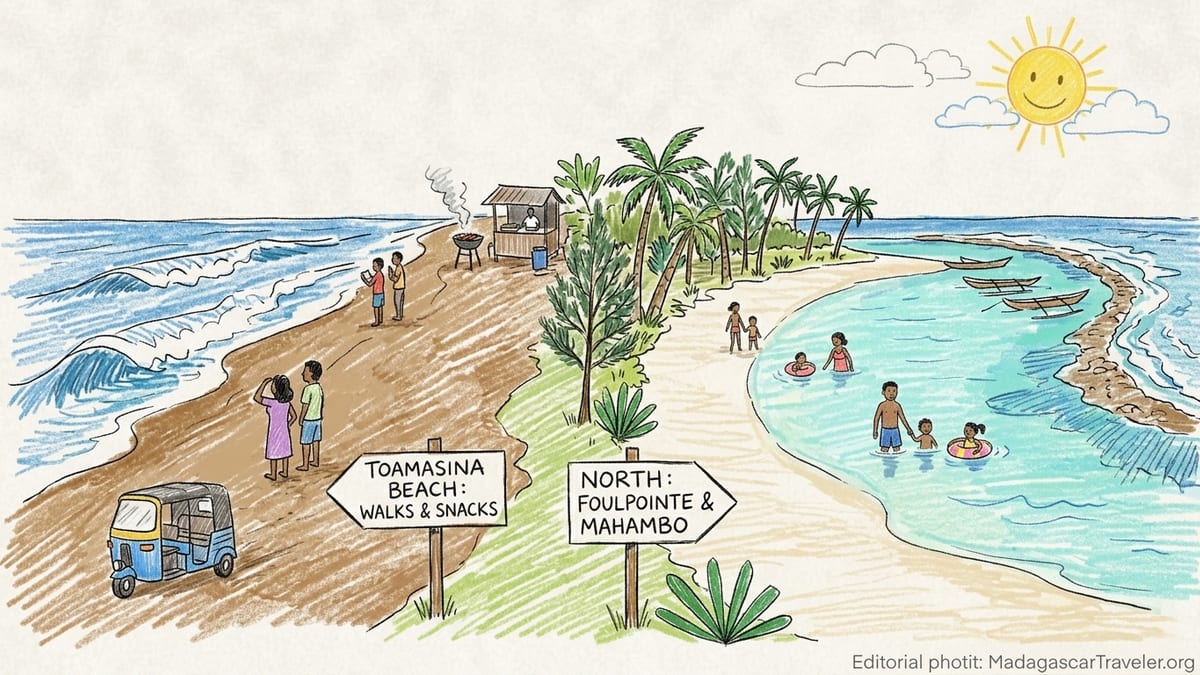
The most obvious beach when you are in Toamasina is the long strand that runs north and south of the port, a few minutes from the central market and taxi stands. I walked this shoreline more than a dozen times in 2024 and early 2025, usually in the late afternoon between 4 p.m. and sunset. On three separate days I briefly entered the water up to my waist. On each of those days, the sand was medium-grained and light brown, sloping quickly once you reached the swash zone. There was no reef visible offshore and no lagoon. Instead, low waves broke with a strong push, and even in apparently modest surf I could feel a tugging lateral current around my legs.
On my longest stay in the water here, about 20 minutes on a dry-season afternoon with light onshore wind, I kept to the shallows. There were no lifeguards, no marked safe swimming areas and no flags. A few teenagers were body-surfing, but most local families stayed close to the high-tide line, children running in and out of the foam rather than swimming. The lack of natural protection and the reputation of Madagascar’s east coast for strong currents are consistent with warnings from regional coastal assessments, which list Toamasina’s shoreline as vulnerable to erosion and storm impacts. Even on a calm-looking day, I never felt comfortable fully committing to a sustained swim here.
From a practical point of view, Toamasina’s beach is easy to reach. From the central area around Boulevard Joffre, I usually paid a short tuk tuk ride to the seafront, often around a few thousand ariary, or just walked 15 to 20 minutes past the port. There is ample informal “parking” along the avenue where local drivers leave their cars. Shade is limited. There are a few trees set back from the sand and some concrete shelters, but in midday sun you mostly rely on the shadow of simple food shacks or bring your own umbrella. Food is available from street vendors and basic restaurants grilling fish, serving rice dishes and cold soft drinks. I treated these like I would any busy street-food corner: choosing stalls with high turnover and cooking to order.
Facilities are basic. I did not find dedicated changing rooms by the most central stretches, so I either arrived wearing swimwear under my clothes or used the restroom at a beachfront bar and politely asked to change there after ordering a drink. On clearer afternoons the beach felt lively rather than crowded, with couples, local joggers and families but plenty of open sand. For most visitors based in Toamasina, I would frame this beach as ideal for walks, sunrise or sunset photos, and perhaps very shallow paddling under local advice, not as a classic swimming beach. It may suit strong, confident ocean swimmers who understand rip currents and are comfortable reading the sea, but even for them, caution and local consultation are vital.
Foulpointe (Mahavelona): Reef-Protected Lagoon From Toamasina
Foulpointe, also known as Mahavelona, lies roughly 60 kilometers north of Toamasina along the RN5. It is consistently described by Madagascar Tourism and regional brochures as a beach with a coral reef that forms a protective lagoon. I made two separate visits here during my stays in Toamasina. The first was a long day trip in the dry season. The second was an overnight stay toward the start of the rainy season. On both occasions I swam in the lagoon itself, walked along the inner reef edge at low tide with reef shoes, and remained in the water for at least 45 minutes each time.
On my first visit, I left Toamasina by taxi brousse shortly after 8 a.m. from the main RN5 departure area. The shared minibus fare to Foulpointe was in the range commonly quoted by recent travelers, tens of thousands of ariary per person, and the journey took just under three hours including a roadside stop. From the drop-off near the main road, it was a short walk past simple hotels and snack bars to the sand. By late morning the lagoon was at mid-tide. The sand inside the lagoon zone was light beige and fine, compact near the waterline, with only a gentle slope. The coral barrier reef sits hundreds of meters offshore and, crucially, blocks the large ocean swell that hits the east coast further south.
I entered the water at about 11:30 a.m. and swam for roughly one continuous half-hour followed by shorter dips over the next hour. Inside the lagoon the water reached chest height about 30 to 40 meters from shore. Small wind-driven ripples rolled in, but there was no shore break to speak of and no obvious current pulling me along the beach. I could float easily and chat with local families, many of whom were standing waist-deep while children used inflatable rings closer to shore. I also did some light snorkeling. Visibility was not crystal-clear but good enough to see small fish near the sandy bottom and scattered patches of seagrass. In sections closer to the reef, I used reef shoes because there were broken coral fragments and occasional sea urchins reported by local guides.
On my second visit, during more unsettled weather, conditions changed noticeably. Heavy rain the night before had left the water slightly murkier, and there was a stronger push in the upper water column, especially closer to the mouth of the lagoon where the reef gap feeds exchange with the open sea. That afternoon I limited myself to around 25 minutes of swimming, staying closer to shore and keeping an eye on where other swimmers congregated. The takeaway for me is that Foulpointe’s lagoon can feel extremely gentle on calm days and much more energetic after heavy rain or stronger trade winds. Nothing in my experience suggests it is dangerous by default, but I would not call any reef lagoon permanently “safe.” Conditions, especially around the outer reef and channels, change with tide and weather.
On shore, Foulpointe works very well for a relaxed beach day from Toamasina. Along the main stretch you find a run of basic and mid-range hotels, such as simple bungalow-style properties and a few larger establishments that open their beachfronts to non-guests who buy drinks or a meal. I paid a small fee on one visit to use a hotel’s changing area and shower as a day guest after ordering grilled fish and rice for lunch. Shade is excellent compared to Toamasina’s city beach. Casuarina trees and coconut palms line sections of the sand, and several restaurants have thatched shelters right on the beach, where you can sit in the shade between swims.
Food focuses on grilled fish, prawns when available, and Malagasy staples like rice, romazava and seasonal vegetables. I paid typical coastal restaurant prices, often under the equivalent of ten euros for a full meal with a soft drink. Crowd levels varied. On a weekday in the dry season, the beach felt pleasantly busy, with local families, a few visitors from Toamasina and small boats offering short lagoon rides. On a weekend closer to local holidays, it was significantly livelier, with groups coming from the city in chartered minibuses. There was still plenty of space to spread out, but noise levels near the main access road rose with music from bars. For most travelers based in Toamasina who want a genuinely swimmable sea with sand underfoot and minimal surf, Foulpointe is the clearest recommendation, provided you still respect tides, ask locals about the day’s conditions and do not push far toward reef gaps without guidance.
Mahambo: Surf Energy With Selective Swimming
Mahambo sits further north again along the RN5, between Foulpointe and Fénérive Est. It has built a quiet reputation in French and European surf circles as an east-coast surfing hub, with listings on dedicated surf spot guides and mentions in travel magazines. I visited Mahambo twice while based in Toamasina, once for two nights and once for a quick overnight stop while transiting toward Sainte Marie. On both visits I saw the contrast between its surf-facing beach and the more sheltered areas near the river mouth and small lagoon that some guesthouses promote for non-surfers.
On my first arrival, after a taxi brousse ride of around three hours from Toamasina toward the Fénérive Est direction, I reached Mahambo by mid-afternoon. The main taxi brousse fare fell into the same range as Toamasina to Foulpointe, with a small additional charge for the final piste from the main road to the beachfront hotels. The long main beach faces open ocean. On that particular day, shoulder-high waves were breaking on mid-tide banks in front of one of the established surf camps. I watched half a dozen surfers working the peaks with leashes and shortboards. The sand was slightly coarser than at Foulpointe, pale yellow with a steeper profile where the waves were dumping.
I did not swim directly in front of the surf break that afternoon. Instead, I walked down the beach and chose a quieter section where the waves were smaller and the crowd consisted of local kids. I entered the water to about chest depth, staying in for perhaps 15 minutes. Even there, I could feel a pulsing push and pull from the swell. It was fun for body-surfing small waves, but not what I would call relaxed, float-and-chat swimming. There was no fringing reef blocking the incoming waves. A local surf instructor later explained that strong currents often appear near the river mouth and along certain sandbars, and that beginners should always ask around before deciding where to go in.
The second visit, several months later, showed a different face of Mahambo. The swell had dropped considerably, with smaller, cleaner waves that mainly attracted longboarders. In the morning, before the wind picked up, I joined other guests in a more sheltered cove-like area near a small river. Here the waves rolled in gently, breaking early and then reforming as soft shore lappers. I spent around 30 minutes in the water, mostly at waist to chest depth, floating and chatting. There was still a noticeable current, but much milder than during my previous trip. This reinforced the central point that Mahambo’s swimming experience is tightly linked to swell size, wind, tide and your exact position along the coast.
Facilities in Mahambo cater both to surfers and to relaxed beachgoers. Small hotels and bungalows offer direct beach access, with simple outdoor showers and, in some cases, designated changing areas for day visitors who pay for a meal. Several surf schools advertise board rentals and lessons right on the beach, with prices that, during my visits, were in line with regional surf destinations for emerging markets. Food options range from basic Malagasy canteens serving rice, laoka and grilled fish to beachfront restaurants offering pizzas and simple pasta dishes. Shade tends to come from the vegetation behind the high-tide line and from the built structures of the hotels rather than from rows of big trees on the sand, so planning your beach time for early morning or late afternoon makes sense.
Who is Mahambo for, based on the days I spent there? Confident swimmers, surfers and travelers who already feel at ease in open-ocean conditions. If you are traveling as a mixed group, with one person keen to surf and others simply wanting beach time, Mahambo can still work, especially if you choose accommodation near a more sheltered stretch or lagoon-like area. However, if your number one priority is calm, shallow, lagoon-style water where small children can play, Mahambo is less predictable than Foulpointe and demands more day-to-day judgment.
Comparing Conditions: Toamasina, Foulpointe and Mahambo
Looking back at my logged notes from each visit, the contrast between these three main options becomes clear. On Toamasina’s own beach, the dominant feeling in the water was exposure: direct Indian Ocean swell, a steep beach face and the sense of a sideways pull once you got more than knee deep. I never saw a coral barrier offshore and never experienced a truly calm swim there. Even on my most relaxed visit, I kept my feet within easy reach of the sand and stayed close to the shore. The city’s shoreline is visually striking and essential to its identity, but in terms of swimming comfort it sat at the bottom of my list.
Foulpointe, by comparison, felt like a natural swimming pool on my calmest day. The reef-protected lagoon meant almost no breaking waves close to shore. I could stand chest deep with my feet on sand, look back at the palm-fringed beach and carry on a normal conversation without being forced to watch every incoming set. Children splashed nearby with inflatable toys, and local fishermen paddled dugout canoes near the inner edge of the reef. On my second visit, after heavy rain, the water remained shallow and manageable but gained a bit more energy, which reminded me not to be lulled into ignoring currents entirely.
Mahambo slotted squarely between the two. Where Toamasina is exposed and Foulpointe is sheltered, Mahambo is dynamic. On a strong-swell day, the shore break and rip-prone areas near the river mouth made it look like a place best left to surfers and very confident swimmers. On a smaller-swell day, selected pockets along the beach felt fine for a 20 to 30 minute swim at moderate depth, especially earlier in the morning. I never once felt as relaxed in Mahambo’s water as I did inside Foulpointe’s lagoon, but I also never felt as wary as I did on Toamasina’s city beach.
Transport and logistics also influence which beach is actually realistic from Toamasina. Foulpointe sits closer to the city, with taxi brousse services and private drivers making it a manageable day trip even if you leave after breakfast and return before dark. Mahambo, while still accessible in half a day by road, works better as an overnight or multi-night stay, particularly if you want to surf at different tides. Toamasina’s own beach is obviously the easiest to reach, but ease does not automatically translate into the best swimming. When I factored in travel time, cost and how long I actually stayed in the water, I found myself returning to Foulpointe most often when I wanted a true “swimming day,” and to Mahambo when friends visiting from overseas were keen on surf and coastal atmosphere.
Safety and Comfort: What My Visits Can and Cannot Tell You
Because the east coast of Madagascar is shaped by cyclones, river outflows and strong trade winds, it would be misleading to treat my personal experiences as universal truths. On a coast where scientific assessments highlight erosion and extreme events, any calm day is just a snapshot, not a guarantee for next month. For instance, Toamasina’s beach has seen documented storm impacts, and even regional tsunami surveys have noted how surges can push far inland across low-lying sands. None of that was visible during my peaceful late-afternoon walks in the dry season, yet it shapes the overall risk profile of the area.
At Foulpointe, the reef that forms the lagoon is a gift for swimmers but also a structure that focuses tidal flows. On my calmest swim, the current inside the lagoon was barely noticeable. On my rainier visit, I felt a subtle draw toward a low point in the reef line, and a local boatman casually warned me not to stray too close to visible channels where water exchanged with the open ocean. The fact that families and beginner swimmers enjoyed themselves all around me does not cancel the need for situational awareness. If wind picks up sharply during the day, or if there has been unusual swell offshore, that balance can change.
In Mahambo, the variability is even more pronounced. Surf guides describe the area in terms of swell direction, period and tide, and during my stay I saw how quickly a friendly-looking shore can switch mood as the tide rises onto sandbars. On one afternoon, watching from my bungalow veranda, I saw a set of larger waves close out on a group of novice surfers, pushing them sideways down the beach. They all surfaced quickly and paddled in, but the scene reinforced the idea that this is an environment best approached with humility. My own 15 to 30 minute swims in Mahambo always stayed well within my comfort zone, but they would not make me declare the beach “safe” for everyone.
What my notes can tell you with more confidence is how each place felt to inhabit for a beach day. Foulpointe combined easy-entry water with practical shade, food and facilities that made it simple to stay all day. Mahambo offered a more active scene, with surfboards on racks, lessons in progress and a sense of movement in both water and village. Toamasina’s city beach played a different role entirely: urban promenade, working coastline, and moody backdrop for sunsets rather than a primary swimming venue. Any traveler choosing between them should match their own skills and risk tolerance to these distinct atmospheres.
Choosing the Right Beach From Toamasina
If you are based in Toamasina and have limited days on the coast, your decision comes down to your swimming confidence, your appetite for travel time and the kind of day you want. For travelers who mainly want calm water for floating, casual laps and children’s play, the reef-protected lagoon of Foulpointe is the most logical choice among the places I personally tested. It offers fine sand, relatively predictable shallow zones inside the reef and enough infrastructure to make logistics straightforward. You can leave Toamasina in the morning by taxi brousse or arranged car, spend four to six hours on the sand with multiple swims, then return before dark.
For visitors who surf or who are traveling with someone who does, Mahambo becomes a compelling option. Here you trade guaranteed calm water for waves, surf schools, a soft-paced village and the chance to spend mornings in the ocean and afternoons under palm trees with a book. You should plan at least one or two nights to make the journey worthwhile and to catch different tides. Strong swimmers who enjoy feeling the energy of open-ocean beaches and are comfortable getting advice from local surfers or instructors will likely thrive in Mahambo’s conditions.
If you have no time to leave the city, Toamasina’s own beach remains worth visiting as an urban and cultural space. You can watch fishing pirogues, see locals exercising, buy a grilled snack and feel the power of the Indian Ocean up close. Whether you choose to go beyond ankle-deep paddling should depend on your skill level, the day’s conditions and the advice of people who know the beach well. During my time there, I saw that many locals themselves limited their water time to splashing at the edge, which in itself is a useful signal.
Whichever beach you choose, consider simple, concrete habits that improve your margin of safety: arriving in the morning when winds are lighter, swimming where there are other people around, avoiding alcohol during water time, and stepping out if visibility drops after rain or if you notice a strong sideways pull. On this coast, attention matters more than bravado. A beach that feels tranquil on a dry-season weekday can be very different the morning after a distant storm.
FAQ
Q1. Is Toamasina’s city beach safe for swimming?
On the calmest days I visited, I waded to about waist depth for short periods, but I always felt a sideways pull and saw no lifeguards or flagged safe zones. Regional studies describe this coast as exposed to erosion and storm impacts, so I personally treat the city beach as a place for walks and very shallow paddling rather than full swimming, unless you are an experienced ocean swimmer and have local advice.
Q2. Why is Foulpointe often recommended over Toamasina for beach days?
On the days I visited, Foulpointe’s offshore coral reef created a shallow lagoon with fine sand and minimal shore break, which made swimming and floating much more comfortable than in Toamasina’s exposed surf. Families with children were able to spend hours in chest-deep water, and there was more natural shade and better access to showers, food and changing facilities right by the sand.
Q3. Can beginners and children swim safely in Foulpointe’s lagoon?
On my calm-day visit, I saw many local children playing in the lagoon and found the water gentle enough for relaxed chest-deep swimming. However, after heavy rain or on days with stronger winds, currents inside the lagoon became more noticeable. I would consider it suitable for beginners and children only with close supervision, staying near shore, using flotation aids if needed and avoiding channels closer to the reef.
Q4. What makes Mahambo different from Foulpointe for swimmers?
Mahambo faces the open ocean more directly and is known as a surf spot, so waves and currents feel stronger and more variable. On smaller-swell days I managed short, enjoyable swims at waist to chest depth in selected areas, but on larger-swell days I stayed out of the water or limited myself to quick dips. Compared with Foulpointe, Mahambo demands more judgment and is better suited to confident swimmers and surfers.
Q5. How long does it take to reach Foulpointe and Mahambo from Toamasina?
On my trips in 2024 and 2025, Toamasina to Foulpointe by taxi brousse or private car typically took around two and a half to three hours, depending on traffic and stops. Continuing onward to Mahambo required roughly another hour or so by road. Road conditions and journey times can change with weather and maintenance, so it is wise to confirm locally before you travel.
Q6. Are there changing rooms and showers at these beaches?
On Toamasina’s city beach I did not find formal public changing rooms or showers near the stretches I used, so I relied on restrooms at beachfront bars or arrived wearing swimwear under my clothes. In Foulpointe and Mahambo, several hotels and restaurants on or near the sand allowed me to use their showers and changing areas after I bought a meal or drink, which made full beach days much more comfortable.
Q7. What should I budget for a basic beach day from Toamasina?
Exact amounts vary with fuel prices and negotiation, but when I visited, a taxi brousse seat between Toamasina and Foulpointe or Mahambo cost the equivalent of just a few euros, while a simple grilled fish lunch with rice and a drink at the beach was often under ten euros. Private car hire was significantly more expensive but still reasonable when shared among several people. I always carried extra cash for unexpected costs like return-journey changes or additional snacks.
Q8. Do I need special gear like reef shoes or a rash guard?
For Foulpointe, I was glad to have reef shoes when walking closer to the inner edge of the reef, where bits of coral and occasional sea urchins can appear. In Mahambo, a rash guard helped with both sun protection and minor board and sand abrasion while body-surfing or learning to surf. At all three beaches, strong sun meant that a wide-brimmed hat, high-SPF sunscreen and plenty of drinking water were essential.
Q9. Are there lifeguards on these beaches?
During my visits I did not see any formal lifeguard presence or marked rescue posts on Toamasina’s city beach, in Foulpointe’s main lagoon area or along the main beach in Mahambo. Some surf schools in Mahambo had instructors watching their students closely, which added a layer of informal oversight, but I still approached every swim as if I was fully responsible for my own safety.
Q10. Which beach should I choose if I only have one free day in Toamasina?
If your highest priority is relaxed swimming in relatively calm water, and you have the time and budget for a day trip, I would choose Foulpointe based on my own experiences. If you prefer to minimize travel and are content with a seaside walk, people-watching and maybe ankle-deep paddling, staying in Toamasina and using the city beach as a promenade can still be rewarding. Mahambo, with its surf focus and longer journey, is best saved for when you can spare at least one night away from the city.