


I arrived in Toamasina just before the afternoon rain, on a short flight from Antananarivo that took barely an hour but felt like a full reset. I had booked four nights, trying to juggle city wandering, a Pangalanes Canal trip and a look at the nearby coast. In the end I squeezed too much into two days, lost half a morning to flight delays and another chunk of time to unpredictable traffic on the way to the river port. Some plans survived, some were rained off, and a few highlights ended up feeling rushed instead of revelled in. That stay, plus later returns, reshaped how I now plan 2, 3 and 5 days in Madagascar’s main east coast city.
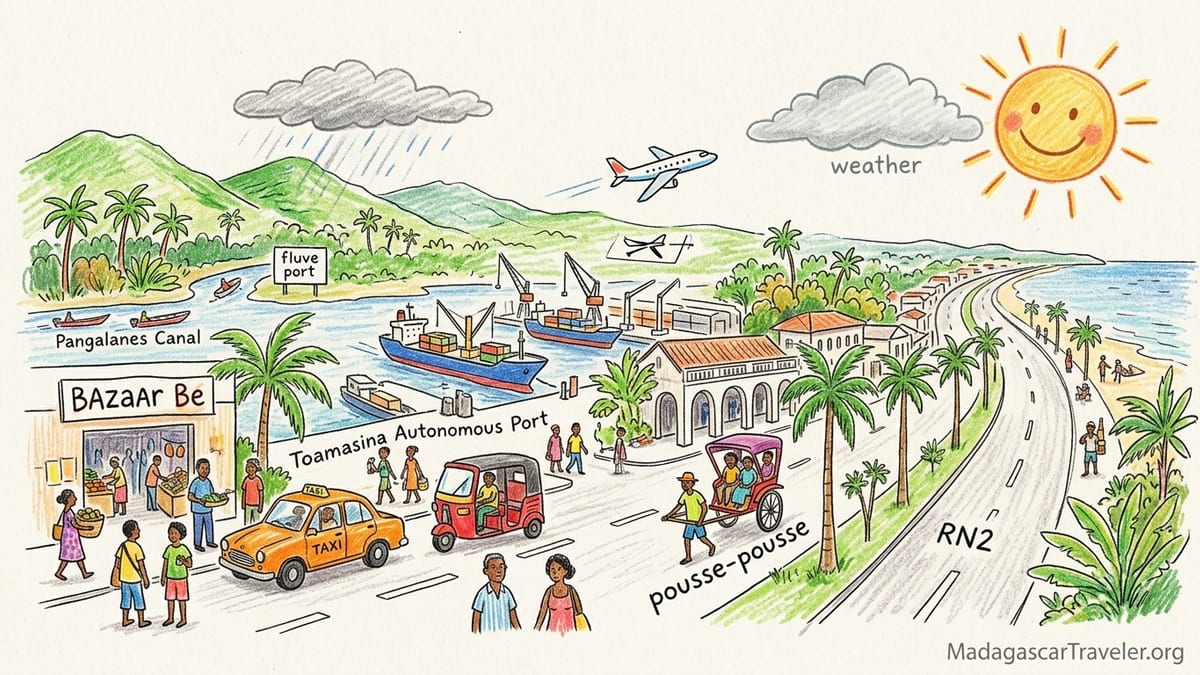
Starting Point: How My Real Stay in Toamasina Played Out
My first proper Toamasina stop was four nights, tagging on after a week in Antananarivo and Andasibe. I flew in on an Air Madagascar / Tsaradia operated flight from Ivato, a hop of about 50 minutes that runs most days according to current schedules, though not always on time. I landed around midday, but by the time bags appeared and I negotiated a taxi into town, the sky had already gone that familiar east coast grey that tells you heavy rain is coming.
The airport is only a few kilometres from the centre, and recent travellers report standard taxis into town for roughly 30,000 to 50,000 ariary depending on negotiation and time of day, still under the cost of many airport transfers in Antananarivo. Traffic within the city is busy but not usually gridlocked; the bigger time drains I hit were slow baggage handling, weather-related flight delays and waiting around at the fluvial port for boats to fill before they departed.
On paper I planned to explore the colonial streets, spend a long half-day at the Bazaar Be and waterfront, squeeze in a full-day Pangalanes Canal excursion and then dash up the coast toward Foulpointe before looping back. In practice, a stormy afternoon closed the beach, the Pangalanes trip started almost an hour later than promised because of a mix of fuel delivery delays and late passengers, and a planned coastal outing got shelved when I realised the taxi-brousse timetable and my onward flight did not like each other. What saved the stay were the slower city pockets: watching cargo ships ease into the Toamasina Autonomous Port, dodging puddles between colonial arcades, and lingering over grilled zebu brochettes at dusk along the seafront.
Looking back, I tried to treat Toamasina like a resort base and a transit hub at the same time. The lesson I took into later visits is simple: two days is city plus one focused outing at most, three days lets you add one nature or canal experience, and five days can work if you accept a slower rhythm or use the city as a launchpad for the wider east coast rather than ping-ponging in and out.
Understanding Toamasina’s Rhythm: Weather, Traffic and Working Hours
However long you stay, Toamasina’s rhythm matters more than what you draw on a map. This is the country’s main cargo port and the economic capital of the east coast, a place where container trucks rumble past hand-pulled pousse-pousse rickshaws and workdays bend around ships, markets and tropical rain rather than tourist schedules. That makes timing as important as your budget.
The east coast has a humid tropical climate, and Toamasina sees more rain than Antananarivo. Showers can blow in at any time of year, but the heaviest downpours and strongest cyclones usually hit between about January and March. Even outside that peak, afternoon squalls are common. On my last December visit, sunny mornings turned into electrical storms by three o’clock several days in a row. If you try to stack multiple outdoor experiences into a single day, a mid-afternoon storm can wipe them all out at once.
Traffic inside Toamasina rarely reaches the full standstill of Antananarivo, but transfers still take longer than maps suggest. Pousse-pousse and tuk-tuks are everywhere for short hops, and they are part of the city’s character, but they are slower than you expect when a line of trucks is heading to the port. Even with a private car, I would allow at least 30 minutes to get from a central hotel to the river port area for canal trips, simply because of surprise bottlenecks and the occasional roadworks serving this expanding maritime hub.
Market and boat schedules also shape your days. Bazaar Be and other markets are liveliest early, with the best spice, vanilla and coffee selection before midday, while many canal and coastal boat departures from the fluvial port cluster between about 7.30 and 9.00 in the morning. I have turned up at 8.00 for a promised 8.00 departure only to leave closer to 9.00 because the operator was still waiting to fill seats. None of this ruins a trip, but it does mean that combining, for example, a serious market visit, a full Pangalanes cruise and a beach sunset bar on the same day is more fantasy than reality.
What 2 Days in Toamasina Really Allows
If you are treating Toamasina mainly as a gateway after a busy Antananarivo schedule, two days is essentially one full day and two halves once you factor in arrival and departure. In that time you can get a solid feel for the city and squeeze in one signature experience, but only if you resist the urge to chase the whole east coast.
My revised 2-day pattern looks like this. On arrival day, I now assume that at least a couple of hours will disappear into airport queues, haggling for a taxi and checking into a hotel. Rather than racing off to the canal or trying to find a boat in the afternoon, I stay in town. A realistic afternoon and evening might include a slow walk between the colonial streets around the old centre, a look toward the Toamasina Autonomous Port from one of the accessible viewpoints, and a first pass through Bazaar Be while stallholders are packing up. Dinner along the seafront, perhaps with skewers from one of the popular brochette stands, is more enjoyable when you are not staring at your watch for a 5 a.m. alarm.
The single full day is when I recommend choosing one of three priorities. Option one is a proper city immersion: back to Bazaar Be early for coffee beans and spices, a rickshaw or tuk-tuk ride along the palm-lined boulevards, and time to explore older neighbourhoods and seaside areas at a walking pace. Option two is a day on the Pangalanes Canal, joining one of the small-boat excursions leaving from the fluvial port. Recent east coast operators advertise relaxed day trips for about 50,000 ariary per adult, departing between around 7.30 and 8.30 and returning by late afternoon, with stops for swimming or village visits. Option three is a short coastal escape closer to town, such as a boat ride to nearby islands or a stretch of beach within a quick drive, keeping in mind that truly postcard-perfect sand is better saved for Foulpointe or Mahambo on another trip.
What does not fit into two days is trying to combine a full Pangalanes day, a serious market morning and a multi-hour side trip up the coast. From experience, the moment you add weather risk and boat delays, you either miss your flight back to Antananarivo or end up cancelling something last minute. For most travellers who have just crossed the highlands by road or air, a 2-day Toamasina stop works best as a decompression city break with one carefully chosen outing rather than a packed sampler of everything the east offers.
What 3 Days Adds: City Culture Plus One Nature or Canal Experience
With three days and nights to play with, Toamasina starts to breathe. This is the amount of time I would now choose if I wanted both city culture and at least one proper nature or water-based experience without constantly refreshing a taxi-brousse schedule on my phone. It is also where the temptation to overschedule really kicks in.
On my second long stop, I used day one for arrival and orientation and then split the next two days between the city and the canal. One day was dedicated mostly to Toamasina itself: browsing Bazaar Be in the morning while the fish and spice stalls were in full swing, then following the waterfront past the main port to watch cargo and fishing boats come and go, and detouring into older streets where crumbling colonial facades hint at the city’s past. With a full day you can also add one indoor cultural experience, such as a local museum or gallery, and still have time to rest before dinner at a simple restaurant on the seafront.
The second full day went to the Canal des Pangalanes. The canal system stretches for hundreds of kilometres along the east coast, but from Toamasina most travellers sample it as a day trip by motorised pirogue or small boat. One locally advertised group outing operated by a well-known tour company lists a price of about 50,000 ariary for adults on a recent Sunday day trip, including life jackets and guiding but not lunch. Departure from the fluvial port was scheduled between 7.30 and 8.30, with a lazy return before 17.00. That pattern is typical: long enough on the water to watch the vegetation and villages slide by, but still back in Toamasina in time for a shower and an early dinner.
Three days is also long enough to recover from an overland arrival. If you have driven from Antananarivo along RN2, a journey that recent reports place around 9 to 11 hours depending on roadworks and traffic, your first day in Toamasina will be slower. In that case I would push any boat trip to day two or three, using the first full day for something more flexible: markets, short tuk-tuk rides, beach soccer on the city shore and harbour watching. The key with three days is to protect at least one morning from early alarms and fixed departure times. Without that buffer you are likely to feel you simply swapped Tana’s congestion for a new timetable in port city humidity.
What still does not belong in a 3-day plan is a there-and-back dash to one of the dedicated beach hubs like Foulpointe or Mahambo. The taxi-brousse ride up the coast may look short on a map, but once you add waiting at the station, weather and the need to get back in time for a flight or onward bus, your margin for error shrinks. I now save those stretches of coast for separate hubs and let Toamasina be exactly what it is best at in three days: a working city that happens to sit beside a remarkable canal network.
When 5 Days Makes Sense: Slow Explorers and East Coast Launchpads
Five days in Toamasina is not for everyone. If you are chasing lemurs, long hikes and picture-perfect beaches, you will almost certainly want to split your time between several east coast bases instead. However, for some travellers a 5-night stay can be exactly the right choice. That includes visitors using the city as a launchpad for the broader Canal des Pangalanes, those coordinating around limited domestic flights, or anyone who enjoys watching a port city over several market cycles rather than collecting sights.
With five nights, the biggest gift you gain is recovery time. You can arrive by road from Antananarivo, sleep in, spend the first full day doing nothing more demanding than people-watching on the seafront and haggling gently for vanilla at the market, and still have three more usable days. One of those could be a long canal day trip as described above, another a closer-to-town nature or community visit, and a third a day that starts late and runs into the evening, maybe with live music or a night out if you fall in with locals or other travellers. For port watchers, this is the timeframe where you start to recognise particular ships and rhythms, something that simply does not happen in a 36-hour sprint.
Five days can also support more than one east coast excursion without constant repacking, but this is where planning and honesty are essential. For example, you might book one 3 days and 2 nights loop on the canal, sleeping at a lakeside lodge or at Akanin’ny Nofy further south, arranged with an operator who handles transfers from the Toamasina side. With that in place, you could still keep a couple of nights at the start and a night at the end in Toamasina itself to smooth over flight delays and road surprises. Alternatively, you might choose a 5-night block in Toamasina but dedicate individual days to nearby stretches of coast by private vehicle, returning each evening instead of moving hotels every night.
Where five days becomes less sensible is if you try to treat Toamasina as a substitute for staying in those other hubs entirely. Foulpointe, Mahambo, Sainte Marie and lakeside canal lodges exist because they offer a different environment to the working port. If you find yourself planning two or three separate very early taxi-brousse starts from Toamasina to squeeze in beaches and islands, you will almost certainly be happier relocating for at least part of the time. In my notebook, five nights in Toamasina works best if it includes either one overnight excursion out on the canal or at least one solid day of doing very little between more structured days.
A final note for long stays is seasonal risk. The longer you are in one east coast base during cyclone season, the more you may face heavy rain days that cut outdoor options. In that context, Toamasina has some advantages, including indoor markets, bars and the simple spectacle of the port. It is still a place where streets can flood for short periods and onward buses or flights may be disrupted when the weather turns, so five days should always be coupled with a flexible onward plan.
Experiences You Should Not Stack Into a Single Day
Across multiple visits, a short list of combinations have reliably turned good plans into tired travellers. The most obvious one is a full Pangalanes Canal outing plus serious market shopping plus a long overland transfer on the same day. Boat trips that are supposed to return to Toamasina by mid-afternoon can be pushed later by weather or slow boarding, and by the time you clean up and make it to Bazaar Be most spice stalls are closing for the day. If you then try to jump straight onto an overnight taxi-brousse toward the highlands, you arrive in Antananarivo the next morning exhausted and without any recovery window.
Another risky stack is a dawn arrival from Antananarivo by road, a same-day coastal dash and an early flight the next morning. Travellers report RN2 journeys of 9 to 11 hours under normal conditions, and that is without major breakdowns or landslides. If you arrive in Toamasina late at night and then set your alarm for a pre-sunrise taxi up the coast to chase a half-day at a beach, you have essentially used two days for one rushed swim and several cramped hours in vehicles. By the time you are back at Toamasina Airport for a morning departure on an ATR 72 or similar turboprop, the experience blends into one long transit blur.
The last stacking trap is social rather than logistical. Toamasina can be lively after dark, especially along the waterfront where informal grills, small bars and nightclubs pull in port workers, students and travellers. It is very easy to stay out late, particularly after several quiet nights in the highlands, and then realise you booked a 7.30 canal departure or an 8.00 taxi-brousse to Foulpointe. In humid heat, on bumpy roads or slow boats, too little sleep catches up fast. On nights before early transfers or excursions, I now consciously treat the seafront like a place for a quiet walk and an early dinner rather than a big night out.
The practical rule is simple: pair one fixed, early-start experience per day with flexible city time, not with another fixed commitment. A morning canal trip can match with an unscheduled afternoon wandering the markets and seafront. A long road transfer belongs with an easy evening of street food and people-watching, not with an early next-day alarm. Leaving just one key promise per day gives you room to absorb the realities of rain, truck traffic and slow boarding lines without losing your whole plan.
When to Move On From Toamasina to Other Hubs
Because Toamasina anchors the east coast, it is tempting to treat it as the one-size-fits-all base for beaches, canals and island excursions. After several trips, I have come to a different conclusion. The city is an authentic and rewarding stop, but its strengths are specific: urban life, access to day trips on the northern stretches of the Pangalanes, and its role as a transport hub. Once you start designing an itinerary around long beach days or multi-night canal stays, it becomes more efficient and more pleasant to move onward.
If your heart is set on a classic sandy east coast beach experience, particularly with calm water and a cluster of small guesthouses, you are better off continuing to dedicated seaside towns after a short Toamasina stay. The same applies if you plan to focus on the canal itself, perhaps with two or three nights at a lodge only accessible by boat. In that case Toamasina remains your staging post: one night on the way in and one on the way out, long enough to adjust from Antananarivo’s altitude and stock up on essentials, but not your main base.
The sensible pivot point is around night four. If you are pencilling five or more nights in Toamasina and more than half of your must-do list lies outside the city limits, it is time to reframe the plan. Keep two or three nights in town wrapped around a domestic flight or a long road trip, and then move those extra nights to Foulpointe, Mahambo, Sainte Marie or a canal-side retreat. That way you reduce the number of predawn starts from the port city and spend more of your time actually by the sand or lagoon you came to see.
There are exceptions. Long-term travellers, digital nomads or volunteers working in Toamasina may welcome a week or more in the city, using weekends for occasional side trips while embracing the rhythms of a working port on weekdays. For most holiday itineraries, though, Toamasina works best in focused doses, tied closely to what you want from this part of Madagascar rather than to the simple fact that many buses and planes pass through here.
The Takeaway
My rule for Toamasina has changed with each visit, but it now comes down to matching the number of nights to a clear priority. Two days, or one night and two halves, works when you primarily want to reset after Antananarivo, taste the east coast air and either explore the city or take one well-chosen outing, usually a canal day or a light coastal escape. Three days is the sweet spot for most travellers who want both Toamasina’s urban energy and a solid Pangalanes or nature experience without turning the stay into a chain of early alarms.
Five days can be wonderful if you enjoy watching a port city at work, are building in an overnight canal loop, or need a steady base to coordinate flights and taxi-brousse connections up and down the east coast. Beyond that, unless you are here for work or a long-term project, it often makes more sense to break your time between Toamasina, a canal lodge and at least one dedicated beach hub rather than treating the port as your only anchor. The city is a gateway, but it is also a destination when given room to breathe.
In practice, my revised rule now reads like this. If you mainly want the city itself, markets, port and street life, give Toamasina two or three nights. If your dream is the Pangalanes, base in the city for a night on either side of an overnight canal trip and add one extra night if you love watching boats and markets. If beaches and long swims define the east coast in your imagination, keep Toamasina to a short gateway stop before moving on to those sands. And if you simply need an east coast transit base, one or two nights are enough to recover from RN2 or a delayed flight before the next leg of your Madagascar journey.
FAQ
Q1. Is it better to reach Toamasina by road or by air from Antananarivo?
Both options work, but they feel very different. The road journey along RN2 usually takes around 9 to 11 hours in current conditions, which can be tiring but shows you highland scenery and roadside villages. Direct flights on Air Madagascar or its domestic brand typically take about 50 minutes and are more comfortable, but schedules can change and delays are not uncommon, so you should avoid tight same-day connections.
Q2. How many days should I plan in Toamasina if I am mainly interested in the city?
If your focus is the markets, colonial streets and waterfront, two to three nights is a good range. That gives you time for an unhurried circuit of Bazaar Be, some port watching, and a few walks or short tuk-tuk rides without stacking early starts. Anything longer for pure city sightseeing tends to feel repetitive unless you particularly enjoy slow urban observation.
Q3. Can I visit the Pangalanes Canal as a day trip from Toamasina?
Yes, several local operators and small tour companies organise day trips from the fluvial port. Typical outings use motorised pirogues, depart between about 7.30 and 8.30 in the morning, and return by late afternoon, with prices that recent examples place around 50,000 ariary per adult excluding meals. You should build in a time buffer in case of late departures or weather changes and avoid booking a same-day evening flight or long taxi-brousse journey.
Q4. Is two days enough in Toamasina if I also want beach time?
Two days is tight if you want both the city and a substantial beach experience. You can manage a short coastal outing close to town or a relaxed city day, but not a full excursion to dedicated beach hubs such as Foulpointe or Mahambo without feeling rushed. For meaningful beach time linked to Toamasina, three nights or more split between the city and a beach base works much better.
Q5. What is a realistic stay if I plan to use Toamasina mainly as a transit base?
As a transit base before moving on to Sainte Marie, the northern canal or other east coast towns, one or two nights is normally enough. That gives you a cushion for delayed flights or slow RN2 driving and a chance to rest, stock up at the market and adjust to the humid coastal climate. Longer transit stays only make sense if you purposely want to see more of the city or are waiting on fixed dates for boats or tours.
Q6. How does the rainy season affect itinerary planning in Toamasina?
Heavy rain and potential cyclones between roughly January and March can disrupt boat trips, make streets temporarily flood and slow overland transfers. Even outside those months, afternoon squalls are common. This means you should avoid planning multiple outdoor-dependent activities on the same day and consider flexible back-up plans such as market visits or indoor stops. A longer stay of three to five days builds in slack to reschedule canal or coastal outings around weather windows.
Q7. Are pousse-pousse and tuk-tuks practical for getting around?
Yes, for short distances pousse-pousse and tuk-tuks are practical and very common, especially in central areas. They are slower than taxis but easier to manoeuvre in traffic and give you more direct contact with daily life. Fares are negotiated, usually in Malagasy ariary, and it is wise to agree the price before departing. For longer trips to the fluvial port or out of town, a conventional taxi or arranged car is more comfortable.
Q8. Should I prebook Pangalanes or coastal excursions before arriving?
If you are travelling in a busy local holiday period, have very limited time, or want an overnight canal trip, prebooking through a lodge or trusted operator is sensible. For simple day trips from Toamasina, some travellers arrange outings after they arrive by visiting agencies or asking their accommodation to connect them with local boatmen. Either way, confirm departure times, inclusions such as life jackets and whether meals are provided, then plan your Toamasina days around one fixed early start rather than several.
Q9. When does it make more sense to move from Toamasina to a dedicated beach or canal hub?
If more than half of your must-see list lies outside the city, such as Foulpointe’s beaches, Mahambo’s surf or multi-night canal lodges, it usually makes sense to move after two or three nights in Toamasina. Staying in those hubs reduces travel time, avoids repeated very early starts from the port city and lets you enjoy longer blocks of beach or lagoon time instead of commuting back and forth.
Q10. How should I split time between Toamasina, the Pangalanes and beaches on a first east coast trip?
For a first visit with about a week on the east coast, a balanced pattern could be two or three nights in Toamasina for the city and a canal day, followed by several nights in a canal lodge or on a beach such as Foulpointe or Mahambo. That way you experience the markets and port life without staying longer than your interests justify, then spend the bulk of your time where the water and sand are your main focus rather than the cargo cranes.