


Set high in Madagascar’s central highlands, Antsirabe is a cool, compact city of crater lakes, thermal springs and brightly painted pousse-pousse rickshaws. Many travelers treat it as a simple overnight stop on the RN7 between Antananarivo and the south, but the countryside around Antsirabe, especially Lake Tritriva, Lake Andraikiba and the rice terraces near Betafo, rewards anyone willing to slow down. This guide focuses on those experiences to help you decide whether Antsirabe deserves just one night or a longer stay on your Madagascar itinerary.
Why Antsirabe Belongs on a Central Highlands Itinerary
Antsirabe sits about 1500 meters above sea level in the Vakinankaratra region, roughly three to four hours’ drive south of Antananarivo along the RN7. Founded in the 19th century around mineral-rich hot springs, it became a colonial spa town with wide boulevards, European-style villas and grand hotels. Today it is Madagascar’s third-largest city, but it still feels relaxed compared with the capital, with cool evenings, misty mornings and a strong agricultural economy visible in the markets piled high with potatoes, carrots and cabbages.
Travelers usually reach Antsirabe by taxi-brousse or a booked seat on more comfortable intercity buses that run several times a day between Antananarivo and the highlands. Companies like Cotisse Transport and similar outfits operate modern minibuses with fixed departure times and reserved seating. As of mid 2026, one-way tickets from Antananarivo to Antsirabe typically cost the equivalent of 8 to 15 US dollars, depending on class and operator, and the journey can stretch to five hours in heavy traffic even though the distance is around 170 kilometers.
Once in town, the first impression is often the sheer number of pousse-pousse, hand-pulled rickshaws painted in bright reds and blues and decorated with football logos or movie stars. They line up around the main market and the train station, competing cheerfully for short rides across town. A typical hop within the center might cost the local-currency equivalent of 0.30 to 0.60 US dollars; longer trips to outlying neighborhoods run a little higher. It is common and appreciated to agree a fare before you climb in and to round up slightly as a tip.
Because Antsirabe breaks up long drives to Ranomafana, Isalo or the west coast, many organized tours already include at least a brief stop here. Some itineraries do little more than an evening stroll and a quick pousse-pousse tour the next morning. Others add half or full days at the nearby crater lakes and in the Betafo countryside. Deciding how much time to spend hinges mainly on how appealing you find relaxed highlands landscapes, gentle walks and local craft workshops compared with Madagascar’s headline wildlife destinations.
Lake Tritriva: Sacred Crater Lake of the Highlands
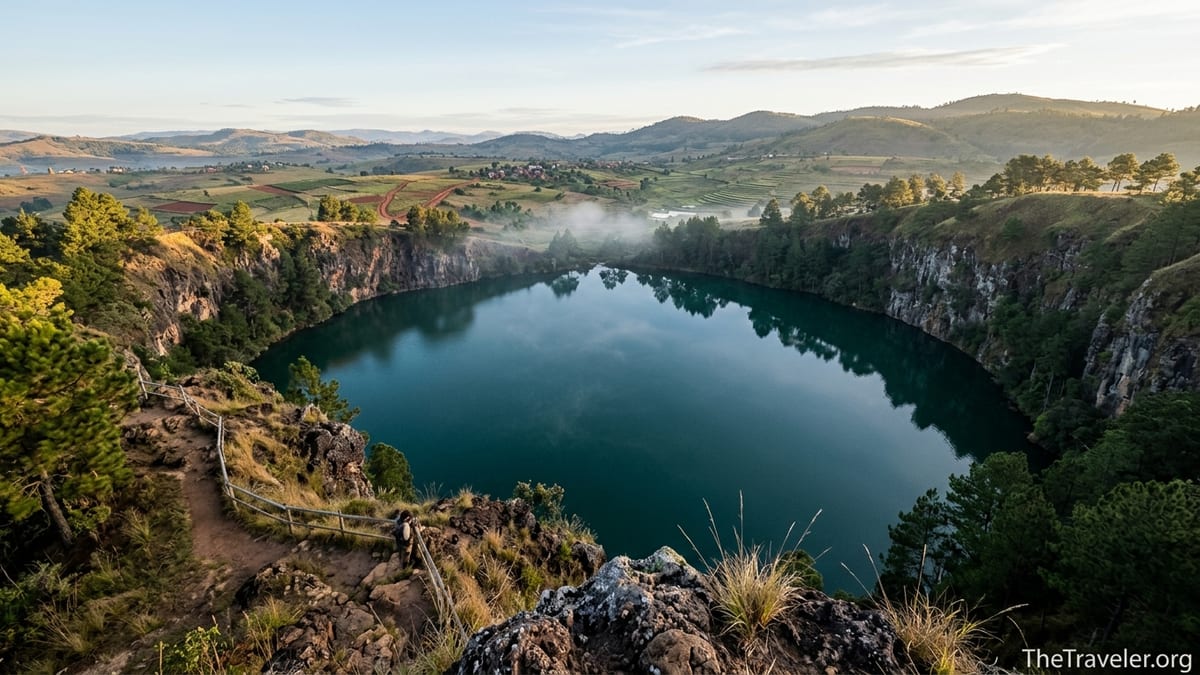
Lake Tritriva is the region’s headline natural attraction, a deep-blue volcanic crater lake surrounded by pine trees and cliffs about 15 kilometers southwest of Antsirabe. From the rim you look down into still, dark water reputed to be over 150 meters deep in places. On clear days, the surrounding hills and patchwork of fields form a near-perfect reflection on the lake surface, and travelers often describe it as one of the most atmospheric highlands landscapes they see in Madagascar.
Reaching Tritriva starts with a drive from Antsirabe along a mix of paved and unpaved roads that usually takes 45 to 60 minutes one way. Most visitors hire a car with driver in town, either through a hotel or an agency, at day rates that in 2026 typically start around the equivalent of 40 to 70 US dollars for a half-day circuit including Lake Tritriva and often Lake Andraikiba. Some travelers use scooters or bicycles, but the final approaches involve steep dirt sections and can be tiring at altitude, especially in the rainy season when tracks become muddy.
On arrival you pay a modest entry fee per person plus a separate fee if you choose to take a local guide. Prices change with inflation, but travelers commonly report paying the rough equivalent of 1 to 3 US dollars for park access and similar amounts again for a guide. In practice, hiring a local guide is strongly recommended. The crater rim path is uneven, and a guide not only keeps you away from fragile or dangerous sections but also explains the lake’s stories and taboos and may point out good viewpoints for photos that you might otherwise miss.
Legends around Tritriva tell of star-crossed young lovers who are said to have leapt into the lake, and visitors are often shown a tree or rocks associated with their story. The water is considered sacred, and local communities maintain fady, or traditional taboos, about behavior here. Visitors are typically asked not to swim, not to shout or play loud music and not to throw stones or rubbish into the lake. More specific taboos, such as restrictions on clothing colors or certain foods, can vary. Guides will brief you on current expectations, which is another reason they are so useful. Respecting these customs is a sign of courtesy to the community and helps preserve good relations between locals and visitors.
Lake Andraikiba and the Classic Crater Lake Circuit
Closer to town, Lake Andraikiba lies about 7 kilometers west of Antsirabe along the same general direction as Tritriva. Once a main local swimming and boating area, it is quieter today but still makes a pleasant stop, especially if you are doing a combined crater lakes outing. Many travelers walk part of the circuit around the lake, which takes roughly an hour at a gentle pace, with views of cultivated fields and low hills reflected in the water.
You can reach Andraikiba by car, bicycle or even on foot from Antsirabe. Renting a mountain bike in town for a half day is usually affordable, often in the range of 5 to 10 US dollars, and the mostly paved road and moderate distance make it realistic for reasonably fit riders. Cyclists should be prepared for traffic leaving town and for some hills, but compared with other parts of Madagascar, this is one of the easier countryside rides.
Along the lakeshore you may find small stalls selling snacks, bottled water, local handicrafts and sometimes simple souvenirs made from zebu horn or semi-precious stones. Activity levels tend to be higher on weekends or holidays when local families visit. Weekdays can feel almost deserted, which appeals to travelers who value quiet landscapes. While Andraikiba is not as dramatically scenic as Tritriva, its accessibility means it works well if you have only a few spare hours in Antsirabe and want to see at least one crater lake without a long excursion.
For many visitors with one full day in Antsirabe, the most efficient option is a loop that includes both lakes: a morning start from town, a stroll or short walk at Andraikiba, then continuing another 30 to 40 minutes by vehicle up into the hills for a midday or early afternoon visit to Tritriva before returning via a different backroad if conditions allow. Local drivers and guides know which tracks are currently passable and will adjust the order of stops depending on recent rain and road works.
Guides, Drivers and Safety Around Lake Tritriva
Whether you need a guide or driver for Lake Tritriva depends on your travel style, budget and experience with Malagasy roads. Officially, independent travelers can arrange a taxi or negotiate with a driver directly in Antsirabe, but language barriers and variable road conditions make a prearranged vehicle through your guesthouse or a trusted local operator more practical for many visitors. A typical arrangement is a local driver with a basic sedan or 4x4 collecting you mid-morning, doing the crater lake loop and returning by late afternoon.
Hiring a local guide at Tritriva is usually worthwhile even if you already have a driver. Guides come from nearby villages and know both the physical terrain and the cultural expectations. They walk with you along the crater rim, point out viewpoints and sometimes take you down small side paths for different angles on the lake. A guide also acts as a bridge to local residents who may be selling snacks or crafts, helping you avoid misunderstandings over prices or photography. Cash payment in local currency is expected, and small notes are appreciated.
In terms of safety, the main risks at Tritriva are physical rather than criminal. The lake lies in a rural area, and petty theft is possible like anywhere, but violent incidents are rarely reported. The real hazards are steep drops, loose rocks and sometimes slippery paths after rain. Simple precautions like wearing closed shoes with good grip, avoiding the rim edge, and keeping children close are important. Your guide will usually tell you where not to stand and may discourage risky selfie poses near cliffs, which is advice worth following.
The drive itself offers a window into highlands life. You pass small villages where children wave from the roadside, see farmers working terraced fields with zebu cattle, and watch women washing clothes in streams. Distances are not great, but travel is slow. Potholes, livestock on the road and slow trucks mean that self-driving is only advisable for travelers comfortable with African road conditions. Many visitors who have self-driven elsewhere in the world choose to rely on drivers in Madagascar to reduce stress and support local employment.
Thermal Springs, Colonial Architecture and Pousse-Pousse in Town
Antsirabe’s original claim to fame was its thermal water. The city’s nickname “ville d’eau” reflects its network of hot springs and its national thermal center just outside the compact center. The main thermal baths complex offers a mix of medical treatments prescribed by local doctors and wellness-oriented services like mineral-water baths, mud packs and massages. Exact prices vary by treatment, but simple access to facilities or a basic soak is generally priced affordably by international standards, often comparable to a few cups of coffee in a European capital.
While some visitors come specifically for multi-day therapeutic cures, most travelers sample the spa culture with a one-off visit. You might combine an hour at the baths with a late afternoon walk along Antsirabe’s wide, tree-lined boulevards such as Avenue de l’Indépendance, where colonial buildings and churches line the street. The old train station, no longer serving regular passenger trains, is a popular photo stop thanks to its classic French-style facade and the steady stream of pousse-pousse waiting outside.
Pousse-pousse rides are not just tourist novelties but an integral part of daily life in Antsirabe. Many operators rely on these fares as their main income. When you hail a pousse-pousse, first ask the price to your destination. Short rides within the central grid are cheap, and most visitors can afford to be generous within local norms. For example, if a driver asks for the equivalent of 2000 ariary for a ride, offering 2500 or 3000 ariary as a small tip can make a meaningful difference to them while still representing a small amount to most foreign visitors.
As you ride, you will likely pass several historic churches and buildings from the colonial period. These include stone churches built by Norwegian and French missionaries and grand villas from the early 20th century. Not every building is restored, and part of the interest lies in seeing how Antsirabe’s colonial past sits alongside present-day street life, with street food stalls, small grocery shops and phone credit vendors occupying the ground floors of once-elegant facades.
Craft Workshops and Day Trips to the Betafo Countryside
Beyond lakes and thermal baths, Antsirabe is known for its craft workshops. Several small, family-run operations welcome casual visitors during the day, often without the need for advance booking. Common stops include a miniature-vehicle workshop where artisans handcraft toy Renault 4s and pousse-pousse from recycled cans, a zebu horn workshop where workers transform discarded cattle horn into jewelry and utensils, and gemstone polishing shops that cut and shine the semi-precious stones mined in the region.
These visits usually involve a short demonstration followed by time in a small showroom. Prices vary widely depending on the item, but simple souvenirs such as small horn spoons or earrings often cost only a few dollars equivalent, while larger decorative pieces and polished stones can be more expensive. Bargaining is expected but generally polite and low-key. Many travelers choose to buy at least a small item as thanks for the demonstration, which helps sustain these workshops as living crafts rather than staged attractions.
For a deeper look at rural highlands life, consider a half or full day in the Betafo countryside, west of Antsirabe along the RN34. The small town of Betafo itself sits about 20 to 25 kilometers from Antsirabe and can be reached in around 30 to 45 minutes by car, depending on traffic and road conditions. The countryside around Betafo is notable for its terraced rice paddies, irrigation canals and traditional Merina villages, recognized by heritage organizations as representative of long-developed highlands agricultural systems.
Several local operators and independent guides in Antsirabe offer walking routes in this area. A typical day might include a drive to a village trailhead, a few hours of walking through rice terraces and along irrigation channels, a visit to a local church or historic site, and a simple lunch in a family home or basic village restaurant. Terrain is usually moderate rather than strenuous, but paths can be muddy after rain. Compared with the crater lakes, Betafo offers more interaction with everyday rural life and less focus on single panoramic viewpoints.
How Many Nights in Antsirabe: Itinerary Scenarios
Deciding whether Antsirabe merits one night or a longer stay depends on your broader Madagascar route, your interests and your tolerance for slow travel days. Travelers following the classic RN7 route from Antananarivo to Isalo and the coast often have limited time and many long drives, so they look closely at where to allocate extra nights. Antsirabe competes with rainforest parks like Ranomafana, granite landscapes like Andringitra, and beach time near Tulear or on the west coast.
If you are mainly focused on lemurs, rainforest and snorkeling, Antsirabe can serve as a comfortable overnight break rather than a main destination. In that case, arriving from Antananarivo late afternoon, taking a short pousse-pousse tour, dinner at a local restaurant and a quick look at colonial architecture the next morning may feel sufficient before you continue south. This one-night stop still has value, cutting what would otherwise be a long, tiring drive into manageable segments.
If, however, you enjoy walking, local culture and cooler highlands temperatures, two or even three nights in Antsirabe can be rewarding. With two full days, you can dedicate one to the crater lakes, including Tritriva and Andraikiba, and another to the Betafo countryside and craft workshops. You might also find time for the thermal baths and a more leisurely exploration of the city. This pace suits travelers who prefer to build in recovery days between rougher roads or more physically demanding hikes elsewhere in Madagascar.
Budget also plays a role. Antsirabe has a range of midrange and budget accommodations, often cheaper than equivalent options in Antananarivo or coastal resort areas. For long trips of two to three weeks, using Antsirabe as a base for a few nights can help control costs while you enjoy relatively good infrastructure such as reliable electricity, cafés with decent coffee and bakeries selling French-inspired pastries. Many overland tour participants later comment that they were surprised by how much they enjoyed simply sitting in a café here watching pousse-pousse traffic flow past.
The Takeaway
Antsirabe and its surroundings sit at a crossroads of Madagascar’s natural and cultural stories. Within easy reach of the city you can stand on the rim of Lake Tritriva, a sacred volcanic crater lake whose still waters are bound up with local legends, stroll around the gentler shores of Lake Andraikiba, soak in thermal waters that first attracted Norwegian missionaries, and ride through colonial-era streets in a hand-pulled pousse-pousse that remains a modern livelihood for many residents.
Adding a visit to the Betafo countryside layers in rice terraces, irrigation channels and small villages that illustrate how people have adapted to the highlands environment over generations. When you combine these experiences with craft workshops and café stops in town, Antsirabe becomes more than a utilitarian overnight halt. It turns into a place to slow down, walk, talk with locals and absorb a different side of Madagascar often overshadowed by the country’s forests and coasts.
For travelers rushing along the RN7, one night in Antsirabe offers a welcome pause and a quick sampler of highlands life. For those with a little extra time and an interest in landscapes, local stories and everyday culture, two or more nights allow for crater lakes, countryside walks and thermal relaxation without feeling hurried. Either way, approaching Lake Tritriva and the wider Antsirabe region with curiosity and respect for local fady will help ensure your visit is both memorable and appreciated by the communities who call these highlands home.
FAQ
Q1. How long does it take to reach Lake Tritriva from Antsirabe?
Travelers typically take 45 to 60 minutes by car each way, depending on road conditions and whether you stop in villages or at viewpoints along the route.
Q2. Do I really need a guide at Lake Tritriva?
While not strictly mandatory, a local guide is strongly recommended for safety on the rim paths, to explain the lake’s legends and fady, and to help you navigate local expectations.
Q3. Can I swim in Lake Tritriva or Lake Andraikiba?
Swimming is strongly discouraged at Lake Tritriva because the water is considered sacred and local fady ask visitors not to enter it, while policies at Andraikiba can vary and you should ask locally.
Q4. Is Antsirabe safe to walk around at night?
The center of Antsirabe is generally calm, but as in most cities, it is wise to avoid poorly lit streets, keep valuables discreet and use taxis or pousse-pousse for longer distances after dark.
Q5. How much should I budget for a crater lake excursion?
A typical half-day circuit by private car with driver and local guide fees usually comes to the rough equivalent of 50 to 90 US dollars for two people, excluding food and souvenirs.
Q6. What should I wear when visiting Lake Tritriva and Betafo?
Wear comfortable walking shoes with good grip, lightweight layers for cool mornings and warmer afternoons, and modest clothing that covers shoulders and knees to respect local norms.
Q7. Are there ATMs and reliable internet in Antsirabe?
Antsirabe has several banks with ATMs that accept international cards and a handful of cafés and guesthouses with Wi-Fi, although connections can be slower and less stable than in major cities.
Q8. Can I visit Lake Tritriva and the Betafo countryside in one day?
It is possible but makes for a long outing; most travelers prefer to dedicate one day to the crater lakes and another to the Betafo area to avoid rushing and to allow for road delays.
Q9. Is Antsirabe suitable for families with children?
Yes, many families enjoy the cool climate, short walks, crater lake views and pousse-pousse rides, though close supervision is essential near lake cliffs and busy roads.
Q10. When is the best time of year to visit Antsirabe and Lake Tritriva?
The dry season from roughly May to October offers more stable weather, better road conditions and clearer lake views, while the rainy season brings greener landscapes but muddier tracks.