


Linking the rainforest of Andasibe with the lakeside calm of Akanin’ny Nofy is one of eastern Madagascar’s most memorable journeys. It is also one of the least intuitive to plan. The route combines a long drive on the RN2, a rough final access road to Manambato on Lake Rasoabe, and then a boat transfer through the Pangalanes waterways to the sandy peninsula of Akanin’ny Nofy. This guide breaks down each step so you know exactly what to expect, how long it really takes, and how to organize a smooth connection.
Understanding the Andasibe to Akanin’ny Nofy Route
The classic route from Andasibe to Akanin’ny Nofy runs east along the RN2 before turning off toward the lakeside village of Manambato, where the road ends and the water journey begins. From Manambato, small motorboats cross Lake Rasoabe and then follow stretches of the Pangalanes Canal system to reach the lodges clustered around Akanin’ny Nofy, including the well known Palmarium Reserve. In total, you should plan for roughly 4 to 6 hours by road, followed by about 1 to 1.5 hours by boat, depending on conditions and the exact boat landing used.
In distance terms, this is not a particularly long journey, but Madagascar’s roads and piste (dirt tracks) are slow. Several reputable operators currently describe the Andasibe–Manambato section as approximately 125 to 140 kilometers by road. The last 7 to 10 kilometers are on an unpaved track that can become muddy and deeply rutted in the rainy season, which is a key reason travel time can stretch out toward the upper end of the estimate. Building realistic expectations around those times is essential when you are connecting rainforest walks in Andasibe with afternoon boat departures toward Akanin’ny Nofy.
Most travelers undertake this trip as part of a private, driver guided itinerary that links Antananarivo, Andasibe, the Pangalanes and sometimes onward journeys toward the east coast or Sainte Marie. You can, in theory, try to connect the route using a patchwork of local taxi brousse vehicles and ad hoc boat arrangements in Manambato, but road conditions, sparse departures and limited daylight make that a stressful option. For almost all visitors, a prearranged car and private boat transfer is the most practical and comfortable way to travel.
Driving Andasibe to Manambato: RN2 and the Final Track
The first phase of the journey is by road from Andasibe eastward toward Brickaville on the RN2. This national road is fully paved on this stretch but winding and shared with heavy truck traffic heading to and from the port at Toamasina. A realistic non stop driving time between Andasibe and the Manambato turn off is about 3.5 to 4.5 hours, depending on weather, traffic and how often you stop for views, photos or roadside snacks such as mofo gasy (Malagasy rice cakes) and seasonal fruits sold in small villages along the way.
From the RN2, a signposted junction near Brickaville leads toward Manambato and Lake Rasoabe. The precise condition of this access road changes from year to year, but recent trip reports and operator descriptions agree that the final 7 to 10 kilometers are on a dirt track rather than asphalt. In the dry season this section can take around 30 to 40 minutes in a high clearance 4x4, weaving through red earth, puddles and occasional patches of sand. In the rains, when sections turn to sticky clay or standing water, the same short distance can stretch to closer to one hour.
Because of these variables, operators that regularly drive the route often quote a total Andasibe–Manambato travel time of around 4 to 6 hours. This allows for one or two short stops, slow progress behind trucks on the RN2 and whatever the piste serves up on that particular day. In practice, on a dry day in September with an early start, you might leave Andasibe at 8:00, reach the RN2 junction around midday and roll into Manambato village shortly after 13:00. On a wet February day with poor visibility and churned up mud near the lake, the same stretch could comfortably occupy you until mid afternoon.
Private Transfers, Vehicles and What Happens After Manambato
Most visitors travel this route with a private vehicle and driver arranged through a local tour company, car rental agency with driver or independent guide. In Antananarivo and Andasibe, agencies commonly use Toyota Land Cruiser, Nissan Patrol or Mitsubishi L200 pickups for the eastern circuits, precisely because the last section into Manambato demands higher clearance than a standard sedan. Daily hire for a vehicle and driver on this kind of route often falls in the rough range of 70 to 120 euros per day, excluding fuel, though exact quotes vary with fuel prices, itinerary complexity and language skills of the guide.
In almost all cases, your vehicle does not continue with you to Akanin’ny Nofy. Manambato is essentially the end of the road. There is no bridge or car ferry across Lake Rasoabe for tourists, and the lodges at Akanin’ny Nofy are reached only by boat. For travelers on a multi day circuit, the driver will typically drop you at the small lakeside embarkation point, help unload luggage, then park the vehicle in Manambato and remain in the village or nearby while you spend one or more nights at Akanin’ny Nofy. The same driver then meets you again at the pier in Manambato on your return day.
Parking in Manambato is usually arranged informally through the boat operator, a small local guesthouse or lakeside landowner. Fees remain modest by international standards, often calculated per day or per night rather than per hour, and are usually bundled into your overall tour or transfer quote. For example, if you have booked an Andasibe–Manambato–Akanin’ny Nofy circuit through a regional operator, your invoice might simply list one return transfer price with boat and parking included, rather than itemizing each component. If you are self organizing, confirm with your boat provider in advance where your driver will leave the vehicle, whether it is in a fenced yard or open area, and how payment is handled.
Boarding at Manambato and Transferring Luggage to the Boat
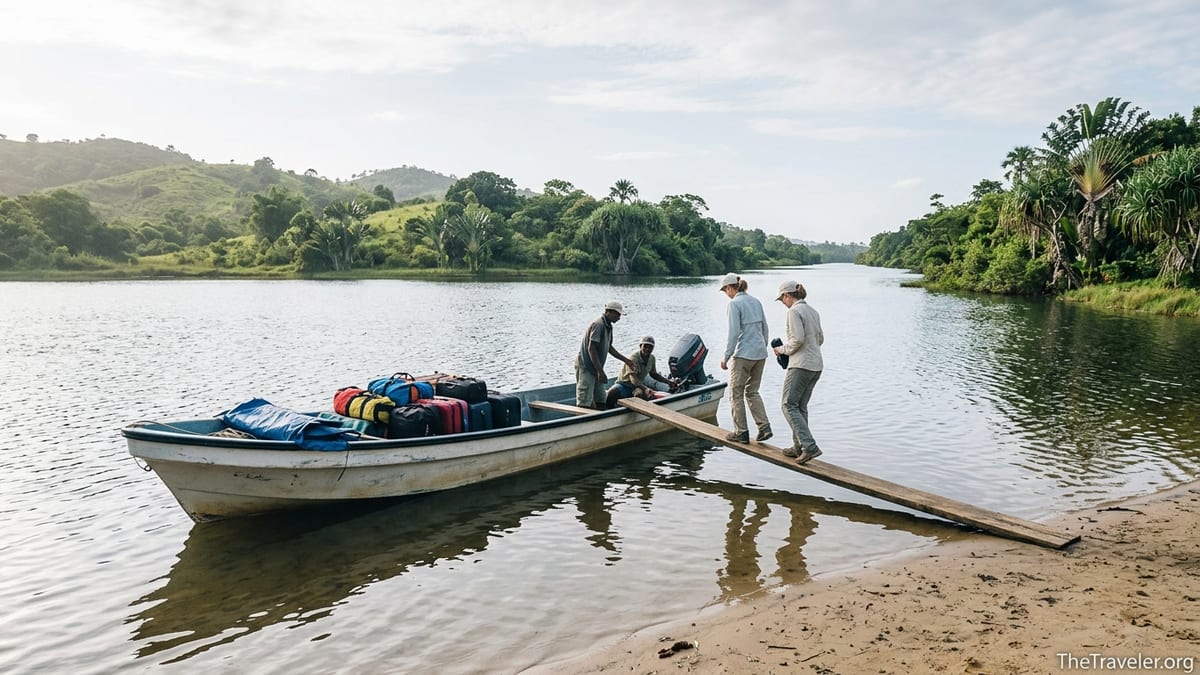
On arrival in Manambato, your road journey ends at a simple lakeside landing, usually a sandy or grassy shore with a small pontoon or wooden jetty. There is rarely a formal pier with large infrastructure. Instead, boat captains pull their launches as close to shore as water depth allows, and passengers wade a short distance or use a narrow plank to board. You should expect your shoes to get dusty or damp and dress in comfortable clothing that allows easy movement; this is a practical transfer rather than a polished marina experience.
Luggage is typically transferred directly from your vehicle to the waiting boat by a combination of your driver, boat crew and local porters. On a common itinerary, such as a three night stay at Palmarium Reserve, couples often arrive with one or two medium suitcases plus daypacks. Boat crews are used to handling this amount and will usually stack larger suitcases in the stern or bow, covering them with a plastic tarpaulin if there is a chance of rain or spray. Lightweight duffel bags and backpacks handle the transfer especially well because they are easier to lift in and out of the boat and to stow under seats.
If you have valuables such as camera equipment or laptops, keep them in a smaller hand carried bag that stays at your feet rather than in the pile of larger cases. While theft is not commonly reported on these short crossings, lakeside embarkation points can be busy with people loading multiple boats, and it is sensible to keep passports, electronics and cash close. Your driver will normally stay on shore, wave you off, and then move the parked vehicle to its agreed spot. Before stepping on board, double check that you have everything you need for your days on the water and at Akanin’ny Nofy, as you will not have access to the car again until you return.
Crossing Lake Rasoabe and Entering the Pangalanes
The boat leg from Manambato to Akanin’ny Nofy is a scenic contrast to the drive that precedes it. Small motor launches, often seating between 6 and 12 passengers, leave Manambato and quickly cross the shallow waters of Lake Rasoabe. In calm conditions, this part of the crossing can take around 20 to 30 minutes, with low waves and broad views over the surrounding hills and wetlands. The pilot then guides the boat toward connecting channels and eventually into stretches of the Pangalanes waterway that thread south toward Lake Ampitabe and the sandy peninsula of Akanin’ny Nofy.
Overall, operators quote a journey time of roughly 1 to 1.5 hours from Manambato to Akanin’ny Nofy. The exact duration depends on the type of boat, engine power, water levels and whether the captain detours slightly for birdlife or local traffic. On some itineraries, the crossing also passes via smaller lakes such as Rasoamasay en route. This water journey is rarely rushed. Many pilots throttle back to reduce spray, bypass floating vegetation and give guests opportunities to photograph fishermen in dugout canoes, stands of pandanus and the silhouetted shapes of traveler’s palms along the shore.
Most lodges, including well known options such as Palmarium and Palmarium Beach, operate or charter their own boats and coordinate schedules with inbound road transfers. For example, a traveler leaving Andasibe at 8:00 might be booked onto a 14:00 private boat departure from Manambato, arriving at Akanin’ny Nofy around 15:15 in good weather. Where accommodation is booked independently, it is crucial to confirm in advance whether the lodge can send a boat to meet you, at what time, and from which exact embarkation point in Manambato, as there can be more than one small landing along the shore.
Weather, Seasonal Factors and Safety on the Water
Weather plays a major role in both the road and boat segments of this route. Eastern Madagascar has a humid, tropical climate. The dry season, broadly from May to October, generally offers firmer piste conditions into Manambato and calmer lake crossings, especially in the morning. The rainy season from November to April sees heavier downpours, higher humidity and, occasionally, cyclones that can disrupt both road and water travel, particularly between January and March.
On the water, operators aim to avoid departures in the teeth of strong storms or when winds whip up whitecaps on Lake Rasoabe. While the boats used on this route are dependable workhorses with outboard engines and life jackets, they are relatively small. In practice, this means that your captain may decide to delay departure by an hour or two if a squall is passing through or if lightning is visible. In the height of the rainy season, some travelers find it more comfortable to schedule late morning or early afternoon departures, when overnight squalls have had time to pass and visibility has improved.
From a safety perspective, you should expect your captain to provide life jackets and a simple safety briefing, at least in basic English or French. If you do not see life jackets on board, request them before departure. It is also wise to protect electronics and documents in waterproof pouches or dry bags, particularly in the wetter months when sudden showers are common. Sun can be surprisingly strong even on overcast days, so wearing a hat, sunglasses and sunscreen is recommended, as is carrying a lightweight windproof layer in case the wind picks up across the open lake.
Planning Realistic Timing and Sample Day Itineraries
Because the Andasibe to Akanin’ny Nofy connection involves multiple moving parts, building a buffer into your schedule is essential. You should not plan an international flight departure from Antananarivo on the same day that you are traveling by water from Akanin’ny Nofy, nor should you book a late afternoon boat to Akanin’ny Nofy if you are only leaving Andasibe after a long morning hike. Give yourself enough time for delays on the RN2, slower than expected progress on the Manambato access track and potential pauses due to weather on Lake Rasoabe.
As a concrete example, a balanced travel day in the dry season might look like this: breakfast and final walk in Andasibe from 7:00 to 9:00, departure by road at 9:30, a brief roadside lunch stop along the RN2 around 12:30, arrival at Manambato between 14:00 and 15:00, and boarding a prearranged 15:30 private boat to Akanin’ny Nofy, reaching your lakeside bungalow by 16:30. This schedule keeps you off the road after dark, which drivers generally avoid for safety, and allows some margin for minor delays.
In wetter months or if traveling with young children, many families choose an even earlier start from Andasibe, around 7:30 or 8:00, and aim for a midday or early afternoon boat. Arriving at your lodge in Akanin’ny Nofy with a couple of hours of daylight remaining lets you get your bearings, walk the beach, and perhaps join an early evening guided walk to spot nocturnal lemurs. It also gives your driver ample time to settle the vehicle in Manambato and find his accommodation, which is an often overlooked but important part of making this unusual road and water connection work smoothly.
The Takeaway
The Andasibe to Akanin’ny Nofy route is not a quick hop between two tourist hubs but a layered journey across some of eastern Madagascar’s most atmospheric landscapes. It requires a half day or more of combined driving and boating, a willingness to embrace rough roads and simple lakeside infrastructure, and an understanding that schedules may flex with weather and road conditions. In return, travelers are rewarded with a near seamless transition from humid montane forest, echoing with the calls of indri lemurs, to a tranquil lakeside peninsula fringed with palms and sandy coves.
Planning ahead is crucial. Arrange a reliable 4x4 vehicle and experienced driver for the Andasibe to Manambato leg, confirm boat times and pick up points with your lodge at Akanin’ny Nofy, and build generous buffers into your day so that delays feel like part of the adventure rather than crises. Remember that your vehicle will remain in Manambato while you continue by water, and that luggage, weather gear and personal essentials should be packed with both road dust and lake spray in mind.
Approached with realistic expectations and a flexible mindset, this unusual junction of road and water can be one of the highlights of an eastern Madagascar itinerary. You will finish the day not only having connected two iconic destinations but with a vivid sense of the landscapes, communities and waterways that link them. That sense of connection is what turns a simple transfer into a journey worth remembering.
FAQ
Q1. How long does it really take to travel from Andasibe to Akanin’ny Nofy?
Most travelers should plan for 4 to 6 hours by road from Andasibe to Manambato, followed by around 1 to 1.5 hours by boat to Akanin’ny Nofy, plus time for brief stops.
Q2. Do I need a 4x4 vehicle for the Manambato access road?
A high clearance 4x4 is strongly recommended because the final 7 to 10 kilometers into Manambato are on an unpaved track that can become muddy, rutted or sandy, especially in the rainy season.
Q3. What happens to the car and driver while I stay at Akanin’ny Nofy?
Your driver usually drops you at the lakeside in Manambato, helps with luggage, then parks the vehicle in the village and stays nearby until your scheduled return, when he meets you again at the same pier.
Q4. Can I do this route using public transport instead of a private transfer?
In theory you could combine taxi brousse services on the RN2 with a locally arranged boat in Manambato, but departures are irregular and roads are slow, so most visitors find a prebooked car and boat transfer far more reliable.
Q5. Are there fixed boat schedules between Manambato and Akanin’ny Nofy?
There are no large ferries with rigid timetables; instead, most crossings are run by lodges or local operators who schedule boats around guest arrivals and arrange specific pick up times in advance.
Q6. What should I pack in my hand luggage for the boat crossing?
Keep passports, cash, electronics, medication, a light jacket, sunscreen and any fragile items in a small bag that stays at your feet rather than in the larger luggage stacked in the bow or stern.
Q7. Is the boat ride across Lake Rasoabe safe for children?
Yes, families regularly do this route, but you should request appropriately sized life jackets, make sure children stay seated while the boat is moving and avoid departures during storms or strong winds.
Q8. What time of year offers the easiest travel between Andasibe and Akanin’ny Nofy?
The drier months from roughly May to October usually bring firmer piste conditions into Manambato and calmer waters on Lake Rasoabe, though showers are still possible and road speeds remain moderate.
Q9. Can I travel from Antananarivo to Akanin’ny Nofy in one day via Andasibe?
It is technically possible but long and tiring; most itineraries split the journey by spending at least one night in Andasibe before continuing to Manambato and Akanin’ny Nofy on a separate day.
Q10. Do I need to tip the driver or boat crew on this route?
Tipping is not obligatory but is appreciated; many travelers choose to offer a modest cash tip to the driver at the end of the broader itinerary and smaller tips to boat crew or porters who help with luggage.