


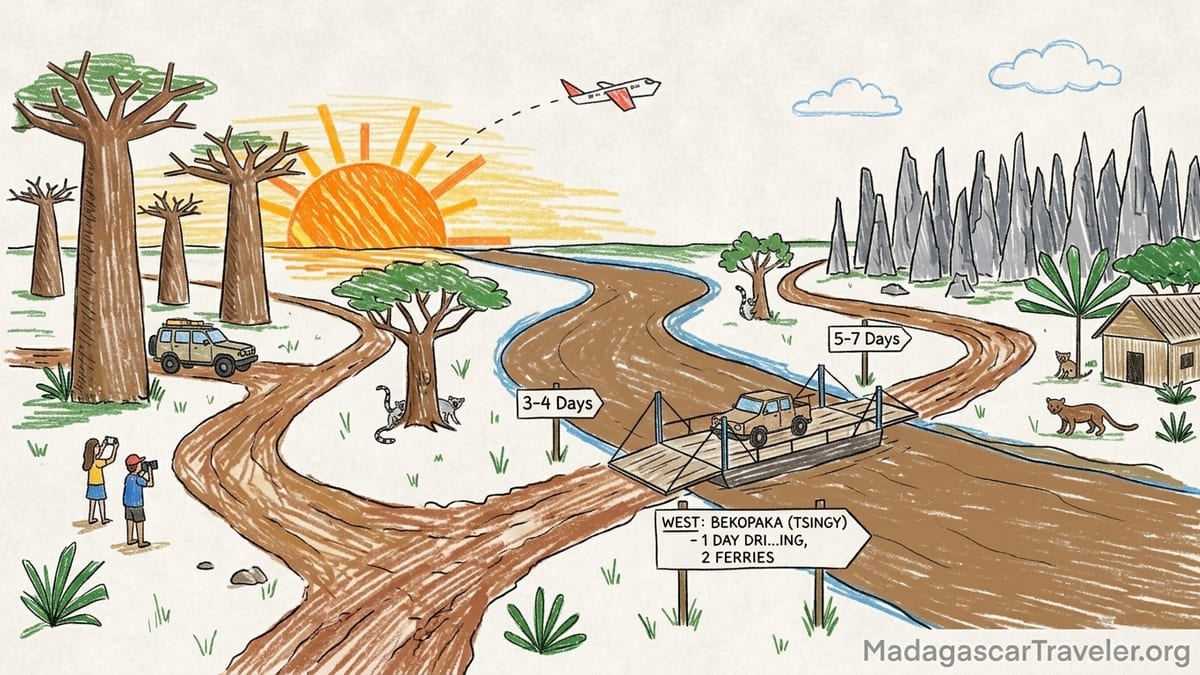
Western Madagascar looks compact on a map, but distances, rough pistes and river ferries mean travel here is slow. Planning around real drive times and overnight stops is essential if you want to enjoy Morondava, the Avenue of the Baobabs, Kirindy Forest and Tsingy de Bemaraha without exhausting detours or missed connections. This guide breaks the region into three practical tiers that reflect how visitors are actually traveling in 2026: a 1–2 day Morondava and Baobabs taster, a 3–4 day Tsingy-focused route, and a 5–7 day circuit that adds Kirindy and extra time on the coast or rivers.
Understanding Distances, Seasons and Travel Logistics
On paper, Morondava to Bekopaka, gateway to Tsingy de Bemaraha, is only about 200 kilometers. In practice, it is a full 8 to 10 hour 4x4 journey each way, including two small but crucial ferry crossings over the Tsiribihina and Manambolo rivers. The dirt road north from Morondava is heavily corrugated in the dry season and muddy in the rains, which is why travelers and local drivers talk about days, not kilometers, when describing this route. The Avenue of the Baobabs sits roughly 20 to 25 kilometers north of Morondava along this same track, which is why it easily fits into even a very short stay.
Kirindy Forest lies further along the same road as the Baobab Avenue, roughly 60 kilometers and about 1.5 to 3 hours’ driving from Morondava depending on recent rain. For many trips it functions as a logical overnight stop to break up the long haul to Bekopaka. Several 2025 and 2026 tour itineraries combine a sunset at the baobabs with a night in Kirindy, then continue to Bekopaka the next morning, reflecting the real rhythm of travel rather than a tidy but unrealistic “see everything from Morondava” approach.
Seasonality matters as much as distance. Access to Tsingy de Bemaraha is typically possible only from roughly mid-April to mid-November, with the piste often impassable in the peak of the rainy season and around cyclones. Even in the dry months, heavy rain can temporarily close the ferries. Travelers aiming for May to October usually find the most reliable conditions, though June to September is the sweet spot for cooler, drier weather on this hot and dusty coast.
Costs also reflect the remoteness. As of 2026, a private 4x4 with driver from a Morondava-based agency for the Morondava to Bekopaka run often starts around the equivalent of 130 to 200 US dollars per day, excluding park fees, ferries and fuel. Shorter transfers such as a return taxi from Morondava to the Baobab Avenue at sunset are typically quoted locally in ariary, but many recent visitors report paying the rough equivalent of 20 to 40 US dollars for a half-day outing when bargaining directly with a driver at the Morondava taxi stand or through a small hotel.
1–2 Days: Morondava and the Avenue of the Baobabs
A 1 to 2 day stay in Morondava works for travelers flying in for a quick taste of western Madagascar or making a brief detour off an overland route from Antananarivo. The focus is simple: enjoy the coast and visit the Avenue of the Baobabs in the best light. The baobab-lined track is roughly a 30 to 45 minute drive from central Morondava, so you can easily come out for sunrise, return for breakfast, and still have time for a sunset visit the same day if you want different light and fewer people in your photos.
With one night only, the most efficient pattern is to arrive in Morondava by midday, check into a seaside guesthouse, and book a late-afternoon trip to the Baobab Avenue. Many hotels maintain preferred local taxi drivers with flat prices for a sunset run, often including a quick stop at the smaller “Baobab Amoureux” trees a little further along the track. You return to Morondava after dark for dinner on the beach. This uses Morondava as your only overnight base, which is ideal if your onward flight or taxi-brousse leaves early the next morning.
With two nights, you can slow down. A typical example would be Day 1 arrival, late-afternoon walk along Morondava’s beach or an outrigger canoe trip with fishers towards Betania village, then an early dinner. Day 2 might start with a pre-dawn drive to the Baobab Avenue for sunrise, followed by a leisurely brunch back in town, and a second visit at sunset with more time to wander side tracks for different angles away from the main crowd. Night two is again in Morondava, giving you a buffer if your incoming flight is delayed or if weather forces you to reschedule one of the baobab visits.
Travelers sometimes ask if it is worth trying to reach Kirindy Forest as a day trip on this kind of short visit. In theory it is possible to leave Morondava early, stop at the baobabs on the way, spend a few hours in Kirindy, and return by evening. In reality, the 3 to 6 hours of roundtrip driving on a rough road can make for a punishing day, especially if you have just flown in. For 1 to 2 day stays, keeping things simple with Morondava overnights and multiple baobab visits usually delivers a better experience than chasing extra road time.
3–4 Days: A Tsingy-Focused Route From Morondava
A 3 to 4 day itinerary centered on Tsingy de Bemaraha is aimed at travelers determined to see Madagascar’s famous limestone pinnacles but who lack a full week. In this case the Baobab Avenue and Kirindy become scenic stops rather than primary destinations. Most itineraries that local agencies and recent independent travelers describe take essentially three full days of travel time between Morondava and Bekopaka plus one major hiking day inside the park itself.
With three days, an intense but workable pattern is: Day 1 early departure from Morondava, sunrise or quick morning stop at the Baobab Avenue, then continue by 4x4 north to cross the Tsiribihina River by ferry at Belo sur Tsiribihina. After a simple lunch in Belo, you push on across the second ferry at the Manambolo and reach Bekopaka by late afternoon or early evening, depending on queues at the ferries. Night 1 is in Bekopaka. Day 2 is your full Tsingy day, usually with one of the classic circuits that mix suspension bridges, ladders and narrow rock passages. Night 2 is again in Bekopaka. Day 3 is the long return drive to Morondava, often reaching town by late afternoon or early evening for your final night.
Adding a fourth day makes the trip significantly more comfortable. One common version is to break the northbound journey with a night in or near Belo sur Tsiribihina, particularly useful if water levels are low and ferries are slow to load. Another option is to keep the northbound leg long but add a second Tsingy day, using one day for the more demanding “Grand Tsingy” circuit and another for a shorter “Petit Tsingy” walk combined with a canoe or pirogue float on the Manambolo River to see caves and cliff-side tombs. In both cases your nights would fall as one night in Belo or Bekopaka, one or two more nights in Bekopaka, then a final night back in Morondava.
On these tight itineraries, most travelers use Morondava purely as an entry and exit point rather than a base. You might fly in from Antananarivo, spend a single night in Morondava to buffer against flight delays, then head north first thing. Your return night in Morondava at the end doubles as a rest before a domestic flight or long taxi-brousse back to the capital. By building around the time-consuming ferries rather than trying to force a perfect loop, this 3 to 4 day Tsingy route gives you a realistic chance of enjoying at least one long, unhurried day in the park.
5–7 Days: Adding Kirindy and Extra Time in the Region
With 5 to 7 days you can follow the full western circuit that underpins many up-to-date 2026 tour programs: Morondava, Avenue of the Baobabs, Kirindy Forest, Bekopaka and back, with time left for river or beach extensions. A classic 6-night version might look like this: Night 1 Morondava, Nights 2 and 3 Kirindy or nearby Marofandilia area, Nights 4 and 5 Bekopaka for Tsingy, Night 6 back in Morondava. This pattern spreads the driving, gives at least two nights close to wildlife in Kirindy, and still reserves two full days for Tsingy circuits.
In practice, many travelers go straight from Morondava airport to Kirindy on Day 1, especially if their flight from Antananarivo lands by mid-afternoon. You might stop at the Baobab Avenue for sunset on the way, then sleep in one of Kirindy’s basic lodges so you can join a night walk to look for the fossa and nocturnal lemurs. Night 1 is in Kirindy instead of Morondava. Day 2 is a morning forest walk followed by the long drive to Bekopaka via Belo and both ferries, with Night 2 in Bekopaka. Days 3 and 4 are spent on Tsingy hikes and a Manambolo River pirogue excursion, with Nights 3 and 4 again in Bekopaka. Day 5 is the return drive to Kirindy or Morondava depending on how you want to break the journey; Night 5 in Kirindy or Morondava. Day 6 gives you a spare day on the coast in Morondava, with a second baobab visit at sunset if you like, before an early departure on Day 7.
This longer window also allows for small but memorable add-ons. Some visitors accept an extra half-day detour to spend a few hours or a night on the Tsiribihina or Manambolo rivers, often in a local pirogue, which provides a different perspective on the baobab-dotted landscape and the Sakalava villages along the banks. Others build in a beach day in Morondava or a village visit to Betania, reached by pirogue through the mangroves. These pieces are easier to add once your core pattern of Kirindy and Bekopaka nights is fixed.
Because the road and ferry timings are unpredictable, the key advantage of a 5 to 7 day plan is buffer. A common real-world scenario is a delay of several hours at one of the ferries due to mechanical issues or low water. With spare nights in Kirindy or Morondava, you are better placed to absorb such delays without losing your only Tsingy day or missing a domestic flight. Rather than treating the week as a rigid loop, think of it as a spine of confirmed nights in Kirindy and Bekopaka with flexible bookends on the coast.
Where You Actually Sleep: Morondava, Kirindy/Belo and Bekopaka
Morondava is your most comfortable base in western Madagascar. It offers a small spread of mid-range seaside hotels with air conditioning and pools, simple guesthouses closer to the taxi-brousse station, and a handful of slightly more upmarket boutique properties facing the Mozambique Channel. Almost all 1 to 2 day itineraries use Morondava for every night. In 3 to 4 day Tsingy runs you will typically sleep in Morondava on the first and last nights only. For week-long routes, many travelers either begin or end with two consecutive nights in town to rest and enjoy the beach after long days on the piste.
Kirindy and Belo sur Tsiribihina serve mainly as functional stops rather than destinations in their own right for most visitors. Near Kirindy Forest the accommodation ranges from very simple bungalows with solar power and bucket showers to basic but solid lodge-style rooms run by local or Antananarivo-based operators. Nightlife is limited to early dinners and the sounds of the forest, but that is exactly what many visitors come for. One common pattern is to spend 1 to 2 nights in Kirindy to maximize dawn and night walks for fossa and lemur viewing, especially between August and October when sightings tend to peak.
Belo sur Tsiribihina, on the southern bank of the river of the same name, offers a couple of modest hotels and restaurants that cater mostly to overland groups waiting for the ferry. If you want to break up the 8 to 10 hour push between Morondava and Bekopaka, Belo makes sense for one night. In a 3 to 4 day Tsingy trip this might be your first overnight stop, with Nights 2 and 3 in Bekopaka. On a 5 to 7 day schedule, you might choose to push through Belo on the way north and stop there on the way back, turning what would otherwise be another very long driving day into two more manageable stages.
Bekopaka itself has improved slightly in recent years, with more guesthouses and small hotels that offer private bathrooms, mosquito nets and sometimes fans or limited generator-powered electricity. These properties, spread across the village and along the track towards the park entrance, host almost all visitors to Tsingy de Bemaraha. Expect patchy internet and limited menus based on what is available that week, but also genuine access to the park’s circuits with early starts. In nearly every realistic itinerary that includes Tsingy, you will sleep in Bekopaka at least two, and ideally three, nights.
Ferries, Road Conditions and When to Add River or Beach Time
Two small vehicle ferries control the rhythm of travel between Morondava and Tsingy. The first crosses the Tsiribihina River at or near Belo sur Tsiribihina, and the second spans the Manambolo River just south of Bekopaka. Neither operates on a fixed Western-style timetable. Instead, they run back and forth while there is daylight and enough vehicles to justify a crossing. In the dry season, low water can mean long loading times or the need to wait for the right tide level, while at the tail ends of the rainy season, high water can delay service for safety reasons.
This is why even tour companies that operate the route every year tend to quote journey times of “roughly 8 to 10 hours” for Morondava to Bekopaka, with occasional reports of 12 hour days when queues build up. It is also why a local driver might suggest leaving Morondava as early as 5 or 6 in the morning, not only to beat midday heat but also to reach Belo while the ferries are still relatively quiet. Your schedule should allow space for a missed or delayed crossing, especially on the return leg if you have a domestic flight booked out of Morondava.
River and beach extensions fit most naturally around these ferry constraints. If you want a half-day or overnight trip on the Manambolo River by pirogue, the best moment is usually on a Tsingy day starting and ending in Bekopaka: you paddle through gorges and caves in the morning, then hike Petit Tsingy in the afternoon or vice versa. Longer three-day descents of the Tsiribihina River usually begin far east of Belo and end there, so travelers often step off the riverboats and continue by road to Bekopaka, adding a Tsingy extension onto an existing river itinerary rather than the other way around.
Beach time, by contrast, belongs at the Morondava end. Once you have completed the demanding Tsingy and Kirindy sections, a full day of doing very little on Morondava’s wide sandy beach can be extremely welcome. Some visitors add informal day trips by pirogue to Betania village or short walks through mangroves, but many simply enjoy a pool, sunset drinks and fresh seafood. Because this kind of downtime is the most flexible part of a western itinerary, it works best at the end in case overland delays eat into your days earlier in the trip.
Practical Tips for Booking and On-the-Ground Costs
Western Madagascar remains a region where planning tends to go more smoothly when you enlist a local driver-guide or agency, particularly for Tsingy. In 2026, many travelers still report booking a 4x4, driver and basic accommodation package starting from Antananarivo or Morondava, covering all transport to Kirindy and Bekopaka, ferry fees and park guiding. This kind of arrangement reduces the risk of getting stranded at a river crossing or arriving in Bekopaka without a bed in the busiest months of July and August.
If you prefer to organize things independently, it is still possible but demands more time. You will likely begin in Antananarivo, either flying to Morondava when the route operates or taking a full day or longer by taxi-brousse or private car to reach the coast. Once in Morondava, you can negotiate directly with 4x4 drivers for Kirindy and Bekopaka. Prices vary widely depending on fuel costs, vehicle condition and whether you share with other travelers, but you should be prepared for multi-day quotes in the hundreds of euros equivalent for the full Tsingy run, as fuel and maintenance on this road are expensive for local operators.
On a smaller scale, practical costs such as baobab visits remain relatively modest. Recent visitors describe paying the equivalent of a few US dollars in local currency for the Baobab Avenue access fee and community-run parking areas, and 20 to 40 US dollars for a private vehicle from Morondava to cover sunset visits and waiting time. In Kirindy, expect to pay separate park entry and mandatory guide fees in addition to your lodge costs, with guided night walks often priced as a small group rate for anyone staying at the same camp.
For all three itinerary tiers, carrying cash in ariary is essential, especially for ferry tolls, local restaurants in Belo and Bekopaka, and informal services such as pirogue rides. Card payments are spreading slowly in Morondava’s larger hotels, but in Kirindy, Belo and Bekopaka they remain the exception. Building a daily buffer for unexpected costs, such as an extra night’s lodging if ferries are halted, will help keep your plans flexible as conditions change.
The Takeaway
Designing a western Madagascar itinerary is less about drawing a neat loop on a map and more about respecting the slow reality of the road, the ferries and the seasons. The three tiers described here mirror the way travelers are actually moving in 2026. A 1 to 2 day stay in Morondava gives you a satisfying encounter with the Avenue of the Baobabs without leaving the comfort of a beach town base. A 3 to 4 day push to Tsingy de Bemaraha adds one of Madagascar’s most dramatic landscapes, as long as you accept that much of your time will be spent on the piste and at ferry ramps.
With 5 to 7 days you can finally stitch the region together: baobabs, Kirindy’s wildlife, the twin river crossings and Tsingy’s spires, plus room for a river paddle or a quiet beach recovery day. The key is to plan nights, not just sights. Decide upfront how many nights you want in Morondava, Kirindy or Belo and Bekopaka, then let those anchor points dictate how ambitious your daily distances can be. In a place where a 200 kilometer drive can swallow a day, building around these real constraints is what turns a demanding route into an unforgettable journey.
FAQ
Q1. How many days do I really need for Tsingy de Bemaraha from Morondava?
Most travelers need at least three days: one long day to reach Bekopaka, one full day in Tsingy for hiking, and one long day to return to Morondava. Four days gives you a more comfortable pace and the option of a second Tsingy or Manambolo River day.
Q2. When is the best time of year to visit Morondava, Kirindy and Tsingy?
The main season runs roughly from mid-April to mid-November, with June to September offering the driest conditions and cooler temperatures. Access to Tsingy is often impossible or unreliable in the heart of the rainy season, so most operators avoid January to March for this route.
Q3. Can I visit the Avenue of the Baobabs as a quick day trip without staying overnight?
Yes, if you arrive in Morondava early by flight or long-distance taxi-brousse, you can hire a taxi for a late-afternoon or sunset trip and return the same evening. However, staying at least one night in Morondava gives you more flexibility if travel delays occur and allows a second visit at sunrise.
Q4. Is it possible to do Kirindy Forest as a day trip from Morondava?
It is technically possible but not ideal. The one-way drive takes around 1.5 to 3 hours on a rough road, so a round trip eats much of the day and you miss the best times for wildlife at dawn and after dark. Most visitors who prioritize Kirindy spend at least one or two nights near the forest.
Q5. How difficult are the hikes in Tsingy de Bemaraha?
Tsingy circuits range from short, relatively easy walks on flat or gently undulating terrain to demanding routes involving ladders, fixed cables and narrow rock crevices. Visitors with a reasonable level of fitness and no major mobility issues usually manage at least one classic circuit, but you can choose shorter options if you are nervous about heights.
Q6. Do I need to book a tour in advance, or can I arrange everything in Morondava?
For the baobabs alone you can usually arrange taxis and guides on arrival. For Kirindy and especially Tsingy de Bemaraha, booking a 4x4 and accommodation through a local agency or driver-guide in advance is strongly recommended, particularly in July and August when beds and vehicles can sell out.
Q7. How much should I budget for transport on a 5 to 7 day western itinerary?
Costs vary widely, but multi-day 4x4 hire with a driver on this route often totals several hundred euros equivalent, particularly once fuel, ferries and the long distances to Bekopaka are included. Shorter trips, like a taxi to the Baobab Avenue, are much cheaper and are usually paid in local currency at the time.
Q8. Are there ATMs or card facilities along the route?
Morondava has some ATMs, though they can occasionally run out of cash or be offline. Along the road to Kirindy, in Belo and in Bekopaka, you should not rely on ATMs or card payments. Bring sufficient ariary from Antananarivo or Morondava to cover park fees, ferries, meals and extra nights if required.
Q9. Is self-driving recommended between Morondava, Kirindy and Tsingy?
The route is technically drivable by experienced off-road drivers with the right vehicle, but most visitors choose a local driver who knows the piste, the ferries and current conditions. Road quality, lack of signage and unpredictable river levels make this a challenging area for a first-time Madagascar driver.
Q10. Can I combine the Tsiribihina or Manambolo River descents with a Tsingy visit?
Yes. Many multi-day Tsiribihina river trips end near Belo sur Tsiribihina, where travelers transfer to 4x4s and continue to Bekopaka for a Tsingy extension. Shorter pirogue trips on the Manambolo River can be added as half-day or full-day excursions from Bekopaka during a Tsingy-focused stay.