


If you have made it as far as Morondava but do not have the days required to reach the Tsingy de Bemaraha, you are not out of options. The Avenue of the Baobabs and nearby Kirindy Forest Reserve together offer classic western Madagascar landscapes, close-up lemur encounters and a real chance of seeing the elusive fossa, all possible in one long day or an easy overnight from town. This guide explains the main short-tour formats currently sold from Morondava, how they work in practice, and what is worth paying for when time is tight.
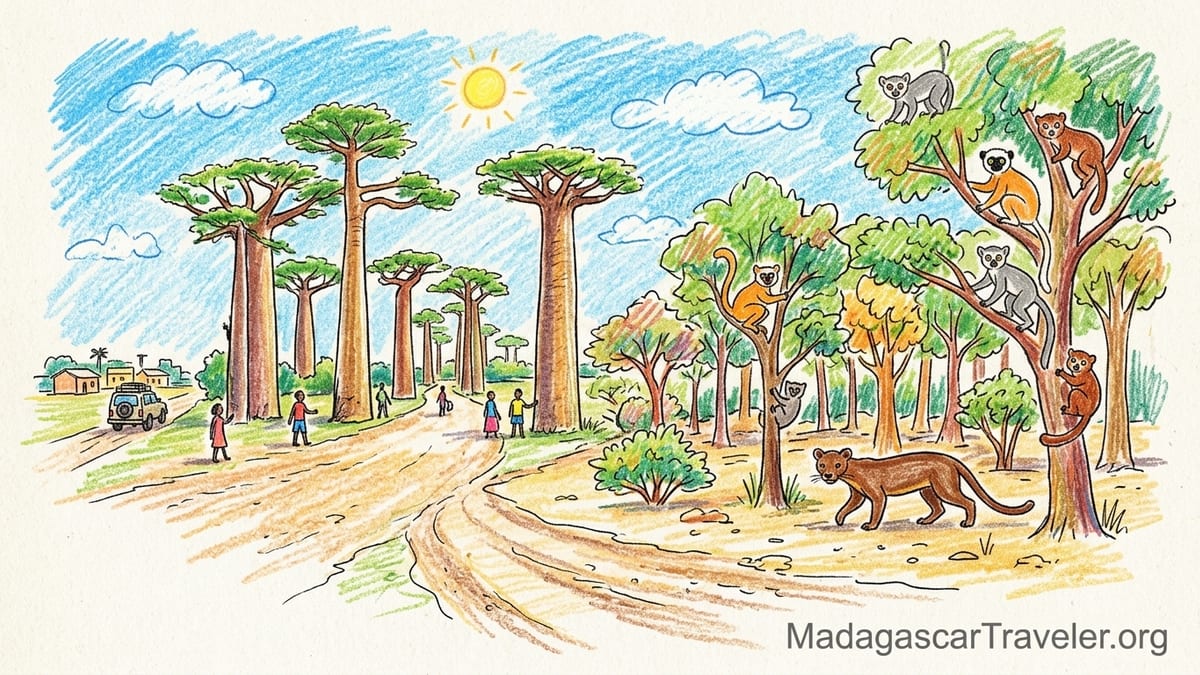
Understanding the Baobabs and Kirindy From Morondava
Morondava is the natural base for short trips to both the Avenue of the Baobabs and Kirindy Forest. The baobab avenue lies roughly 20 kilometers north of town along the RN8 dirt road, usually a 30 to 40 minute drive in the dry season. Kirindy Forest Reserve sits further along the same track at about 50 to 60 kilometers from Morondava, commonly reached in 1.5 to 2.5 hours each way depending on recent rain and traffic from freight trucks.
The Avenue of the Baobabs itself is a short, unpaved stretch of road lined by towering Grandidier’s baobabs. Even travelers who have seen baobabs elsewhere tend to agree that the concentration and symmetry here are uniquely photogenic, especially in the warm light of sunrise or sunset. Visiting is free, but there are small community-run fees for parking and for stopping at nearby viewpoints such as the “baobab amoureux” or sacred trees.
Kirindy Forest Reserve protects a pocket of dry deciduous forest that is famous among wildlife enthusiasts for its fossa population, as well as several lemur species and a host of nocturnal reptiles and invertebrates. A number of tour operators and local drivers in Morondava promote combined Baobabs and Kirindy trips specifically for visitors who cannot extend north to the Tsingy. Typical offerings range from half-day baobab outings to two-day Baobabs plus Kirindy packages with a night in a simple forest lodge.
Because almost all tours use the same rough road and visit the same sites, the main decisions you will make are about timing, comfort and pace. The most common questions are whether to prioritize sunrise or sunset at the baobabs, whether to include Kirindy at all when time is short, and if it is worth paying for a private vehicle rather than joining a shared 4x4.
Sunset-Only Baobab Excursions: Classic and Convenient
A sunset-only excursion to the Avenue of the Baobabs is the easiest option from Morondava and is heavily promoted by guesthouses and small agencies in town. Many hotels, from beachside properties like Chez Maggie to simple bungalows along the waterfront, will arrange a late-afternoon departure in a private car or 4x4. A typical program leaves Morondava around 3.30 to 4.00 pm in the dry season, allowing time for photo stops at “baobab amoureux,” various solitary baobabs and then a longer pause at the main avenue for golden hour and sunset.
In terms of cost, travelers in recent seasons commonly report paying the equivalent of around 40 to 90 euros per person for a short private tour when booked through local outfits such as MadaAssist or smaller Morondava-based agencies, depending on whether the rate is per vehicle or per person and how many people share. Basic taxi runs arranged directly at the waterfront or near the market can be cheaper, sometimes from roughly 60,000 to 100,000 ariary for a return ride, but these usually do not include a guide and may not stop at multiple viewpoints on the way.
The main appeal of a sunset-only outing is that it fits easily around flights or beach time, and it delivers the classic image that draws most visitors to Morondava. The downside is that you will often share the experience with dozens of other vehicles, particularly between July and September when groups are returning from Tsingy. Dust, vehicle traffic and people in the frame can make photography more challenging, especially if you prefer minimalist compositions. If sunset photos are your absolute priority and you are short on time, this option still makes sense, but it is worth managing expectations about crowds.
For photographers, a private vehicle has real advantages on these short trips. Having your own driver makes it easier to adjust timing, move between angles and linger after most tour groups leave in the immediate glow after sunset. Guides familiar with the spot will also know less obvious side tracks that allow you to step back and capture the silhouettes without rows of people and vehicles in the foreground.
Sunrise at the Baobabs: Quieter Light and Early Starts
Sunrise trips from Morondava to the Avenue of the Baobabs are less publicized than sunset excursions but are increasingly offered by local agencies that target photographers. The format is simple: depart Morondava in the dark, often around 4.00 to 4.30 am in the dry season, and reach the baobab avenue as the first light colors the eastern sky. A few operators advertise dedicated sunrise or “sunrise plus village visit” options in an air-conditioned private vehicle, sometimes combining it with a later transfer to Kirindy.
Compared with sunset, sunrise visits are generally quieter. You may share the avenue with only a handful of other vehicles, often photo groups or small private tours. The air is cooler, dust is less stirred up and wind is usually light, which can give you cleaner horizons and sharper silhouettes. Colors can be more subtle and pastel than the fiery hues often seen at sunset, but for many photographers this softer light and emptier foregrounds are preferable.
The trade-off is the very early start and, in some seasons, the risk of morning haze or low cloud on the horizon. If your time in Morondava is limited to one night and you are arriving on a late afternoon flight, a sunrise trip followed by a leisurely breakfast and beach time can be a pleasant way to structure your stay without feeling rushed in the evening. Some visitors also choose a sunrise outing specifically to avoid the small crowds of souvenir sellers and local bystanders that gather at sunset, although supporting these micro-economies through small purchases or tips is one way your visit can benefit the community.
Prices for sunrise-only trips are usually similar to sunset excursions, as the distance and vehicle time are the same. Where the cost can increase is when a sunrise visit is paired with a same-day transfer to Kirindy, because the driver and vehicle will be working a much longer day and road conditions beyond the avenue are more demanding.
Full-Day Kirindy plus Baobabs: Wildlife Focus in One Long Day
Travelers who want a wildlife experience but cannot spare an overnight in Kirindy often opt for a very full day that combines a morning or midday visit to Kirindy Forest with either sunrise or sunset at the baobabs. In practice, this usually means leaving Morondava quite early, sometimes at 5.00 or 6.00 am, with your guide and driver, heading straight through the baobab avenue toward Kirindy, then stopping at the avenue either on the outbound leg for dawn light or on the return for sunset.
The road between the baobab avenue and Kirindy is rough and slow, with sections of deep sand and ruts. Most tour companies insist on a 4x4, and in the rainy season from roughly December to March parts of the track can be impassable. In the dry season roughly April to November, agencies in Morondava actively market day trips including Kirindy. Several international booking platforms list private full-day tours in the range of about 200 to 250 US dollars per person including a 4x4, local guide, park entrance fees and a sunset stop at the baobabs on the way back.
Inside Kirindy, day walks of around 1.5 to 3 hours typically search for Verreaux’s sifaka, red-fronted brown lemurs, birds and giant jumping rats, along with smaller chameleons and invertebrates. While fossas are more active in the early morning and late afternoon, there is still a chance of seeing one around camp during the day, particularly in the austral spring when they are known to be more visible. If you only have one day, a knowledgeable local guide can make the difference between a quick stroll and a productive wildlife viewing experience, so it is worth confirming that a guide is included rather than assuming the driver will double as one.
The main limitation of a full-day Kirindy plus baobabs tour is fatigue. You will spend many hours being jolted along the RN8, most likely in hot conditions, then try to enjoy a sunset session at the baobab avenue while tired. Travelers who are particularly keen on night walks or photographing the baobabs in different light might find that compressing everything into one day is not ideal. However, if this is your only realistic chance to see Kirindy and you are in reasonable health, a full-day combination is a strong compromise and is specifically designed for people who do not have time to go all the way to Tsingy.
Overnight in Kirindy: Nocturnal Walks and Fossa Chances
Spending a night at Kirindy Forest Reserve or a nearby lodge is the best way to experience the reserve’s nocturnal wildlife and significantly improves your odds of seeing a fossa. Several Morondava-based agencies and independent guides advertise two-day Baobabs and Kirindy packages that include a sunset or sunrise stop at the avenue, 4x4 transport, one night in a basic lodge such as Relais de Kirindy or a similar property, and guided walks by day and night.
Typical pricing for these packages is broadly in the low to mid hundreds of euros per person depending on group size and accommodation level. For example, some travelers have reported recent quotes around 300 to 350 euros per person for a two-day private 4x4 tour including a night near Kirindy, all driving from Morondava, guide services and multiple baobab stops. This compares reasonably with the cost of longer Tsingy itineraries and is much more manageable if you only have a couple of spare days on the west coast.
Most overnight itineraries follow a similar rhythm. You leave Morondava after an early lunch, stop briefly at the baobab avenue and nearby special trees for first photos, arrive in Kirindy in mid to late afternoon, and then join a late-afternoon walk that may produce your best chance of seeing a fossa around the research station or lodge clearing. After dark, a guided night walk searches for mouse lemurs, sportive lemurs, chameleons, owls and other nocturnal specialists along sandy forest paths. The following morning usually includes another circuit in daylight before you drive back toward Morondava, timing your return to catch another sunset at the baobabs if conditions allow.
Compared with a single long day, the overnight option lets you experience both the diurnal and nocturnal sides of Kirindy without rushing, and it breaks up the road time. It also allows for some flexibility around weather. If clouds flatten one sunset at the baobabs, you might still have a colorful sunrise or a second chance the next evening. If a private vehicle is ever worth its cost, it is on this kind of two-day trip, where being able to adjust departure times and stops can significantly improve your wildlife encounters and light for photography.
Baobab Photography Timing, Logistics and When to Pay for Private
For many visitors, the biggest practical question is how to time their visit to the Avenue of the Baobabs for the best light and least crowding. In general, sunrise offers quieter conditions and softer light, while sunset produces the most dramatic colors and silhouettes but also the greatest concentration of vehicles. If you are staying in Morondava for at least two nights, a good strategy is to visit once at sunset and once at sunrise, pairing one of those visits with a Kirindy trip so you are not repeating the same drive purely for photography.
On a typical day tour in the dry season, the sun sets between roughly 5.15 and 6.00 pm. Most tours aim to arrive at the avenue at least 45 minutes before sunset to allow time to explore different angles along the road and nearby footpaths. This is when tour buses and 4x4 convoys from the Tsingy also start to arrive. If your driver is flexible, consider staying until the sky has fully darkened and the first stars appear; many groups leave as soon as the sun drops below the horizon, but the post-sunset glow can be the most atmospheric time for images.
Transport and guide fees vary widely depending on how you book. A basic local taxi hired in Morondava may only provide a French-speaking driver and a fixed schedule. In contrast, booking through a dedicated tour company, whether a small local operator or a regional agency, often includes an English-speaking guide, pre-arranged park fees at Kirindy, and the ability to customize stops. For independent travelers, hiring a vehicle with driver for the day, even if it costs more than piecing together separate taxis, can simplify logistics and prevent misunderstandings about waiting times, especially if language is a barrier.
As for whether a private vehicle is worth paying for, the answer depends on your priorities. If you are mainly interested in seeing the baobab avenue once, are on a tight budget and do not mind a fixed schedule, sharing a 4x4 or joining a small group through your guesthouse can be good value. However, if you care deeply about photography, want to stop frequently for roadside baobabs and villages, or are planning an overnight at Kirindy with early and late walks, the extra flexibility of a private 4x4 and dedicated guide is usually well worth the added cost.
Choosing the Right Tour Format if You Skip Tsingy
Because current operators in Morondava market a range of short tours aimed at those without time for Tsingy, it helps to think through your priorities before booking. If your main goal is simply to stand among baobabs in beautiful light and you are not particularly focused on wildlife, a sunset-only or sunrise-only excursion is perfectly adequate. These trips are widely available, easy to arrange on arrival and do not require you to commit an entire day on rough roads.
If wildlife is important but your schedule allows only a single free day, a full-day Kirindy plus baobabs tour uses your time efficiently. You will experience the dry forest ecosystem, likely see at least a few lemur species, and still walk among the baobabs in golden light. Just be prepared for a long, bumpy day and keep expectations realistic: fossa sightings are never guaranteed in a single daytime visit, and photography at the baobabs may be rushed at the end of the day.
For those who can spare two days and one night, the overnight Kirindy option is the most rounded experience. You get more than one chance at the baobabs, both nocturnal and daytime forest walks, and a much better probability of seeing a fossa along with a richer roster of lemurs and nocturnal creatures. Two-day Baobabs plus Kirindy packages sold by Morondava-based operators are explicitly designed as a shorter alternative to Tsingy circuits, providing a taste of western Madagascar’s landscapes and wildlife without the logistical complexity and time commitment of reaching Bekopaka.
Whichever format you choose, it is wise to confirm a few details in advance with your chosen operator or driver: whether park fees and local Kirindy guide services are included, how many hours of walking are planned, exactly which baobab viewpoints are included, and what time they expect to return to Morondava. Clear expectations help you make the most of the limited time you have and reduce room for surprise surcharges at the end of the trip.
The Takeaway
Morondava offers more than just a single famous photo stop. Even if you do not have the days required to reach the Tsingy de Bemaraha, combining the Avenue of the Baobabs with Kirindy Forest can deliver a memorable blend of landscapes and wildlife in as little as one long day or one night away from town. Sunset-only and sunrise-only baobab excursions are simple and flexible, while full-day and overnight Kirindy options add the thrill of lemur encounters and a real chance to see Madagascar’s top predator.
When deciding between these formats, think carefully about your tolerance for long, bumpy drives, your priorities around photography versus wildlife, and whether the extra cost of a private 4x4 and guide aligns with your expectations. In many cases, travelers who invest slightly more in a private overnight trip return to Morondava with a richer sense of the region than those who rush through in one afternoon.
Ultimately, there is no single right way to see the baobabs and Kirindy. The key is to choose a tour that matches both your calendar and your travel style, and to approach the journey with patience. The road may be rough, but the reward of watching baobabs change color with the sky or spotting a fossa ghosting between tree trunks in the dusk is more than worth the effort.
FAQ
Q1. Can I visit the Avenue of the Baobabs and Kirindy in one day from Morondava?
Yes, it is possible to visit both in a single long day, usually by leaving Morondava very early, spending a few hours walking in Kirindy during the cooler morning, and stopping at the Avenue of the Baobabs on the way back for sunset. Expect a long, bumpy day with several hours of driving on rough roads in each direction.
Q2. Is sunset or sunrise better for photographing the Avenue of the Baobabs?
Sunset usually delivers the most dramatic colors and silhouettes but is also the busiest time with more vehicles and visitors. Sunrise is quieter and cooler, with softer light and fewer people in the frame. If you have two opportunities, many photographers choose to visit once at each time of day.
Q3. How likely am I to see a fossa in Kirindy on a short visit?
Fossa sightings are never guaranteed, but Kirindy is one of the best places in Madagascar to see them, especially if you stay overnight and include both late-afternoon and early-morning walks. On a single daytime visit your chances are lower, though some visitors are lucky enough to see fossas near the camp area even without staying the night.
Q4. Do I need a 4x4 to reach Kirindy from Morondava?
For most of the year a 4x4 is strongly recommended because the RN8 beyond the baobab avenue is unpaved, with sandy and rutted sections that can be difficult for standard cars. In the rainy season, conditions can deteriorate further, and reputable operators generally insist on high-clearance 4x4 vehicles for safety and reliability.
Q5. Are guided night walks in Kirindy worth the extra time and cost?
Yes, for most wildlife enthusiasts the night walks are a highlight. They offer the chance to see mouse lemurs, sportive lemurs, chameleons, owls and other nocturnal species that are rarely visible by day. The additional fee for a guided night walk is usually modest compared with the overall trip cost and adds a very different perspective on the forest.
Q6. How much should I budget for a basic baobab sunset tour from Morondava?
Recent travelers commonly report paying the equivalent of roughly 40 to 90 euros per person for a short private baobab sunset tour including transport and a guide when booked through local agencies. Hiring a simple taxi directly in town can cost less, but may not include guiding or multiple stops at different baobab sites.
Q7. Is it necessary to book Baobabs and Kirindy tours in advance?
If you are traveling in the peak season from about July to September or have only one possible day to visit, advance booking is sensible, especially for overnight stays in Kirindy where lodge space is limited. Outside the busiest months, many visitors successfully arrange baobab sunset trips and even full-day Kirindy excursions through their Morondava accommodation a day or two before departure.
Q8. What should I wear and bring for a Kirindy and Baobabs tour?
Lightweight, breathable clothing, a hat and sunscreen are important for the exposed baobab areas and open 4x4 rides. For Kirindy, closed shoes, insect repellent and a small flashlight or headlamp for night walks are useful. Carry water and some snacks, as options can be limited along the RN8. In the cooler months, a light jacket is helpful for early mornings and after dark.
Q9. Can I visit the baobab avenue independently without a tour?
Yes, you can hire a local taxi or private driver in Morondava to take you to the baobab avenue and wait while you explore. The site itself does not require you to be with an organized tour. However, having a guide can add context about the trees, nearby villages and the best spots for photography, and can simplify communication about timing and stops.
Q10. If I have only one spare day in Morondava, should I prioritize Kirindy or spend more time at the baobabs?
If you are most interested in landscapes and photography, spending more time at the baobab avenue at either sunrise or sunset may be more rewarding. If you value wildlife encounters and are comfortable with a long day of driving, a full-day trip that includes Kirindy plus a sunset stop at the baobabs offers a wider variety of experiences in the limited time you have.