


In western Madagascar, the best time to visit is not just about air temperature or sunny skies. Here, the real seasons are defined by rain, mud, river levels and whether remote tracks and ferries are operating. If you want to reach the Avenue of the Baobabs, Kirindy Forest and the Tsingy de Bemaraha without getting stranded axle-deep on a laterite track, you need to plan around road accessibility first and weather second. In practice, that usually means travelling between about April or May and November, with May to October the most reliable window for reaching the Tsingy and other off‑piste highlights.
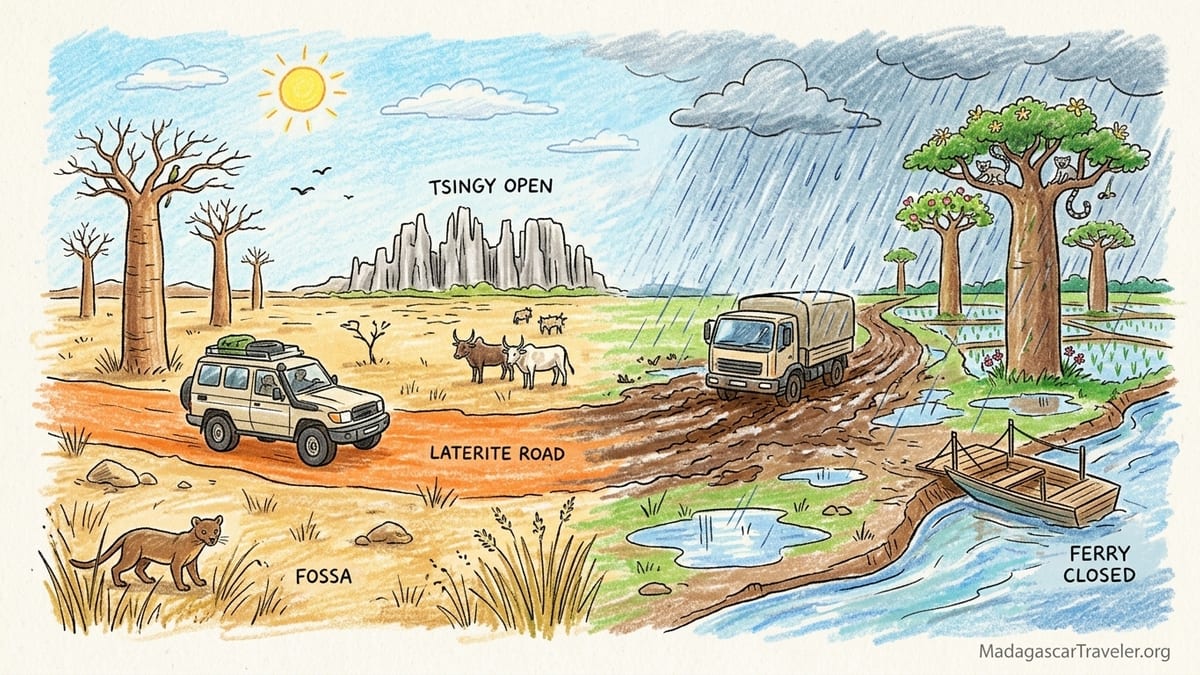
Understanding Western Madagascar’s Seasons
Western Madagascar has two dominant seasons: a long, hot wet season roughly from November to March and a cooler, drier season from about April to October. On paper, you can visit year‑round. In reality, the state of Route Nationale 8 between Morondava, Belo‑sur‑Tsiribihina and Bekopaka, and the condition of smaller sand and laterite tracks along the coast, are what decide whether your itinerary is possible. During peak rains in January and February, sections of track dissolve into deep mud, village river crossings rise over their banks and ferries frequently stop running for days at a time.
By contrast, from around May to October, the laterite bakes hard, rivers retreat into their channels and local operators resume regular 4x4 departures to the Tsingy and beyond. Tour companies in Antananarivo routinely structure their western itineraries around this pattern, marketing Baobab Alley and Tsingy trips from late April or May through October because the odds of making it all the way to Bekopaka are far higher. For independent travellers, aligning with this seasonal rhythm can be the difference between a smooth 10‑hour 4x4 day to Bekopaka and a two‑day slog that ends early because a ferry has been pulled out of service.
The shift between seasons is gradual rather than a clean switch. Early April can still see lingering mud holes and swollen fords after late storms, while by late October and into November the first heavy showers can arrive suddenly on otherwise blue‑sky days. Locals in Morondava and drivers in Belo‑sur‑Tsiribihina often talk in terms of river height and “piste” condition rather than calendar dates, which is why it is common for lodges in Bekopaka to open and close flexibly depending on how the season actually unfolds.
Road Accessibility: When Tracks and Ferries Actually Work
Western Madagascar’s signature sights sit at the end of unpaved tracks. The most important of these is RN8, the 198‑kilometre dirt road that runs from Morondava north through Belo‑sur‑Tsiribihina to Bekopaka, gateway to Tsingy de Bemaraha. In the dry season, a chartered 4x4 can cover Morondava to Bekopaka in 10 to 12 hours, including waits for the two basic ferries across the Tsiribihina and Manambolo rivers. In a bad wet season, those same 198 kilometres can be largely cut off for weeks because trucks sink into mud and wooden ferries are grounded by strong currents or safety concerns.
For travellers, the practical takeaway is that April to November is generally the operational window for RN8, but May to October is when you can reasonably expect to get through in a single long day. Tour operators routinely refuse bookings to Bekopaka before mid‑April because they know they might have to turn around at Belo‑sur‑Tsiribihina if the ferry is not running. Even in high season, unexpected local storms can create temporary problems: for example, drivers in recent seasons have reported arriving at the Tsiribihina only to find a backlog of 4x4s and trucks waiting half a day because the small barge can only carry two vehicles at a time.
Off the main RN8 corridor, the same pattern applies. The rough coastal tracks south of Morondava towards Andavadoaka and Toliara rely on narrow wooden ferries such as the one at Bevoay and long stretches of deep sand. In August or September, 4x4 taxis‑brousses and local trucks grind through in a long but predictable day. In January, those same routes can be completely impracticable, which is why few operators are willing to run scheduled public transport there in the wet months. When planning a western loop, always ask specifically about current ferry operations and whether your driver expects any sections of “piste inondée” or “piste coupée” on your dates.
Tsingy de Bemaraha: Opening Dates, Mud and Safety
Tsingy de Bemaraha National Park is the crown jewel of western Madagascar, but it is also one of the country’s most seasonal destinations. Park authorities officially open access from around 1 April to 30 November, yet local guidance from both lodges in Bekopaka and Antananarivo‑based tour companies is more conservative. They typically recommend May through October as the most reliable period, when the RN8 has dried out, the Tsiribihina and Manambolo crossings are stable and internal park trails are no longer slick from the rains.
In practice, late March often remains too wet for safe access. Travellers who push for an early season Tsingy visit sometimes find that their driver can only reach Belo‑sur‑Tsiribihina, or that they reach Bekopaka but park circuits like the Grand Tsingy’s Andamozavaky route are closed because ladders and fixed cables need safety checks after the rains. In contrast, arriving in July or August almost guarantees that both Petite Tsingy and Grand Tsingy circuits are operating, albeit with more visitors on the famous suspension bridges and narrow limestone corridors.
There are also real safety reasons behind these seasonal restrictions. In the wet months, sinkholes open on the tracks, laterite slopes slump away and wooden bridges near villages like Bekopaka can be undermined by strong currents. Guides in Bekopaka recount seasons where 4x4s that ignored local advice became stuck overnight between fords, forcing passengers to sleep by the roadside. For most visitors, it is simply not worth attempting Tsingy before the local community, park authorities and drivers all agree that the route is firmly open, which is why May to October has become the standard recommendation across the industry.
Rain, Mud and the Reality of River Crossings
The defining travel challenge in western Madagascar is not rain itself but what happens to the ground and rivers once it has rained. A short, intense storm in December can turn the laterite road to the Avenue of the Baobabs into a slippery red ribbon that only high‑clearance vehicles can tackle safely. On RN8, persistent rain between December and March churns the surface into axle‑deep mud. Trucks bog down, and the ruts left behind harden into deep grooves once the surface dries, making later dry‑season driving bumpy even when there is no more water on the ground.
River levels add another layer of complexity. The crossings at Belo‑sur‑Tsiribihina and on the Manambolo rely on small barges that shuttle vehicles across all day in dry season. In the heaviest rains, operators may suspend service altogether because of strong currents or floating debris. Travellers in recent years have described arriving in Belo to find ferries pulled to the bank and locals advising them that there would be no crossing for at least several days. This is why even in the shoulder months of November or early April, most reputable agencies build “buffer days” into Morondava–Bekopaka itineraries, allowing for weather delays.
For independent visitors, understanding this dynamic is crucial. A cheap seat in a 4x4 taxi‑brousse from Morondava to Bekopaka might cost significantly less than a private vehicle, but if heavy rain hits and the truck is stuck on the wrong side of a river, you may lose multiple days waiting in a village with very basic facilities. In contrast, travelling in the heart of the dry season, say mid‑July, means those same ferries run almost continuously from early morning to late afternoon, and even a delay usually just means a few extra hours sitting in the queue in Belo or beside the Manambolo watching zebu carts roll onto the barge.
Wildlife Seasons: Kirindy, Baobabs and Beyond
Once road access is secure, seasonal patterns in wildlife are the next factor to weigh. Kirindy Forest Reserve, reached on the same road that leads from Morondava towards the Tsingy, is one of the best places to see the fossa, Madagascar’s top predator. The peak fossa mating season runs in the late dry season, around October and November, when these elusive animals are more active by day near the main camp. Visiting Kirindy in July or August still gives a good chance of spotting nocturnal lemurs on night walks, but fossa encounters may require more patience and luck.
Birdlife in western Madagascar also follows the seasons. The cool dry months from June to August bring many species into breeding plumage and make long walks more comfortable in the heat. In late dry season, around September and October, waterholes near Kirindy and the Tsiribihina become magnets for both birds and mammal species as surface water grows scarce elsewhere. Conversely, the early wet months can be spectacularly green but birds and lemurs may be more dispersed, and getting to their habitats is harder because of mud and standing water.
Baobabs themselves change appearance over the year. Around Morondava’s Avenue of the Baobabs, trees are often leafless through much of the dry season, giving that classic “roots in the sky” silhouette against dusty orange sunsets. As the first rains arrive in late spring and early summer, the same trunks sprout fresh green foliage, and later some species blossom with white or cream flowers. Photographers sometimes choose the shoulder season in October or November precisely to capture baobabs just as they begin to leaf out, even though that means accepting a slightly higher risk of rain showers on the track.
Photography Conditions: Light, Dust and Seasonal Trade‑offs
For photographers, western Madagascar’s seasons offer distinct moods. From May to October, skies are often clear, humidity is low and sunsets along the Avenue of the Baobabs regularly produce golden light and clean horizons. Dust kicked up by 4x4s can create dramatic shafts of light at ground level when the sun is low, especially in June and July. Night‑sky photography has flourished here in recent years because the dry season brings predictable dark, cloud‑free nights and the absence of street lighting along the dirt road.
The visual downside of high dry season is that landscapes can look parched. By August and September, grasses near Morondava and Kirindy are yellow, and the baobab trunks rise from bare, dusty ground. Many photographers like this starkness and the way it emphasizes the tree shapes, but travellers seeking lush greens may prefer the shoulder months. In the early wet season, especially around December, the same baobab corridor can be framed by flooded rice paddies and pools that mirror the sky. Reaching the site in those months, however, requires accepting the risk of muddy access tracks and potential last‑minute cancellations if storms blow in.
Practical considerations also shape when to shoot. In July and August, Morondava and the Avenue can feel busy at sunset, with multiple tour vehicles lining the dirt road. Those willing to travel in May or late September often find fewer crowds while still enjoying firm tracks and clear light. At the Tsingy, seasonal timing controls how much heat you endure on the exposed limestone. Hiking the Grand Tsingy circuits in October can mean baking in strong sun on the plateaus, while tackling them in July offers cooler air but a higher chance of sharing ladders and bridges with other groups.
Lodges, Closures and Seasonal Pricing
Accommodation availability in western Madagascar follows the same rhythm as the roads. In Bekopaka, the small cluster of lodges that serve visitors to Tsingy de Bemaraha usually close entirely during the heart of the rainy season, typically from December through March, and sometimes into early April if RN8 remains problematic. Staff return to their home villages, maintenance is done on bungalows, and only a skeleton crew may remain to watch over the property. It is not unusual for travellers to find that a lodge is only willing to confirm bookings from early or mid‑May onward, once local drivers have reported that the road is dry and ferries have resumed reliable operations.
In Morondava, hotels along the seafront and in town are more likely to stay open year‑round, though some smaller beach bungalows scale back services in the wettest months when visitor numbers are low. Kirindy’s simple campsite and bungalow operations usually anchor their season around the same May to October window as Tsingy, because most guests combine the two in a loop. During peak dry season from July to September, room availability can tighten significantly, especially around national holidays and European summer breaks, so booking well in advance is wise if you want specific properties or family rooms.
Prices also fluctuate with these patterns. Local agencies often advertise lower shoulder‑season rates in May, June and October, reflecting slightly reduced demand and the possibility of more flexible itineraries. By contrast, a 4x4 with driver between Morondava and Bekopaka in August can command a noticeably higher day rate than the same service in late October, when some operators are already looking ahead to winding down the western routes for the coming rains. Travellers on a budget sometimes use these price differences to structure trips, visiting western Madagascar in June or October for value, then heading to more accessible regions with paved roads during the core of the wet season.
Putting It Together: Month‑by‑Month Guidance
Late March and April are transitional. In some years, light rains linger and RN8 remains sticky, with occasional “piste coupée” warnings from drivers who have attempted an early run to Bekopaka. In a drier year, experienced operators begin testing the route from early April, and by mid‑month the first small groups reach Tsingy on soft but passable tracks. If your schedule forces you into April, plan generous buffer days, choose a flexible local agency and be ready to adjust if a ferry closes or a bridge is damaged.
May to August forms the backbone of the reliable season. By May, most mud has dried, ferries run predictably, and both Petite and Grand Tsingy circuits are normally open. Temperatures are cooler, making long days in the car and on the trails more comfortable. June, July and August are peak months for tour groups from Europe and North America, so roads are at their busiest but logistics are also most established, with multiple vehicles plying the route each day between Morondava, Kirindy and Bekopaka. Wildlife viewing in Kirindy is strong, and the Avenue of the Baobabs delivers the classic bare‑branched silhouettes under crisp sunsets.
September and October are excellent for travellers willing to trade slightly higher heat for rich wildlife activity and a touch of green. As the dry season wears on, rivers are low and crossings straightforward, while fossa activity in Kirindy peaks and some baobabs begin to leaf out and flower, particularly into October. The downside is hotter midday temperatures on exposed Tsingy plateaus and along the Baobab Avenue track, so early starts and plenty of water become essential. November is more of a gamble: in some years, the first storms do not arrive until late in the month, leaving tracks dry and ferries operating; in others, heavy early rains can quickly create deep mud and prompt operators to wind down Tsingy trips earlier than planned.
From December to early March, western Madagascar is at its most challenging. Storms roll in from the Mozambique Channel, the Tsiribihina and Manambolo rise, and villages along RN8 can be temporarily isolated. While Morondava town and the Baobab Avenue may still be reachable for determined visitors in 4x4s, Tsingy de Bemaraha is effectively off the map for normal tourism during these months. Many travellers instead focus on other corners of Madagascar that are better served by paved, elevated roads, saving the adventurous west for a future dry‑season trip when the logistics line up in their favour.
The Takeaway
Planning a trip to western Madagascar is ultimately an exercise in timing your adventure to the rhythms of rain, mud and river levels. While guidebooks often speak in terms of hot versus cool seasons, on the ground it is far more important to consider when RN8 is drivable, when the Tsiribihina and Manambolo ferries are running and when lodges in Bekopaka and Kirindy are open. Current regional guidance and recent operator experience converge on a practical travel window from about April or May through November, with May to October particularly dependable for reaching the Tsingy and exploring baobab country without major disruptions.
If your priority is guaranteed access and comfortable conditions, aim for June, July or August, book 4x4 transport with a reputable local driver and reserve your Tsingy and Kirindy accommodation well in advance. If you value slightly greener landscapes, fewer crowds and heightened wildlife activity, consider May, September or October, understanding that heat and a small risk of early or late rains are part of the bargain. Whatever month you choose, keeping road accessibility at the heart of your planning will let you experience western Madagascar’s baobabs, karst pinnacles and dry forests in the way they were meant to be seen: reached after a dusty, memorable journey rather than cut short by an impassable track.
FAQ
Q1. When is the most reliable time of year to reach Tsingy de Bemaraha by road?
May to October is generally the most reliable period, when RN8 has dried out, river levels have dropped and both ferries and park circuits usually operate normally.
Q2. Is it possible to visit the Avenue of the Baobabs in the rainy season?
Yes, it is sometimes possible between December and March, but heavy showers can turn the laterite access track muddy and occasionally impassable, so visits are less predictable.
Q3. Are the lodges in Bekopaka open all year?
No. Most Bekopaka lodges close during the core rainy months, typically from December to March, and only start confirming bookings once the RN8 is reliably passable, often from April or May.
Q4. How long does the drive from Morondava to Bekopaka take in the dry season?
In good dry‑season conditions, a private 4x4 usually takes around 10 to 12 hours including waiting times at the Tsiribihina and Manambolo ferry crossings.
Q5. When is the best time for wildlife viewing in Kirindy Forest?
Wildlife is good throughout the dry season, but late dry season around September and October is especially productive, and fossa are most active during the mating period in October and November.
Q6. What is the best month for photography at the Avenue of the Baobabs?
June to September offers clear skies and classic bare‑branched silhouettes at sunset, while October and November add fresh leaves and flowers for those who prefer a slightly greener look.
Q7. Can I use public transport to reach Bekopaka, or do I need a private 4x4?
Shared 4x4 taxis‑brousses sometimes run the route in dry season, but schedules can be irregular; most travellers choose a chartered 4x4 with driver for flexibility and safety.
Q8. How risky is it to plan a Tsingy visit in April or November?
Both months are shoulder seasons; in some years the road is fine, in others late or early rains cause mud and ferry disruptions, so you should build in extra time and stay flexible.
Q9. Do river ferries operate every day in the dry season?
In the heart of the dry season they usually run daily from morning until late afternoon, though queues can be long; mechanical issues or local events can still cause occasional short suspensions.
Q10. If I only have one week, which months give me the best chance of seeing baobabs, Kirindy and Tsingy in one trip?
Planning for any time between June and September gives the strongest chance that roads, ferries and park circuits will all be open for a one‑week western Madagascar circuit.