


Sainte-Marie, or Nosy Boraha, off Madagascar’s lush east coast, has a coastline that changes in mood every few kilometres. On one side are shallow, protected lagoons and palm-fringed coves where the sea barely ripples. On the other, you find wilder surf, quieter fishing villages and pockets of sand that feel completely removed from the modern world. Add tiny Île aux Nattes at the southern tip, and you have one of the Indian Ocean’s most varied small-island beach destinations. This guide breaks down the main beach areas coast by coast, explaining where to swim safely, where to snorkel, and which stretches are best experienced as a day excursion rather than a full resort stay.
Understanding Sainte-Marie’s Coastline
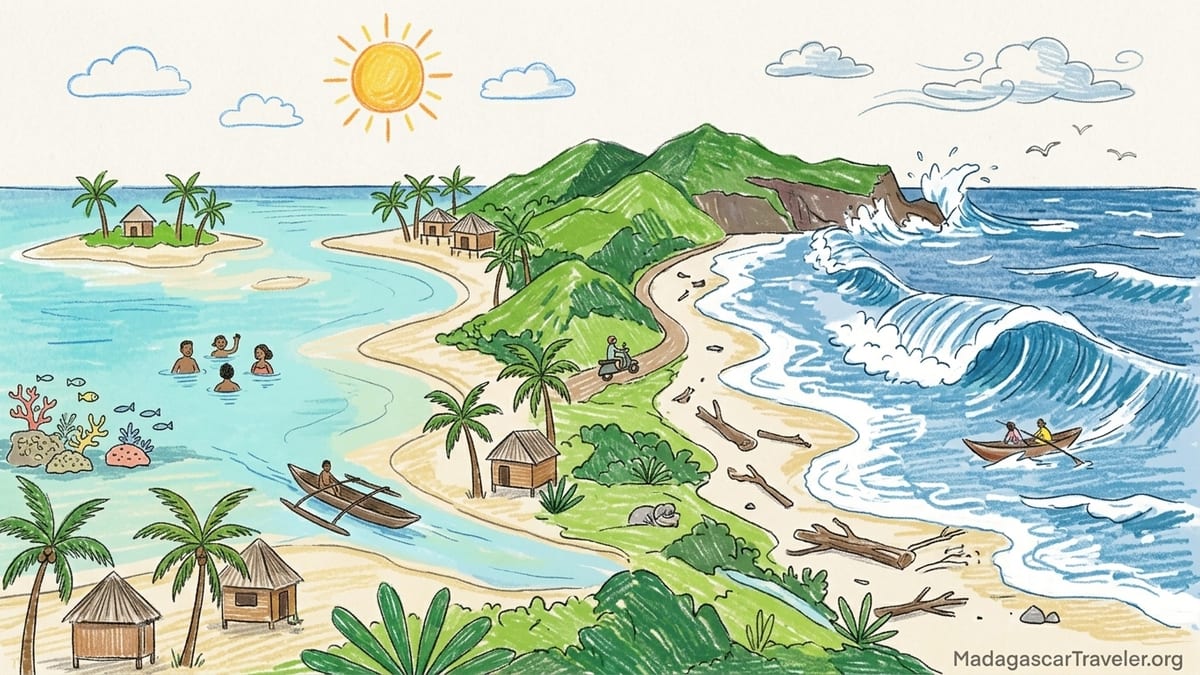
Sainte-Marie is a long, narrow island running roughly north to south, with its west side facing the sheltered Mozambique Channel and its east side exposed to the open Indian Ocean. That geography explains why conditions differ so sharply from one coast to another. The official tourism board often promotes the island around its tropical beaches and preserved coral lagoon, but the reality on the ground varies: some beaches have calm, bath‑warm shallows, while others see heavier swell, seasonal currents and patches of coral rubble underfoot.
Most of the classic “postcard” beaches sit on the west and south, or around Île aux Nattes, where a belt of coral reef helps break the waves before they reach the sand. Here you usually get swimmable conditions at mid and high tide, light chop rather than surf, and long bands of powdery sand shaded by coconut palms. In places like Vohilava and Ravoraha, small hotels and bungalows sit almost directly on the beach, so you can step from your terrace into the lagoon in a few strides.
By contrast, the east coast is more about drama than ease. It is beautiful, with breakers rolling in, driftwood on the high‑tide line and small fishing pirogues cutting through the foam, but long swims are more for confident swimmers and locals who know the currents. The northern coastline, tapering towards secluded coves and small islets, offers some of Sainte-Marie’s quietest sand and is where a few of the island’s more isolated ecolodges and small resorts operate, trading nightlife and restaurant choice for silence and starry skies.
Distances are short. You can drive the main north–south road in a couple of hours in dry conditions, or hire a scooter or bicycle for slow exploration. That makes it easy to stay in one main area and still visit other beaches as day trips. Many travellers base themselves for several nights on the southern or western beaches, then hop over to Île aux Nattes for a night or two, or simply visit it as a long, lazy day in especially calm water.
Île aux Nattes: Calm Lagoon & Postcard Beaches
Just off the southern tip of Sainte-Marie, Île aux Nattes (also known as Nosy Nato) concentrates almost every image people have of an ideal Indian Ocean beach. The island is only about three square kilometres, with no cars and a ring of sand so white that even on an overcast day it seems to glow. A narrow channel, typically crossed in around 10 minutes by dugout pirogue from the Sainte-Marie village of Pointe Caravelle or nearby beaches, separates it from the main island, so it feels like an escape yet remains very accessible.
The key appeal here is the water. Most of the coast of Île aux Nattes is protected by a shallow coral reef, which turns the sea into a natural swimming pool at mid and high tide. On the north and west sides especially, you can wade 20 or 30 metres out and still be in chest‑deep, glassy water. For families, this lagoonlike setting is a major advantage: children can paddle where the waves are no more than a soft lap on the sand, and adults can float for hours without worrying about strong currents. The seabed is generally sandy, though wearing light reef shoes is sensible as pockets of coral and sea urchins appear in places.
Snorkelling on Île aux Nattes is not on the same scale as world‑class coral destinations, but for many travellers it is still a highlight. From simple beach guesthouses such as La Maison Blanche or other small lodges, you can often borrow or rent a mask and fins and swim out over patches of coral heads dotted with clownfish, parrotfish and the occasional turtle. Boatmen offer half‑day lagoon trips in small motorised pirogues for the equivalent of around 20 to 40 US dollars per boat depending on season and your negotiation, stopping at snorkel spots and sandbars that emerge at low tide.
In terms of where to stay versus day‑tripping, Île aux Nattes works very well as both. If you want the full tropical‑island bubble, spend two or three nights in one of the small beachfront guesthouses that dot the west and north shores, where you will fall asleep to surf on the outer reef and roosters in the backyards. Nights here are dark and quiet, with only a handful of eateries offering grilled fish, coconut curries and cold beer. If you prefer more choice of restaurants and a slightly livelier atmosphere, base yourself on the south of Sainte-Marie in Vohilava or Ravoraha and come to Île aux Nattes as a day excursion, catching an early pirogue, walking part of the sandy perimeter path, swimming in the calmest coves and returning with the late‑afternoon light.
Southern Beaches of Sainte-Marie: Easy Swimming & Resort Comfort
The southern section of Sainte-Marie, particularly around the villages of Vohilava and Ravoraha, is the most developed for classic beach holidays. Here the west‑facing coastline is broken into a sequence of bays lined with palms, and sheltered shallows that suit long swims when the tide is right. Small hotels such as Villa Sainte Marie in Vohilava open directly onto the sand, with rooms just metres from the high‑tide line, so guests can roll from breakfast to the sea in seconds without crossing a road.
Swimming conditions on these southern beaches are generally forgiving, with the main factor to note being tidal depth. At low tide, the water can pull back to expose coral heads, leaving ankle‑deep pools dotted across the sand. It is still pretty but not ideal for proper swimming. From mid‑tide upwards, however, those same beaches turn into broad, waist‑ to shoulder‑deep lagoons with very gentle movement, ideal for less confident swimmers. If you time your main swim or stand‑up paddle session for two or three hours either side of high tide, you will have the most comfortable experience.
Compared with Île aux Nattes, snorkelling directly from the southern Sainte-Marie shore is more hit‑and‑miss because the beach is interspersed with seagrass and coral rubble. Many hotels help guests arrange boat trips to clearer patches of offshore reef for an extra charge, often combining snorkelling with a simple grilled‑fish lunch on a nearby sandbar. Prices are negotiable, but as a reference, couples in recent seasons have reported paying the equivalent of 30 to 60 US dollars for a private half‑day outing, which is modest by Indian Ocean standards.
From a trip‑planning perspective, the southern beaches are almost always worth choosing as your main base if you value convenience and resort comfort. You can walk to several small restaurants, hire bicycles to ride up and down the coastal road, organise excursions to the pirate cemetery near Ambodifotatra or the island’s natural freshwater pools, and still be close enough to the pirogue crossings for Île aux Nattes that a day trip is straightforward. This balance of beautiful lagoon scenery, decent infrastructure and easy transport connections makes the south the logical choice for first‑time visitors and for travellers who would rather not move hotels too often.
Western Coast & Lagoons: Whale Watching & Gentle Seas
Stretching north from the southern beach belt, Sainte-Marie’s west coast remains within the island’s sheltered lagoon system for a considerable distance. This side faces the Mozambique Channel and is where many of the island’s whale‑watching outfits base their boats during the austral winter, roughly July to September, when humpback whales gather in the warm shallows to mate and calve. Between whale trips, the same calm seas make this coast appealing for casual swimmers and stand‑up paddleboarders who prefer not to deal with wind‑blown surf.
In the dry season, the sea here often looks like a patchwork of blues and greens, with channels of deeper water cutting through broad sandy shallows. Small lodges scattered along the coast, some near Ambodifotatra and others in quieter stretches further north, typically have simple beach access: a few steps down from a terrace or lawn and you are in the sand. Because this side of the island sees sunsets over the water, it is particularly atmospheric in the late afternoon. Travellers staying at mid‑range lodges often mention watching whales breaching a few hundred metres offshore while sitting on wooden decks, a rare example of shore‑based whale‑watching that does not require a tour boat at all.
For swimming, the pattern is similar to the southern beaches: high tide brings the best conditions, with lazy waves and enough depth for proper laps. At low tide, the sea recedes further than on the east coast but still exposes seagrass flats and coral rocks that are better for wading than for full immersion. If you are planning a resort stay, this is something to consider when choosing dates and daily rhythms: those who like a pre‑breakfast swim may want to check approximate tide times for the week of their stay, as a very early morning low tide can leave the lagoon shallow at dawn.
As a place to stay versus day‑trip, the western lagoon coast suits travellers seeking a quiet base with a focus on the sea itself, especially couples or friends interested in whale watching and slow days on the beach. While you can, of course, drive over from other parts of the island for a sunset swim or a whale‑watch excursion, coastal accommodations here give you the advantage of simply walking to the water whenever it looks most inviting, without dealing with daytime traffic on the main road.
Quiet Northern Coast: Seclusion and Untouched Sand
The further you go towards the northern tip of Sainte-Marie, the fewer people you meet and the more the coastline feels like a string of private discoveries. The road narrows, villages become sparse, and pockets of sand open between headlands and rocky points. Some of the island’s most secluded small resorts and ecolodges sit here, often with just a handful of bungalows spread along a crescent of sand that you may have almost entirely to yourself on weekdays.
The sea on the northern west coast tends to remain relatively calm thanks to the lingering shelter of the lagoon system, though tides are still pronounced and the beach profile can be steeper in places. Swimming here feels more intimate than in the south because there are fewer boats, fewer beach vendors and little village activity directly on the sand. For those who value silence, this is a significant selling point. It is common for guests at small lodges to plan their days around the tide, reading in hammocks when the sea is far out and slipping into the water when it rises and glows turquoise.
Infrastructure on the northern coast is limited compared with the south and Ambodifotatra. Expect fewer restaurants, fewer shops and occasional power cuts, especially in smaller, off‑grid properties that rely on generators and solar power. When it rains, tracks can turn muddy, which matters if you plan to explore independently by scooter or hire car. For that reason, this area tends to appeal more to travellers who are comfortable with a little unpredictability in exchange for seclusion.
From a planning point of view, the north is best suited to a resort‑style stay rather than a casual drop‑in. Reaching these beaches from the south can easily take an hour or more each way, and because many of the nicest stretches of sand are effectively “in front of” private lodges, your beach time will be more relaxed if you actually book into one of those properties. Think of the northern coast as a place for three or four nights of peace at the end of an itinerary rather than a quick tick on a day‑trip circuit.
Eastern Shore & Wild Surf: Beautiful but Less Sheltered
Although this guide focuses on the more swimmable southern and western beaches, it is worth understanding the character of Sainte-Marie’s east coast because many island tours include a drive along this side. Here the full force of the Indian Ocean is more evident. Atlantic‑style breakers roll in, and even on calm days there is a sense of constant movement. Beaches are generally narrower, sometimes backed by fishing villages and sometimes edged by low forest or coconut groves with no development at all.
Swimming is possible on the east coast but requires more caution. Local children and fishers enter the water daily, often in places that have natural channels between sandbars, but for visitors it is wise to treat the sea here as primarily scenic unless a guide or trusted local indicates a specific safer spot. Rip currents can develop, especially at river mouths and near rocky points, and underwater the seafloor may drop more abruptly than in the lagoons on the west. For simple paddling, most travellers still prefer to walk across the island to the calmer side or to return to their base in the south or west after a coastal drive.
Where the east coast really shines is in its sense of wildness. In some stretches you will see nobody else on the sand, only driftwood, bird tracks and lines of foam. Fishing pirogues launching through the surf at dawn are a common sight, and the villages feel more tied to the rhythms of the sea than the tourism‑oriented settlements further south. This makes the east an excellent candidate for a guided day excursion rather than an area to sleep in, unless you are specifically seeking a remote homestay or a small lodge with a focus on surfing the local breaks.
Because roads on this side can suffer after heavy rains, many local tour operators time east‑coast drives for the dry months, arranging four‑wheel‑drive vehicles and combining beach stops with visits to natural freshwater pools, small waterfalls or lookout points. You can expect to pay the equivalent of 40 to 80 US dollars for a half‑ or full‑day private tour for two to four people, depending on negotiation and what is included, which is fair value for the distance covered and the insight into local village life.
Choosing the Right Beach for Your Stay
With such varied coastline packed into a relatively small island, choosing where to stay on Sainte-Marie comes down to your priorities. First, consider your main daily activity. If you imagine spending much of your time in the water, floating or swimming without thinking too hard about currents, then the southern and western lagoon beaches or Île aux Nattes will serve you best. Aim for a hotel that sits directly on the sand with unobstructed sea access, so you are not crossing a road or mangrove strip every time you want a dip.
If seclusion is your guiding principle, the quiet northern coast is the natural choice, accepting in exchange a thinner selection of restaurants and a longer drive from the airport and main town. Here you are more likely to find small clusters of bungalows where all guests face the same intimate cove. Visitors often book full‑board or half‑board packages, since there may be no alternative dining within walking distance. That can actually make budgeting easier: once you have paid for your room and meals, your main extra expenses will be drinks, boat trips and the occasional taxi.
For those who like variety and exploring, the best strategy is often a split stay. Spend three or four nights on a southern beach with easy access to Île aux Nattes, then move north for another three or four nights on a quieter bay. You can also base yourself entirely in the south and use day trips to sample the rest: one full day on Île aux Nattes with a lagoon boat tour, another driving the east coast and visiting natural pools, and perhaps a third driving towards the north for a change of scenery. Transport by local taxi or private car is relatively affordable by European or North American standards, though you should factor in that fuel prices and rough roads can push up costs compared with mainland Madagascar.
Budget is another consideration. Beachfront guesthouses on Sainte-Marie can start from the equivalent of 25 to 40 US dollars per night for simple bungalows with fans and mosquito nets, rising to 100 dollars and above for larger villas with pools and air conditioning at higher‑end lodges. Île aux Nattes tends to offer more rustic, characterful stays, often with shared generators and bucket showers, while the southern and western Sainte-Marie beaches include a wider range of comfort levels. If you are visiting in peak whale‑watching season or around local holidays, booking ahead is wise, especially for beachfront rooms that open directly onto the sand.
The Takeaway
Sainte-Marie’s charm lies in how much coastal variety fits within its modest length. The southern beaches and west‑coast lagoons give you the classic Indian Ocean mix of palm trees, shallow turquoise water and enough small hotels and restaurants to make a weeklong stay easy. Tiny Île aux Nattes adds especially calm, protected lagoon conditions and a postcard‑perfect ring of sand that rewards both overnight stays and day visits from the main island.
The east coast, beautiful but more exposed to ocean swell, is best treated as a scenic excursion rather than a default swimming area, while the quiet northern coast rewards travellers ready to trade convenience for seclusion. Across all of these areas, knowing how tides, lagoon depth and reef patches shape daily swimming and snorkelling conditions will help you match your own travel style to the right stretch of sand. Whether you are planning a simple barefoot hideaway or a more structured resort holiday, Sainte-Marie and Île aux Nattes offer enough beaches and moods to fill many unhurried days by the sea.
FAQ
Q1. Is it better to stay on Île aux Nattes or on the main island of Sainte-Marie?
Both work well, but in different ways. Île aux Nattes is more intimate, car‑free and lagoon‑focused, ideal if you want a small‑island feel and do not mind limited restaurant choice. The south of Sainte-Marie offers more hotels, easier logistics and better access to tours while still having very good beaches, so it suits first‑time visitors and those who prefer more options.
Q2. Are the beaches on Sainte-Marie safe for swimming?
Most of the southern and western beaches, and those around Île aux Nattes, are safe for relaxed swimming when the tide is mid to high and seas are calm. The east coast and some exposed points can have stronger currents and surf, so those stretches are better for walking and scenery unless you have local guidance and are a confident swimmer.
Q3. When is the best time of year to visit for beach weather and calm seas?
The dry season, roughly from May to October, usually brings the most stable beach weather on Sainte-Marie, with lower humidity and clearer seas. July to September adds the bonus of humpback whale activity off the west coast, though it can be slightly cooler in the evenings. The wet season can still offer lovely days, but heavier rain and choppier seas are more common.
Q4. Can I visit Île aux Nattes as a day trip, or do I need to stay overnight?
You can absolutely visit as a day trip. Local pirogues cross the narrow channel in about 10 minutes, and many travellers spend a full day walking parts of the sandy coastline, swimming in the calmest coves and having lunch at a small beach restaurant before returning to their hotel on Sainte-Marie in late afternoon.
Q5. What should I know about tides when planning beach time on Sainte-Marie?
Tides significantly affect swimming depth on the southern and western lagoon beaches and around Île aux Nattes. At low tide, water can retreat far, exposing coral and seagrass and limiting proper swimming. Planning your main swims for a few hours around high tide will give you deeper, clearer water and fewer surprises underfoot.
Q6. Is snorkelling good around Sainte-Marie and Île aux Nattes?
Snorkelling is pleasant but not as spectacular as at some of Madagascar’s western‑coast reefs. Around Île aux Nattes and certain parts of the western lagoon, you will find coral patches with reef fish and occasional turtles, especially on organised boat trips to slightly deeper spots. It is enjoyable for casual snorkellers, but serious reef enthusiasts should keep expectations moderate.
Q7. Which beaches are best for a quiet, secluded stay?
The quiet northern coast of Sainte-Marie and certain small stretches on Île aux Nattes are best for seclusion. These areas have fewer lodges and very little through‑traffic, so beaches can feel almost private, especially on weekdays. They suit travellers who are happy with simple infrastructure and limited nightlife in exchange for peace and space.
Q8. Are there family‑friendly beaches on Sainte-Marie?
Yes. The southern lagoon beaches around Vohilava and Ravoraha, as well as many parts of Île aux Nattes, are family‑friendly when the sea is calm. Shallow, gently sloping sand and relatively protected water make it easy for children to paddle, though parents should still watch for coral heads, sea urchins and changing tide depth.
Q9. Do I need a car to explore different beaches on the island?
A car is helpful but not essential. Many visitors rely on local taxis, hotel‑arranged transfers and occasional scooter or bicycle rentals to move between beach areas. The island is compact, so day trips are feasible, though some northern and eastern stretches are reached by rougher tracks where a four‑wheel‑drive vehicle or a driver who knows the road conditions is a better choice.
Q10. How developed are the beach areas in terms of restaurants and nightlife?
The southern beaches and Ambodifotatra area have the most restaurants and casual bars, with a handful of spots that can be lively on weekend nights. The northern coast and Île aux Nattes are much quieter, with evenings focused on simple beachfront meals and early nights under the stars rather than organised nightlife. Overall, Sainte-Marie is more about relaxed beach time than late‑night entertainment.