


The Red Tsingy of northern Madagascar are one of the country’s most surreal landscapes: delicate red spires carved from soft earth in a hidden canyon between Diego Suarez and Ankarana. Unlike the razor-sharp grey tsingy of Ankarana, these formations glow in shades of ochre, apricot and cream, changing character with every cloud. This guide explains what makes the Red Tsingy unique, how to reach them from Diego Suarez, when a 4x4 really matters, how much time to allow and how to fold a stop here neatly into the overland route between Diego Suarez and Ankarana instead of planning a separate day trip.
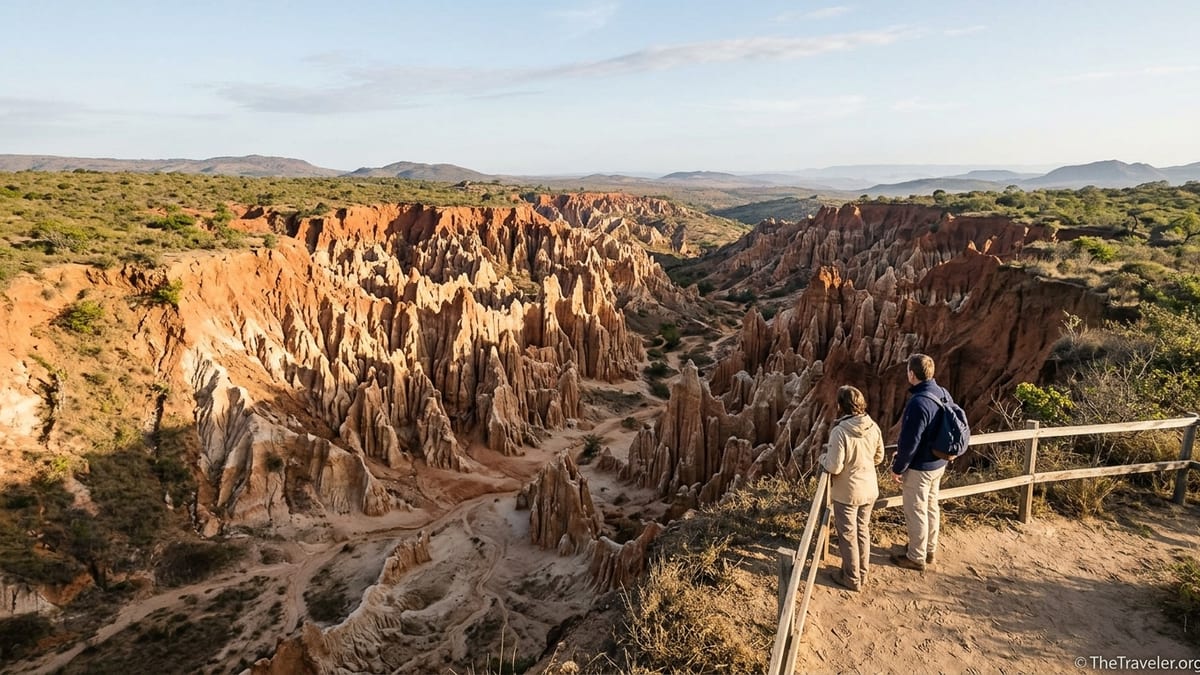
What Makes the Red Tsingy Different from Ankarana’s Grey Tsingy
The Red Tsingy, or Tsingy Rouge, sit on the edge of Analamerana in the Diana region of northern Madagascar. Here the formations are not hard limestone but fragile red laterite, an iron-rich soil that has been sculpted by wind and seasonal rains into fluted pinnacles and thin fins. At the main amphitheatre you look down into a shallow canyon filled with hundreds of freestanding spires, some only knee-high, others a few metres tall, all glowing in warm reds and creams.
By contrast, Ankarana’s tsingy are a classic karst landscape. The grey formations there are dense, jagged limestone ridges, often rising like battlements and requiring proper hiking, ladders and suspension bridges to experience. In Ankarana you walk across the tsingy, edging along knife-like crests and peering into caves and sinkholes. At the Red Tsingy you mostly look into and around a single erosional basin rather than traversing a larger massif.
This difference in geology shapes the experience. The limestone of Ankarana is hard-wearing, so trails can be laid out over and through the tsingy. The laterite at Tsingy Rouge is much softer and erodes rapidly, which is why access is restricted to paths and viewpoints above and at the base of the formations. You do not clamber among the spires, both for safety and to preserve them. As a visitor you should think of Red Tsingy as a dramatic viewpoint walk and photographic stop, while Ankarana is a half-day to full-day hiking destination with caves, forests and wildlife.
For many travellers the visual contrast is the appeal of doing both sites in one trip. In a single day you can see the smooth curving reds of Tsingy Rouge and by late afternoon be looking out over Ankarana’s sharp grey terraces. The pairing highlights just how varied northern Madagascar’s landscapes are within a relatively short distance.
Where the Red Tsingy Are and How They Fit Into a Northern Madagascar Itinerary
The Red Tsingy lie inland from the RN6 highway that connects Antsiranana (Diego Suarez) with Ambilobe and Ankarana. The signposted turn-off is roughly 45 to 50 kilometres south of Diego Suarez on the RN6, near the small settlement of Sadjoavato. From this junction a rough piste heads east towards the Irodo Valley and the main viewpoint area. The site itself is around 60 to 75 kilometres from Diego Suarez, depending on the exact track used and the condition of the road.
Because the access piste loops out from the RN6 and then rejoins it further south, Tsingy Rouge is perfectly placed as a stop on the overland route between Diego Suarez and Ankarana. Many small tour operators and private drivers structure the day as Diego Suarez to Red Tsingy to Ankarana, covering about 120 kilometres total, rather than returning to Diego Suarez after visiting the Red Tsingy. On sample itineraries, this combined travel and sightseeing day is usually estimated at around four to six hours on the road, plus time on foot at the site.
This positioning makes it straightforward to include Tsingy Rouge without adding extra days or backtracking. A typical northern circuit might run Diego Suarez to Amber Mountain National Park, then continue south along the RN6 with a detour to the Red Tsingy before overnighting at a lodge near the Ankarana reserve. From there many travellers continue on to Ambilobe, Ambanja and Nosy Be or reverse the route if starting from the islands.
If you are organising travel independently, it is useful to think in terms of drive segments instead of simple distances. Diego Suarez to the Tsingy Rouge turn-off on the RN6 can easily take 90 minutes with traffic and occasional potholes. The piste to the site then adds another 45 to 90 minutes each way, depending on recent weather. Planning your day around these time blocks will give you enough margin to see the formations in good light and still reach Ankarana before dark.
Getting to the Red Tsingy from Diego Suarez
Most visitors start from Diego Suarez, the regional hub in the far north with an airport, banks and a range of hotels. From town you head south on the RN6, initially on asphalt. Local taxis-brousse use this route, but they usually do not detour to the Red Tsingy. In practice, travellers either arrange a private 4x4 with driver through a hotel, local agency or guesthouse, or join a small-group excursion that includes the Red Tsingy and onward travel to Ankarana.
From Diego Suarez to the Red Tsingy signposted junction is normally around one to one-and-a-half hours on sealed road, with slower patches where the tarmac has broken up. At the turn-off, a dirt road leads towards the Irodo Valley. This track is not paved and conditions change with the seasons. In the dry months from roughly May to November, the track is usually dusty and corrugated but passable, with stretches of sand and some rutted sections. After heavy rains, large puddles and washed-out parts can appear, and there may be small river crossings.
Given these variables, most up-to-date local advice is that a 4x4 is strongly recommended year-round, and can become close to essential in the wetter months or after storms. Even in the dry season, a higher-clearance vehicle will handle the sand and erosion channels more comfortably than a standard car. Travellers sometimes report making it in a normal sedan during an unusually dry spell, but the consensus among local tourism offices and recent visitors is that this is more luck than a reliable plan.
For a concrete example, a couple booking a day transfer from Diego Suarez to Ankarana with a stop at Tsingy Rouge in 2025 might be quoted in the range of 400,000 to 600,000 Ariary for a private 4x4 and driver, depending on negotiation, fuel prices and whether guiding is included at the site. This is only an indicative figure and can vary, but it gives a sense that chartering a 4x4 is a major but manageable cost in the context of a northern Madagascar itinerary.
Understanding the Final Access Track and When a 4x4 Is Necessary
The final approach to the Red Tsingy is part of the experience. The piste cuts through a patchwork of scrub, small villages and laterite soil, with occasional views towards distant hills. It is not technically difficult in dry conditions, but it is rough enough that progress is slow. Expect to creep along at 20 to 40 kilometres per hour, sometimes less, as your driver picks a line around ruts and stones.
In the late dry season, usually September and October, the track tends to be at its most passable. At this time of year a robust 4x4 with good tyres and a driver who knows the route can usually reach the parking area without drama. A small 2WD car might technically get through on the driest days, but the risk of underbody damage or getting stuck in a sandy hollow is real. Given the remote setting and lack of roadside assistance, the savings from skipping a 4x4 are rarely worth the potential difficulties.
During and just after the rainy season, roughly December to March, the situation is very different. Heavy showers cut channels in the laterite, turning gentle dips into sharp gullies. Sections of the track may become deeply rutted or muddy, and minor stream crossings can swell. At these times even 4x4s may need to wait out bad weather, and local drivers will have the best sense of whether the site is practical to access on a given day. Travellers who visited in recent wet seasons frequently describe the approach as slow and bumpy, but still achievable with an experienced driver and the right vehicle.
The safest rule of thumb is to assume you will need a 4x4, plan and budget accordingly, and treat any easier conditions you encounter as a bonus. If you are travelling on a tight schedule, consider allowing some flexibility so that if the piste is temporarily impassable you can adjust your route or focus on Amber Mountain and Ankarana instead.
On-Site Experience: Time Needed, Viewpoints and Photography Conditions
The Red Tsingy site is compact, which makes it relatively easy to visit without rushing. From the parking area, simple paths lead to a main upper viewpoint, then down towards the base of the amphitheatre. Most travellers spend between 60 and 90 minutes walking around and taking photographs. If you enjoy taking your time with composition and changing light, two hours is comfortable.
There are usually several marked viewpoints. The upper vantage points give sweeping views over the entire field of spires, which is ideal for wide shots that capture the scale and the contrast between the red formations and the surrounding green or brown hills. Lower paths approach the formations more closely, allowing for tighter images that show the delicate ridges and colour gradations. Local site staff or guides can point out the safest paths and where you should stop to avoid damaging the fragile ground.
Photographically, the best times are early morning and late afternoon when the sun sits lower and the red laterite takes on warm, saturated tones. Around midday, when many tours arrive, the light is harsher and shadows are more pronounced, which can still be dramatic but requires some care in exposure. On lightly overcast days the colours remain rich but contrast softens, which can be helpful for close-up shots of texture. A standard zoom lens in the 24–70 millimetre range on a full-frame camera is ideal for capturing both wider scenes and details, although even a phone camera can produce striking images thanks to the intense natural colour.
If you are combining the Red Tsingy with onward travel to Ankarana on the same day, plan to arrive at the site by late morning at the latest. That way you can enjoy a slower walk, pause for photographs and perhaps a simple picnic at the parking area before continuing south. Remember that facilities are basic: there may be a small shelter, informal stalls and basic toilets, but you should not expect restaurants or formal visitor centres. Carry water, sun protection and snacks from Diego Suarez or Joffreville.
Costs, Local Guides and Practical Tips
The Red Tsingy are not part of the Madagascar National Parks system, so entry fees and arrangements differ slightly from better-known parks such as Ankarana or Amber Mountain. Travellers typically pay a modest entrance fee per person at the gate, in Ariary, and may be encouraged or required to take a local guide. The exact amount can change from year to year with inflation and local decisions, so it is best to carry small-denomination notes and expect to pay a reasonable sum rather than a token amount.
In practice, using a local guide is worthwhile. Beyond supporting the surrounding communities, guides can explain how the formations develop, point out the safest vantage points and help manage time if you need to reach Ankarana before dark. Many drivers from Diego Suarez work regularly with specific guides at the Red Tsingy and can introduce you on arrival, easing any language barrier.
For a realistic budget, consider three main costs: the vehicle and driver, the entrance fee and guide contribution, and your food and water. A private 4x4 hire for a day that includes the Red Tsingy and travel onwards to Ankarana will likely be your biggest single expense. Entry and guiding will be a smaller fraction of that. Food costs depend on whether you arrange a packed lunch in Diego Suarez, buy simple snacks en route or rely on lodge meals at Amber Mountain and Ankarana instead.
Practical packing makes the visit more comfortable. Closed shoes with some grip are helpful on dusty or uneven paths, even though the walks are relatively short. A hat, sunscreen and at least one to two litres of water per person are strongly recommended, as the site is exposed and can feel very hot in the dry season. A light scarf or bandana can make the drive more pleasant if windows are open on the dusty track.
Combining Red Tsingy with Ankarana: Avoiding Unnecessary Backtracking
One of the easiest ways to streamline your northern Madagascar itinerary is to treat the Red Tsingy as a natural stop between Diego Suarez and Ankarana, rather than an isolated day trip out and back. This is how many local operators design their routes, and it works well in practice.
A common pattern is to leave Diego Suarez after an early breakfast, drive south on the RN6 for around 90 minutes, then turn off for the piste to the Red Tsingy. You arrive at the site by late morning, spend 60 to 90 minutes exploring and photographing the formations, then return to the main road and continue to Ankarana in mid-afternoon. The last leg from the piste back to the RN6 and on to the park entrance near Mahamasina can take two to three hours depending on road conditions, so reaching your lodge around late afternoon or early evening is realistic.
This approach avoids repeating the rough access road twice on different days and reduces your total driving distance. It also means that if weather or road conditions are marginal, you and your driver can make a same-day call on whether to attempt the piste. If the track looks too damaged or rain has been heavy, you can continue directly to Ankarana and perhaps shift your focus to the limestone tsingy and caves there instead.
For travellers heading in the opposite direction, perhaps coming from Nosy Be and Ambanja, the same logic applies in reverse. From Ankarana you can visit the Red Tsingy around the middle of the day and finish in Diego Suarez by evening, ready to explore Amber Mountain or the bays near town the next day. Because road conditions on the RN6 change slowly, it is worth asking in Ambanja or Ankarana for current estimates of driving times and any issues before committing to the combined transfer.
The Takeaway
The Red Tsingy are a compact but memorable highlight of northern Madagascar. Their soft red laterite spires, constantly reshaped by erosion, offer a very different experience to the hard, grey limestone tsingy of Ankarana. With a bit of planning, you can visit them without adding days to your itinerary or retracing your steps, simply by folding a stop at the site into the natural overland route between Diego Suarez and Ankarana.
Focusing on the practicalities makes the visit smoother. Plan on using a 4x4, especially outside the driest months, and allow enough time on the piste for slow but steady progress. Budget for entrance and guide fees, take plenty of water and sun protection and time your visit for softer light if photography is important to you. Above all, remain flexible. Road conditions in Madagascar change with the weather, and local advice on the ground is invaluable.
For travellers prepared for the bumpy access and basic facilities, the payoff is considerable. Standing at the edge of the Red Tsingy amphitheatre, watching the light shift across the spires, you gain a tangible sense of how Madagascar’s landscapes are still being shaped. Combined with the grey tsingy and caves of Ankarana and the nearby forests and bays, the Red Tsingy help turn a northern circuit into a varied and rewarding journey.
FAQ
Q1. Where exactly are the Red Tsingy in relation to Diego Suarez and Ankarana?
The Red Tsingy sit inland from the RN6 highway between Diego Suarez and Ankarana, with the turn-off roughly 45 to 50 kilometres south of Diego Suarez and the site itself reached via an unpaved piste further east.
Q2. Do I really need a 4x4 to visit the Red Tsingy?
A 4x4 is strongly recommended year-round and becomes close to essential in or after the rainy season, when the access track can be rutted, muddy and partially washed out.
Q3. How long does a visit to the Red Tsingy take on site?
Most travellers spend between 60 and 90 minutes walking to the viewpoints and taking photos, with two hours providing a relaxed pace and time to enjoy the scenery.
Q4. Can I visit the Red Tsingy on the way from Diego Suarez to Ankarana?
Yes, this is often the most efficient option. Many visitors travel Diego Suarez to Red Tsingy in the morning, then continue south to Ankarana in the afternoon instead of returning to Diego Suarez.
Q5. What is the best time of day for photography at the Red Tsingy?
Early morning and late afternoon generally offer the most flattering light, with the lower sun enhancing the reds and creams of the formations and reducing harsh shadows.
Q6. Are there facilities such as restaurants or shops at the site?
Facilities are basic. You may find a small shelter, informal stalls and simple toilets, but it is safer to bring your own water, snacks and sun protection from Diego Suarez or nearby towns.
Q7. Is the visit suitable for children and less experienced walkers?
The paths are short and not technically difficult, so most children and less experienced walkers can manage them, though supervision is important near drop-offs and the ground can be uneven and dusty.
Q8. How does the Red Tsingy experience compare to Ankarana?
The Red Tsingy is primarily a scenic viewpoint stop over soft red laterite spires, while Ankarana offers longer hikes over and among hard limestone tsingy, caves and forests with more varied wildlife.
Q9. Can I reach the Red Tsingy by public transport?
Public taxis-brousse along the RN6 generally do not turn off for the Red Tsingy, so in practice you will need to arrange a private vehicle, shared tour or taxi that specifically includes the piste to the site.
Q10. When is the best season to visit the Red Tsingy?
The dry season from around May to November usually offers the best access conditions, with drier tracks and clearer skies, though road quality can still vary and local advice remains important.